Quick Answer: A bushing is a type of plain bearing, so bushing vs bearing usually means a plain bushing compared with a rolling-element bearing. Bushings support load through sliding contact between a shaft and a bore. Rolling bearings carry load through balls or rollers running on raceways. Bushings often suit low-speed, high-pressure, oscillating, or tight-space duties, while rolling bearings generally suit continuous rotation, low friction, and higher speed. The final choice depends on load direction, speed, lubrication, clearance, environment, and life target.
The question is not whether a bushing counts as a bearing. It does. The practical question is whether a plain bushing or a rolling-element bearing fits the duty better. That choice affects friction, start-up behavior, speed, stiffness, space, lubrication, contamination tolerance, and expected life. This guide separates the terminology first, then compares the two constructions on the criteria that decide a real application.
Terminology: A Bushing Is a Type of Plain Bearing
A bearing is a machine element that supports or guides relatively moving parts. ISO 4378-1:2024 uses that broad definition and then places plain or sliding bearings in a separate group, where relative motion is sliding. A bushing is therefore not a rival category to a bearing. It is a bearing in which the shaft slides against a bore or against the inner surface of a replaceable sleeve.
The more precise engineering term is plain bearing bush or bearing bush. ISO 4378-1:2024 describes it as a replaceable tubular bearing element whose inner surface, outer surface, or both form the sliding surface. In everyday purchasing, ‘bushing’ is the shorter term. The title’s ‘bushing vs bearing’ wording is practical shorthand for a plain bushing compared with a rolling-element bearing. The ICS classification also keeps the families apart, listing 21.100.10 Plain bearings and 21.100.20 Rolling bearings.
Load direction gives the next distinction. A plain journal bearing carries load radially, a plain thrust bearing carries load axially, and a journal thrust or flanged bearing can carry both. Those names describe the duty, not a different material or brand.
A bushing is not a rolling-element bearing, but it is still a bearing. Treating the two as unrelated categories leads to poor comparisons.
How Bushings and Rolling Bearings Carry Load and Motion
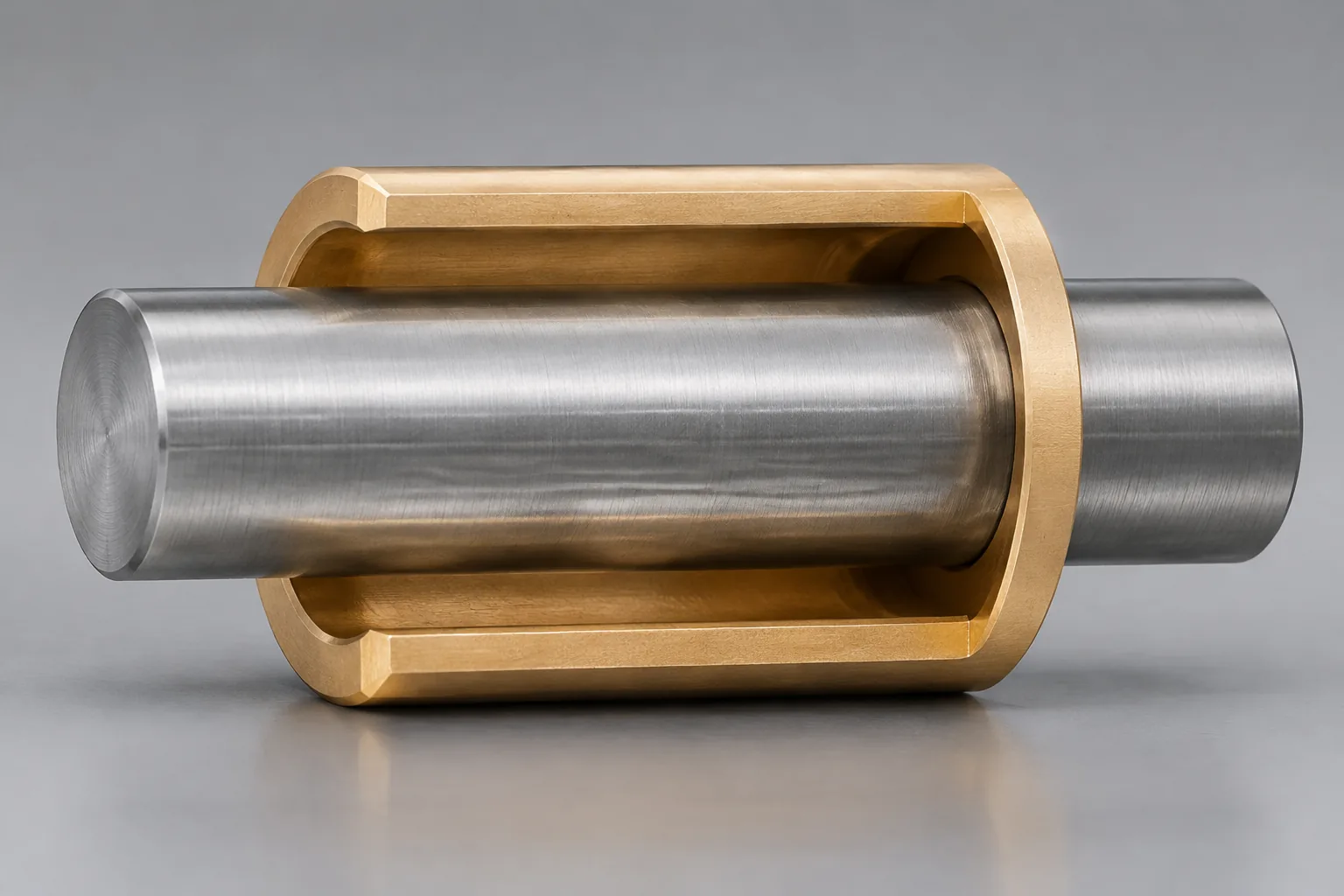
A plain bushing has no balls, rollers, or raceways. The shaft slides against the bushing bore, and the contact area spreads the load through a film of lubricant, a solid lubricant, or the bearing material itself. The construction can be a solid bush, a multilayer bush, a wrapped bush, a seamless bush, or a flanged bush. Material options listed in ISO plain-bearing terminology include aluminum alloys, copper alloys, white metal, POM, PA, PPS, rubber, and cermet composites. Each choice changes load capacity, conformability, corrosion behavior, and allowable temperature.
A rolling bearing transfers load through rolling elements and raceways. Common families include deep-groove ball, angular-contact ball, cylindrical roller, spherical roller, needle roller, and tapered roller bearings. The contact geometry decides whether the bearing is stronger in radial load, axial load, stiffness, or speed. A deep-groove ball bearing mainly carries radial load and can take light axial load in both directions. An angular-contact bearing carries combined radial and axial load, and a larger contact angle generally raises axial capacity.
Load direction and motion type decide the construction. A continuously rotating shaft, a small oscillating pivot, and a heavily loaded pin joint do not place the same demands on contact geometry, lubrication, or clearance.
Rolling bearings are not frictionless. Their cages, seals, and lubricant still involve sliding, and some aligning motion can make rolling elements slide on the raceway. The comparison is therefore sliding contact versus mostly rolling contact, not contact versus no contact.
Friction, Starting Torque, and Speed Behavior
Bushing friction comes from sliding at the shaft-bore interface. Rolling bearings replace most of that sliding with rolling contact, which is why they are generally preferred for low friction, continuous rotation, and higher speed. The advantage is not a universal zero-friction condition. Starting torque can be higher than steady rolling torque, and contact seals add drag while reducing the limiting speed. A seal that improves grease retention and contaminant control can therefore cost torque and speed.
Do not assign one friction coefficient to every bushing. Friction depends on the material pair, surface finish, load, speed, lubrication, temperature, and duty cycle. Published data for one POM composite plain bearing family gives μ = 0.02 to 0.20 depending on load, speed, material pairing, surface condition, and lubrication. That range belongs to that product family, not to bushings as a class.
Use friction data only for the exact material, lubricant, surface, load, and speed combination. A single catalogue value cannot rank every bushing against every rolling bearing.
Bushing Vs Bearings: Load Capacity and Speed Limits
Plain-bearing selection commonly uses projected pressure p, sliding speed v, and the product pv. These values describe the duty at the bearing surface and help predict wear and heat. A bushing is often a good fit for low speed, high projected pressure, oscillating motion, intermittent motion, or a short stroke. It is not automatically the higher-load choice. Capacity depends on size, material, speed, lubrication, allowable deformation, and shaft condition.
One published POM composite plain-bearing example lists a dynamic allowable pressure of 120 N/mm² at v ≤ 0.02 m/s, a static allowable pressure of 250 N/mm², a maximum sliding speed of 2.5 m/s at p ≤ 1.0 N/mm², and an operating temperature range of -40°C to +110°C. These are product-specific limits. They must not be transferred to bronze, white-metal, PTFE-lined, or other bushing types.
Rolling bearings are generally preferred for higher speed. Ball bearings usually have lower load capacity than roller bearings at the same size, but their smaller rolling contact area supports higher speed. Cylindrical roller bearings are strong in pure radial load, speed, and stiffness, but they are not intended for pure axial load. Deep-groove ball bearings take mainly radial load plus light axial load, while angular-contact and tapered roller bearings take combined load when correctly adjusted.
Compare catalogue limits at the actual speed and load, not at a generic category level. A plain bushing and a rolling bearing of similar bore can have very different pressure, speed, and stiffness limits.
Space, Weight, and Mounting Envelope
A bushing is mechanically simple. It can be a single sleeve with no inner ring, outer ring, rolling elements, or cage, so it can provide a thin radial section. That can matter in a hinge, a small pivot, or a housing with limited wall thickness. A rolling bearing needs a complete ring and rolling-element assembly, and its radial envelope depends on the bearing type, seal, and mounting arrangement.
When radial space is tight, a thin-wall bushing or a needle roller bearing may be a starting point, but the choice still needs calculation. Check the housing bore, shaft tolerance, wall thickness, installation method, and the effect of press fit before assuming a space advantage. The final envelope must come from the actual catalogue dimensions.
Wrapped bush dimensions, including cylindrical and flanged types, are covered by ISO 3547-1:2018. The measurement of thin-wall bush wall thickness is covered by ISO 3547-7:2020. Those standards help define the part, but they do not prove that a given bushing will fit a given housing without a tolerance check.
Space claims must be based on installed geometry, not on a bare sleeve or a bare bearing.
Lubrication and Maintenance
Plain bearings include hydrodynamic, hydrostatic, solid-film-lubricated, unlubricated, self-lubricating, and porous self-lubricating types. A self-lubricating bearing is lubricated by its material, its constituents, or a solid lubricant coating. A porous self-lubricating bearing uses interconnected pores that hold lubricant. Neither definition means the material continuously generates liquid oil.
Some polymer and composite bushings are maintenance-free in specific product lines. That claim applies to those products, not to all bushings. A POM composite bushing may be designed for boundary lubrication and filled with grease at installation, with additional lubrication available to extend life. A bronze or white-metal bushing may need a defined oil film, a grease interval, or a controlled start-up procedure.
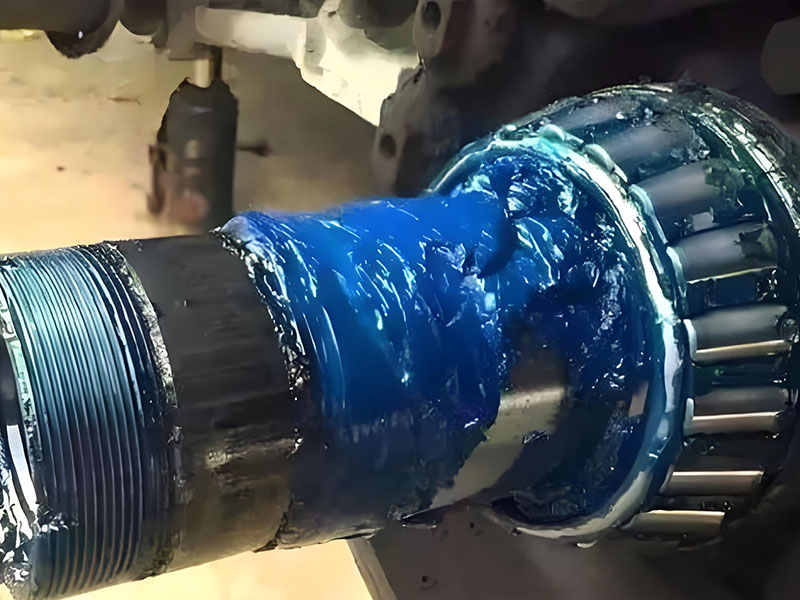
Rolling bearings need a suitable grease or oil viscosity, a correct supply method, effective sealing, proper clearance, and correct fits. Lubricant selection interacts with speed, temperature, load, and contamination. More grease is not automatically better. Excess grease can increase friction and raise bearing temperature.
Describe a product as maintenance-free only when its own datasheet supports that claim.
Contamination, Corrosion, and Environment
A polymer bushing that runs without external grease can avoid the sticky lubricant film that attracts dust and grit. That can be an advantage in a dirty pivot or a light-duty linkage. Wear still depends on shaft material and finish, load, speed, motion type, temperature, dirt, and chemical exposure. A dry-running polymer is not immune to abrasive particles.
Rolling bearings usually rely on seals or shields to keep out water, dust, and particles. A stronger contact seal can improve protection, but it adds friction and reduces the limiting speed. The seal choice therefore follows the environment and the speed requirement together.
Plastic bushings do not suffer electrochemical rust in the way ordinary steel parts do, but ‘corrosion-free’ is not a universal property. Some chemicals can change a polymer structure, reduce hardness, and increase wear. Check chemical-resistance data for the specific polymer or seal material before specifying it for a washdown, a marine joint, or a fluid-exposed assembly.
Match the bearing or bushing to the actual medium, not to a general label such as dirty or wet.
Precision, Clearance, Stiffness, and Fits
Rolling bearings are often chosen when the application needs low friction, precise shaft positioning, predictable clearance, and low rotational runout. A bushing can also locate a shaft, but it must keep a running clearance. Pressing a bushing into a housing can distort the bore, so the final clearance must be checked after installation and at operating temperature.
ISO 4378-1:2024 defines diametral clearance as the bush bore diameter minus the journal diameter. Radial clearance is the difference between the two radii. Final operating clearance should be calculated from the housing bore, shaft tolerance, wall thickness, thermal expansion, and working temperature. Using the unmounted bushing bore alone can give the wrong result.
Fits must match load, temperature, bearing type, and housing material. A common principle is to use interference on the rotating component side to reduce creep or fit loosening. Product-specific recommendations still take precedence. One POM composite bushing example recommends an H7 housing bore, an f7 to h8 shaft tolerance, a shaft surface roughness no greater than Ra 0.8 μm, and a shaft hardness of 150 to 600 HB. Those values belong to that product example, not to every plain bushing.
Stiffness and clearance are system properties. Housing stiffness, shaft stiffness, fit, and thermal growth can matter as much as the bearing or bushing alone.
Life and Rating: Different Calculation Systems
Rolling-bearing life is usually assessed with the basic rating life in ISO 281:2007. That basic rating life corresponds to 90% reliability under defined material, manufacturing, and operating conditions. Static load ratings and static equivalent loads are covered by ISO 76:2006. Rating life is useful at normal speed with good lubrication and no severe peak loads. Very low speed, stationary duty, poor lubrication, or occasional peak loads call for a static load check, and some applications need both checks.
Plain bushing life does not use the ISO 281 rolling-fatigue formula. Bushing wear depends on material pairing, projected pressure p, sliding speed v, pv, temperature, lubrication, shaft roughness, contamination, and motion type. Use manufacturer test data or a bushing life calculation tool for the specific material. Do not apply L10 life directly to an ordinary bushing.
The two product families need different life models. A rolling-bearing rating and a plain-bearing wear estimate are not interchangeable numbers.
Selection Guide by Operating Condition
Use the table as a starting point, then verify load, speed, life, environment, and maintenance requirements. The preferred choice can change when one condition dominates.
| Operating condition | Usually preferred starting point |
|---|---|
| High speed, continuous rotation, low friction | Ball bearing or suitable rolling bearing |
| High radial load and higher stiffness | Roller bearing |
| Low speed, high projected pressure, oscillating or short stroke | Plain bushing |
| Tight radial space | Thin-wall bushing or needle bearing after calculation |
| No external lubricant or maintenance-free requirement | Self-lubricating polymer or composite bushing |
| Precise shaft positioning and low runout | Precision rolling bearing |
| Dust, mud, or corrosive environment | Sealed rolling bearing or suitable no-grease bushing, depending on speed and load |
| Combined radial and axial load | Angular-contact bearing, tapered roller bearing, flanged bushing, or combined arrangement |
| Shock, vibration, or small reciprocating oscillation | Bushing often suitable after checking pressure, wear, and shaft surface |
| Hinges, pivots, hydraulic-cylinder pins, and pedal joints | Bushing or spherical plain bearing |
| Motors, fans, and spindles | Rolling bearing usually suitable |
Common Mistakes and Specification Checklist
Several shortcuts produce bad comparisons:
- ‘Bushings are not bearings.’ A bushing is a type of plain bearing.
- ‘Ball bearings have no friction.’ They reduce friction by using rolling contact, but cages, seals, and lubricant still create drag.
- ‘All bushings are maintenance-free.’ Only specific self-lubricating or pre-lubricated products can be described that way.
- ‘Bushings always carry more load.’ Capacity depends on size, material, speed, lubrication, and allowable deformation.
- ‘One friction coefficient or one pv limit fits all bushings.’ Values belong to a material and product family.
- ‘L10 life applies to a plain bushing.’ L10 is part of the rolling-bearing rating system.
Before finalizing a bushing vs bearing decision, check load direction and magnitude, speed, start-stop frequency, available space, stiffness, clearance, temperature, contamination, lubrication, maintenance access, and shaft material and finish. Safety-critical or unusual duty still needs application-specific engineering review.
Conclusion
Bushing vs bearing is not a contest between a bearing and a non-bearing. A bushing is a plain bearing that carries load through sliding contact; a rolling bearing carries load through rolling elements and raceways. Bushings often make sense for low speed, high projected pressure, oscillating motion, short strokes, or a thin radial envelope. Rolling bearings often make sense for continuous rotation, low friction, higher speed, precise positioning, or a defined rating life.
The safe next step is to define the duty first: load direction and magnitude, speed, start-stop frequency, space, stiffness, clearance, temperature, contamination, lubrication, and maintenance access. Then compare product-specific limits. For a bushing, check p, v, pv, material, and shaft condition. For a rolling bearing, check the applicable rating life and static load case. Do not choose by price or by a generic category rule.
FAQs
Q1: Is a bushing a bearing?
A: Yes. A bushing is a plain bearing in which the shaft slides against a bore or sleeve. It is a different construction from a rolling-element bearing, but it is still a bearing.
Q2: Are bushings better for high loads?
A: Not as a general rule. Bushings often work well at low speed and high projected pressure, but load capacity depends on size, material, lubrication, speed, allowable deformation, and shaft condition. A roller bearing may be the better choice for high radial load with rotation and stiffness.
Q3: Do bushings need lubrication?
A: Some do and some do not. Hydrodynamic, hydrostatic, and many metal bushings need a defined oil or grease supply. Self-lubricating and pre-lubricated products are designed to run with the lubricant in their material or installation charge, but that claim applies only to the specific product.
Q4: Are rolling bearings frictionless?
A: No. Rolling contact reduces friction compared with sliding contact, but cages, seals, and lubricant still create drag. Starting torque can be higher than steady torque, and contact seals can increase torque while reducing the limiting speed.
Q5: Can a bushing replace a rolling bearing?
A: Only after a full check. Compare load direction and magnitude, speed, start-stop frequency, stiffness, clearance, lubrication, contamination, temperature, and life target. Matching bore and shaft dimensions is not enough to prove interchangeability.
Q6: How do I choose between a bushing and a bearing?
A: Start with the duty. Use a plain bushing when sliding contact, thin radial space, high projected pressure at low speed, or maintenance-free operation fits the application. Use a rolling bearing when low friction, continuous rotation, higher speed, precise positioning, or a defined rating life is the priority. Then verify the selected product’s limits.