Quick Answer
Deep groove, angular contact, and self-aligning ball bearings each serve different purposes. Deep groove bearings are the most common—versatile, low-friction, and cost-effective, but they tolerate very little misalignment (0.5–1 degree). Angular contact bearings handle heavy axial loads in one direction with high rigidity and precision, but require complex pairing and preload. Self-aligning bearings compensate for up to 3 degrees of misalignment and offer the lowest friction of any rolling bearing, but have extremely limited axial capacity. Choose based on your primary needs: radial loads → deep groove; axial loads + precision → angular contact; misalignment → self-aligning.
Not all ball bearings are the same. Deep groove, angular contact, and self-aligning ball bearings are three of the most common types, yet they serve fundamentally different purposes. Choosing the wrong one can lead to premature failure, excessive downtime, and unnecessary cost.
What’s the difference between these three? Which one handles misalignment best? Which one can take the heaviest axial load? This article answers these questions by breaking down each type—what they are, how they work, and their advantages and disadvantages—so you can make an informed decision for your application.
Deep Groove Ball Bearings
What Is a Deep Groove Ball Bearing?
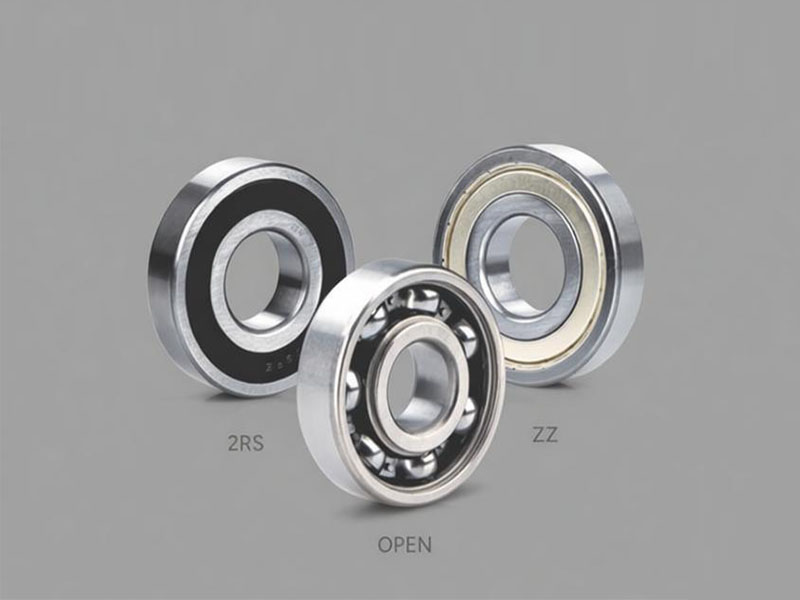
Deep groove ball bearings are the most common rolling bearing type. You’ll find them in electric motors, pumps, compressors, fans, conveyors, and even household appliances. Their defining feature is raceway grooves that are slightly larger than the ball radius, enabling the bearing to carry radial loads as its primary function while also handling axial loads in either direction—though to a limited extent.
Deep groove bearings are available in single-row and double-row designs, with various sealing options: open, shielded (ZZ), and sealed (2RS). They are non-separable—the inner ring, outer ring, balls, and cage form a single assembly. They have low friction between balls and raceways, low noise and vibration, and high rotational speed capability.
Advantages of Deep Groove Ball Bearings
- Versatile and widely available: Produced in thousands of sizes and configurations, making them readily available and cost-effective. Their simple, versatile, and robust design makes them the most commonly used bearing type across industries.
- High-speed capability with low friction: Low friction enables high rotational speeds, reduced energy consumption, and minimal heat generation. They run quietly and smoothly, making them ideal for precision machinery and home appliances.
- Simple structure, easy to mount, low maintenance: Simple in design, easy to mount, and require less maintenance than many other bearing types. Once properly installed, they generally do not require constant lubrication or frequent adjustments.
- Bidirectional axial load capacity: Deep grooves enable axial loads to be carried in either direction. However, axial load capacity is significantly lower than radial capacity—typically 25–35% of the static radial load rating (C₀).
- Low noise and vibration: The way balls contact the raceways makes these bearings quiet and smooth, perfect for applications where noise is a concern.
- Cost-effective: Mass production and standardization make deep groove bearings the most economical choice among all rolling bearing types for general-purpose applications.
Disadvantages of Deep Groove Ball Bearings
- Very limited misalignment tolerance: Typically only 0.5 to 1 degree. If the shaft and housing are not properly aligned, bearing life can be significantly reduced. Misalignment beyond the limit creates uneven load distribution, leading to premature failure.
- Axial load capacity limited: While they can handle axial loads in both directions, capacity is substantially lower than radial capacity—approximately 25–35% of C₀. Applying heavy thrust forces can drastically reduce bearing life.
- Lower load capacity than roller bearings: Generally have a lower load capacity than roller bearings. The point contact between balls and raceways limits their ability to handle extremely heavy loads.
- Not resistant to impact: Sensitive to impact loads and may have a relatively low life expectancy under shock conditions. Not suitable for applications with frequent shocks or heavy impacts.
- Limited high-temperature tolerance: Standard operating range is approximately -30°C to +110°C, with lubricants deteriorating above this range.
Angular Contact Ball Bearings
What Is an Angular Contact Ball Bearing?
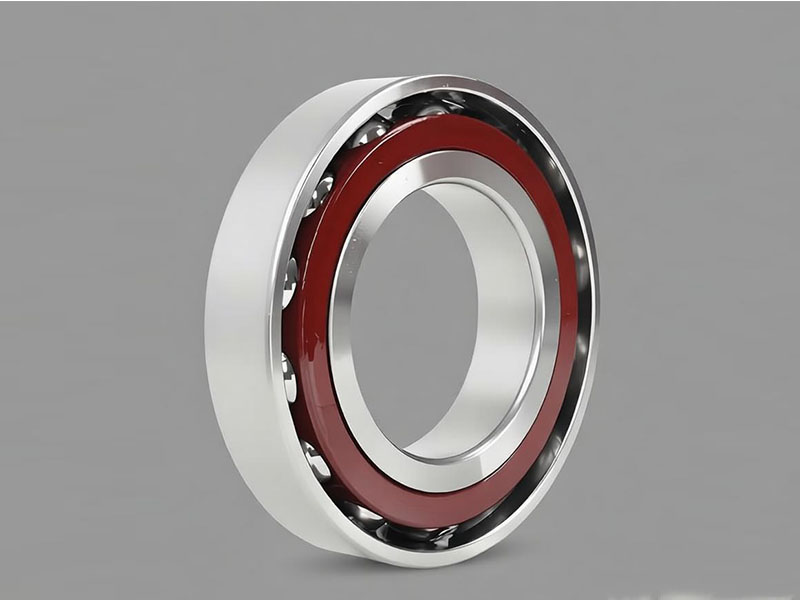
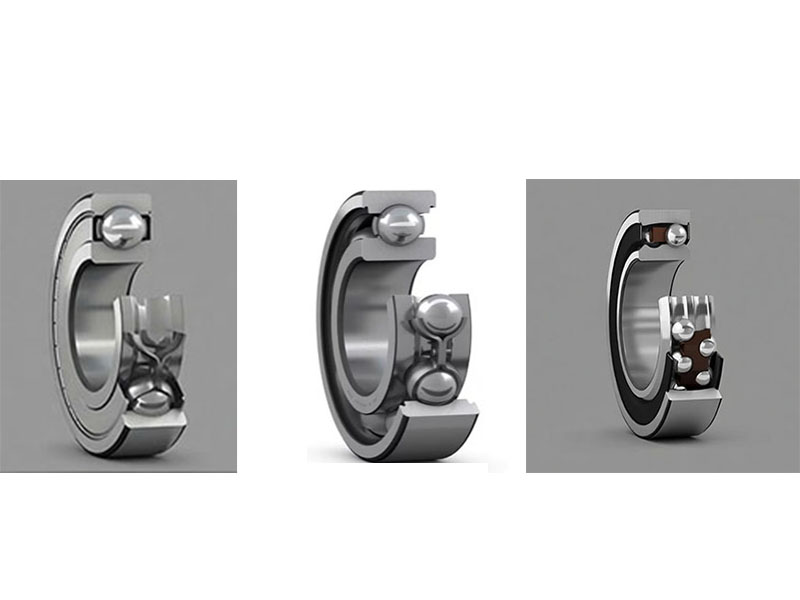
An angular contact ball bearing features inner and outer ring raceways that are displaced relative to each other in the direction of the bearing axis. This displacement creates a contact angle, defined as the angle between the line connecting the ball’s contact points and the radial plane. Standard contact angles are 15°, 25°, 30°, and 40°.
The contact angle determines load-handling characteristics: larger angles provide greater axial load capacity but reduce speed capability. High-precision and high-speed bearings typically use a 15° contact angle.
Single-row angular contact bearings are designed for uni-directional thrust—they handle axial loads in one direction only. For bidirectional loads, they must be mounted in pairs—back-to-back (DB), face-to-face (DF), or tandem (DT) arrangements.
Key applications: Machine tool spindles, high-speed motors, precision gearboxes, pumps, robotics, and centrifugal equipment.
Advantages of Angular Contact Ball Bearings
- Excellent combined load capacity: Simultaneously support radial loads and significant axial loads in one direction. Excel under heavy axial loads due to contact angle design—the steeper the angle, the more thrust they can carry.
- High axial rigidity and precision: Contact angle design provides superior axial stiffness. Larger contact angles deliver higher axial rigidity. Preferred choice for machine tool spindles and other precision applications where deflection must be minimized.
- High-speed capability: Small contact angle (15°) models achieve extremely high rotational speeds. Under oil lubrication, speeds can exceed 30,000 RPM for certain sizes.
- Adjustable preload: Preload can be precisely adjusted to optimize stiffness, eliminate internal clearance, and prevent ball skidding. Allows engineers to tune bearing performance for specific operating conditions.
- Multiple pairing arrangements: DB (back-to-back), DF (face-to-face), and DT (tandem) configurations provide flexible solutions for different load directions and stiffness requirements.
- High load-carrying capacity (D design): D design bearings contain the maximum number and size of balls, providing the highest possible load-carrying capacity among precision angular contact bearings.
Disadvantages of Angular Contact Ball Bearings
- Unidirectional axial load (single-row): Single-row bearings can only accommodate axial loads in one direction. For bidirectional axial loads, must use double-row bearings, four-point contact bearings, or pair two single-row bearings—adding cost and complexity.
- Complex installation: Requires precise pairing and preload adjustment. Unlike deep groove bearings, angular contact bearings demand correct pairing arrangement selection (DB/DF/DT), accurate preload application, and careful measurement. Requires skilled technicians.
- Extremely limited misalignment tolerance: Very limited angular adjustment capability—typically less than 2 minutes of arc. Misalignment beyond the limit causes uneven load distribution, leading to noise, vibration, and premature failure.
- Higher cost: Precision manufacturing, matched pairs, and tighter tolerances make angular contact bearings more expensive than deep groove ball bearings of comparable size.
- Larger overall dimensions: Have a larger rotary section, increasing overall dimensions and footprint compared to deep groove bearings.
Self-Aligning Ball Bearings
What Is a Self-Aligning Ball Bearing?
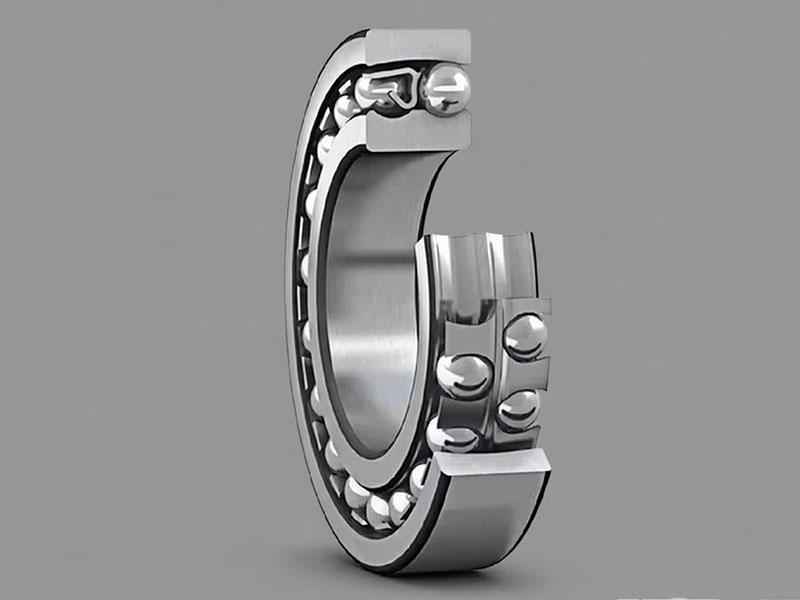
A self-aligning ball bearing is a double-row ball bearing with an outer ring that has a spherical raceway and two deep groove raceways on the inner ring. The outer ring’s spherical raceway has no traditional groove—it’s a smooth, curved surface. The inner ring carries two rows of balls.
The center of the outer ring’s spherical raceway coincides with the bearing center. This allows the inner ring, balls, and cage assembly to tilt freely around the bearing center, automatically compensating for angular misalignment.
Depending on the series and design, open-type self-aligning ball bearings can accommodate misalignment of up to 3 degrees without affecting performance. Sealed (2RS) types are limited to 1.5 degrees. Under normal loads, some manufacturers—including NSK—permit dynamic misalignment of approximately 0.07 to 0.12 radian (4 to 7 degrees). They generate less frictional heat and can accommodate higher speeds than other types of self-aligning rolling bearings.
Key applications: Transmission shafts, conveyor systems, fans and blowers, agricultural machinery, gearboxes, electric motors, pumps and compressors.
Advantages of Self-Aligning Ball Bearings
- Exceptional misalignment compensation: The defining advantage. The spherical outer ring raceway allows the bearing to accommodate up to 3 degrees of static and dynamic misalignment (open type) without affecting performance. Sealed types handle up to 1.5 degrees. This capability reduces stress on mechanical components, simplifies installation, and extends machine life—particularly valuable when shaft deflections or mounting errors are expected.
- Lowest friction of any rolling bearing: SKF states that self-aligning ball bearings generate less friction than any other type of rolling bearing. This enables them to run cooler even at high speeds, reducing energy consumption and extending lubricant life.
- Low noise and vibration: The design of self-aligning ball bearings can reduce noise and vibration levels, making them suitable for applications like fans where quiet operation matters.
- Low minimum load requirements: Have low minimum load requirements, performing exceptionally well under light loads with high-speed rotation.
- Long service life with low maintenance: Low friction translates to lower operating temperatures, which extends lubricant life and maintenance intervals. Sealed versions come pre-lubricated and reduce maintenance requirements.
- Cost-effective self-aligning solution: Compared to spherical roller bearings, self-aligning ball bearings are more affordable while still providing the alignment compensation many applications need.
Disadvantages of Self-Aligning Ball Bearings
- Extremely limited axial load capacity: Small contact angle results in extremely limited axial load capacity. Generally not suitable for applications with large thrust forces. If axial loads are expected, consider thrust bearings with aligning seats instead.
- Lower load capacity than conventional ball bearings: Have lower radial load-carrying capacity compared to deep groove ball bearings. Point contact means radial load carrying capacity is lower compared to barrel bearings with line contact.
- Lower speed limits than deep groove bearings: Have relatively low limiting speeds compared to deep groove ball bearings—though they offer excellent high-speed performance among self-aligning types.
- Sealed types have reduced misalignment tolerance: Sealed (2RS) bearings have misalignment tolerance reduced from 3 degrees to 1.5 degrees. Rubber seals physically constrain the bearing’s internal tilt capability.
- Cannot transmit torque: Self-aligning ball bearings cannot transmit torque. The spherical interface that enables self-alignment also prevents torque transfer—this is by design.
Comparison Table
| Feature | Deep Groove | Angular Contact | Self-Aligning |
|---|---|---|---|
| Misalignment tolerance | 0.5–1° | < 2 minutes of arc | Up to 3° (open) / 1.5° (sealed) |
| Axial load direction | Bidirectional (limited) | Unidirectional (single-row) | Bidirectional (very limited) |
| Axial load capacity | Moderate (25–35% of C₀) | High | Very low |
| Radial load capacity | High | Moderate | Moderate |
| Speed capability | High | High (15° models) | Moderate |
| Friction | Low | Low | Lowest of all rolling bearings |
| Installation | Simple | Complex (pairing + preload) | Simple |
| Cost | Lowest | Higher | Moderate |
| Typical applications | Motors, pumps, fans, conveyors | Spindles, precision machinery | Transmission shafts, conveyors, fans |
How to Choose the Right Bearing Type
Selecting the right bearing comes down to understanding your application’s specific demands. Here’s a decision framework:
Choose Deep Groove Ball Bearings when:
- Loads are primarily radial with only moderate axial components
- High rotational speeds are required
- Installation is straightforward and alignment can be maintained
- Cost is an important factor—deep groove bearings are the most economical
- You need bidirectional axial load capacity (limited)
- Applications include general-purpose machinery, motors, pumps, and conveyors
Choose Angular Contact Ball Bearings when:
- Loads combine radial and significant axial components
- Axial rigidity and precision are critical
- High rotational speeds are required (15° contact angle models)
- You can accommodate complex installation with precise pairing and preload
- Applications include machine tool spindles, high-speed motors, and precision gearboxes
Choose Self-Aligning Ball Bearings when:
- Misalignment is unavoidable—shaft deflection or mounting tolerances are expected
- Loads are primarily radial with very limited axial components
- You need lowest possible friction—lower than any other rolling bearing
- High speed and light load are the operating conditions
- Applications include transmission shafts, conveyors, fans, and agricultural machinery
Quick decision guide:
- Radial loads + simple installation + low cost → Deep Groove
- Axial loads + precision + high speed → Angular Contact
- Misalignment + low friction + light loads → Self-Aligning
Conclusion
Deep groove, angular contact, and self-aligning ball bearings each have their place. There’s no single “best” type—only the right one for your specific application.
Deep groove ball bearings are the workhorse of the bearing world. They’re versatile, cost-effective, and easy to install. Choose them for most general-purpose applications where alignment can be maintained and axial loads are moderate.
Angular contact ball bearings are the precision specialists. They handle significant axial loads with high rigidity and speed. Choose them when you need precision, high speeds, and the ability to carry heavy thrust loads—but be prepared for more complex installation and higher cost.
Self-aligning ball bearings are the misalignment masters. They tolerate shaft deflection and mounting errors that would destroy other bearings, all while delivering the lowest friction of any rolling bearing. Choose them when alignment is a challenge and loads are primarily radial.
Understanding the trade-offs—misalignment tolerance, axial load capacity, speed capability, installation complexity, and cost—is the key to making the right selection. When in doubt, start with your primary constraint: Is it misalignment? Axial load? Speed? Cost? The answer will point you to the right bearing type.
At DUHUI Bearing, we have been manufacturing automotive and industrial bearings since 2003, serving customers in over 60 countries. Our product range includes deep groove, angular contact, and self-aligning ball bearings produced to international standards with precision grades up to P5 and above. Whether you need standard sizes or custom configurations, we are here to help you find the right bearing solution for your application.
Frequently Asked Questions (FAQs)
Q1: What is the main difference between these three bearing types?
The main difference lies in their design purpose. Deep groove bearings are general-purpose—they handle radial loads and moderate bidirectional axial loads, but tolerate very little misalignment (0.5–1 degree). Angular contact bearings are designed for significant axial loads in one direction with high precision and rigidity, but require complex pairing. Self-aligning bearings compensate for up to 3 degrees of misalignment and offer the lowest friction of any rolling bearing, but have extremely limited axial capacity.
Q2: Which bearing type is best for high-speed applications?
Deep groove bearings and angular contact bearings (15° contact angle models) both offer excellent high-speed performance. Deep groove bearings are simpler and more cost-effective for general high-speed applications. Angular contact bearings are preferred when high speed must be combined with significant axial loads and high precision. Self-aligning bearings have lower speed limits than deep groove bearings.
Q3: Which bearing type can tolerate the most misalignment?
Self-aligning ball bearings tolerate the most misalignment—up to 3 degrees (open type) or 1.5 degrees (sealed type). Deep groove bearings tolerate only 0.5–1 degree. Angular contact bearings tolerate less than 2 minutes of arc. If misalignment is a concern, self-aligning bearings are the clear choice.
Q4: Can angular contact bearings replace deep groove bearings?
Not directly—they serve different purposes. Angular contact bearings handle higher axial loads but only in one direction (single-row), require complex pairing and preload, and cost more. Deep groove bearings handle bidirectional axial loads, are simpler and cheaper to install, and work well for general-purpose applications. Replace deep groove with angular contact only when your application demands higher axial capacity and precision.
Q5: When should I choose self-aligning bearings over others?
Choose self-aligning bearings when misalignment is unavoidable—shaft deflection, loose mounting tolerances, or applications where precise alignment is difficult. They’re also the best choice when you need the lowest possible friction of any rolling bearing. However, avoid them when axial loads are significant—their axial capacity is extremely limited.
Q6: Which bearing type is the most cost-effective?
Deep groove ball bearings are the most cost-effective. They are mass-produced in thousands of sizes, widely available, and simple to install. Angular contact bearings cost more due to precision manufacturing and pairing requirements. Self-aligning bearings are moderately priced—more than deep groove but less than angular contact for comparable sizes.
Q7: What are the misalignment tolerances for each type?
| Bearing Type | Misalignment Tolerance |
|---|---|
| Deep Groove | 0.5–1 degree |
| Angular Contact | < 2 minutes of arc |
| Self-Aligning (open) | Up to 3 degrees |
| Self-Aligning (sealed) | 1.5 degrees |
Q8: Can self-aligning ball bearings handle axial loads?
Yes, but very limited. Self-aligning ball bearings can handle minor axial loads in both directions but are generally not suitable for applications with large thrust forces. Their small contact angle significantly limits axial capacity. If axial loads are significant, consider angular contact bearings instead.