When designing plain bearing systems for industrial machinery, engineers must choose from a range of metallic materials. Bronze bushings are the industry benchmark, but other alloys—brass, carbon steel, stainless steel, aluminum bronze, and cast iron—each offer specific advantages under certain operating conditions.
Common questions include: Is bronze always superior to steel or brass? Which alloy provides the best combination of wear resistance, load capacity, and corrosion resistance? When should I avoid bronze entirely?
This plain bearing material comparison focuses on bronze bushings (tin bronzes, leaded bronzes, aluminum bronzes) versus other metallic alloys used for solid bearings. The analysis covers classification, working principles, technical specifications, advantages and disadvantages, and selection criteria.
Classification of Plain Bearing Alloys
Plain bearing alloys are divided into two main groups based on base metal composition.
Copper-based alloys
- Tin bronzes (CuSn): CuSn8, CuSn12 – highest wear resistance and sliding properties.
- Leaded bronzes (CuSnZnPb): CuSn7Zn4Pb7 (gunmetal) – cost‑effective, good emergency operation.
- Aluminum bronzes (CuAl): CuAl10Fe, CuAl10Ni – high strength, excellent seawater corrosion resistance.
- Brass (CuZn): CuZn37, CuZn40 – lower cost but inferior wear resistance compared to bronze.
Iron-based alloys
- Carbon steel: high strength, low cost, but poor sliding properties without surface hardening.
- Stainless steel: excellent corrosion resistance and high‑temperature capability.
- Cast iron: contains graphite flakes that provide inherent dry lubricity.
Other less common alloys (zinc‑aluminum, babbitt) are outside the scope of this comparison.
Operating Principle and Structural Characteristics
Bronze Bushings
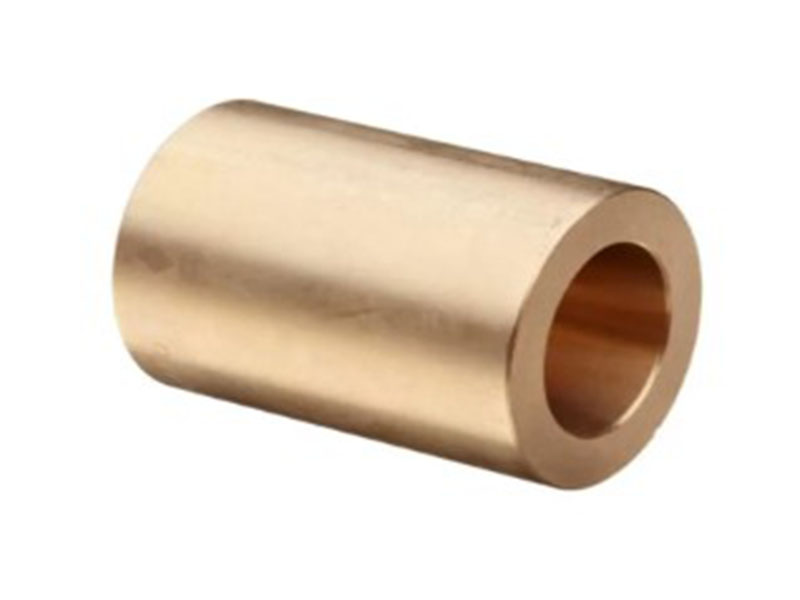
Bronze bushings are monolithic (single‑material) components manufactured from copper‑tin or copper‑tin‑lead alloys. Their sliding performance relies primarily on proper lubrication, as bronze has limited dry‑running capability. Most bronze bushings incorporate lubrication grooves—machined channels that distribute grease or oil across the bearing surface. In the event of lubrication failure, bronze can operate in emergency running mode for a limited period, preventing immediate seizure.
Other Alloy Bushings
Brass bushings function similarly to bronze but have lower tin content, resulting in reduced wear resistance and higher friction. They are suitable for low‑load, low‑speed, or disposable applications.
Steel bushings (carbon steel) require through‑hardening or surface induction hardening to achieve acceptable wear resistance. Unhardened steel against a steel shaft leads to rapid galling. Steel’s primary advantage is high strength at low material cost.
Stainless steel bushings offer excellent corrosion resistance but are prone to galling when sliding against stainless steel shafts. Different alloys (e.g., 316 vs. 440C) and surface treatments can mitigate this.
Cast iron bushings contain graphite flakes that act as a solid lubricant, providing some self‑lubrication for intermittent or minimal lubrication applications.
Aluminum bronze bushings (CuAl10Fe, CuAl10Ni) operate on the same monolithic principle as tin bronze but with higher mechanical strength and superior corrosion resistance. They require lubrication for continuous operation, similar to other copper alloys, and perform well against hardened steel shafts. Aluminum bronze is particularly suitable for high‑load, low‑speed applications in marine or chemical environments.
Technical Similarities Across Alloys
All metallic plain bearing alloys share certain characteristics:
- Single‑phase or multi‑phase homogeneous materials without separate sliding layers.
- Lubrication is required for continuous high‑speed or high‑load operation.
- PV value (pressure × velocity) is the primary design parameter for predicting frictional heat.
- Shaft material compatibility matters – harder alloys generally require hardened shafts.
- Thermal expansion must be accounted for in clearance design.
Technical Specifications: Bronze Bushings vs. Other Alloys
The table below summarizes typical mechanical and operational parameters for common plain bearing alloys. Values represent standard ranges for commonly used grades.
| Alloy Type | Typical Grades | Tensile Strength (MPa) | Max Continuous Temp (°C) | Wear Resistance | Corrosion Resistance | Relative Cost |
|---|---|---|---|---|---|---|
| Tin Bronze (CuSn8) | CuSn8 | 450–620 | 250 | Excellent | Moderate | Medium |
| Tin Bronze (CuSn12) | CuSn12 | 550–650 | 250 | Excellent | Moderate | Medium‑High |
| Leaded Bronze | CuSn7Zn4Pb7 | 280–350 | ~250 | Good | Moderate | Medium |
| Aluminum Bronze | CuAl10Fe, CuAl10Ni | 550–750 | 300 | Very Good | Excellent (seawater) | High |
| Brass | CuZn37, CuZn40 | 300–500 | 200 | Fair | Poor | Low‑Medium |
| Carbon Steel | 1045, 4140 (hardened) | 500–700 | 150 | Poor (needs hardening) | Poor | Low |
| Stainless Steel | 304, 316, 440C | 500–850 | 400 | Good (when hardened) | Excellent | High |
| Cast Iron | GG20, GG25 | 200–350 | 400 | Good (graphite lubricant) | Moderate | Low |
PV value reference (lubricated, continuous operation):
- Tin bronze (CuSn8): permissible PV up to 3.0 N/mm²·m/s (steel shaft, oil lubrication)
- Aluminum bronze: permissible PV up to 2.5 N/mm²·m/s
- Cast iron: permissible PV up to 1.5 N/mm²·m/s
- Brass: permissible PV up to 1.2 N/mm²·m/s
PV = p × v (p in N/mm², v in m/s). Actual PV must remain below the permissible value for the selected alloy.
Advantages and Disadvantages of Bronze Bushings Relative to Other Alloys
Bronze vs. Brass
Advantages of bronze: Tin bronze offers significantly higher wear resistance, better load capacity, and superior emergency running properties. Bronze also handles edge loading and misalignment better than brass.
Disadvantages: Bronze is more expensive. For light‑duty, low‑speed, short‑lifetime applications (e.g., consumer appliances), brass may be sufficient at lower cost.
Bronze vs. Carbon Steel
Advantages of bronze: Bronze has excellent embeddability – small debris particles embed into the bronze surface without scoring the shaft. Steel bearings lack this. Bronze also runs well against unhardened shafts, while steel requires hard shafts or extensive lubrication.
Disadvantages: Carbon steel has higher tensile strength (up to 700 MPa) and lower raw material cost. However, steel bearings need additional surface hardening or coating, which adds manufacturing cost.
Bronze vs. Aluminum Bronze
Advantages of aluminum bronze: Higher strength (up to 750 MPa), excellent corrosion resistance in seawater and chemical environments, and good performance at elevated temperatures (up to 300°C). Preferred for marine, pump, and valve applications.
Disadvantages: Aluminum bronze is more expensive than tin bronze and more difficult to machine. Its sliding properties are slightly inferior to tin bronze under mixed or boundary lubrication.
Bronze vs. Cast Iron
Advantages of bronze: Higher toughness, better impact resistance, and superior load capacity. Bronze conforms better to shaft irregularities.
Disadvantages: Cast iron’s graphite content provides self‑lubrication, reducing lubricant needs in some applications. Cast iron is also less expensive but becomes brittle under shock loads.
Bronze vs. Stainless Steel
Advantages of bronze: Bronze is less prone to galling against steel shafts. Stainless‑on‑stainless often results in severe adhesive wear. Bronze also costs significantly less than stainless steel.
Disadvantages: Stainless steel provides far superior corrosion resistance and higher temperature capability (up to 400°C). For food processing, medical equipment, or chemical plants, stainless steel solid bearings are often mandatory despite higher cost and galling risk.
Selection Criteria for Plain Bearing Alloys
To select the optimal alloy for a plain bearing application, evaluate these factors in priority order.
Load Magnitude and Type
- Low to moderate static loads (<20 MPa): CuSn7Zn4Pb7 or brass.
- High static loads (20–50 MPa): CuSn8, CuSn12, aluminum bronze, or hardened steel.
- Impact or shock loads: CuSn12 or aluminum bronze; avoid cast iron and brass.
Sliding Speed and PV Value
- High speed, high PV (>3.0 N/mm²·m/s) with continuous lubrication: CuSn8 phosphor bronze.
- Low speed, high load: Aluminum bronze or CuSn12.
- Very low speed, intermittent operation: Cast iron or brass.
Lubrication Conditions
- Continuous oil or grease lubrication: Any alloy, but bronze provides optimal performance.
- Intermittent lubrication: Cast iron (graphite lubricant) or leaded bronze.
- Minimal or no lubrication possible: Cast iron or specialized sintered bronze.
Operating Temperature
- Up to 150°C: Bronze, brass, carbon steel, cast iron, stainless steel.
- 150°C to 250°C: Tin bronze, aluminum bronze, stainless steel.
- 250°C to 300°C: Aluminum bronze (max 300°C), stainless steel, CuSn8 (intermittent).
- 300°C to 400°C: Stainless steel, cast iron.
Corrosion Environment
- Dry indoor: Any alloy.
- Humid or wet: Bronze (especially aluminum bronze) or stainless steel.
- Seawater or chemical exposure: Aluminum bronze or stainless steel 316.
- Acidic/alkaline: Stainless steel (specific grades).
Shaft Material Compatibility
- Unhardened carbon steel shaft: CuSn7Zn4Pb7 ideal.
- Hardened steel shaft: CuSn8 or CuSn12.
- Stainless steel shaft: Avoid stainless‑on‑stainless; use bronze or aluminum bronze.
Cost and Regulatory Requirements
- Lowest cost: Cast iron or brass.
- Best performance‑to‑cost: CuSn7Zn4Pb7 for general use; CuSn8 for demanding applications.
- RoHS compliance: Leaded bronzes (CuSn7Zn4Pb7) are not RoHS‑compliant. Use CuSn8, CuSn12, aluminum bronze, steel, or stainless steel for RoHS‑regulated markets.
Frequently Asked Questions
Q1: Which bronze alloy is best for high‑speed applications?
A1: CuSn8 phosphor bronze. It offers the best combination of wear resistance, heat resistance, and fatigue strength for high‑speed, high‑load conditions with continuous lubrication.
Q2: Can I use a steel bearing instead of bronze?
A2: Yes, but only if the steel is surface‑hardened (≥55 HRC) and adequately lubricated. Unhardened steel bearings will gall against steel shafts. Steel lacks bronze’s embeddability and emergency running capability.
Q3: Is brass ever better than bronze?
A3: For very low‑duty, low‑speed, intermittent applications where low material cost is the primary driver, brass can be sufficient. For any continuous or moderate‑load application, bronze is superior.
Q4: What is the difference between aluminum bronze and tin bronze?
A4: Aluminum bronze offers higher tensile strength (up to 750 MPa) and excellent seawater corrosion resistance. Tin bronze provides better sliding properties, higher wear resistance under boundary lubrication, and better conformability. Choose aluminum bronze for strength and corrosion; choose tin bronze for sliding performance.
Q5: Do bronze bearings require hardened shafts?
A5: Not necessarily. CuSn7Zn4Pb7 (leaded gunmetal) is specifically formulated for unhardened steel shafts. For higher loads and speeds with CuSn8 or CuSn12, hardened shafts (≥55 HRC) are recommended.
Q6: What is the maximum temperature for bronze bushings?
A6: CuSn8 tin bronze can operate continuously up to 250°C and intermittently up to 300°C with sufficient lubrication. Aluminum bronze runs at 300°C continuous. Above 300°C, use stainless steel or cast iron.
Q7: Which alloys are RoHS‑compliant?
A7: Lead‑free alloys: CuSn8, CuSn12, aluminum bronze, stainless steel, carbon steel, cast iron. Leaded bronze (CuSn7Zn4Pb7) and some brasses are not RoHS‑compliant.
Q8: What is a PV value and how is it calculated?
A8: PV = p × v, where p = specific load (N/mm²) and v = surface speed (m/s). It represents the frictional heat generated. Each alloy has a maximum permissible PV value. For CuSn8 with oil lubrication, permissible PV ≈ 3.0 N/mm²·m/s; for cast iron, ≈ 1.5 N/mm²·m/s.
Conclusion
This plain bearing material comparison shows that bronze bushings, particularly tin bronzes (CuSn8, CuSn12), offer an excellent balance of wear resistance, load capacity, sliding properties, and cost for general industrial applications. They perform well against both hardened and unhardened shafts, tolerate edge loading, and provide emergency running capability.
However, bronze is not always optimal. Other alloys outperform bronze in specific scenarios:
- Extreme strength and high temperature: stainless steel or aluminum bronze
- Seawater or chemical corrosion: aluminum bronze or stainless steel
- Lowest cost in light‑duty applications: brass or cast iron
- Self‑lubricating properties (intermittent operation): cast iron
Selection must be based on the full set of operating conditions: load, speed, temperature, corrosion risk, lubrication availability, shaft material, and regulatory requirements (RoHS). By understanding the technical specifications and trade‑offs of each alloy family, engineers can make reliable plain bearing selections for their applications.