
Basic Construction
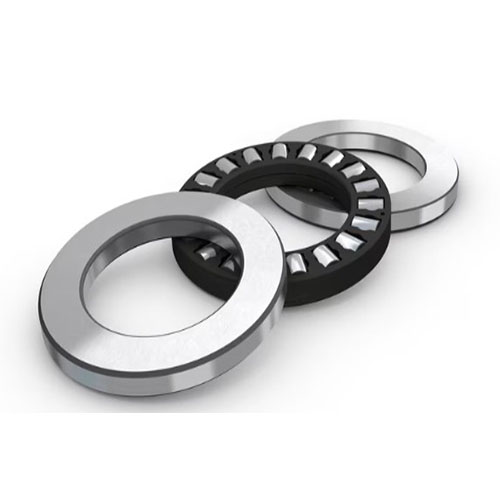
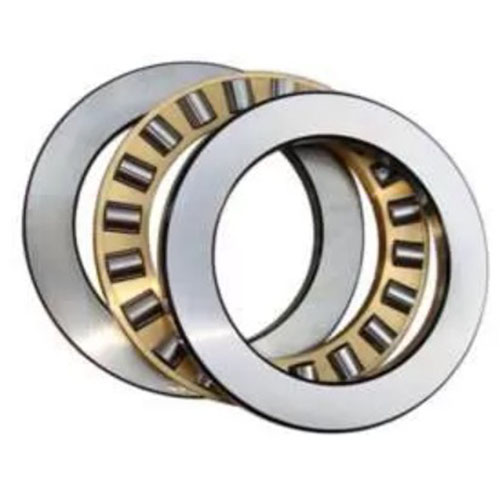
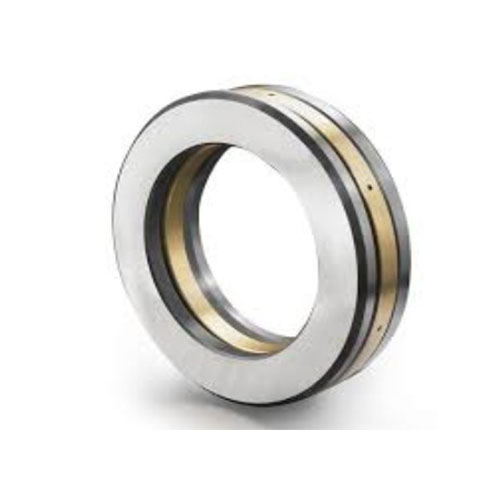
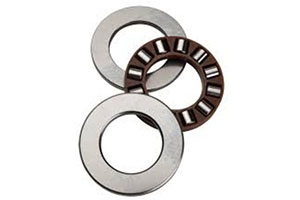
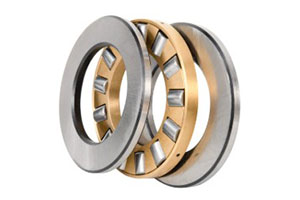
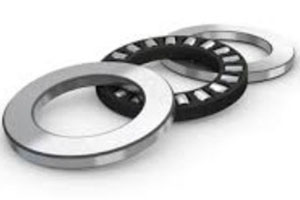
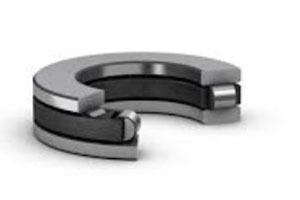
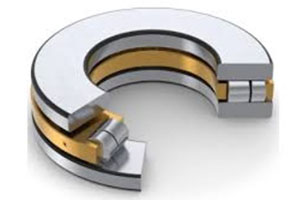
A thrust cylindrical roller bearing consists of three separable components: a shaft washer (interference fit on shaft), a housing washer (clearance fit in housing), and a roller-and-cage assembly. Cylindrical rollers provide line contact, delivering high axial load capacity. All DUHUI series conform to ISO 104 and DIN 722-1, ensuring full interchangeability with SKF, FAG, NSK, and Timken. Bore sizes range from 15 mm to over 1200 mm. The separable design simplifies mounting and inspection, particularly in vertical pumps and gearboxes where shaft removal is impractical.
Performance Features
- High axial load density: Line contact between cylindrical rollers and flat raceways delivers 5–8 times the dynamic axial load rating (Ca) of thrust ball bearings in the same bore size.
- No misalignment accommodation: Requires precise parallel alignment between shaft and housing washers. Angular errors exceeding 0.02 mm/m cause edge loading and rapid fatigue. For misaligned applications, use thrust spherical roller bearings.
- Fully separable components: Shaft washer, housing washer, and roller/cage assembly are separate pieces. This simplifies inspection, allows replacement of individual worn parts, and permits mixed-brand combinations if dimensions match.
- Moderate speed capability: Limiting speed depends on cage material and lubrication. Polyamide-caged bearings: up to 2000 rpm with oil. Brass-caged: up to 3000+ rpm with oil circulation. Higher speeds require forced oil jet lubrication.
- Zero radial load tolerance: Cannot support any radial force. Every application must include separate radial bearings (deep groove or cylindrical roller types) to handle perpendicular loads.
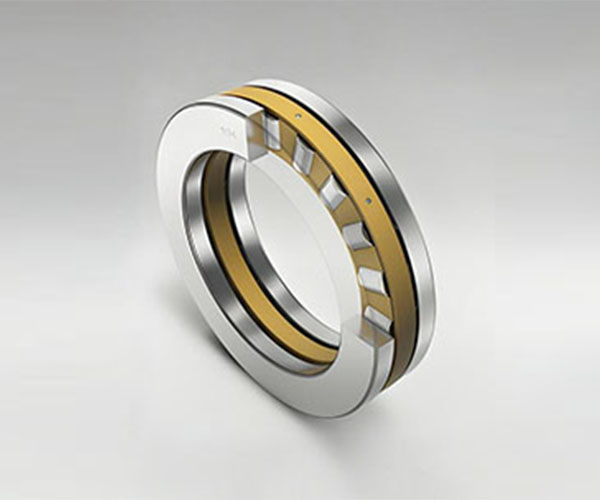
Thrust Cylindrical Roller Bearings Selection Guide
What defines a thrust cylindrical roller bearing?
A thrust cylindrical roller bearing is an axial rolling element bearing optimized for unidirectional thrust loads. Its flat raceways and cylindrical rolling elements create line contact, enabling load capacities far exceeding those of thrust ball bearings. The three-piece separable design — shaft washer, housing washer, and roller cage assembly — distinguishes it from non-separable thrust bearing types.
Selection factor 1: Axial load magnitude and directionality
Measure the maximum steady-state axial load, peak shock loads, and duty cycle. Thrust cylindrical roller bearings accept loads only in one axial direction. For reversing axial loads, you must install two opposed bearings or select a different bearing category. Compare the required dynamic load with the bearing’s basic dynamic axial load rating Ca. For static applications, use the static axial rating C0a with a safety factor of 1.5–2.0 for normal operation or 3.0–4.0 for shock loads.
Selection factor 2: Rotational speed and lubrication regime
Calculate the product n × dm (speed in rpm multiplied by pitch circle diameter in mm). For n×dm values below 200,000, grease lubrication with a high-viscosity lithium complex grease (ISO VG 220) is acceptable. Between 200,000 and 350,000, oil bath or circulating oil is required. Above 350,000, forced oil jet lubrication becomes mandatory. Polyamide cages (TN/TVP) have lower speed limits than brass cages (M suffix). Always verify that the selected bearing’s thermal speed rating exceeds your application’s operating speed after applying lubrication and ambient temperature correction factors.
Selection factor 3: Minimum axial load – technical explanation and calculation
At elevated speeds, the centrifugal force acting on rollers can overcome the external axial load, causing rollers to slide instead of rotate. This skidding condition generates frictional heat, damages cage pockets, and rapidly degrades lubricant. To prevent skidding, maintain a minimum axial load Famin. A practical formula for oil-lubricated thrust cylindrical roller bearings is Famin = 0.005 × C0a. For grease lubrication, Famin = 0.01 × C0a. If the application’s inherent axial load falls below this threshold, incorporate a preload mechanism such as a wave spring, belleville washer stack, or adjustable housing cover with shims.
Selection factor 4: Dimensional accuracy and tolerance grades
Standard thrust cylindrical roller bearings are manufactured to Normal (PN) tolerance class per ISO 199. For applications demanding lower axial runout — including precision machine tool spindles, measuring equipment, and aircraft actuation systems — P5 (precision) or P4 (super-precision) grades are available on request. Dimensional tolerances for the shaft washer bore (d) follow ISO 492 class 6, while the housing washer outer diameter (D) follows class 7. When interchanging bearings from different manufacturers, verify corner radii (r min) and the height tolerance band (ΔH).
Selection factor 5: Environmental conditions – temperature and contamination
Continuous operating temperature directly impacts cage material selection. Polyamide 66 (TN suffix) is limited to +120°C. Polyamide 46 (TVP suffix) withstands short-term peaks up to +150°C. Machined brass cages (M suffix) operate reliably up to +300°C with proper high-temperature oil. For sub-zero environments down to -40°C, special low-temperature grease and modified cage clearances are required. Contamination from dust, water jets, or process chemicals demands additional sealing — consider shaft seals, labyrinth covers, or specifying bearings with increased internal radial clearance (C3 or C4).
Selection factor 6: ISO and DIN standard conformity – interchangeability assurance
All DUHUI thrust cylindrical roller bearings are manufactured to ISO 104:2002 (Rolling bearings – Thrust bearings with flat raceways) and DIN 722-1 (Dimensions and tolerances for thrust cylindrical roller bearings). This means that a DUHUI 81108 TN bearing has identical bore (40 mm), outer diameter (60 mm), and height (13 mm) as an SKF 81108 TN or FAG 81108 TVP. Washer flatness, parallelism, and surface roughness also conform to ISO standards. For aftermarket buyers, this guarantees drop-in replacement without housing or shaft modifications. We provide a cross-reference chart from major brands to DUHUI equivalents upon request.
Selection factor 7: Separability and maintenance access
The three-piece construction offers significant advantages during equipment overhaul. You can remove the housing washer and roller assembly while leaving the shaft washer pressed onto the shaft. This allows bearing inspection and replacement without dismantling the entire rotor or shaft assembly — particularly valuable for large vertical pumps, marine thrust blocks, and steel mill drives. When ordering replacement components, note that shaft washers and housing washers from different manufacturers may be mixed as long as the bore, outer diameter, height, and surface finish meet ISO tolerances. However, DUHUI recommends replacing all three components simultaneously for maximum service life.
Product types and series
DUHUI manufactures a complete range of single-row and double-row thrust cylindrical roller bearings in standard 811, 812, 893, and 894 dimensional series. All dimensions follow ISO/DIN standards for direct interchangeability with European, Japanese, and American brands. Cage options include glass-fiber reinforced polyamide (cost-effective, quiet), machined brass (high temperature, high speed), and stamped steel (general purpose). Custom non-standard dimensions and special heat treatments are available for large aftermarket contracts.
- Product types
- Single-row series
- Double-row series
- Custom series
Product types
Thrust cylindrical roller bearings are primarily categorized by the number of roller rows and the material used for the roller guide cage. Single-row designs occupy the smallest axial height and are suitable for the majority of industrial applications. Double-row designs distribute the axial load across two sets of rollers, significantly increasing the dynamic and static ratings for the same bore diameter. Cage material determines the upper temperature limit and maximum permissible rotational speed.
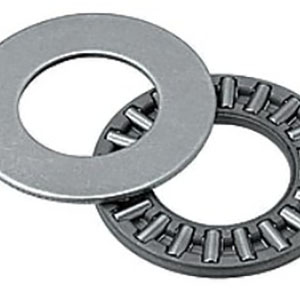
One annular set of cylindrical rollers arranged between a single shaft washer and a single housing washer. This configuration offers the lowest axial profile for any given bore size. Standard applications include vertical pump thrust bearings, lead screw support positions on machine tools, and input shaft thrust locations on gearboxes. Available with all three cage materials.
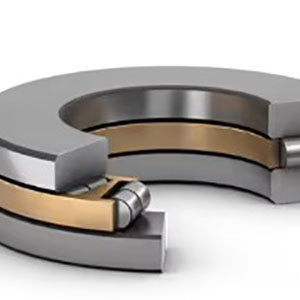
Two independent rows of rollers operating in parallel between a common shaft washer and housing washer. Double-row bearings achieve approximately 60% higher axial load capacity than single-row bearings of the same bore and outer diameter. They require slightly more axial height (approximately 1.6× the height of a comparable single-row bearing). Used in hydraulic presses, steel mill backup roll thrust positions, and large marine propulsion systems.
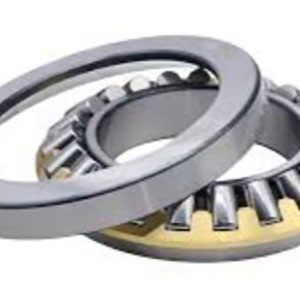
DUHUI provides custom thrust bearings with modified washer thickness, alternative chamfer geometries, and special surface coatings (manganese phosphate for break-in, DLC for friction reduction). Cage materials beyond standard offerings include PEEK (for aggressive chemical environments) and aluminum bronze (for extreme wear resistance). Custom orders require engineering drawings and approval of minimum order quantities.
Single-row series
The following single-row thrust cylindrical roller bearings represent DUHUI’s most frequently ordered aftermarket items. Each series is dimensionally interchangeable with equivalent models from SKF, FAG, NSK, and Timken. Variations in cage material and internal geometry (A suffix for improved load distribution) allow matching to specific operating conditions.
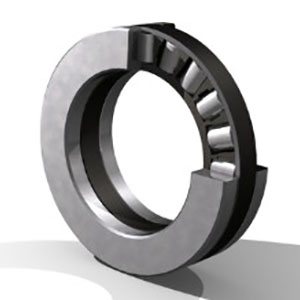
811 series – compact axial height
Single-row thrust bearing with the smallest possible axial height for its bore range. Designed for applications where vertical space is constrained. The rollers are guided by a pressed steel or polyamide cage. Separable components simplify mounting in confined assemblies. Commonly specified where a thrust ball bearing has proven inadequate for the actual axial load.
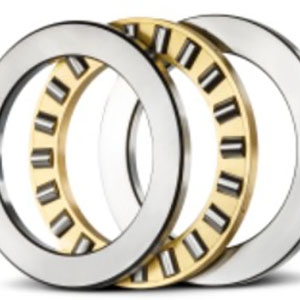
811M series – brass cage for high temperatures,Same compact dimensions as standard 811 but equipped with a machined brass cage (M suffix). Brass provides superior dimensional stability up to 300°C and greater resistance to shock loads compared to polyamide. Recommended for continuous operation in steel mill auxiliary drives, rolling mill screwdown mechanisms, and other high-ambient-temperature environments.
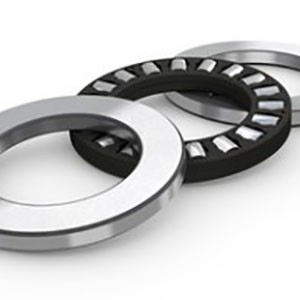
812A series – maximum load density in single row,Combines the taller cross-section of the 812 envelope with the improved internal geometry of the A-series. Results in the highest possible dynamic axial load rating available in a single-row thrust cylindrical roller bearing. Aftermarket replacement for screw press thrust bearings and vertical turbine pumps requiring maximum load capacity without changing to double-row designs.
Double-row series
Double-row thrust cylindrical roller bearings are selected when single-row capacity is insufficient but bore size cannot increase. The 893 series offers a moderate height increase over single-row bearings, while the 894 series provides the highest load capacity in the smallest possible envelope. Both series are available with polyamide or brass cages.
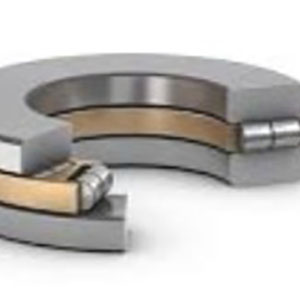
894 series – double row, maximum load
Tallest cross-section among standard thrust cylindrical roller bearings. Achieves the highest possible axial load rating for any given bore size within the ISO dimensional system. Designed for extreme loads, including peak shock loads from hydraulic press cycles and steel mill roll forging impacts. The increased washer thickness also improves resistance to deformation under heavy static loads.
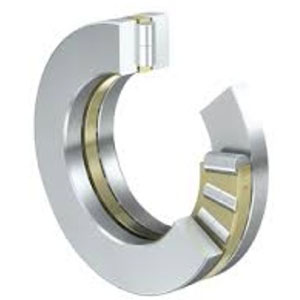
894M series – highest capacity with brass cage,The ultimate combination of load rating and thermal capability. Used in the most demanding industrial applications, including large hydraulic extrusion presses, primary rolling mill drives, and heavy marine propulsion systems. The brass cage ensures long-term reliability under continuous maximum load and is compatible with high-temperature oil lubrication.
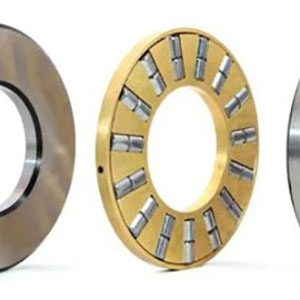
893E series – enhanced dynamics for double row,Engineered with improved internal roller geometry and optimized cage pocket design to increase the dynamic axial load rating Ca by approximately 10–15% compared to standard 893 bearings. Roller end profiles are modified to reduce edge stresses. Suitable as a performance upgrade replacement for existing 893-series bearings in paper machinery and large vertical motor applications.
Custom series
For applications requiring non-standard bore/outer diameter combinations, special washer thicknesses, or alternative cage materials not offered in standard catalogs, DUHUI provides custom design and manufacturing services. Minimum order quantities depend on complexity and are negotiable for large aftermarket contracts. Typical engineering lead time is 4–8 weeks from drawing approval to first article inspection.
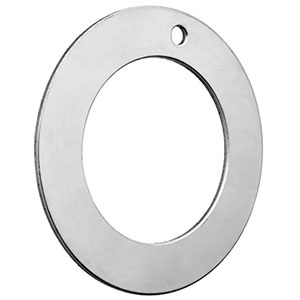
Custom washer configurations-DUHUI manufactures thrust bearing washers with user-specified bore diameters, outer diameters, and thicknesses that fall outside standard ISO 104 tables. Alternative washer materials include through-hardened 52100 chromium steel (standard), case-hardened low-carbon steel (for impact resistance), and AISI 440C stainless steel (for corrosion resistance). Surface grinding to Ra 0.1 µm or better is available for noise-sensitive or high-speed applications.
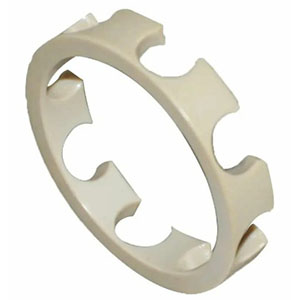
Custom cage designs-Beyond standard polyamide, machined brass, and stamped steel cages, DUHUI offers custom-machined cages from PEEK (polyetheretherketone) for chemical resistance up to 250°C, aluminum bronze for heavy shock loads and abrasive contamination, and carbon-fiber reinforced polymer for ultra-high-speed applications. Cage geometry — including pocket shape, clearance, and guidance method — can be optimized per customer drawing.
Other Thrust Bearing Types
Thrust cylindrical roller bearings are one of several axial bearing families. Depending on load magnitude, speed, alignment requirements, and radial load presence, engineers may select different thrust bearing types. Below is a technical comparison.
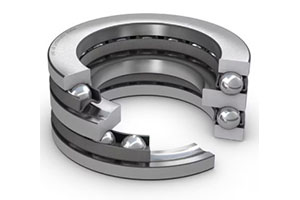
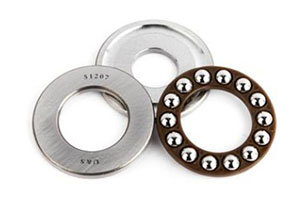
Point contact between balls and raceways results in lower axial load capacity than cylindrical roller bearings of equivalent size. However, thrust ball bearings operate at higher speeds and generate less friction. Suitable for light to moderate axial loads in high-speed applications such as machine tool spindles, light vertical pumps, and electric motor axial positioning.
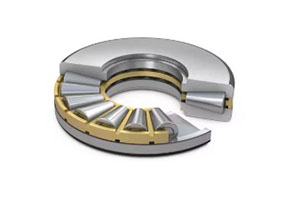
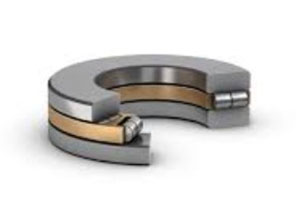
Rollers and raceways are conical, allowing the bearing to support combined axial and radial loads in one direction. Thrust tapered roller bearings are not separable and require precise axial preload adjustment. They generate higher friction than cylindrical designs. Used in screw presses, heavy vehicle kingpins, and mining equipment where radial load cannot be routed to separate bearings.
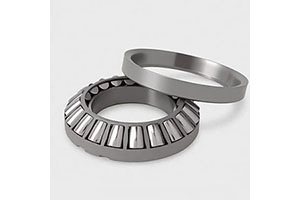
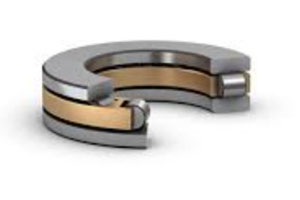
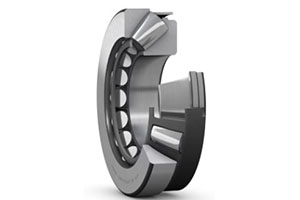
Featuring a spherical raceway on the housing washer, these bearings self-align to compensate for angular misalignment between shaft and housing (typically up to 1.5–2 degrees). They handle heavy axial loads plus some radial load. Speed limits are lower than cylindrical roller bearings. Standard applications include continuous casters, paper machine drying cylinders, and vibrating screens where alignment cannot be guaranteed.
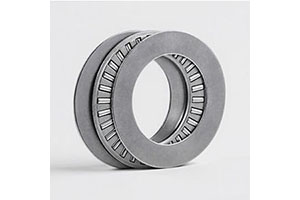
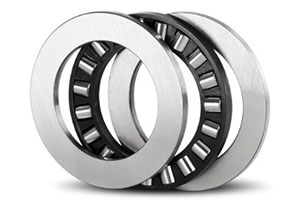
Extremely thin cross-section with long, slender rollers (needles) that provide high load capacity in very limited axial space. Thrust needle bearings are not self-contained — they require hardened and ground raceways on the adjacent shaft and housing components. Commonly used in automotive automatic transmissions, gear pumps, and compact actuators where axial height is critical.
Industry Applications
Thrust cylindrical roller bearings are specified across heavy industries wherever high unidirectional axial loads, compact axial packaging, and separable mounting are priorities. The following sections detail typical equipment and operating conditions by industry sector.

Thrust bearings support the full hydraulic axial load generated by pump impellers or turbine runners. 812 series (single-row) for medium head pumps; 893 or 894 series (double-row) for high-head multistage pumps. Oil bath lubrication with forced circulation for installations exceeding 500 kW.
Used on intermediate shafts and high-speed input shafts to counteract gear reaction thrust forces. 811 series for gearboxes under 200 kW; 812 or 893 series for high-torque reducers in steel rolling mills and cement kiln drives.
Extreme static and dynamic axial loads occur during pressing and extrusion cycles. Double-row 894 series with brass cages and circulating high-viscosity oil are standard. Bearings in these applications see peak loads approaching the static rating C0a with long dwell times.
Massive thrust bearings (89348 or 894 series with bore diameters exceeding 300 mm) absorb propeller thrust ranging from 50 to 500+ kN depending on vessel size. Slow speed operation (typically 100–500 rpm) with oil bath lubrication and periodic axial clearance inspection.
Thrust bearings on backup rolls, work rolls, and continuous casting equipment must withstand extreme shock loads from billet entry and scale buildup. Brass-caged M-series bearings with specially hardened washers (60+ HRC) are mandatory. Oil-air lubrication is common to prevent scale contamination.

Precision-grade (P5 or P4) thrust cylindrical roller bearings provide accurate axial positioning for CNC lead screws and indexing tables. 811 TN series with polyamide cages are preferred for quiet operation and reduced vibration transmission to the workpiece.

Thrust bearings at the discharge end of a screw conveyor counteract the material reaction force from moving bulk solids (grain, cement, coal). Double-row 893 series with grease lubrication and sealing washers are standard for dusty, low-speed environments.
Technical Comparisons
Engineers specifying replacement bearings often need to justify the selection of thrust cylindrical roller bearings over other types. The following articles provide comparative analysis from an aftermarket reliability and dimensional interchange perspective. Each article includes cross-reference tables and application examples.
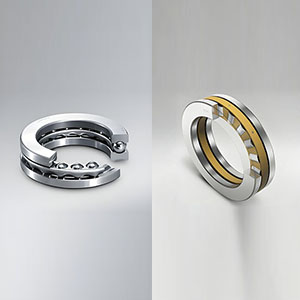
This article compares dynamic load ratings, speed limits, and lubrication requirements between the two types. Thrust cylindrical roller bearings offer 5–8 times higher Ca ratings but require oil lubrication and have lower speed limits. Includes a step-by-step upgrade procedure for converting 512xx ball bearing positions to 812xx cylindrical roller bearings without housing modification.
For more details, please read“Thrust Cylindrical Roller Bearing vs. Thrust Ball Bearing”
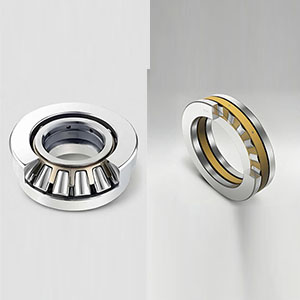
Analysis of axial-only vs. combined axial-radial load support. Thrust cylindrical bearings require separate radial bearings, while tapered designs integrate both functions. Includes calculation examples for hydraulic press applications and a decision flowchart based on available radial space and shaft stiffness.
For more details, please read“Thrust Cylindrical Roller Bearing vs. Thrust Tapered Roller Bearing”
Related Products
The following part numbers represent DUHUI’s most frequently ordered aftermarket thrust cylindrical roller bearings. All dimensions conform to ISO standards, ensuring direct replacement for SKF, FAG, NSK, NTN, and Timken equivalents. Stocked items ship within 24–48 hours. For non-stocked sizes, lead time is typically 2–3 weeks.
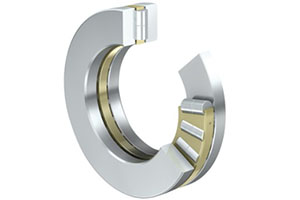
89424 M-Double-row bearing with brass cage, 120×250×78 mm. Dynamic axial load rating 1158 kN, static 3999 kN. Grease speed limit 572 rpm, oil speed limit 1511 rpm. Mass 21.9 kg. Specified for heavy vertical pump thrust bearings, machine tool spindle drives, and oil drilling rig rotary tables.
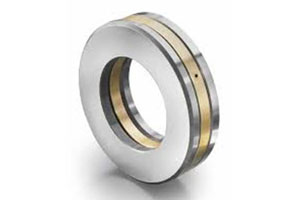
89348 M-Massive double-row bearing, 240×440×122 mm. Weight exceeds 50 kg. Used in marine propulsion thrust blocks for medium-size vessels and heavy industrial gearboxes for steel mill drives. Requires oil circulation lubrication and slow speed operation (under 500 rpm). Special aftermarket stocking item – consult DUHUI for availability.
Common Failure Modes – Symptoms, Root Causes, and Corrective Actions
| Failure mode | Observable symptoms | Root cause analysis | Inspection and correction |
| Washer flatness deviation / out-of-parallel | Localized temperature rise on one side of housing; uneven roller contact marks; premature spalling on one sector of raceway | Housing shoulder or shaft shoulder not ground flat; soft shoulder material compresses under load; cover bolts torqued unevenly | Apply Prussian blue to washer back face; rotate against shoulder and inspect contact pattern (>85% contact required). Remachine shoulder on surface grinder or install hardened backing ring. |
| Roller end / cage rib scoring (lubrication failure) | Bearing temperature above 95°C; visible wear marks on roller ends and cage guide surfaces; oil analysis shows high iron content | Oil viscosity too low at operating temperature; oil level below minimum; blocked oil supply passages or filter | Increase base oil viscosity to ISO VG 220 or 320. Convert from grease to oil circulation. Inspect and clear oil passages. Install flow sight glass for visual verification. |
| Edge loading / roller end spalling | Localized flaking on roller ends and raceway edges; bearing noise increases; vibration spectrum shows multiple harmonics | Shaft-to-housing misalignment exceeding 0.02 mm/m; assembly skew during mounting | Realign shaft and housing using dial indicators. Select bearings with factory-crowned rollers (standard on DUHUI A and E series) to distribute edge stresses. |
| Overload fatigue spalling | Large flakes or pits covering >10% of raceway surface; bearing fails before calculated L10 life | Cyclic axial load exceeds material fatigue limit; bearing under-sized for actual dynamic load spectrum | Recalculate required dynamic rating Ca with actual load cycles and shock factors. Upgrade to next higher series (e.g., 811 → 812 → 893). Consider double-row design if axial space permits. |
Washer Deformation and Flatness Deficiency – Detailed Diagnostic Procedure
Thrust cylindrical roller bearings depend entirely on the flatness and parallelism of their supporting shoulders. Even small deviations — as little as 0.01 mm — cause uneven load distribution, with some rollers carrying the full load while others remain unloaded. This leads to rapid fatigue and overheating. Diagnostic procedure: Remove the bearing and clean all components. Place the shaft washer on a precision surface plate and measure flatness with a dial indicator moving across at least four radial directions. Maximum deviation should not exceed 0.005 mm for bearings under 200 mm bore, or 0.010 mm for larger sizes. For the housing shoulder, apply marking compound to the housing washer back face, install it without rollers, rotate 90 degrees, and remove. The contact pattern should show even compound transfer across the entire back face. If less than 85% contact, the shoulder requires re-machining. For field repairs where disassembly is impractical, selective shimming using precision stainless steel shims can compensate for flatness errors up to 0.05 mm.
Installation and Maintenance Best
Practices
Mounting sequence for separable thrust bearings: (1) Thoroughly clean the shaft, housing bore, and both bearing washers. Remove any burrs or contaminants. (2) Heat the shaft washer to 80–100°C using an induction heater or oil bath. Slide it onto the shaft and press firmly against the shoulder. Never apply force through the rolling elements. (3) Allow the shaft washer to cool, then verify that it does not move axially. (4) Place the roller-and-cage assembly onto the shaft washer, ensuring the cage orientation matches the direction of the axial load (the closed side of the cage faces the load). (5) Insert the housing washer into the housing bore with a loose fit (recommended clearance H7 or js6). The housing washer should be able to rotate slightly by hand. (6) For double-row bearings, apply final torque to housing cover bolts in a cross pattern using a calibrated torque wrench. (7) After mounting, measure axial clearance by moving the shaft axially with a dial indicator against the shaft end. Normal residual axial clearance for most industrial applications is 0.05–0.20 mm. If clearance is outside this range, add or remove shims between the housing washer and housing shoulder.
Lubrication selection and relubrication intervals: Oil lubrication is always preferred for thrust cylindrical roller bearings because oil flows through the roller-raceway contacts, removing heat and flushing away wear debris. For speeds above 1500 rpm or ambient temperatures above 70°C, forced oil circulation or oil jet lubrication is mandatory. If grease must be used (e.g., because of safety or environmental regulations), select a lithium-complex NLGI 2 grease with a base oil viscosity of ISO VG 150–220. Relubricate every 500 operating hours for normal conditions, or every 250 hours for heavy loads or dusty environments. Grease-filled bearings should never exceed 70% of the oil-rated limiting speed.
Axial clearance verification after installation: Thrust cylindrical roller bearings must operate with a small positive axial clearance (end play) to accommodate thermal expansion of the shaft and housing. To measure: mount a dial indicator with the probe contacting the shaft end. Apply a known axial force in the opposite direction of normal thrust — for example, 5–10% of the static load rating — using a hydraulic jack or mechanical press. Record the axial movement. Subtract the calculated thermal expansion (α × L × ΔT, where α ≈ 11.7 × 10⁻⁶ /°C for steel). The resulting residual clearance should fall within the manufacturer’s recommendation. For DUHUI bearings in general industrial service, target 0.05–0.15 mm. For steel mill applications with large temperature swings (ambient to 150°C), target 0.15–0.30 mm.
How to Upgrade from Thrust Ball Bearings to Thrust Cylindrical Roller Bearings – A Practical Guide
Many older machines were originally equipped with thrust ball bearings (511xx, 512xx, or 513xx series) because of their low cost and wide availability. However, field failures under heavy or shock loads often indicate the need for an upgrade to thrust cylindrical roller bearings. The following step-by-step procedure applies to common size conversions.
Step 1 – Verify dimensional interchangeability. Compare the existing thrust ball bearing dimensions (bore d, outer diameter D, height H) with standard 811 or 812 series cylindrical bearings. For example, a 51208 thrust ball bearing has dimensions 40×68×19 mm — exactly matching an 81208 thrust cylindrical roller bearing. A 51112 ball bearing (60×85×17 mm) matches an 81112 TN. DUHUI provides a complete cross-reference table from ball bearing to cylindrical bearing equivalents. In most cases, no housing or shaft modification is required.
Step 2 – Recalculate load and speed parameters. Thrust cylindrical roller bearings typically have dynamic axial load ratings Ca that are 5–8 times higher than a thrust ball bearing of the same envelope. However, the limiting speed of a cylindrical bearing is approximately 60–70% of the ball bearing’s speed rating. Calculate the product n × dm (rpm × pitch diameter in mm). For ball bearings, the safe limit is around 400,000. For cylindrical roller bearings with polyamide cages, the limit is 250,000; with brass cages, up to 350,000. If your n×dm exceeds 350,000, consider whether speed reduction or a switch to oil jet lubrication is feasible.
Step 3 – Modify lubrication system. Thrust ball bearings can often run on grease. Thrust cylindrical roller bearings generally require oil. If the equipment has no oil lubrication system, you have three options: (a) retrofit an oil bath housing (add a sump and filler port); (b) install an oil circulation pump and lines; or (c) accept reduced life with grease and compensate by using a larger bearing. For grease operation, reduce the permissible speed by half and relubricate four times more frequently than the ball bearing schedule.
Step 4 – Upgrade shoulder flatness requirements. Thrust ball bearings tolerate moderate shoulder flatness deviations (0.03–0.05 mm) because the balls can pivot slightly. Thrust cylindrical rollers require flatness better than 0.01 mm for bearings under 150 mm bore, and 0.02 mm for larger sizes. Before installing a cylindrical bearing, measure the shaft shoulder and housing shoulder flatness. If readings exceed these limits, re-grind the shoulders or install hardened and ground backing rings. DUHUI can supply precision-ground backing rings as part of an upgrade kit.
Step 5 – Test and monitor after upgrade. Run the equipment at 25% speed for 30 minutes, then 50% speed for 30 minutes, checking housing temperature every 10 minutes. Then operate at full speed for two hours. The bearing temperature should stabilize below 85°C. Measure vibration levels using a handheld accelerometer; a successful upgrade typically shows a 20–40% reduction in vibration velocity (mm/s rms) compared to the previous ball bearing configuration. Document these baseline measurements for future maintenance comparisons.
DUHUI offers pre-engineered upgrade kits for the most common thrust ball bearing to thrust cylindrical roller bearing conversions. Each kit includes the cylindrical bearing, a matched set of hardened backing rings (if required), and a lubrication adapter fitting. Contact our aftermarket engineering team with your existing bearing part number for a specific recommendation.
Thrust cylindrical roller bearings deliver 5 to 8 times higher dynamic axial load capacity because rollers contact raceways along a line rather than a point. They also provide greater axial stiffness, fully separable components for easier servicing, and superior resistance to shock loads. The trade-offs include lower permissible speeds and a requirement for oil lubrication in most continuous-duty applications.
No. These bearings are designed exclusively for pure axial loads. Any radial load applied will cause rollers to skew, generating excessive heat and leading to rapid cage destruction. Radial loads must be directed to separate radial bearings such as deep groove ball bearings or cylindrical roller bearings mounted elsewhere on the same shaft.
Three standard cage materials: polyamide (TN/TVP) for moderate temperatures up to +120°C and speeds up to 2000 rpm (lowest cost); machined brass (M) for high temperatures up to +300°C and speeds up to 3500 rpm under oil lubrication (highest durability); stamped steel for general-purpose applications where neither extreme temperature nor maximum speed is required. For custom orders, PEEK and aluminum bronze cages are available.
Yes. All DUHUI thrust cylindrical roller bearings conform to ISO 104:2002 and DIN 722-1 dimensional standards. An 81108 TN from DUHUI has identical bore (40 mm), outer diameter (60 mm), and height (13 mm) as the corresponding product from any major brand. Washer flatness, parallelism, and surface roughness also meet ISO tolerances, ensuring drop-in replacement without any housing or shaft modification.
The separable design allows component-by-component assembly. First, press the shaft washer onto the shaft (interference fit) until it seats firmly against the shaft shoulder using a sleeve that contacts only the washer face. Second, place the roller-and-cage assembly onto the shaft washer with correct orientation (cage pocket openings face the axial load direction). Third, insert the housing washer into the housing bore with clearance fit. After assembly, verify axial clearance of 0.05–0.20 mm for normal industrial service.
At high speeds or very low external loads, centrifugal forces can cause rollers to skid instead of roll. This skidding generates heat, damages cage pockets, and degrades lubricant. For oil-lubricated bearings, minimum axial load Famin = 0.005 × C0a (static axial rating). For grease lubrication, Famin = 0.01 × C0a. If the application’s inherent axial load is lower, add a preload spring or belleville washer stack.
Oil lubrication is strongly preferred. Oil flows through roller-raceway contacts, removes heat, and flushes away wear debris. Use oil bath up to 1500 rpm, circulating oil from 1500–3000 rpm, and oil jet above 3000 rpm or high ambient temperatures. Grease is acceptable only for slow speed (under 500 rpm) and low duty cycles. If grease is used, select a high-viscosity (ISO VG 220) lithium complex NLGI 2 grease and relubricate every 500 hours.
Typical applications include: vertical pump thrust bearings (water, chemical, oil & gas); heavy-duty industrial gearboxes (steel mills, cement plants); hydraulic press main cylinders and extrusion presses; marine propulsion thrust blocks; steel mill roll neck thrust positions; screw conveyor drive ends; and machine tool lead screw supports. Each industry favors specific series — 812 or 893 for pumps, 894 for hydraulic presses, and 893-M for continuous casting machines.
Three frequent failure modes: (1) Raceway deformation due to insufficient shoulder flatness — symptoms include localized overheating and uneven contact marks. Diagnose with Prussian blue contact pattern. (2) Roller end rubbing from lubrication starvation — symptoms include temperature above 95°C and visible galling. Diagnose by checking oil level and viscosity. (3) Edge loading from shaft misalignment — symptoms include spalling on roller ends and raceway edges. Diagnose by measuring alignment with dial indicators.
No. Thrust cylindrical roller bearings have zero self-aligning capability. Angular misalignment exceeding 0.02 mm per meter of shaft length causes edge loading, leading to micropitting, spalling, and premature failure. If angular misalignment is unavoidable, realign the equipment or select thrust spherical roller bearings, which accommodate up to 1.5–2 degrees of misalignment.

