Quick Answer: In drawn cup vs machined needle roller bearings, the drawn cup uses a thin stamped outer ring that is pressed into a rigid housing and reaches final geometry after installation. The machined type uses a solid machined ring, so it holds its shape and offers more lubrication, sealing and inner-ring options. Both are radial bearings; choose by radial space, housing stiffness, shaft raceway, load, speed and axial displacement, then verify C, C0 and limiting speed for the parts.
Drawn cup vs machined needle roller bearings is a construction choice before it is a part-number choice. Both families use needle rollers to support radial load in a compact envelope, but they form their running geometry in different ways. That difference changes housing fit, shaft preparation, lubrication, sealing and the amount of axial movement the arrangement can accept.
The practical question is usually not which family sounds stronger. It is which family fits the housing, shaft and duty cycle without hiding a constraint. Use the comparison as a screening guide, then verify the selected series against the manufacturer dimension table.
Terminology and Standards: What Drawn Cup and Machined Actually Mean
Bearing catalogs use drawn cup and machined as ring-construction terms. They are not quality grades, and they do not by themselves define load capacity or speed capability.
Drawn cup needle roller bearing
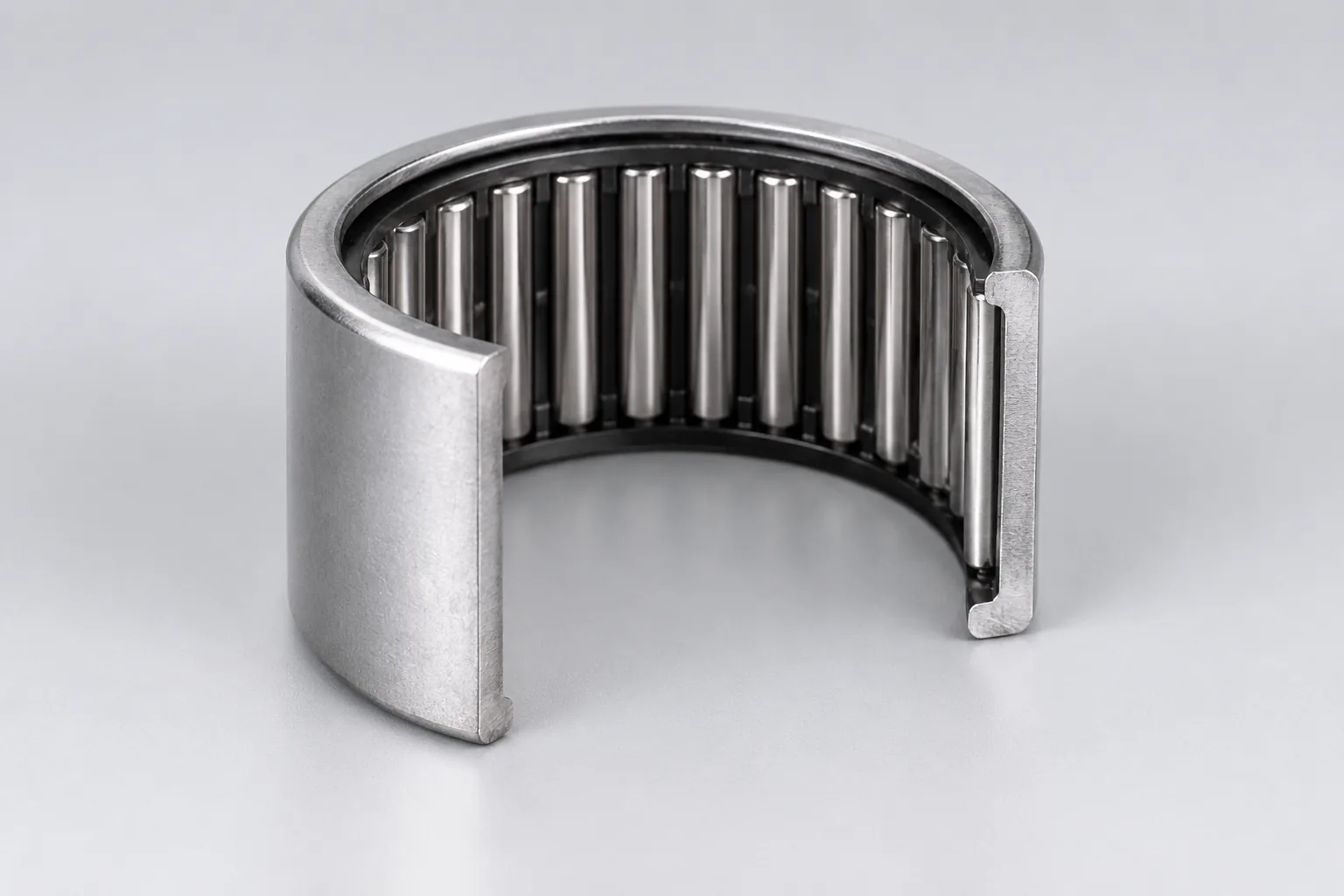
A drawn cup needle roller bearing has a thin-walled outer ring formed by drawing or stamping sheet steel. The usual unit combines that drawn outer ring with needle rollers and a cage. Standard products are often supplied without an inner ring, so the shaft can serve as the raceway or a separate inner ring can be added.
Drawn cup bearings are available open at both ends or closed at one end. A closed-end type can help retain lubricant and exclude contaminants at the shaft end. Most single-row drawn cup bearings have no lubrication hole. Final dimensional and geometric accuracy is reached after the bearing is pressed into a suitable housing bore.
Drawn cup bearings without inner rings are covered by ISO 3245:2023, published in January 2023. It is the fifth edition and runs to 15 pages, covering boundary dimensions, preferred sizes, chamfers, closed-end thickness and tolerances for the needle set bore and outer ring width.
Machined needle roller bearing
A machined needle roller bearing uses an outer ring, or inner and outer rings, machined from solid steel. The ring is self-supporting: its geometry is formed during manufacture and does not depend on the housing bore to be rounded. Machined series are available with or without inner rings. A no-inner-ring version allows a larger shaft diameter, which can raise shaft stiffness while keeping the radial envelope compact.
Common outer-ring features include a lubrication groove and at least one lubrication hole. Open, single-sealed and double-sealed versions are available. Single-row and double-row designs exist, and some double-row designs use two needle cage assemblies.
Machined ring needle roller bearings are covered by ISO 1206:2023, published in January 2023. It is the fifth edition and runs to 21 pages, covering complete bearings and bearings without inner rings, with boundary dimensions and normal-class dimensional and geometrical tolerances. An amendment, ISO 1206:2023/Amd 1:2024, also exists.
Standards and accuracy references to check
Separate dimensional standards from accuracy standards. A dimensional standard tells you the boundary envelope; an accuracy standard tells you how much form, position and runout variation is permitted. One does not replace the other.
Drawn cup dimensional and geometric accuracy is referenced to DIN 618 rather than ISO 492. Do not apply ISO 492 automatically to a drawn cup outer ring. For machined rings, ISO 1206 covers the bearing family, including complete bearings and bearings without inner rings. For either family, cite the edition and any amendment that applies to the selected product and market.
Finally, read the suffix system carefully. A machined brass cage suffix, commonly M, is not the same thing as a machined-ring bearing. Cage and seal suffixes describe internal features, not the outer-ring construction.
Structural Comparison at a Glance
The table compares the usual single-row forms. Special or double-row variants can differ, so confirm the exact series.
| Feature | Drawn cup | Machined ring |
|---|---|---|
| Outer ring | Thin steel ring formed by drawing or stamping | Solid steel ring machined from bar or tube stock |
| Radial section | Extremely small radial section | Usually thicker, so it needs more radial space |
| Ring stiffness | Thin wall; relies on a rigid housing for support | Higher ring stiffness in the bearing itself |
| Final geometry | Reached after a correct interference press fit | Formed during manufacture |
| Inner ring | Standards are mostly without an inner ring; an IR or LR ring can be added | Available with or without an inner ring |
| Closure and sealing | Open at both ends or closed at one end | Open, single-sealed or double-sealed versions |
| Lubrication | Most single-row types have no lubrication hole; some double-row ZW versions have holes in the outer ring | Outer ring commonly has a lubrication groove and at least one hole |
The radial-section difference is the first constraint to check. A drawn cup can fit where a machined ring cannot, but that advantage depends on a housing that can support the thin wall. A machined ring uses more radial space but brings its own stiffness and often more configuration choices.
Fit, Accuracy, and Housing Support
The two families reach final running geometry in different places. That changes what the housing must do and how the bearing should be installed.
Drawn cup: interference fit and final geometry
Drawn cup bearings are designed for an interference press fit into the housing bore. The thin outer ring may be slightly out of round before mounting. The specified housing bore and press fit form the final dimensions and geometric accuracy.
The housing must provide adequate rigid support. Installation should use a suitable mounting mandrel, and the bearing must not be pressed in at an angle. A damaged or insufficiently rigid housing can prevent the bearing from reaching its intended running geometry, even if the bearing itself is correct.
Use a housing bore and tolerance designed for the specific drawn cup series. Do not treat the bearing as a stand-alone round ring before installation.
Machined ring: self-supported geometry and housing fit
A machined ring has a stiff, dimensionally stable solid outer ring. It does not depend on the housing to correct roundness. Housing fit must still be selected from load direction, load magnitude and required rotational accuracy.
A machined ring does not remove the need to check housing material, thermal expansion and bore tolerance. The ring is stiffer, but the housing interface still carries the load path.
Typical fits and material effects
Published fit tables for common HK and BK drawn cup series give a useful starting point:
- Steel housing bore: N6 (N7).
- Light-alloy housing bore: R6 (R7).
- Shaft without an inner ring: h5 (h6).
- Shaft with an inner ring: k5 (j6).
These are series-level recommendations for the referenced HK and BK range. Other series can differ, so final values must come from the selected product catalog. Light-alloy housings can lose interference as temperature rises, so account for thermal expansion during fit selection. High-temperature or light-alloy applications need a thermal-expansion check even when a standard fit table is followed.
Shaft and Raceway Requirements
If the needle rollers run directly on the shaft, the shaft surface must be hardened and ground as a raceway. This applies to drawn cup bearings used without an inner ring and to machined bearings used without an inner ring.
If the shaft cannot serve as a raceway, use an IR or LR inner ring with a drawn cup bearing, or select a machined bearing with an inner ring. A machined no-inner-ring bearing allows a larger shaft diameter, which can increase shaft stiffness while keeping the radial envelope compact.
Do not assume a general commercial shaft surface is acceptable just because the bearing has no inner ring. With an inner ring, the shaft is no longer the rolling raceway, but shaft fit and geometry still matter.
Load, Speed, and Rigidity: How to Compare Fairly
Both families are radial needle roller bearings. Their common advantage is a high radial load capacity in a small radial section. The construction label alone does not tell you which is stronger or faster.
Radial load capacity
Compare the basic dynamic radial load rating C and the basic static radial load rating C0 for the same boundary dimensions and internal configuration. A category label is not a load rating. Full-complement designs such as HN use more needles and can increase load capacity, while caged designs generally support higher speed.
Use the manufacturer data for final sizing, and account for load direction, shock and required life. The RNA5917 example is a machined no-inner-ring bearing with Fw 100 mm, outer diameter 120 mm, width 46 mm, C 137 kN and C0 290 kN. Those values apply only to that part number and must not be treated as representative of all machined bearings.
Speed limits
Check limiting speed for grease and oil lubrication separately. Caged drawn cup bearings are generally preferred over full-complement HN versions when higher speed is required. Machined series can offer single-row and double-row configurations, so verify the exact speed rating by part number and lubrication method.
The same RNA5917 example lists a grease limiting speed of 2,700 r/min and an oil limiting speed of 4,000 r/min, with an operating temperature range of -40 to 120 °C. These are part-specific catalog values. Speed ratings depend on lubrication, load, cooling and the exact part, so catalog values are reference conditions, not a guarantee for every application.
Rigidity, alignment, and axial displacement
Drawn cup radial stiffness is strongly affected by the housing bore and housing stiffness. The thin outer ring is not a standalone rigid ring. A machined ring provides a stiffer ring structure, but it still requires correct housing fit and alignment.
Alignment remains a design requirement for both types. A drawn cup can follow a correct housing bore, but a distorted housing transfers distortion to the raceway. A machined ring is stiffer, but it does not correct a misaligned housing.
Machined needle roller bearings are non-locating bearings. They permit axial shaft displacement relative to the housing and must not be used as axial locating bearings. Where axial location or axial load is required, add a separate thrust bearing or select a combined bearing arrangement. Drawn cup products can also be combined with axial bearings. Do not use either standard radial type as a fixed axial locating bearing without a separate axial component.
Common Suffixes and Configuration Options
Suffix tables help you specify the right variant, but prefixes and suffixes can vary by manufacturer. Group the codes by family so you do not mix drawn cup and machined-ring designations.
Drawn cup designations
- HK: open at both ends, with a cage.
- BK: closed at one end.
- HN: full complement needle rollers; higher load capability but lower speed capability than caged versions.
- ZW: double-row design. Double-row drawn cup versions can have lubrication holes in the outer ring.
Suffix availability depends on size and manufacturer. Confirm the exact code before ordering.
Machined ring designations
- NK, NKS, RNA48, RNA49, RNA69: without an inner ring.
- NKI, NA48, NA49, NA69: with an inner ring.
- RS or RSR: single-side seal.
- 2RS or 2RSR: double-side seal.
- ZW: double-row design.
ZW can appear in both families, so read it together with the prefix. Some machined double-row series, such as RNA69, use two needle cage assemblies when Fw is above 40 mm. Confirm sealing and internal design by the exact catalog number.
Cage and seal suffixes are not ring-type suffixes
TN indicates a roller-guided polyamide cage; M indicates a roller-guided machined brass cage. A machined brass cage suffix M does not make the bearing a machined-ring needle roller bearing. Seal suffixes describe sealing, not outer-ring construction. Manufacturer-specific suffix systems may differ, so verify the current catalog.
Selection Guide: When to Choose Drawn Cup vs Machined
Use application constraints rather than a generic ranking. The right choice is the one that satisfies the housing, shaft, load, speed and axial-location requirements with the least hidden risk.
Choose drawn cup when
- Radial installation space is the primary constraint and an extremely thin bearing section is needed.
- The housing can provide a rigid, correct bore for interference press fitting.
- Simple press installation and low component cost are priorities.
- The shaft can be hardened and ground as a raceway, or an IR or LR inner ring can be accommodated.
- No lubrication hole, seal or wide configuration range is required; open or BK closed-end types are sufficient.
The housing material and bore tolerance must be suitable for the required interference fit. A drawn cup is a poor match for a soft, distorted or weakly supported housing.
Choose machined when
- A dimensionally stable, self-supporting solid outer ring is preferred.
- The design needs an outer-ring lubrication groove and lubrication hole.
- The application needs single- or double-sealed versions, with or without an inner ring, or a wider range of size and load configurations.
- The bearing is used as a non-locating radial bearing and axial displacement must be allowed.
- A larger shaft is desired by using a no-inner-ring machined bearing to increase shaft stiffness.
Design checks before finalizing
- Verify housing bore tolerance, housing material, required interference and thermal expansion.
- Verify shaft hardness, grinding, diameter tolerance and whether an inner ring is needed.
- Compare C, C0 and limiting speed for the exact candidate parts at the same boundary dimensions.
- Confirm lubrication method, lubrication hole or groove need, sealing and axial location.
- Confirm installation tooling, and avoid pressing a drawn cup bearing in at an angle.
Complete these checks against the current manufacturer catalog and the application duty cycle. A dimensionally similar part is not automatically a safe substitute.
Pre-Order Verification Checklist
Before ordering, confirm the complete bearing identity and the surrounding design:
- Confirm the bearing family and exact suffix, not just the nominal bore size.
- Confirm the housing fit and shaft fit from the selected series table.
- Confirm whether the shaft is the raceway or an inner ring is required.
- Confirm the required load rating, speed rating, lubrication and sealing.
- Confirm axial displacement or location requirements and whether a separate thrust bearing is needed.
- Record the applicable standard edition and any customer-specific requirement.
Conclusion
The drawn cup vs machined needle roller bearings decision comes down to how the outer ring gets its geometry and how much support it needs from the housing. A drawn cup is the compact, press-fit choice when the housing is rigid and the shaft raceway is properly prepared. A machined ring is the more self-supporting choice when you need a stable solid ring, lubrication features, sealing options, inner-ring configurations or a wider selection range.
Neither family is automatically stronger or faster. Compare C, C0 and limiting speed for the exact candidate parts, then check housing fit, shaft hardness, lubrication, sealing and axial displacement. For a safe next step, take the selected series table and verify the bore, shaft, load and speed against the real duty cycle before releasing the order.
FAQs
Q1: Are drawn cup and machined needle roller bearings interchangeable?
A: Not generally as direct drop-in replacements. Housing fit, outer-ring stiffness, shaft raceway, inner-ring option, lubrication, sealing and axial displacement behavior can differ. Check boundary dimensions and the complete surrounding design before substituting one family for the other.
Q2: Which type has higher load capacity?
A: There is no category-wide answer. Compare C and C0 for the same boundary dimensions and internal design. Full-complement HN drawn cup versions can increase load capacity, but they reduce speed capability compared with caged versions.
Q3: Do drawn cup bearings require a hardened and ground shaft?
A: Yes, if the needle rollers run directly on the shaft without an inner ring. If an IR or LR inner ring is used, the shaft is not the direct raceway, but shaft fit and geometry still must be controlled.
Q4: Can machined needle roller bearings carry axial loads?
A: Standard machined needle roller bearings are non-locating radial bearings and should not be used for axial location. Use a thrust bearing or a combined needle roller bearing when axial load or axial positioning is required.
Q5: Why is drawn cup accuracy described after mounting?
A: The thin drawn outer ring may not be fully round before installation. A correct interference fit in a rigid housing bore forms the final dimensions and geometric accuracy.
Q6: Does machined mean a machined brass cage?
A: No. Machined describes the bearing ring construction. A machined brass cage is indicated by a cage suffix such as M and is a separate feature.