Quick Answer: Mounted bearings are ready-to-mount units that combine an insert bearing with a housing, so a shaft can be supported with fewer assembly steps. Common types include pillow block, flange, take-up, hanger, and cartridge units. Their main advantages are simple installation, self-alignment, sealed and pre-lubricated designs, and easy replacement. They are widely used on conveyors, fans, agricultural equipment, food-processing lines, and general industrial drives.
A mounted bearing combines a bearing insert and a housing in one ready-to-install assembly. Housing shape, shaft-locking method, sealing, and material determine where the unit fits, how it is maintained, and whether it suits a given load and environment.
What Are Mounted Bearings?
A mounted bearing is a ready-to-mount bearing unit made from an insert bearing fitted into a housing. The housing supports and locates the bearing, while the unit bolts or fits to a machine frame so the shaft can rotate with less assembly work.
The insert usually has a spherical outside diameter that matches a spherical bore in the housing. This pair creates a self-aligning effect that helps the unit tolerate small angular misalignment between the shaft and mounting surface. The allowance is limited and does not replace accurate alignment.
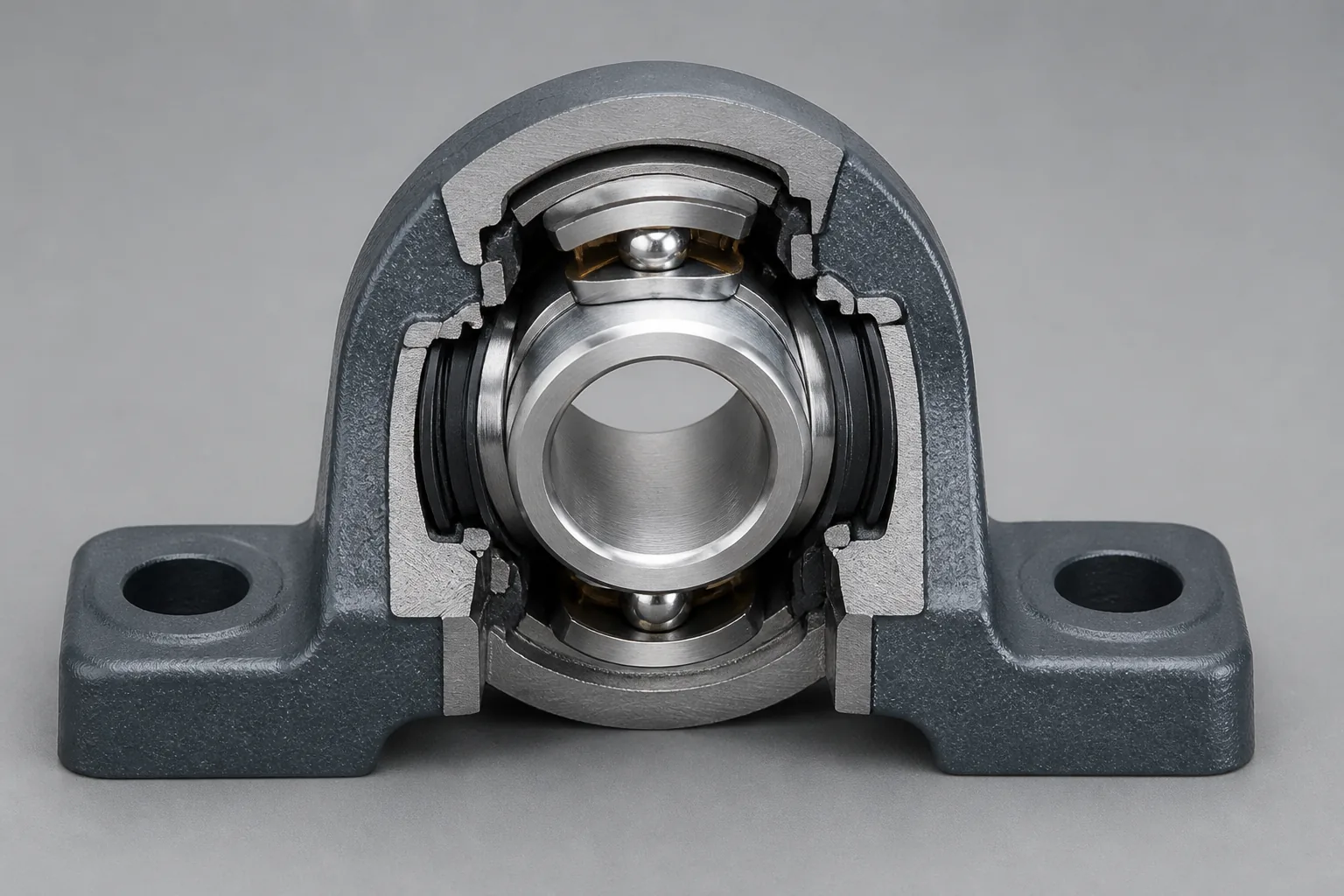
Many units are supplied pre-lubricated and sealed, which simplifies commissioning and routine maintenance. Shaft locking can use a set screw, eccentric locking collar, concentric collar, or adapter sleeve, and the choice affects vibration tolerance, shaft condition, and removal.
Mounted bearings are generally a poor fit for very high axial loads or very high precision requirements. In those cases, a separate bearing and housing arrangement may be more appropriate.
Mounted Bearing Types by Housing Design
Housing design is a practical way to narrow a mounted bearing choice because it sets the mounting orientation. A unit that bolts to a horizontal surface solves a different problem from one that mounts to a vertical face or slides in a tension frame. Insert bearings can be paired with different housings to create these unit types.
Pillow Block Bearings (UCP, SUC)
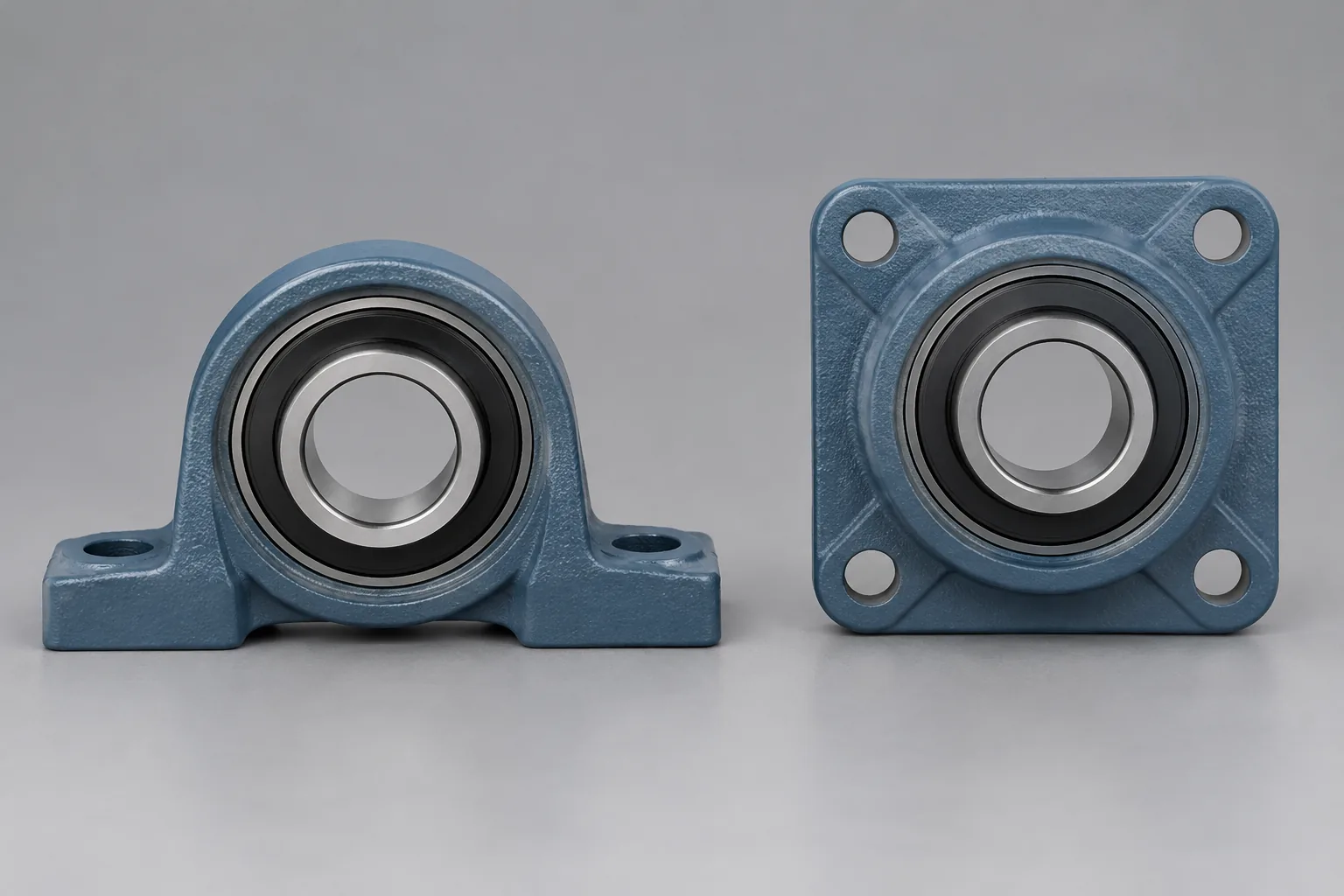
Pillow block bearings are surface-mounted units with a two-bolt base. They support a shaft running parallel to the mounting surface and are common on conveyors, fans, and general machinery. Housings are available in cast iron, ductile iron, and thermoplastic, so the same basic unit can be matched to different duty and environment needs.
Flange Bearings (UCF, UCFL, UCFC)
Flange bearings mount to a machine face or wall and are made with two-bolt, three-bolt, or four-bolt flanges. They suit shafts that run perpendicular to the mounting surface. Common uses include food processing, packaging, and material handling equipment, where a compact face mounting is more practical than a base-mounted pillow block.
Take-Up Bearings (UCT)
Take-up bearings are designed for belt or chain tensioning in a slide frame. The housing moves in the frame so the shaft position can be adjusted to maintain tension. They are frequently used on conveyors and agricultural equipment where belt or chain slack must be corrected over time.
Hanger Bearings (UCHA)
Hanger bearings suspend a shaft from an overhead structure. They appear in screw conveyors, augers, and ceiling-mounted shaft runs. The housing shape provides a mounting thread or bracket so the unit can hang from a support while still locating the shaft.
Cartridge Bearings (UCB)
Cartridge bearings insert into a bored housing or frame for a compact mounting arrangement. They provide a simple way to install a bearing in a machined cavity and are useful where space is limited and a flange or base is not practical.
Specialty and Other Housing Types
Other housing types include oval flange, three-bolt flange, pressed steel, and stainless steel or thermoplastic units. These designs address washdown, corrosion resistance, light-duty equipment, or a mounting pattern that standard pillow block and flange units cannot match.
Shaft Locking Methods and Their Uses
Shaft locking secures the insert to the shaft and influences vibration behavior, shaft condition, and removal. Select the method by load, speed, vibration, and access to the shaft.
- Set screw locking is simple and common for light to moderate loads, but the screw may mar the shaft and is not ideal for frequent disassembly or high vibration.
- Eccentric locking collar suits vibration and moderate loads. It usually requires the shaft to rotate in the intended direction for the collar to stay tight.
- Concentric locking collar provides better balance and higher speed capability than a set-screw design.
- Adapter sleeve allows mounting on larger shafts and can make removal easier, but it adds components and must be matched to the shaft and bearing bore.
Key Advantages of Mounted Bearings
Mounted bearings offer practical advantages in general industrial machinery:
- Ready-to-mount design reduces assembly time and alignment effort.
- Self-aligning capability accommodates small shaft and mounting misalignment.
- Sealed, pre-lubricated units simplify maintenance when the duty matches the seal and lubricant.
- Easy replacement helps reduce downtime when a spare unit is available.
- Cost-effective construction compared with many custom bearing and housing assemblies.
- Wide availability across housing materials and configurations.
These advantages are strongest in general industrial applications with moderate loads and speeds. High-precision, high-axial-load, or extreme-temperature applications may need a separate bearing and housing solution instead.
Materials and Sealing Options
Housing material and sealing determine how well a unit handles dust, moisture, cleaning chemicals, and temperature. Common housing materials are cast iron, ductile iron, thermoplastic, and stainless steel. Insert bearings are commonly made from chrome steel or stainless steel.
Seal options include contact lip seals, labyrinth seals, and felt seals. Lubrication options include grease, solid lubricants, and relubricatable designs. Food processing and washdown environments often call for stainless steel or thermoplastic housings with seals suited to the cleaning method.
Common Applications and Uses
Mounted bearings appear wherever a rotating shaft needs a supported, replaceable bearing point. Typical uses include:
- Conveyors and material handling equipment
- Agricultural machinery such as combines, planters, and augers
- Food and beverage processing equipment
- Mining, quarrying, and aggregate equipment
- HVAC fans and air-handling units
- Packaging and textile machinery
- Automotive assembly and general industrial drives
The application changes the priority among sealing, housing material, locking method, and maintenance access. A washdown line and a dusty aggregate conveyor may use the same basic housing style but need different protection and inspection routines.
How to Select Mounted Bearings
Select a mounted bearing by matching the unit to the shaft, load, environment, and mounting space. A practical sequence is:
- Determine load magnitude and direction, including radial and axial components.
- Confirm shaft size, speed, and expected misalignment.
- Assess dust, moisture, chemicals, temperature, and washdown exposure.
- Choose the housing type from the mounting orientation and available space.
- Select the locking method and the seal and lubrication options.
- Review maintenance access and replacement intervals.
High axial loads may require a different bearing design or additional thrust support. Extreme temperatures may require special lubricants, seals, or housing materials. Vertical shaft applications may need specific housing styles or thrust handling rather than a standard horizontal-shaft unit.
Installation and Maintenance Best Practices
Installation quality affects noise, seal life, and locking reliability. Follow the unit specification for torque and clearance, and use these general steps:
- Clean the shaft and housing before mounting.
- Check shaft tolerance and surface finish against the unit requirement.
- Use proper tools and avoid damaging seals during installation.
- Align the unit and tighten the locking device to specification.
- Lubricate according to the application and inspect periodically for seal wear, vibration, and temperature rise.
If a unit runs hot, becomes noisy, or shows shaft movement, stop and inspect the locking device, seal, lubrication, and alignment before the bearing damages the shaft.
Mounted Bearings vs. Separate Bearing and Housing
Mounted bearings and separate bearing-and-housing arrangements solve the same basic support task with different trade-offs.
- Mounted units reduce assembly time and simplify alignment and replacement.
- Separate arrangements can offer higher load capacity and precision when the housing and bearing are selected as a system.
- Mounted units are generally more cost-effective for standard industrial applications with moderate loads.
- Separate arrangements may be preferred for special loads, high speeds, or unique mounting constraints.
Choose mounted units for standard moderate-load applications where easy replacement matters. Separate bearings may be required for high axial loads, high precision, or very large shaft diameters.
Conclusion
Mounted bearings are a practical choice when a shaft needs a supported, replaceable bearing point without a custom housing assembly. The main types – pillow block, flange, take-up, hanger, cartridge, and specialty housings – differ mainly in mounting orientation and application fit. Their advantages come from ready-to-mount construction, self-alignment, sealed lubrication, and simple replacement, but those advantages depend on correct load, speed, environment, and locking-method selection.
Before ordering, confirm shaft size, load direction, mounting orientation, washdown or contamination exposure, and maintenance access. Then match the housing material, seal, lubricant, and locking device to the duty. For high axial loads, high precision, or extreme temperatures, compare a mounted unit with a separate bearing and housing arrangement rather than forcing one design beyond its limits.
FAQs
Q1: What is the difference between a pillow block and a flange bearing?
A: A pillow block mounts on a surface with its base and supports a shaft running parallel to that surface. A flange bearing mounts to a machine face or wall and supports a shaft running perpendicular to that face. The choice depends on mounting orientation and available space, not on one type being universally stronger.
Q2: Which locking method should I use for a vibrating application?
A: An eccentric locking collar is commonly selected for vibration and moderate loads because it is designed to hold under that condition, but check its required rotation direction. A concentric collar can be a better choice when balance or higher speed matters. Set screws are less suitable for high vibration because they can loosen or damage the shaft.
Q3: Can mounted bearings handle axial loads?
A: Mounted bearings can carry some axial load, but their main role is radial support, and large axial loads may exceed the insert and housing design. For significant thrust, use a bearing arrangement with explicit axial capacity or add thrust support. Confirm the load direction with the unit specification before ordering.
Q4: How often should mounted bearings be relubricated?
A: There is no single interval for all mounted bearings. Relubrication depends on the bearing unit, speed, load, temperature, contamination, seal type, and lubricant. Follow the specification for the exact unit and operating condition, and inspect more often where dust, moisture, or washdown is present.
Q5: What housing material is best for washdown environments?
A: Stainless steel or thermoplastic housings with suitable seals are common choices for washdown because they resist moisture and cleaning exposure. The right choice also depends on chemical compatibility, temperature, mechanical load, and the cleaning method. Confirm these details for the specific unit rather than selecting by material name alone.