How do mechanical systems manage axial loads while maintaining rotational precision? Thrust ball bearings provide the answer—they are specialized rolling-element bearings engineered to support axial loads parallel to the shaft axis, ensuring stable operation across automotive, industrial, and aerospace applications.
What Are Thrust Ball Bearings?
Thrust ball bearings are designed specifically to handle axial (thrust) loads during rotational motion. Unlike radial bearings that support forces perpendicular to the shaft, thrust ball bearings excel at carrying loads parallel to the axis of rotation. They consist of two washer-shaped rings—a shaft washer attached to the rotating shaft and a housing washer mounted in the stationary housing—with a set of precision balls positioned between them. A cage or retainer maintains proper ball spacing and alignment during operation.
These bearings are not designed to accommodate radial loads. When used on horizontal shafts, attention must be paid to the clearance between the shaft washer and the housing washer to maintain proper operation.
How Do Thrust Ball Bearings Work
When an axial force is applied to a thrust ball bearing, the force transmits through the balls from one washer to the other. As the balls roll along the grooved raceways, friction is minimized while the axial load is effectively supported. The load-carrying capacity is influenced by factors including the number and size of balls, the contact angle, and the material properties of the bearing components.
Thrust ball bearings are typically available in two configurations: flat seat type and aligning seat type. Aligning seat washers incorporate spherical surfaces that help compensate for minor mounting errors, reducing the impact of installation inaccuracies on bearing performance.
Components of Thrust Ball Bearings
Understanding the key components of thrust ball bearings helps in selecting and maintaining the right bearing for a given application.
The spherical rolling elements—commonly referred to as balls—are the primary load-carrying components within the bearing. Their spherical shape enables rolling motion between the washers with low friction, making thrust ball bearings suitable for applications requiring moderate speeds and axial loads. The size, number, and material quality of the balls directly affect load capacity and operational life.
Raceways
Thrust ball bearings possess two ring-like raceways: the shaft washer and the housing washer. Both washers feature grooves that guide the balls during rotation. The shaft washer attaches to the rotating shaft, while the housing washer remains stationary within the bearing housing. The precision of these raceway grooves determines the smoothness of ball movement and the efficiency of axial load transmission.
Cage or Retainer
The cage holds the balls in position while allowing them to move freely along the raceways. Typically manufactured from steel or brass, the cage prevents ball-to-ball contact, reduces friction, and ensures uniform load distribution across all rolling elements. A properly designed cage is essential for maintaining ball alignment and preventing premature wear.
Unidirectional vs. Bidirectional Thrust Ball Bearings
Thrust ball bearings are categorized by the direction of axial loads they can support.
Unidirectional Thrust Ball Bearings
Unidirectional thrust ball bearings can accommodate axial loads in one direction only. They consist of a single row of balls positioned between two washers—one shaft washer and one housing washer. The bearing restricts axial displacement in one direction while allowing free movement in the opposite direction.
Applications include vertical shaft supports, printer peripheral equipment, ball screw support sections, and automatic guided vehicles (AGVs).
Bidirectional Thrust Ball Bearings
Bidirectional thrust ball bearings can withstand axial loads in both directions. These bearings feature three washers—one central shaft washer sandwiched between two housing washers—with two rows of balls and two cages. This design enables the bearing to limit axial displacement in both directions.
Applications include vacuum pumps, disc hubs in agricultural machinery, compressors, press machines, and clutch breakers. Bidirectional thrust ball bearings are separable bearings, meaning the components can be disassembled independently, simplifying installation and maintenance.
Ball Thrust Bearings vs. Needle Roller Thrust Bearings
Ball thrust bearings and needle roller thrust bearings serve the same fundamental purpose of handling axial loads, but their design differences make each suitable for distinct operating conditions.
Needle Roller Thrust Bearings
Needle roller thrust bearings utilize cylindrical rollers as rolling elements. The high number of small-diameter rollers provides a larger contact surface area between the rolling elements and the raceways, enabling the bearing to support significantly higher axial loads within a compact radial space.
Key features:
- High load-carrying capacity in a small radial space
- Suitable for applications with limited axial space
- Ideal for low-speed applications requiring high axial load capacity
- Roller thrust bearings may exhibit lower contact stress due to larger contact surface area
Ball Thrust Bearings
Ball thrust bearings use spherical balls as rolling elements. The point contact between balls and raceways reduces friction, allowing these bearings to operate at higher speeds than their roller counterparts.
Key features:
- Suitable for higher-speed applications due to lower friction
- Typically used where moderate axial loads are expected
- Offer precise axial load handling with reduced wear
- More suitable for applications requiring lower friction at moderate speeds
Key Differences
| Feature | Needle Roller Thrust Bearings | Ball Thrust Bearings |
|---|---|---|
| Rolling elements | Cylindrical rollers | Spherical balls |
| Load capacity | Higher axial loads | Moderate axial loads |
| Friction and speed | Higher friction; suited for low-speed | Lower friction; suited for higher-speed |
| Contact surface | Line contact | Point contact |
| Radial space requirement | Minimal (thin profile) | Moderate |
| Typical applications | Automotive transmissions, compact gearboxes | Machine tool spindles, rotary tables, clutches |
Roller thrust bearings can support significantly larger thrust loads than ball thrust bearings, which is why they are commonly found in automotive transmissions supporting helical gears. Conversely, ball thrust bearings excel in applications where moderate axial loads and higher rotational speeds are required.
Applications of Thrust Ball Bearings
Thrust ball bearings are found across multiple industries where axial load management is essential for reliable operation.
Automotive. In automotive transmission systems, clutches, and differentials, thrust ball bearings handle the axial forces generated by helical gears and clutch engagement mechanisms. Forward gears in modern car gearboxes use helical gears which create axial forces that must be managed by thrust bearings.
Industrial Machinery. Thrust ball bearings are used in machine tool spindles, rotary tables, compressors, pumps, and press machines. They provide precise axial positioning while allowing smooth rotational movement.
Aerospace. Aircraft engines, control systems, and satellite positioning equipment rely on thrust ball bearings for high-speed operation with reliable axial load support. The aerospace industry often requires specialized materials such as stainless steel or ceramic hybrids to withstand extreme temperatures and corrosive environments.
Other applications include marine propulsion systems, wind turbines, robotics, and medical equipment where precise axial load control is critical.
Installation Guide for Thrust Ball Bearings
Proper installation is essential for achieving optimal performance and service life from thrust ball bearings.
Step 1: Preparation. Ensure the work area is clean and free of debris. Thoroughly clean the bearing housing and shaft to remove any contaminants that could affect bearing performance. Inspect the bearing for any signs of damage or defects on the raceways, balls, and washers.
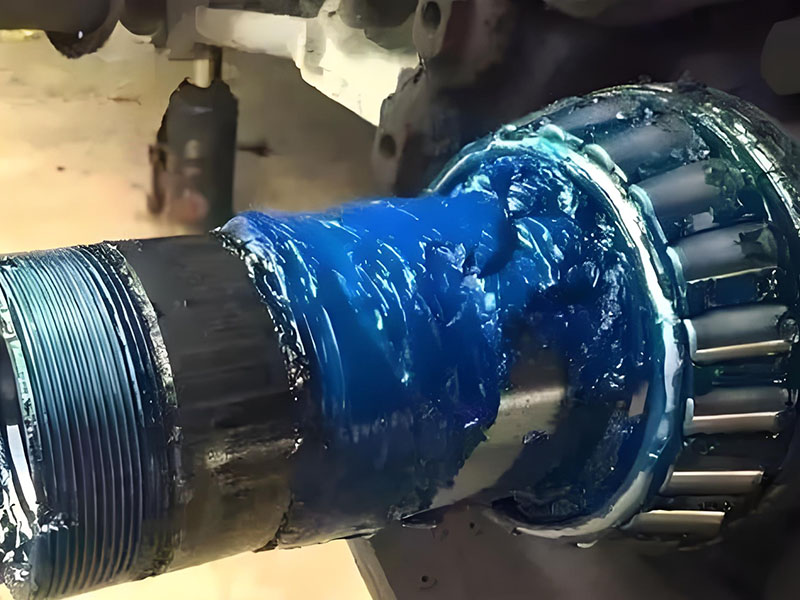
Step 2: Lubrication before installation. Apply an appropriate amount of lubricant evenly across the raceways and balls according to the bearing manufacturer’s recommendations. Use the correct type and quantity of lubricant—grease for most applications, or oil for high-speed or high-temperature conditions. Over-greasing can lead to overheating during operation.
Step 3: Orient the bearing correctly. For unidirectional thrust ball bearings, distinguish between the tight ring (shaft washer) and the loose ring (housing washer). The tight ring (shaft washer) has a smaller bore diameter and should be mounted on the rotating shaft. The loose ring (housing washer) has a larger bore diameter and should be secured in the stationary housing. For bidirectional bearings, the central shaft washer fits onto the shaft, while the two housing washers are positioned on each side against the stationary components.
Step 4: Position the bearing. Carefully place the thrust ball bearing into the designated housing. Ensure the shaft washer fits tightly on the shaft while the housing washer is secured in the housing. If the bearing features a specific orientation, align it according to the manufacturer’s instructions.
Step 5: Secure the assembly. Use the appropriate fasteners—lock nuts, set screws, or bolts—to secure the bearing in place. Tighten fasteners evenly following the manufacturer’s recommended torque specifications to avoid distorting the bearing components or introducing stress concentrations.
Step 6: Check alignment. Verify that the bearing and associated components are properly aligned. Misalignment can lead to uneven load distribution, increased friction, and premature bearing failure.
Step 7: Final inspection. Rotate the shaft manually to ensure smooth operation without unusual sounds or resistance. Check that the bearing is seated correctly and that proper axial clearance has been maintained.
Thrust Ball Bearing Maintenance and Lubrication
Regular maintenance extends bearing service life and prevents unexpected failures.
Lubrication. Proper lubrication is critical for thrust ball bearing performance. Select the lubricant based on operating conditions—grease is suitable for most standard applications, while oil lubrication is recommended for high-speed or high-temperature environments. For grease-lubricated bearings, replenish grease every 3–6 months depending on operating conditions. Oil-lubricated systems require regular oil changes based on manufacturer specifications and operating environment.
Monitoring. During operation, monitor bearing temperature—normal temperature rise should not exceed approximately 55°C above ambient. Unusual temperature increases may indicate insufficient lubrication, excessive preload, or overload conditions. Unusual noise or vibration may signal misalignment, lubrication issues, or raceway damage.
Inspection. During scheduled maintenance, inspect the bearing for signs of wear, corrosion, or damage. Check for ball or raceway spalling, cage deformation, or contamination. If any abnormalities are detected, replace the bearing promptly to avoid damage to surrounding components.
Conclusion
Thrust ball bearings provide reliable axial load handling across automotive, industrial, and aerospace applications. Their design—incorporating precision balls, grooved washers, and retainers—enables efficient management of thrust forces while maintaining rotational smoothness. When selecting thrust ball bearings, consider the direction of axial loads (unidirectional vs. bidirectional), operating speed, load magnitude, and available mounting space. Proper installation and regular lubrication are essential for achieving maximum service life and operational reliability.
FAQs
Q1: What is the difference between axial load and radial load?
Axial load (also called thrust load) is a force applied parallel to the shaft axis. Radial load is a force applied perpendicular to the shaft axis. Thrust ball bearings are designed specifically for axial loads and cannot handle significant radial loads.
Q2: Can thrust ball bearings handle radial loads?
No. Thrust ball bearings are not designed to accommodate radial loads. Using them in applications with radial loads will cause premature wear and bearing failure.
Q3: What happens if the applied axial load is too small?
If the axial load applied to a thrust ball bearing is too small, the balls may not be sufficiently pressed against the raceways. This can cause ball slippage and displacement due to centrifugal force, disrupting normal bearing operation.
Q4: How do I know whether to choose a ball thrust bearing or a needle roller thrust bearing?
Choose ball thrust bearings for applications requiring higher rotational speeds with moderate axial loads. Choose needle roller thrust bearings for applications requiring higher load capacity in compact radial spaces, even at lower speeds.
Q5: What materials are thrust ball bearings made from?
Standard thrust ball bearings are manufactured from high-grade chrome steel. For demanding environments, stainless steel, ceramic hybrid (steel races with ceramic balls), and full ceramic (zirconia or silicon nitride) options are available.
Q6: Can thrust ball bearings be used on horizontal shafts?
Yes, but caution is required. When used on horizontal shafts, proper clearance between the shaft washer and housing washer must be maintained to prevent the ball retainer from dislodging from the raceway.
Q7: How do I identify the correct mounting orientation for a unidirectional thrust ball bearing?
The shaft washer (tight ring, smaller bore diameter) should be mounted on the rotating shaft. The housing washer (loose ring, larger bore diameter) should be mounted in the stationary housing.
Q8: What is the typical speed range for thrust ball bearings?
Speed capability depends on bearing size, lubrication type, and load conditions. Oil lubrication generally supports higher rotational speeds than grease lubrication. Ball thrust bearings typically operate at higher speeds than needle roller thrust bearings due to lower rolling friction.