Quick Answer: A ball bearing is a rolling-element bearing that carries load through spherical balls running between an inner ring and an outer ring. The balls and cage replace much of the sliding contact found in plain bearings, so friction and starting torque are generally lower. Load direction, speed, sealing, clearance, lubrication, and mounting determine what a specific ball bearing can safely do. Type and duty also set the practical limits.
A ball bearing is a compact assembly for supporting a rotating or oscillating shaft while keeping friction under control. Its useful behavior depends less on the name alone than on the internal design, the way it is mounted, and the conditions in which it runs. This guide explains the basic construction, working principle, common types, key specifications, selection factors, and maintenance points that matter when you specify or replace a ball bearing.
Definition and Basic Function
A ball bearing is a type of rolling-element bearing that carries load through rolling balls. Its primary function is to support a rotating or oscillating shaft while reducing friction between moving and stationary parts. Depending on the specific design, it can accommodate radial load, axial load, or a combination of both.
Ball bearings are not one universal design. Subtype, size, internal clearance, cage, sealing, and lubrication determine the real capabilities of a given bearing. A general-purpose deep groove bearing and a thrust bearing may share the same basic name, but they are not interchangeable in load direction or mounting arrangement.
Main Components of a Ball Bearing
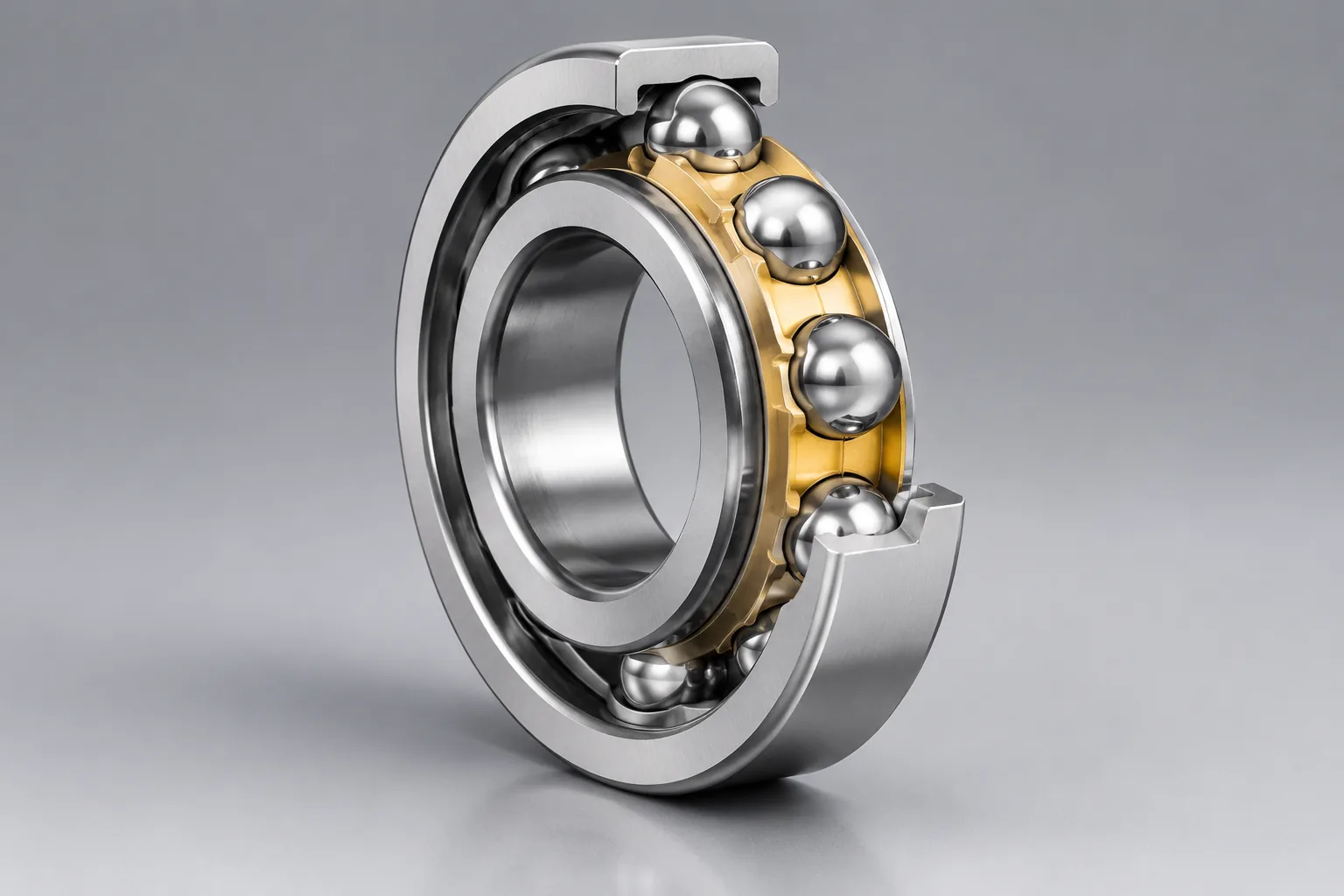
The main load-carrying components are the inner ring, outer ring, balls, and cage. Seals, shields, and lubricant are common, but they are not present in every bearing. Component design affects load capacity, speed, sealing, noise, and service life.
Inner and Outer Rings
The inner ring typically mounts on the shaft, and the outer ring typically fits into the housing. Raceways on the rings provide the rolling paths for the balls. Ring geometry and contact angle influence load direction and capacity. Mounting fits and ring geometry vary by bearing type and application. Some variants use flanged, integrated, or special ring designs, so verify the arrangement before generalizing from a standard bearing.
Balls
Spherical balls are the rolling elements that separate the rings and transfer load. Ball size, quantity, material, and grade affect load capacity and running smoothness. Common bearings use hardened bearing steel balls. Ceramic or hybrid ball options may exist for special requirements, but availability and suitability must be confirmed for the exact bearing rather than assumed from the type name.
Cage or Retainer
The cage, also called a retainer, separates the balls to reduce ball-to-ball contact and maintain spacing. It helps guide and retain the balls during operation and handling. Common cage materials include steel, brass, and polymer, depending on application. Cage selection depends on speed, load, lubrication, and operating environment.
Seals, Shields, and Lubricant
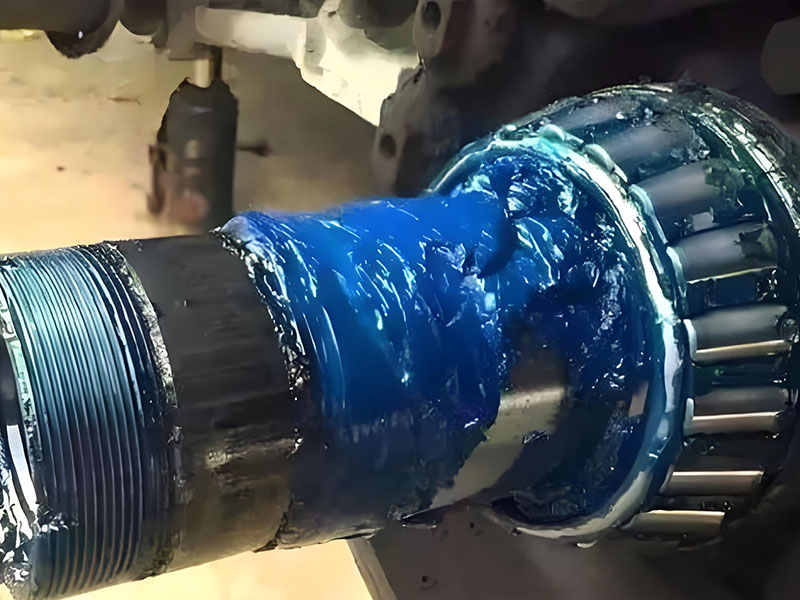
Seals and shields help retain lubricant and exclude contamination. Open bearings rely on external lubrication and may require separate sealing. Lubricant reduces friction and wear and influences speed and temperature limits. Select a sealed, shielded, or open configuration according to the environment and maintenance practice. Not every bearing is pre-lubricated for life; confirm the lubrication condition and re-lubrication requirements for the exact product.
How a Ball Bearing Works
A ball bearing works by replacing sliding contact with rolling contact. Balls roll along the raceways, and load transfers from the shaft through the inner ring, the balls, the outer ring, and the housing. Lower friction reduces torque and heat compared with many plain bearing arrangements, but performance still depends on bearing type, clearance, lubrication, mounting, and operating conditions.
Load Transfer Through the Bearing
The load path depends on fits, internal clearance, contact angle, and mounting arrangement. Radial loads act generally perpendicular to the shaft axis; axial loads act generally along the shaft axis. Combined loads require a bearing design rated for the combined condition. Use general load-direction descriptions for orientation only; exact ratings require published data for the specific bearing.
Contact Angle and Load Direction
Contact angle influences how effectively a bearing supports axial load versus radial load. Deep groove bearings are commonly used for radial and limited axial loads. Angular contact and thrust designs are intended for greater axial or combined load capability. Exact axial capacity depends on the specific series and arrangement. Do not generalize a precise load rating from the type name alone.
Clearance and Preload Basics
Internal clearance affects fit, temperature, noise, vibration, and load distribution. Preload can increase stiffness or reduce runout, but it also increases friction and heat. Clearance and preload choices should follow application requirements and manufacturer guidance, especially where temperature change, shaft deflection, or precision running is important.
Common Types of Ball Bearings
Common ball bearing types are grouped by load direction, internal design, and application needs. Type selection depends on load magnitude and direction, speed, misalignment, available space, and environment. The list below covers representative types; it is a selection overview, not a substitute for published ratings.
Deep Groove Ball Bearings
Deep groove ball bearings are a common general-purpose type. They typically carry radial loads and limited axial loads in both directions. They are available in open, sealed, and shielded configurations. They are often suited to applications where misalignment is limited and general-purpose operation is required. Axial load capacity is limited and must be verified for the specific bearing.
Angular Contact Ball Bearings
Angular contact ball bearings are designed with a contact angle for combined or axial loads. They are often used in paired or arranged mounting configurations. Mounting orientation and pairing affect load capability and stiffness. Selection and mounting must follow the specific arrangement requirements. Do not treat angular contact bearings as direct drop-in replacements for deep groove bearings without verification.
Self-Aligning Ball Bearings
Self-aligning ball bearings can accommodate some misalignment between shaft and housing. They commonly use two rows of balls and a spherical raceway in the outer ring. They are useful where mounting deflection or shaft deflection is expected. Allowable misalignment must be checked against published limits for the exact bearing and mounting.
Thrust Ball Bearings
Thrust ball bearings are intended primarily for axial loads. They are generally not intended for radial load; verify the specific design before use. They are used where axial thrust must be supported. Use them within the load direction and speed limits specified for the bearing.
Miniature and Instrument Ball Bearings
Miniature and instrument ball bearings are used in compact, low-torque, or precision assemblies. Their load capacity is generally limited by their small size. Available configurations vary by bore size, sealing, and precision. Check the exact bore, outside diameter, width, and internal design when replacing a miniature bearing, because small dimensional differences can change fit and running behavior.
Materials and Construction
Rings and balls commonly use hardened bearing steel. Stainless steel may be used where corrosion resistance is required. Ceramic or hybrid bearings may be available for special operating needs. Cages may use steel, brass, or polymer, while seals, shields, and lubricants are selected for the environment. Material and finish choices affect corrosion resistance, load capacity, speed, and cost, so confirm the exact material specification instead of inferring it from a general product description.
Key Specifications and Nomenclature
Key boundary dimensions include:
- Bore.
- Outside diameter.
- Width.
Performance-related specifications include:
- Dynamic load rating.
- Static load rating.
- Speed rating.
- Clearance.
- Tolerance.
- Contact angle where applicable.
Suffixes may indicate seals, shields, cage type, clearance, or precision. Suffix meanings vary by maker and series, so confirm the naming convention before ordering. Do not infer full bearing performance from dimensions alone.
Advantages and Limitations
Advantages can include:
- Low friction.
- Low starting torque.
- High-speed capability.
- Standardized boundary dimensions.
These features make ball bearings common in compact, efficient rotating assemblies. Limitations can include:
- Lower load capacity than roller bearings of similar size.
- Sensitivity to contamination, misalignment, or shock.
Actual performance depends on type, size, lubrication, mounting, and operating environment. Some specialized ball bearings may differ from these general tendencies.
Typical Applications
Ball bearings are used in many rotating machines and mechanisms, including:
- Motors.
- Pumps.
- Fans.
- Conveyors.
- Power tools.
- Appliances.
- Industrial equipment.
These examples are illustrative and do not imply that one bearing type fits all cases. Selection should be based on load, speed, environment, life target, and maintenance requirements.
Selection and Installation Considerations
Selection begins with load magnitude and direction, speed, misalignment, environment, life target, and available space. Correct mounting, fits, lubrication, and sealing strongly affect service life. Critical applications should use published ratings and application engineering support rather than a generic size match.
Selection Factors
- Evaluate radial and axial loads, speed, vibration, temperature, contamination, and shock.
- Consider seal or shield type, clearance, preload, cage, and lubricant.
- Check space constraints and mounting arrangement.
Use manufacturer ratings and application-specific calculations for final selection, especially when the bearing affects safety, downtime, or warranty cost.
Mounting, Lubrication, and Sealing
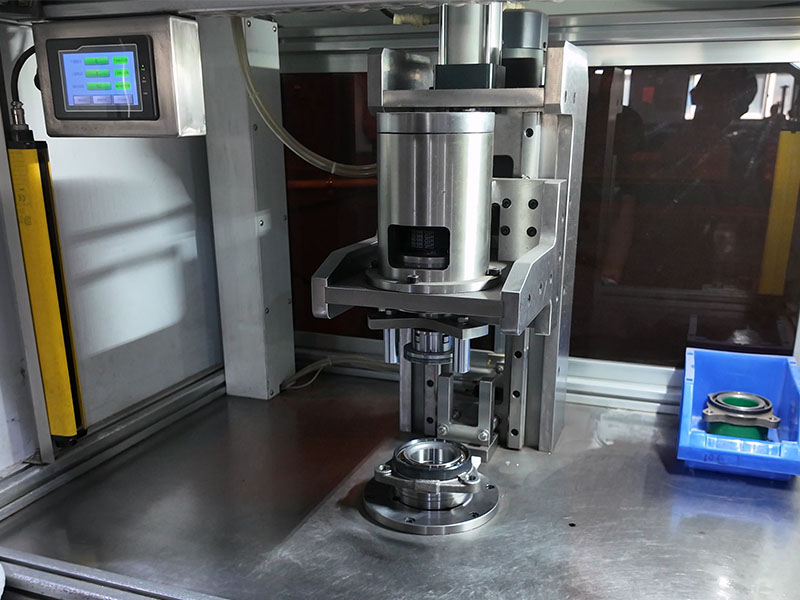
Avoid damaging raceways and rolling elements during handling and mounting. Correct shaft and housing fits affect clearance, load distribution, and heat. Lubricant quantity and sealing method must match the application. Follow manufacturer instructions for fitting practices and lubrication. Do not apply universal torque, fit, or lubricant quantity values without supported data for the exact assembly.
Maintenance and Inspection
Monitor abnormal noise, vibration, temperature rise, leakage, and contamination. Replace bearings showing wear, corrosion, seal damage, or lubricant breakdown. Maintenance intervals depend on duty cycle, environment, and lubrication method. A change in noise or temperature is a reason to inspect the assembly, not proof that the bearing alone is the cause.
Ball Bearing vs Roller Bearing
Ball bearings use spherical rolling elements; roller bearings use cylindrical, tapered, spherical, or other roller shapes. Ball bearings generally suit lower loads and higher speeds; roller bearings generally suit heavier loads. Final selection depends on load, stiffness, speed, misalignment, and space. The comparison below is a starting point, not a rating substitute.
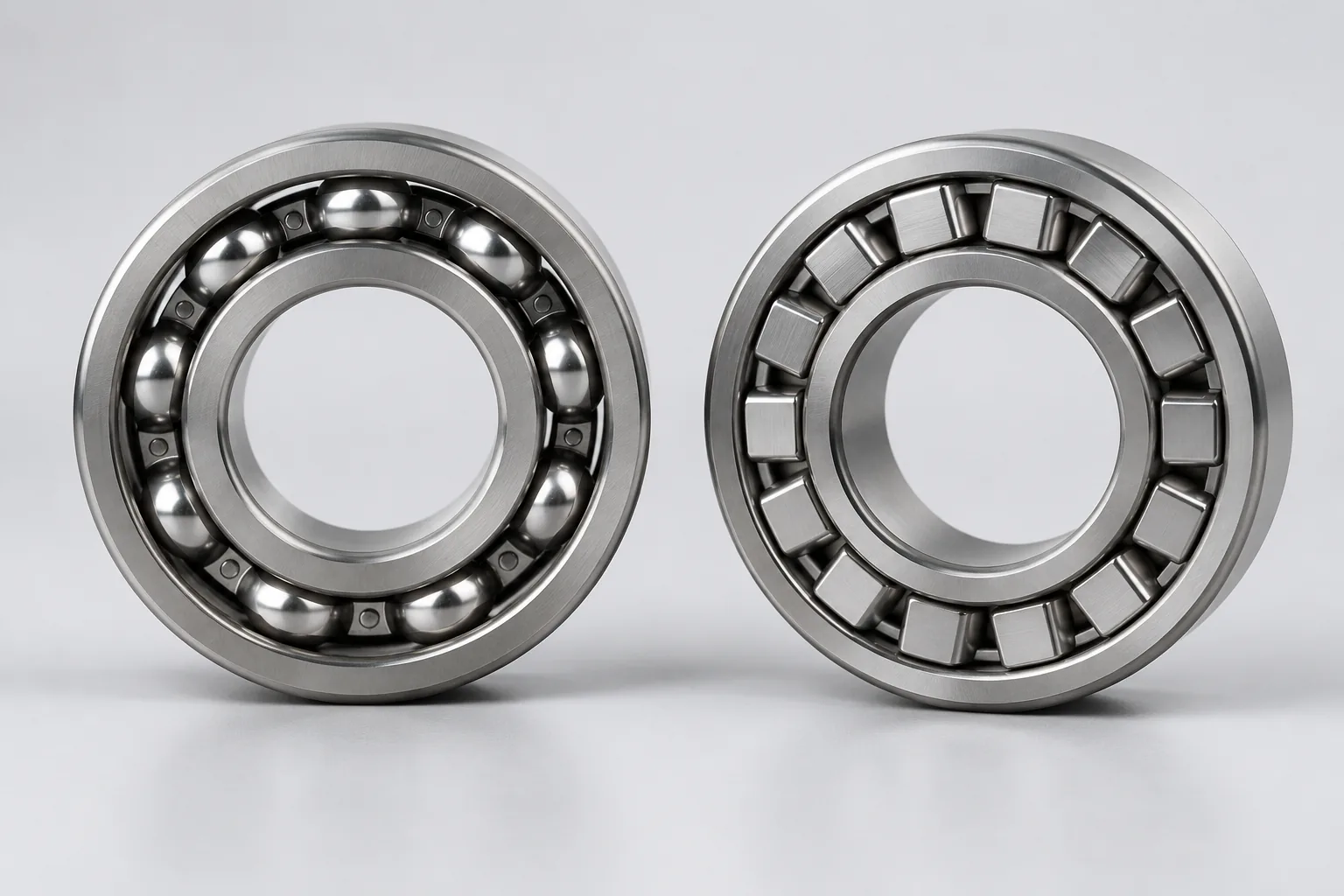
| Consideration | Ball Bearing | Roller Bearing |
|---|---|---|
| Rolling element | Spherical balls | Cylindrical, tapered, spherical, or other rollers |
| Contact pattern | Point contact | Line contact in many designs |
| Typical load tendency | Lower for a similar envelope | Higher for a similar envelope |
| Typical speed tendency | Often higher | Often lower |
| Misalignment response | Depends on type; self-aligning designs are available | Depends on type; some spherical designs accept misalignment |
| Selection basis | Verify load, speed, clearance, sealing, and life | Verify load, stiffness, speed, clearance, and life |
Conclusion
The practical choice is not just ball bearing or roller bearing: load direction and magnitude, speed, misalignment, sealing, clearance, lubrication, and mounting all shape the result. Use the type overview to narrow the options, then confirm dimensions, ratings, suffix meaning, and installation requirements for the exact bearing. If the duty is critical, obtain application engineering support before ordering or replacing the part.
FAQs
Q1: What is a ball bearing used for?
A: A ball bearing supports a rotating or oscillating shaft while reducing friction between moving and stationary parts. It is used in motors, pumps, fans, conveyors, power tools, appliances, and many other assemblies, with the exact type chosen for load direction, speed, space, sealing, and environment.
Q2: How does a ball bearing reduce friction?
A: A ball bearing reduces friction by replacing sliding contact with rolling contact. The balls roll along raceways in the inner and outer rings, while the cage keeps them spaced. Lubrication, sealing, clearance, and mounting still have a major effect on friction, heat, noise, and service life.
Q3: What are the main parts of a ball bearing?
A: The main load-carrying parts are the inner ring, outer ring, balls, and cage. Seals, shields, and lubricant are common additions but are not present in every bearing, so the parts list for one unit depends on its sealing and lubrication arrangement.
Q4: What is the difference between a ball bearing and a roller bearing?
A: A ball bearing uses spherical balls, while a roller bearing uses cylindrical, tapered, spherical, or other roller shapes. Ball bearings generally suit lower loads and higher speeds; roller bearings generally suit heavier loads. The final choice depends on load, stiffness, speed, misalignment, space, and duty.
Q5: Are ball bearings sealed or open?
A: Ball bearings can be open, sealed, or shielded. Seals and shields help retain lubricant and exclude contamination, while open bearings rely on external lubrication and may need separate sealing. Do not assume a sealed bearing is lubricated for its entire service life; confirm the lubrication condition for the exact part.
Q6: How do I choose a ball bearing?
A: Start with load magnitude and direction, speed, misalignment, environment, life target, and available space. Then check bore, outside diameter, width, load ratings, clearance, seal or shield type, cage, and suffix meaning. Follow the manufacturer instructions for fits, mounting, and lubrication, and use application engineering support for critical duty.