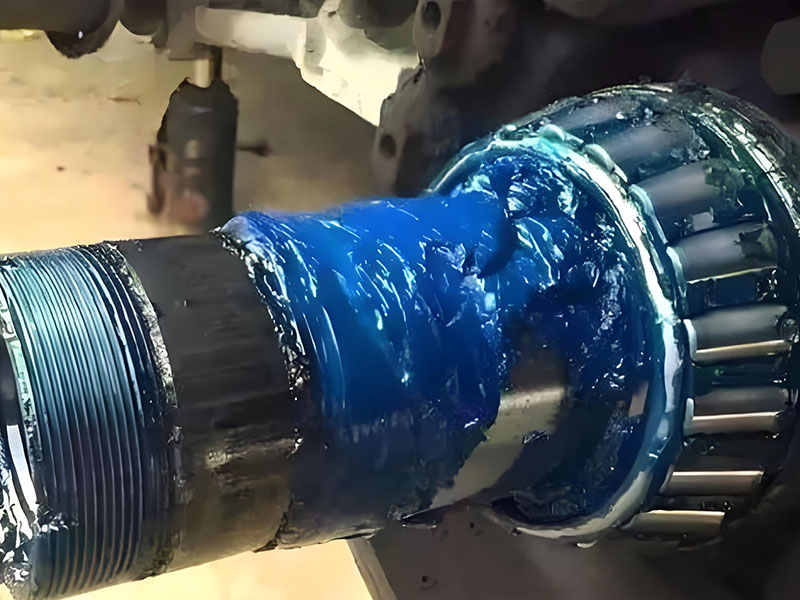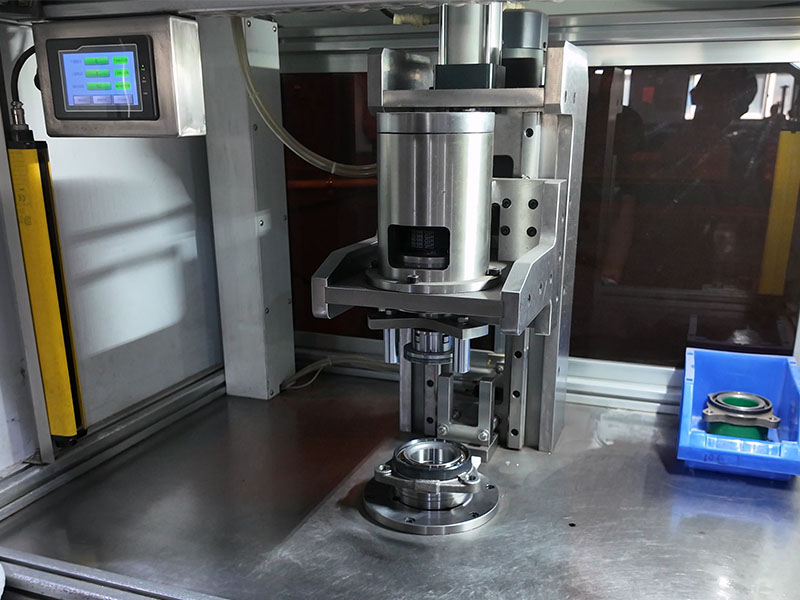
Quick Answer: Sleeve bearings are plain bearings in which a shaft slides against a bushing or liner rather than rolling on balls or rollers. Their types and materials determine load capacity, speed, lubrication needs, temperature tolerance, and contamination resistance. Common designs include cylindrical, flanged, split, wrapped, self-lubricating, and composite bushings, made from bronze, babbitt, brass, cast iron, polymers, graphite, carbon, or ceramic.
Sleeve bearing types, materials, and uses are easier to compare when the duty is clear. A bushing that works well in a low-speed pivot may be a poor choice for a continuously rotating pump shaft, and a material that tolerates dry running may not handle shock loads or contaminated washdown. The practical scope is the bearing construction, the material family, the application conditions, and the checks that prevent a mismatch.
What Is a Sleeve Bearing?
A sleeve bearing is a plain bearing in which a shaft rotates, oscillates, or slides inside a sleeve or bushing. The shaft and bearing surfaces are separated by a lubricant film, a dry-film lubricant, or the low-friction properties of the bearing material. The bearing material reduces friction and wear while supporting the shaft load.
Sleeve bearings differ from rolling-element bearings because they rely on sliding contact rather than balls or rollers. That difference affects starting friction, noise, load distribution, and sensitivity to contamination. Terminology varies by industry: sleeve bearing, bushing, plain bearing, and journal bearing may describe the same general family. The names are not always interchangeable in a specific catalog, so confirm the drawing and dimensions.
Sleeve Bearing Types
Sleeve bearing types are often grouped by construction, mounting style, and lubrication method. The choice depends on load direction, assembly method, maintenance access, and operating conditions. A single bearing can fit more than one category; a flanged oil-impregnated bushing is one example. The sections below use the main construction families that buyers and technicians encounter.
Plain Cylindrical Sleeve Bearings
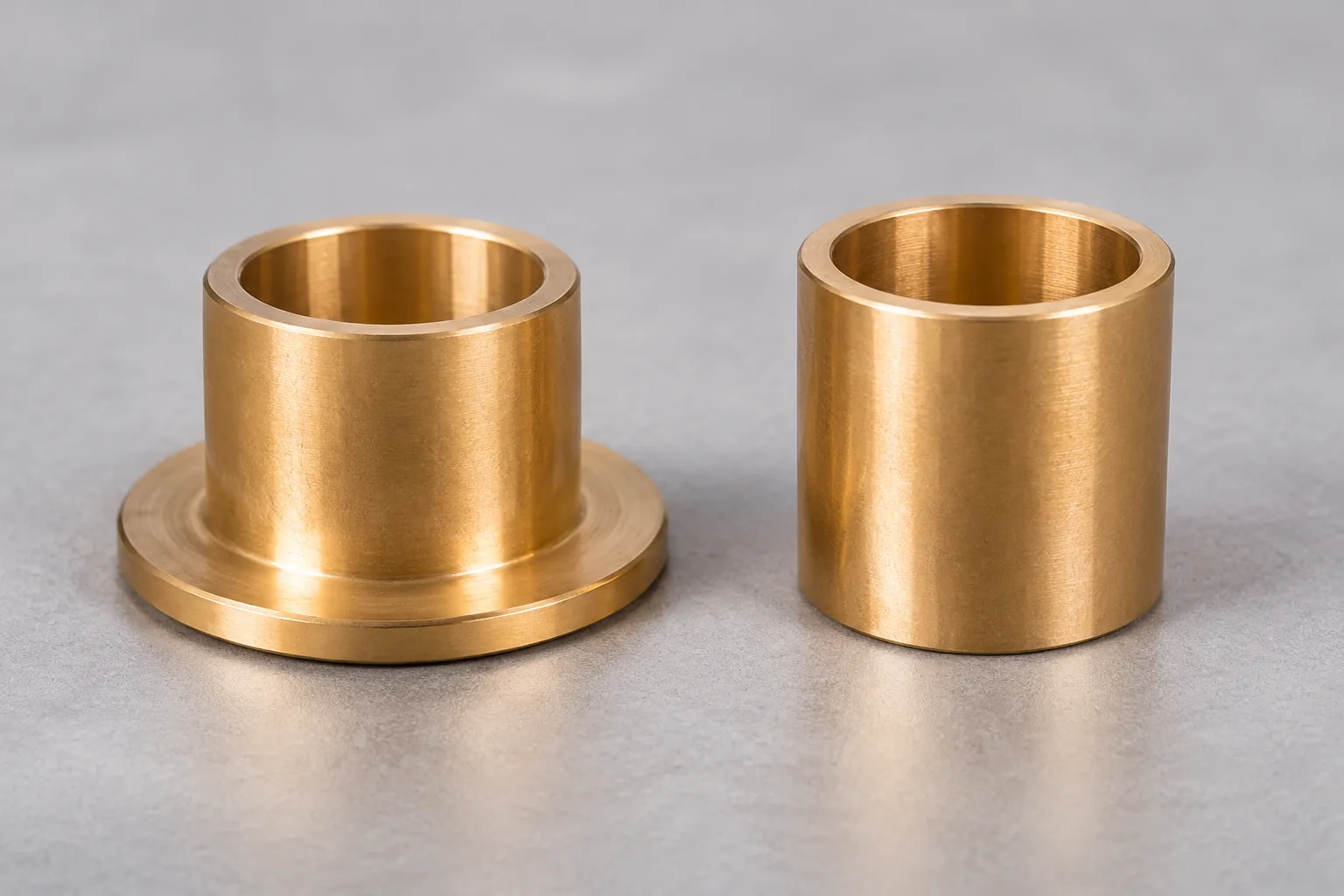
The plain cylindrical sleeve bearing is the simplest straight-bushing design for radial loads. It is common in motors, pumps, conveyors, and general machinery. Depending on the material, it may be lubricated, oil-impregnated, or made for dry running. Axial location must be handled separately by a shoulder, collar, or thrust surface. A plain cylindrical bushing is not ideal where significant axial thrust is present unless it is combined with a thrust face.
Flanged Sleeve Bearings
A flanged sleeve bearing adds a flange that helps locate the bearing axially and can provide a thrust face. It is useful where a shoulder or mounting surface is available, and it is common in linkages, pivots, and compact assemblies. Flange thrust capacity depends on material, lubrication, and contact area. Confirm the allowable thrust for the specific size and material with the supplier’s data rather than assuming the flange carries unlimited axial load.
Split or Two-Piece Sleeve Bearings
A split or two-piece sleeve bearing allows installation around a shaft without full disassembly. It is used where maintenance access is limited or shafts are large, and it is common in heavy machinery and some engine and compressor applications. Joint alignment and shell fit are critical to performance. Split construction is not always suitable for small, high-volume, thin-wall applications, where a wrapped or solid bushing may be easier to control.
Wrapped or Thin-Wall Bushings
Wrapped or thin-wall bushings are made from strip material with a backing and a bearing layer. They are compact and suitable for high-volume production, and they are common in small motors, automotive components, and light machinery. Wall thickness and rework allowance are often limited, so confirm the housing bore, shaft size, and load range for the specific style. Do not assume that a thin-wall bushing can be machined or adjusted in the same way as a thick bronze sleeve.
Self-Lubricating and Oil-Impregnated Bearings
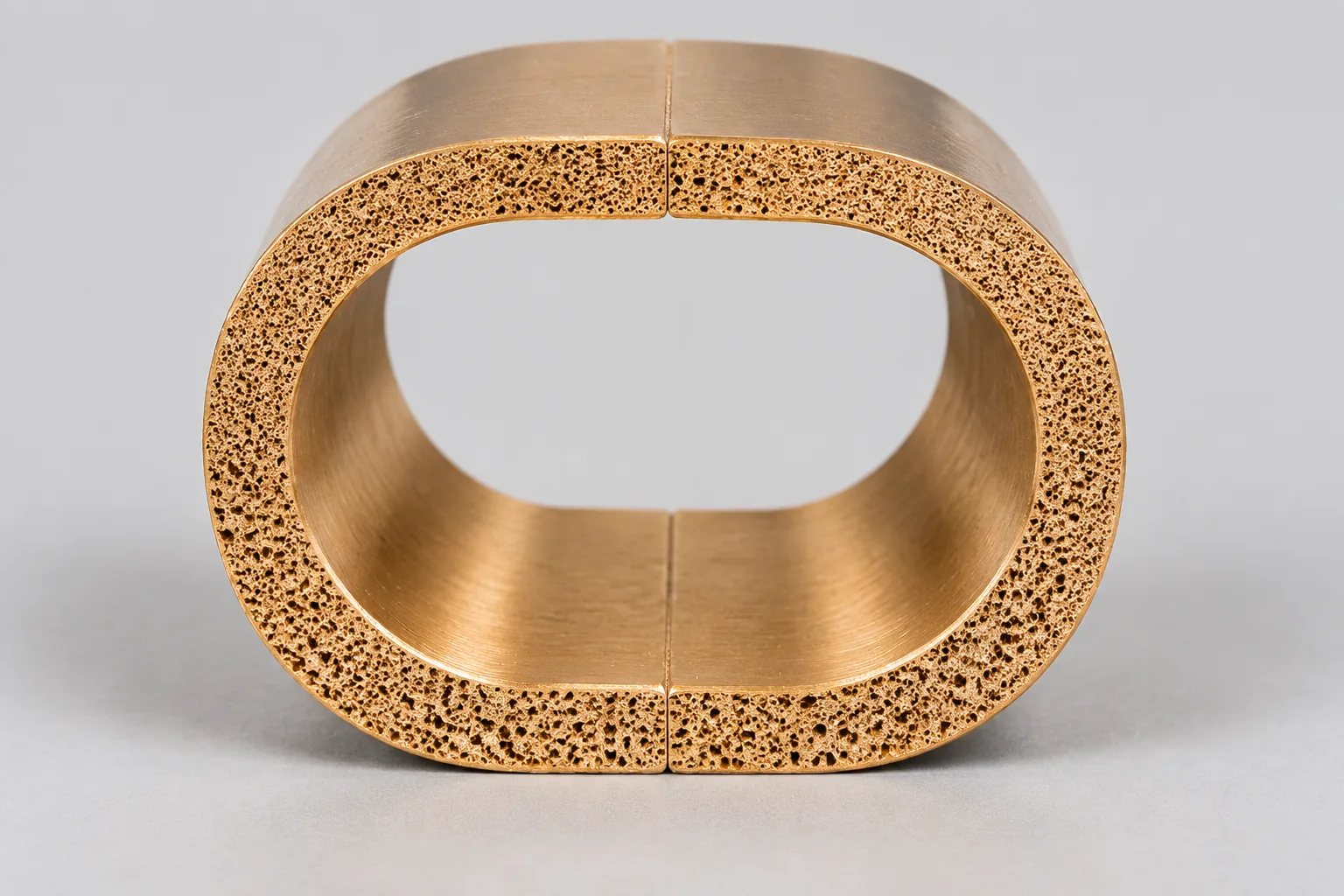
Self-lubricating and oil-impregnated bearings use porous bronze or polymer materials that retain lubricant or rely on inherent lubricity. They are used where regular lubrication is difficult or undesirable, and they are common in small motors, fans, appliances, and light-duty machinery. Load, speed, and temperature limits depend on the material system and lubrication state. These bearings may not suit heavy contamination, high shock loads, or certain high-temperature environments.
Composite and PTFE-Lined Bearings
Composite and PTFE-lined bearings typically use a metal backing with a polymer or PTFE-based liner. Many composite bushings use a steel backing, a porous bronze interlayer, and a polymer or PTFE liner. They offer low friction, dry-running capability, and corrosion resistance in some designs, and they are used in linkages, pivots, and equipment where lubrication is restricted. Performance depends on the PV limit, temperature, shaft surface, and contamination. Check the liner grade and shaft requirements before replacing a lubricated bronze bushing.
Sleeve Bearing Materials
Sleeve bearing materials are selected by matching material properties to load capacity, speed, lubrication, temperature, corrosion, and wear. No single material is best for every application. Material names and compositions vary by region and standard, so confirm the grade rather than relying on a trade name.
| Material family | Main strengths | Main limits | Useful check |
|---|---|---|---|
| Bronze and copper alloys | Good load capacity and machinability; works well with lubrication | Performance varies by alloy and lubricant supply | Alloy, clearance, shaft finish, lubrication |
| Babbitt and white metal | Good conformability and embeddability | Fatigue strength depends on grade and lining thickness | Lining thickness, temperature, lubrication |
| Brass and cast iron | Cost-effective for light-to-moderate duty | More limited in demanding lubricated service | Load, speed, shaft material |
| Polymer, PTFE, and composite | Dry running, low friction, chemical resistance in some grades | Heat dissipation and load capacity can be lower | PV limit, temperature, shaft finish |
| Graphite, carbon, and ceramic | High-temperature or corrosive duties in some grades | Brittle handling and thermal shock risk | Shock loading, thermal shock, chemical compatibility |
Bronze and Copper Alloys
Bronze and copper alloys include cast bronze, sintered bronze, and leaded or tin bronze variants. They are generally known for good load capacity, machinability, and wear behavior with lubrication. They are used in pumps, motors, industrial machinery, and oil-impregnated bushings. Performance depends on alloy, lubrication, shaft finish, and clearance. Sintered bronze is porous and intended for oil retention, while cast bronze is a solid material with different machining and load characteristics.
Babbitt and White Metal
Babbitt and white metal are soft bearing lining materials with good conformability and embeddability. They are often used as a lining on steel or bronze backs in heavier machinery. They require suitable lubrication and backing support. Fatigue strength and temperature limits depend on composition and lining thickness. A thin, well-supported lining behaves differently from a thick lining, so the grade and rebuild specification matter.
Brass and Cast Iron
Brass and cast iron are cost-effective options for light-to-moderate duty applications. Brass is common in simple bushings and hardware, while cast iron appears in some machinery bearings. Performance is generally more limited than bronze in demanding lubricated service. Suitability depends on load, speed, lubrication, and shaft material, so use these materials where the duty and alignment are well controlled.
Polymer, PTFE, and Composite Materials
Polymer, PTFE, and composite materials offer dry running, low friction, chemical resistance, and lightweight construction in some grades. They are common in linkages, appliances, food equipment, and low-maintenance pivots. Lower heat dissipation and load capacity may limit use in high-speed or heavy-load duties. Performance depends on the PV limit, temperature, shaft hardness, surface finish, and contamination. These materials are not a drop-in replacement for heavily loaded bronze bearings without checking limits.
Graphite, Carbon, and Ceramic Options
Graphite, carbon, and ceramic options are used in niche applications requiring dry running, high temperature, or corrosion resistance. They can be brittle or require careful handling and installation. They are often selected when conventional lubricants are unsuitable. Load, speed, thermal shock, and shock loading must be checked carefully. Verify temperature and chemical compatibility with the specific grade before use.
How Type and Material Affect Performance
Load capacity depends on material strength, bearing area, clearance, and lubrication. Speed capability is limited by heat generation, friction, and the lubrication method. The PV limit is a key screening factor for dry-running and boundary-lubricated bearings, because it combines contact pressure and sliding speed. Corrosion resistance, embeddability, conformability, and misalignment tolerance vary by material and design.
Actual performance also depends on shaft finish, shaft hardness, clearance, installation alignment, and the environment. Catalog ratings are application-dependent and should be verified with the manufacturer for the specific grade and duty. A rating from one material system does not transfer automatically to another.
Common Uses and Applications
Common uses are best grouped by operating conditions rather than by industry label. A conveyor, a pedal pivot, and a small fan may all use a sleeve bearing, but the load, speed, lubrication, and maintenance access are different. The examples below are illustrative and should be checked against actual duty conditions.
Electric Motors, Pumps, and Compressors
Sleeve bearings support shafts in small motors, fans, pumps, and some compressors. Oil-impregnated bronze and polymer bushings are common in low-maintenance equipment. Lubrication and alignment are important for quiet, long-life operation. Continuous duty and temperature rise may require more careful material selection than intermittent operation.
Automotive, Agricultural, and Construction Equipment
Sleeve bearings are used in linkages, pivots, pedals, hinges, and other oscillating applications. Split, flanged, wrapped, and composite bushings are common depending on assembly needs. Shock loads and contamination often drive material and sealing choices. Dust, water, and vibration can shorten life unless the bearing system is protected.
Industrial Machinery, Conveyors, and Material Handling
Sleeve bearings are used in conveyor pulleys, fans, mixers, and general rotating equipment. Split and flanged designs help with mounting and maintenance. Lubricated bronze and composite materials serve different duty levels. High radial loads or misalignment may require different housing and bearing designs rather than a simple bushing swap.
Low-Maintenance and Dry-Running Equipment
Self-lubricating and composite bearings are used where lubrication access is limited. They are common in appliances, office equipment, food processing, and clean environments. Material selection must account for temperature, chemicals, and duty cycle. Dry-running bearings still have load and speed limits and may require specific shaft finishes. They are not suitable for all washdown, high-load, or high-speed applications.
Selection Checklist: Matching Type and Material to the Application
- Load direction and magnitude: Confirm radial load, axial load, shock, and edge loading. A cylindrical bushing carries radial load, while a flange or thrust face may carry axial load.
- Shaft speed and duty cycle: Check continuous or intermittent operation and the heat generated at the sliding interface.
- Lubrication and maintenance access: Identify oil, grease, dry-film, or self-lubricating operation and whether relubrication is practical.
- Temperature and environment: Review heat, contamination, corrosion, washdown, and chemical exposure.
- Geometry and fit: Check misalignment tolerance, clearance, shaft finish, shaft hardness, and housing fit.
- Commercial and service factors: Consider noise, cost, availability, replacement strategy, and assembly method.
Base selection on confirmed application data rather than title-level assumptions. High-risk or safety-critical applications require engineering review and testing.
Lubrication and Basic Operating Considerations
Lubrication method affects allowable load, speed, temperature, and life. Oil, grease, dry-film, and self-lubricating systems suit different applications. Clearance, alignment, shaft finish, and contamination control also influence performance. Maintenance intervals should match the lubrication method and operating environment. The lubricant must be compatible with the bearing material, seals, and operating temperature.
When damage is found, ISO 15243:2017 provides a common classification for in-service bearing damage, including fatigue, wear, corrosion, electrical erosion, plastic deformation, and fracture. Detailed maintenance procedures and failure analysis are outside the main scope of this article; use the equipment manufacturer’s instructions for specific work.
Conclusion
Sleeve bearing types, materials, and uses should be matched as a system. Start with load direction and magnitude, then add speed, duty cycle, lubrication, temperature, contamination, and maintenance access. Use the bearing construction that fits the available space and assembly method, and choose a material that can tolerate the lubrication state and environment. Confirm clearance, shaft finish, housing fit, and the manufacturer’s limits before ordering. For high-risk or safety-critical applications, require engineering review and application testing rather than relying on a catalog name alone.
FAQs
Q1: Sleeve Bearing vs. Ball Bearing: What Is the Difference?
A: A sleeve bearing uses sliding contact between a shaft and a bushing, while a ball bearing uses rolling elements between rings. Sleeve bearings can be quieter, simpler, and more compact in some applications, while ball bearings generally offer lower starting friction and different load characteristics. The better choice depends on load, speed, precision, noise, maintenance, and cost.
Q2: How Do I Choose the Right Sleeve Bearing Material?
A: Start with load, speed, lubrication, temperature, and environment, then compare material families against those conditions. Match the material to dry-running or lubricated operation, and verify the PV limit, shaft finish, clearance, and housing fit. Confirm material data from the manufacturer datasheet for the specific grade.
Q3: Are Self-Lubricating Sleeve Bearings Maintenance-Free?
A: They can reduce or eliminate routine lubrication in suitable applications, but they are not maintenance-free in every duty. They still have wear life limits and contamination sensitivity, and operating conditions determine whether they remain maintenance-free. Load, speed, temperature, and contamination must stay within the material limits. Some self-lubricating bearings may require initial lubrication or periodic inspection.
Q4: What Are Common Causes of Sleeve Bearing Failure?
A: Poor lubrication, contamination, misalignment, overload, and incorrect clearance are common causes. Material mismatch and shaft finish problems can accelerate wear, while correct selection and installation reduce risk. Base failure analysis on the actual operating history and inspected components. Detailed failure-analysis procedures are outside the scope of this article.