What is the most widely used rolling bearing across industries? Deep groove ball bearings. From electric motors to heavy mining equipment, these bearings support rotating shafts while reducing friction. This article examines how deep groove ball bearings work, the factors that determine their quality, their key advantages, applications across industries, and how to select the right bearing.
What Are Deep Groove Ball Bearings?
A deep groove ball bearing is a rolling-element bearing that uses balls to maintain separation between two moving raceways — an inner ring and an outer ring. The raceway grooves on both rings are deeper than those found in standard ball bearing designs, creating a circular arc with a radius slightly larger than that of the balls.
This deep-groove geometry allows the bearing to support both radial loads (perpendicular to the shaft) and axial loads (parallel to the shaft) in both directions. The balls are typically retained by a cage, which maintains even spacing between rolling elements to prevent contact and reduce friction.
Deep groove ball bearings are designed as self-retaining units. They do not require separate assembly, making them easy to install and replace in the field. Standard metric series — including 6000, 6200, 6300, and 6400 — conform to international dimensional standards, ensuring compatibility with equipment from different manufacturers.
The internal clearance of a deep groove ball bearing can be specified based on application requirements. Standard clearances (CN) suit most general applications, while increased clearances (C3, C4) accommodate thermal expansion or interference fits in high-temperature environments.
How Do Deep Groove Ball Bearings Work?
The fundamental operating principle of a deep groove ball bearing is straightforward: rolling reduces friction. When a load is applied to the bearing, the balls roll along the raceways of the inner and outer rings. This rolling motion creates significantly less friction compared to sliding contact between two flat surfaces.
Load support. A deep groove ball bearing supports radial loads primarily through the contact between the balls and the raceway bottoms. When a radial load is applied, the contact angle between the ball and raceway is zero. When axial loads are applied, the balls contact the raceway shoulders, establishing a contact angle that enables thrust load support.
Bi-directional capability. Unlike angular contact bearings, which support axial loads in only one direction, the deep groove design accommodates axial forces from either direction. This bi-directional capability makes the deep groove ball bearing particularly versatile for applications where load direction may vary during operation.
High-speed performance. The precision geometry of the raceways combined with high-quality balls minimizes internal friction, allowing deep groove ball bearings to operate effectively at high rotational speeds. Careful control of roundness, waviness, and surface roughness during manufacturing further reduces friction and operating temperatures.
Key Factors Influencing Deep Groove Ball Bearing Quality
The quality of a deep groove ball bearing directly determines its service life, load capacity, and reliability. Several manufacturing and material factors are critical.
Steel Grade
The bearing steel used — typically high-carbon chromium steel such as GCr15 (equivalent to AISI 52100) — must meet stringent purity standards. Steel quality varies significantly between mills. Factors such as inclusion content, carbide distribution, and microscopic homogeneity affect fatigue life directly. High-quality bearing steel undergoes vacuum degassing and special melting processes to reduce oxide and sulfide inclusions, which are common initiation points for rolling contact fatigue.
Design Conformity
The geometric relationship between the balls and the raceways — referred to as conformity — influences both load distribution and friction. Raceway curvature is expressed as a percentage of the ball radius. Tight conformity (high percentage) increases contact area and load capacity but generates higher friction. Looser conformity reduces friction but concentrates stress on smaller contact areas. Drawings for deep groove ball bearings vary among manufacturers, and design modifications made to reduce production costs can compromise long-term durability.
Grinding and Surface Finish
The surface finish of raceways, achieved through grinding and superfinishing processes, determines running smoothness and noise levels. Raceways with superior surface finish reduce wear, keep operating temperatures low, and contribute to quieter operation compared to conventional finishes. Grinding accuracy also affects dimensional consistency — a critical factor for bearings that must fit precisely within assemblies.
Heat Treatment
Heat treatment stabilizes the microstructure of bearing steel, ensuring uniform hardness and wear resistance across the raceways and rolling elements. Proper heat treatment produces a hard, wear-resistant surface while maintaining a tough, impact-resistant core. Bearings may also receive dimensional stabilization treatments (designated S0, S1, SN, etc.) based on maximum operating temperature requirements. Stabilization prevents dimensional changes during service at elevated temperatures.
Other factors affecting deep groove ball bearing quality include quality testing equipment calibration, assembly worker experience, and consistency of quality management systems throughout production.
Advantages of Deep Groove Ball Bearings
Several performance characteristics explain the dominance of deep groove ball bearings in industrial applications.
Enhanced Radial Load Capacity
The deep raceway geometry creates a large contact area between the balls and raceway bottoms, enabling the bearing to support substantial radial loads. This feature makes deep groove ball bearings suitable for applications such as conveyor rollers and gearbox shafts, where radial forces predominate.
Bi-Directional Axial Load Support
Unlike single-direction thrust bearings, deep groove ball bearings accommodate axial loads from either direction. This bi-directional capability reduces component counts and simplifies assembly designs.
High-Speed Operation
Precision raceway finishing and high-grade balls allow deep groove ball bearings to operate at speeds significantly higher than many other bearing types. Reduced internal friction translates to lower energy consumption and less heat generation during high-speed operation.
Versatility in Sizes and Configurations
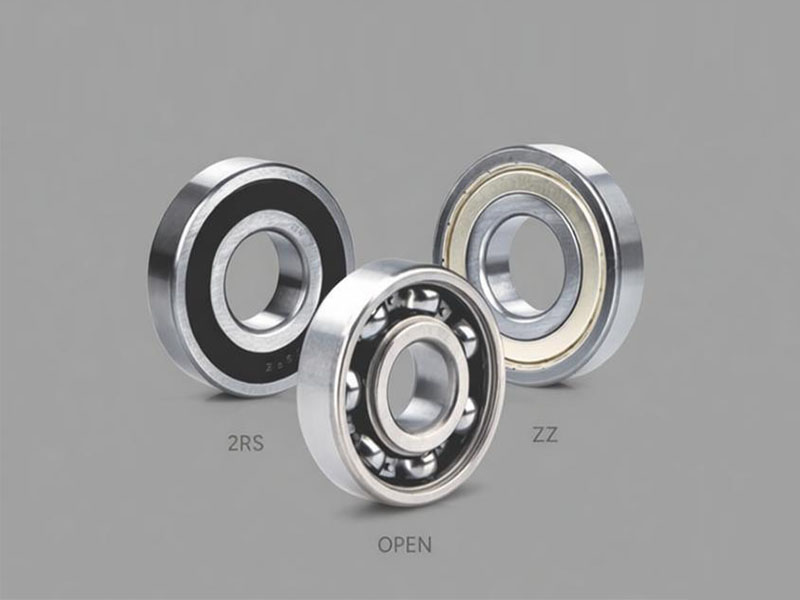
Deep groove bearings are available in a wide range of sizes — from miniature bearings with bores under 3 mm to large bearings exceeding 600 mm. Open, shielded (ZZ or 2Z), and sealed (2RS or 2RSR) configurations suit different contamination protection requirements.
Low Maintenance Requirements
Many deep groove ball bearings are pre-lubricated and sealed for life, requiring no routine maintenance. This feature reduces total cost of ownership in applications where regular regreasing is impractical or hazardous.
Extended Service Life
Advanced manufacturing techniques — including optimized raceway geometry and high-precision grinding — extend bearing life significantly. Some modern deep groove ball bearing series offer 15% longer life compared to conventional designs.
Noise and Vibration Control
Noise-optimized cages and precision-ground raceways enable deep groove ball bearings to operate with substantially reduced noise and vibration levels, making them ideal for applications where acoustic comfort is critical.
Common Applications of Deep Groove Ball Bearings Across Industries
Thanks to their advantages, deep groove ball bearings are the most common rolling bearings worldwide. They are used across diverse industries due to their versatility, operational robustness, ease of maintenance, and economic efficiency. Key applications include:
- Electric motors and generators — high-speed operation, low noise, and energy efficiency are essential.
- Automotive systems — wheel hubs, transmissions, engines, and differential gears rely on deep groove ball bearings for smooth operation and load management.
- Pumps and compressors — bearings handle high and low speeds, vibration, and demanding operating environments.
- Wind energy industry — turbines depend on deep groove bearings for efficiency under variable loads and weather extremes.
- Mining industry — crushers, screens, and conveyors require bearings that withstand heavy impact loads and harsh conditions.
- Rock crushing industry — heavy-duty bearings support high shock loads and continuous operation.
- Paper pulp industry — bearings must resist high heat and moisture while minimizing downtime from maintenance.
- Steel rolling mills and steel industry — bearings operate under extreme loads, high temperatures, and exposure to metal dust and scale.
- Cement industry — bearings endure abrasive dust and heavy radial loads.
- Construction machinery — equipment such as excavators and loaders requires robust bearings for variable load conditions.
- Petrochemical and oil & gas industries — bearings operate in corrosive environments and must resist contamination.
- Agricultural machinery — tractors, harvesters, and balers operate in dirty, dusty conditions with variable loads.
- Sugar industry — bearings handle high humidity, temperature cycling, and the presence of corrosive sugar juices.
- Robotics and automation — precision bearings provide smooth motion and positional accuracy.
- Household appliances — washing machines, refrigerators, vacuum cleaners, and fans benefit from low-noise, low-vibration operation.
The wide-ranging uses of deep groove ball bearings demonstrate their adaptability across diverse operating conditions. Industries often choose sealed or shielded variants to extend bearing life in contaminated environments.
How to Select the Right Deep Groove Ball Bearing for Your Application
Choosing the correct deep groove ball bearing requires careful evaluation of several technical factors. An incorrect selection can lead to premature failure, reduced efficiency, and increased maintenance costs.
Load Requirements
Calculate both the magnitude and direction of loads your application will generate. For purely radial loads, standard deep groove ball bearings are generally suitable. For combined radial-axial loads, verify that the bearing’s axial load rating meets the application’s requirements. Dynamic load ratings (C) determine bearing life under rotating conditions; static load ratings (C0) apply to stationary or slow-oscillating applications.
Speed Requirements
Confirm that the bearing’s limiting speed (expressed in rpm) exceeds your maximum operating speed. Higher speeds typically require tighter internal clearance (C3) and higher precision grades (P5 or P4) to accommodate thermal expansion and maintain running accuracy. Reduced friction designs may offer improved performance at elevated speeds.
Operating Environment
Consider temperature extremes, contamination risks, and chemical exposure. Sealed (2RS) or shielded (2Z) bearings protect against dust and moisture. For high-temperature environments exceeding 120°C, specify heat-stabilized bearings. For corrosive environments, stainless steel rings and balls are recommended.
Mounting and Dimensional Constraints
Verify that the bearing’s bore diameter, outside diameter, and width dimensions fit within your assembly. Standard metric deep groove ball bearings follow ISO dimensional specifications, ensuring interchangeability between manufacturers. Shaft and housing tolerances should be selected based on load conditions — interference fits for rotating loads, clearance fits for stationary loads.
Conclusion
Deep groove ball bearings are among the most widely used rolling bearings in industrial and mechanical applications due to their robust design, bi-directional load capacity, and high-speed performance. The quality of a deep groove ball bearing is determined by steel grade, geometric design, grinding precision, and heat treatment processes — each playing a critical role in service life and reliability.
Selecting the appropriate deep groove ball bearing for a given application requires evaluating load conditions, speed requirements, operating environment, and dimensional constraints. Proper selection ensures longer service life, lower maintenance costs, and improved overall equipment performance.
For engineers and procurement professionals seeking reliable deep groove ball bearings, partnering with a manufacturer that maintains rigorous quality control across material selection, precision manufacturing, and dimensional accuracy is essential. DUHUI Bearing offers a comprehensive range of deep groove ball bearings designed to meet international standards, backed by consistent quality assurance and technical support for industrial applications worldwide. For inquiries regarding your specific application requirements, please contact our technical team.
Frequently Asked Questions About Deep Groove Ball Bearings
Q1: What is the difference between deep groove ball bearings and angular contact ball bearings?
A1: Deep groove ball bearings support axial loads in both directions and are suitable for general-purpose applications. Angular contact bearings support axial loads in only one direction but can handle higher thrust loads due to their contact angle design.
Q2: When should I use sealed bearings versus shielded bearings?
A2: Sealed bearings (typically designated 2RS or 2RSR) provide the highest level of contamination protection and are pre-lubricated for life. Shielded bearings (ZZ or 2Z) offer moderate protection with lower friction but allow some contaminants to enter over time.
Q3: What is the C3 clearance designation?
A3: C3 indicates greater than normal internal clearance. It is specified when higher operating temperatures, interference fits, or higher speeds are expected.
Q4: How do I determine the correct bearing size for my application?
A4: Size selection depends on shaft diameter, space constraints, load requirements, and operating speed. Most manufacturers provide selection tools and engineering support to help identify the appropriate bearing.
Q5: Can deep groove ball bearings be used in high-temperature applications?
A5: Yes, with proper specifications. Standard bearings operate up to approximately 120°C. For higher temperatures, specify heat-stabilized bearings (S0 for up to 150°C, S1 for up to 200°C) with appropriate grease.