A bearing cage—also known as a bearing retainer—is an essential component in rolling element bearings. What happens if a bearing operates without a cage? Without proper spacing, the rolling elements would cluster together, causing increased friction, excessive heat, and premature failure. This guide provides a technical overview of bearing cage types, materials, design considerations, manufacturing processes, selection criteria, and maintenance guidelines for engineers and procurement professionals.
What Is a Bearing Cage?
A bearing cage is positioned between the inner ring and outer ring of a bearing. Its primary purpose is to separate and maintain uniform spacing between the rolling elements (balls or rollers). The bearing cage works together with the inner ring, outer ring, and rolling elements to enable smooth rotation.
The main functions of a bearing cage include:
- Separating rolling elements – Prevents direct metal-to-metal contact, which would generate friction and wear.
- Maintaining uniform spacing – Ensures even load distribution across all rolling elements.
- Guiding the rolling elements – Keeps rolling elements correctly aligned within the raceways.
- Retaining rolling elements during assembly – In separable bearing designs, the cage holds rolling elements in place when rings are separated.
Types of Bearing Cages, Materials, and Manufacturing
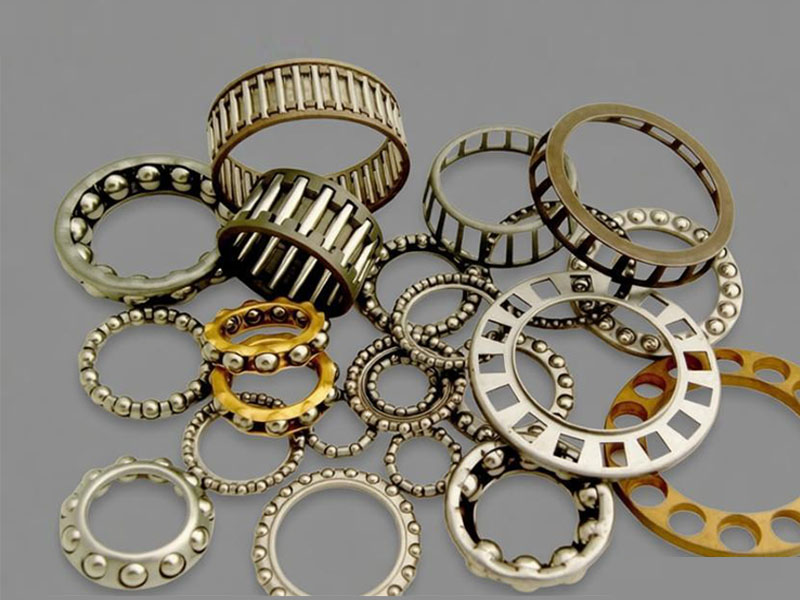
Each cage type is defined by its manufacturing method and material. The following are the most common types used in industrial and automotive applications.
Stamped Steel Cages
- Material & Manufacturing: Thin steel sheet, stamping
- Key Features: High strength-to-weight ratio, cost-effective, suitable for high-volume production
- Temperature Range: Up to 300°C
- Typical Applications: Automotive wheel bearings, industrial gearboxes, electric motors, household appliances
Machined Brass Cages
- Material & Manufacturing: Solid brass (cast or forged), CNC machining
- Key Features: Excellent wear and corrosion resistance, high load capacity, good thermal conductivity
- Temperature Range: Up to 300°C
- Typical Applications: Heavy-duty equipment, mining machinery, marine applications, high-load gearboxes
Polyamide (Nylon PA66) Cages
- Material & Manufacturing: Glass fiber-reinforced PA66, injection molding
- Key Features: Lightweight, low friction, self-lubricating, noise-dampening
- Temperature Range: -40°C to +120°C
- Typical Applications: Aerospace components, consumer electronics, medical devices, high-speed machinery
Note: Nylon cages are also widely referred to as polyamide cages. They offer the best performance-to-weight ratio for moderate temperature ranges.
Crown Cages (Snap‑in)
- Material & Manufacturing: Often polyamide or stamped steel, one-piece snap-in design
- Key Features: Simplifies assembly, excellent rolling element guidance
- Temperature Range: Steel version up to 300°C; polymer version -40°C to +120°C
- Typical Applications: High-speed bearings, precision instruments, applications requiring precise alignment
Machined Aluminum Cages
- Material & Manufacturing: Solid aluminum, machining
- Key Features: Lightweight, good thermal conductivity, corrosion-resistant
- Temperature Range: Up to 200°C (dependent on alloy)
- Typical Applications: Aerospace components, high-speed rotating machinery where weight reduction is critical
Design Considerations for Bearing Cages
Once the cage type and material are selected based on application requirements, the following design factors must be evaluated.
- Cage Geometry – Optimized pocket geometry maintains correct spacing and alignment while minimizing contact between the cage and rolling elements. Reduced contact area lowers friction and heat generation.
- Strength and Durability – The cage material must withstand operational stresses without deformation or fatigue. For high-speed applications, machined cages with precise land guidance are preferred over ball-guided designs.
- Lubrication Requirements – Cages should facilitate proper lubricant distribution. Some materials, such as brass, can absorb lubricant and perform well under marginal lubrication conditions. Many designs incorporate lubrication channels or reservoirs.
- Manufacturing Precision – High-precision manufacturing ensures dimensional accuracy and surface finish quality. This is especially critical for high-speed bearings, where even minor deviations affect performance.
- Weight Considerations – In high-speed or aerospace applications, lightweight materials (polyamide or aluminum) reduce the bearing’s moment of inertia and improve response speed, without compromising strength.
- Noise and Vibration – Cage instability can cause torque fluctuations and noise. Outer ring-guided cages are often used in machine tool spindles to suppress vibration. Polyamide cages inherently dampen noise, making them suitable for medical devices and household appliances.
Manufacturing Processes for Bearing Cages
Different manufacturing methods are used depending on the cage material and production volume.
- Stamping – For thin sheet metal cages (steel, brass). Cost-effective for medium to high volumes.
- Machining – For solid metal cages (brass, steel, aluminum). CNC turning, milling, and drilling achieve precise dimensions and complex geometries. Suitable for small batches and high-precision applications.
- Injection Molding – For polymer cages (polyamide). Allows complex geometries and is efficient for high-volume production.
- Welding / Riveting – Used to join two-piece cages (e.g., ribbon cages).
- Quality Control – Includes dimensional inspection, surface finish verification, material property testing, and non-destructive testing for critical applications.
How to Select the Right Bearing Cage
Understanding manufacturing processes informs selection, as certain cage types are only available through specific production methods. The following guide helps match application parameters to appropriate cage types.
| Selection Parameter | Recommended Cage Type |
|---|---|
| High speed | Machined brass or phenolic resin cages; polyamide cages designed for high speed |
| Heavy load | Steel or brass cages; full complement designs (cageless) for maximum load capacity |
| High temperature (above 120°C) | Steel or brass cages (up to 300°C); PEEK cages for higher temperatures |
| Corrosive environment | Brass, stainless steel, or corrosion-resistant polymer cages (avoid steel unless coated) |
| Low noise / low vibration | Polyamide cages (noise-dampening) |
| Weight reduction | Polyamide or aluminum cages |
For applications with ammonia exposure, avoid brass cages (risk of season cracking). For vacuum environments, polyamide cages are not recommended due to dehydration embrittlement.
Maintenance and Replacement Guidelines
Regular maintenance extends bearing cage service life and prevents unexpected failure.
Regular Inspection
Monitor rolling noise, vibration, temperature, and lubrication status during operation. Bearing vibration is particularly sensitive to cage damage such as peeling, indentation, cracks, or wear. Inspect raceways, rolling surfaces, and cage pockets for abnormalities.
Lubrication
Maintain proper lubrication at all times. Inadequate lubrication causes adhesive wear, generating debris that may enter cage pocket holes and subject the cage to abnormal loads, potentially leading to fracture.
Cleaning
Remove contaminants and abrasive particles during bearing cleaning. Pay special attention to cage pockets and guide surfaces.
Replacement Guidelines
Replace the cage if any of the following are observed:
- Cracks or fractures in the cage structure
- Severe wear on pocket surfaces or guide surfaces
- Loose or missing rivets (for riveted cages)
- Deformation preventing proper rolling element guidance
- Discoloration (dark blue indicating overheating)
Common causes of cage failure include poor mounting, bearing misalignment, shock loads, excessive rotational speed, and sudden acceleration or deceleration.
Frequently Asked Questions (FAQs)
Q1: What is the difference between a bearing cage and a bearing retainer?
A1: The terms are interchangeable; both refer to the same component that separates and guides rolling elements.
Q2: What is the difference between land-guided and ball-guided bearing cages?
A2: In land-guided cages, the cage is guided by the inner or outer ring shoulder (land), providing better stability at high speeds. In ball-guided cages, the cage is guided by the rolling elements themselves, which is simpler but may generate more friction and noise at high speeds.
Q3: What causes bearing cage failure?
A3: Common causes include inadequate lubrication, bearing creep (ring sliding due to insufficient interference), abnormal loads from improper installation, material defects, ingress of hard foreign particles, rapid cage vibration, and excessive rotational speed.
Q4: Can I operate a bearing without a cage?
A4: Generally not recommended. Without a cage, rolling elements cluster together, increasing friction and heat. However, full complement bearings (cageless designs) are available for applications prioritizing maximum load capacity over speed.
Q5: How do I choose the right cage material for high-speed applications?
A5: For high-speed applications, copper alloy or phenolic resin machined cages are suitable. Synthetic resin molded cages designed for high speed are also available. The cage should be guided by inner or outer ring shoulders rather than by rolling elements.
Q6: Are polymer cages suitable for high-temperature environments?
A6: Standard polyamide (PA66) cages are limited to 120°C. For higher temperatures (120–250°C), consider PEEK cages; above 250°C, use steel or brass cages.
Q7: What is the service life of a bearing cage?
A7: Under ideal conditions—proper lubrication, alignment, and load—a bearing cage can last the bearing’s calculated L10 life. In real-world applications, cage life is often limited by lubrication degradation, contamination, or transient loads. Regular inspection is recommended.
Q8: How do I inspect a bearing cage for wear?
A8: During maintenance, check for cracks, deformation, wear on pocket surfaces and guide surfaces, loose rivets, and dark blue discoloration (overheating). Vibration measurement can also help detect cage damage early.
Conclusion
Bearing cages play a critical role in separating, guiding, and retaining rolling elements within a bearing. Understanding the characteristics of different cage types—stamped steel, machined brass, polyamide (nylon), crown, and aluminum—enables informed selection based on speed, load, temperature, and environmental conditions. Design considerations such as geometry, lubrication, manufacturing precision, and weight directly affect performance and service life. Regular inspection and proper lubrication prevent premature failure. By following the selection and maintenance guidelines in this article, engineers and maintenance professionals can improve bearing reliability and reduce unplanned downtime.