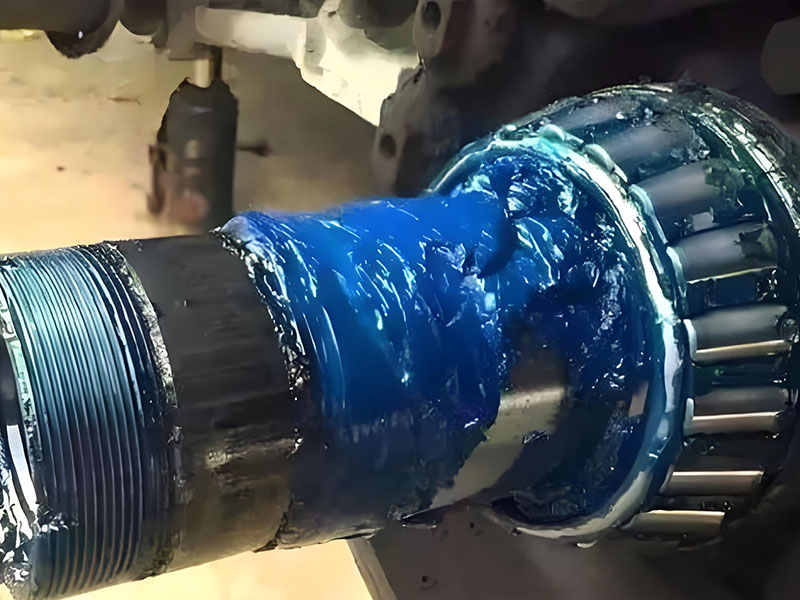
Quick Answer: Bushings are plain-bearing components that support a shaft, carry load, and reduce friction without rolling elements. Common types of bushings include bronze, oil-impregnated sintered bronze, steel and bimetallic, polymer, PTFE-lined composite, rubber, and ceramic or graphite bushings. They are also classified by geometry, lubrication method, load direction, and mounting style. Material, clearance, shaft finish, and operating conditions must be checked together before a bushing is selected.
Types of bushings vary widely because the name covers a family of plain bearings rather than a single part. A bushing may be a simple bronze sleeve in a pump, a flanged polymer bearing in a pedal assembly, or a rubber-bonded isolation mount in a suspension. The right choice depends on load, motion, lubrication, environment, and the housing and shaft it must fit. This guide explains the main bushing types and the selection points that matter in service.
What Is a Bushing and What Does It Do?
A bushing is a plain-bearing element with a non-rolling contact surface. It supports a shaft, carries load, and keeps the shaft in the required position inside a housing. The contact may run on a lubricant film, boundary lubrication, or a self-lubricating solid film.
Its core jobs are to guide shaft position, reduce friction, distribute load over a larger area, damp vibration, and protect the housing bore from wear. A bushing is often a sacrificial part: it is usually cheaper and easier to replace than the housing or shaft it protects.
The term bushing is also used for non-bearing parts, such as electrical insulators, pipe fittings, or drill adapters. In this guide, bushing means a plain bearing or sleeve bearing used for motion and load.
Compared with a rolling-element bearing, a plain bushing has different trade-offs:
- Load capacity: plain bushings spread load over a sliding contact area, while rolling bearings carry load through rolling elements and can be sensitive to shock and contamination.
- Speed limits: rolling bearings generally allow higher speed, while plain bushings are often chosen for low-speed, high-load, or oscillating duty.
- Noise: plain bushings can run quietly, while rolling bearings may add noise from rolling contact.
- Radial space: bushings often fit in thinner radial envelopes, while rolling bearings need radial height for races and rolling elements.
- Misalignment: plain bushings with spherical seats can tolerate more angular misalignment, while standard rolling bearings need careful alignment or a self-aligning design.
How Bushings Are Classified: The Five Main Dimensions
Bushings are easier to compare when they are grouped along five dimensions. A real part is usually a combination of these dimensions, not one category alone.
- Material: metallic, polymer, composite, elastomeric, ceramic, or graphite.
- Geometry: sleeve, flanged, split or wrapped, thrust, spherical or self-aligning, and special-profile designs.
- Lubrication: oil-lubricated, grease-lubricated, dry-running or self-lubricating, and water-lubricated.
- Load and motion: radial, thrust, or combined load; rotating, oscillating, linear, or reciprocating motion.
- Mounting: press-fit, clamped, keyed or tabbed, adhesive-bonded, or bolted flange.
A flanged, oil-impregnated bronze bushing in a small gearbox is one example of a combined classification. So is a split, PTFE-lined composite bushing in a high-volume hinge. The classification helps narrow the choice, but the final part still needs a dimensional and material check.
Types of Bushings by Material
The main material trade-off is between load capacity, speed or PV capability, and lubrication and environment. A material that handles high load may need reliable lubrication; a dry-running polymer may reduce maintenance but carry less load or run hotter. Final selection must also be checked against shaft hardness, surface roughness, and operating temperature.
Bronze, Brass, and Copper-Alloy Bushings
Bronze, brass, and copper-alloy bushings cover a family of alloys. Common families include tin bronze, leaded bronze, aluminum bronze, manganese bronze, and brass. These materials offer good load capacity, machinability, thermal conductivity, and embeddability for small contaminants.
Their limits matter as much as their strengths. Most bronze bushings require oil or grease unless they are oil-impregnated. They can score a hard or poorly finished shaft, and dry running usually lowers the safe speed limit. Typical uses include pump and motor bearings, agricultural and off-highway pivot points, and general industrial machinery.
Sintered Bronze and Oil-Impregnated Bushings
Powder metallurgy creates a porous bronze structure that is vacuum-impregnated with oil. During operation, oil is released from the pores; when the shaft stops, capillary action draws oil back. This gives self-lubricating behavior in low-to-moderate PV applications.
Sintered bronze bushings are often maintenance-free in light duty, quiet in operation, and economical at volume. They are not the right choice for high speed, high temperature, or heavy shock loads. The oil supply depletes over time, and solvents or repeated washing can remove it. Pressing and machining the bore can also close surface pores, so finishing practice must be controlled. Selection depends on the duty cycle and whether re-lubrication is physically possible.
Steel, Bimetallic, and Rolled-Steel Bushings
This group includes hardened and ground steel sleeves, case-hardened bushings, bimetallic bushings with a steel backing and bronze or bearing-alloy lining, and rolled or wrapped steel with a polymer or bronze layer. These designs put high load capacity into a thin wall section, which suits tight radial space envelopes and high shock loads.
Their limits are mainly lubrication and corrosion. A steel bushing needs a reliable lubricant or a bearing lining, and unprotected steel needs corrosion protection. Embeddability is usually lower than in bronze. Typical uses include hydraulic cylinders, suspension and linkage joints, heavy machinery, and wrapped bushings in high-volume assemblies.
Plastic and Polymer Bushings
Common polymer bushings include nylon, acetal (POM), PTFE, UHMWPE, and PEEK. Each has a different balance of friction, load, temperature, and chemical resistance.
- Nylon and acetal: low cost, good dry-running behavior at light loads, low noise, and good chemical resistance. Nylon can absorb moisture, and both materials have temperature limits.
- PTFE and PTFE compounds: very low friction, but low load capacity and creep under sustained load. They are often used as a liner or as a filled compound.
- UHMWPE: excellent abrasion and impact resistance, low friction, and good performance in wet or dirty environments. Its temperature range is limited.
- PEEK and similar high-performance polymers: high temperature and chemical resistance with good dimensional stability, at a higher cost.
General polymer limits include thermal expansion, creep, low thermal conductivity, and heat build-up at the contact surface. Dimensional precision is usually lower than with metals, so the housing and shaft design must allow for the material behavior.
Composite, PTFE-Lined, and Filament-Wound Bushings
A composite bushing uses a structural backing, such as steel, glass fiber, or synthetic fabric, with a self-lubricating sliding layer. The layer may be PTFE fabric, a PTFE-filled compound, or acetal. This construction allows maintenance-free operation with good load capacity relative to weight.
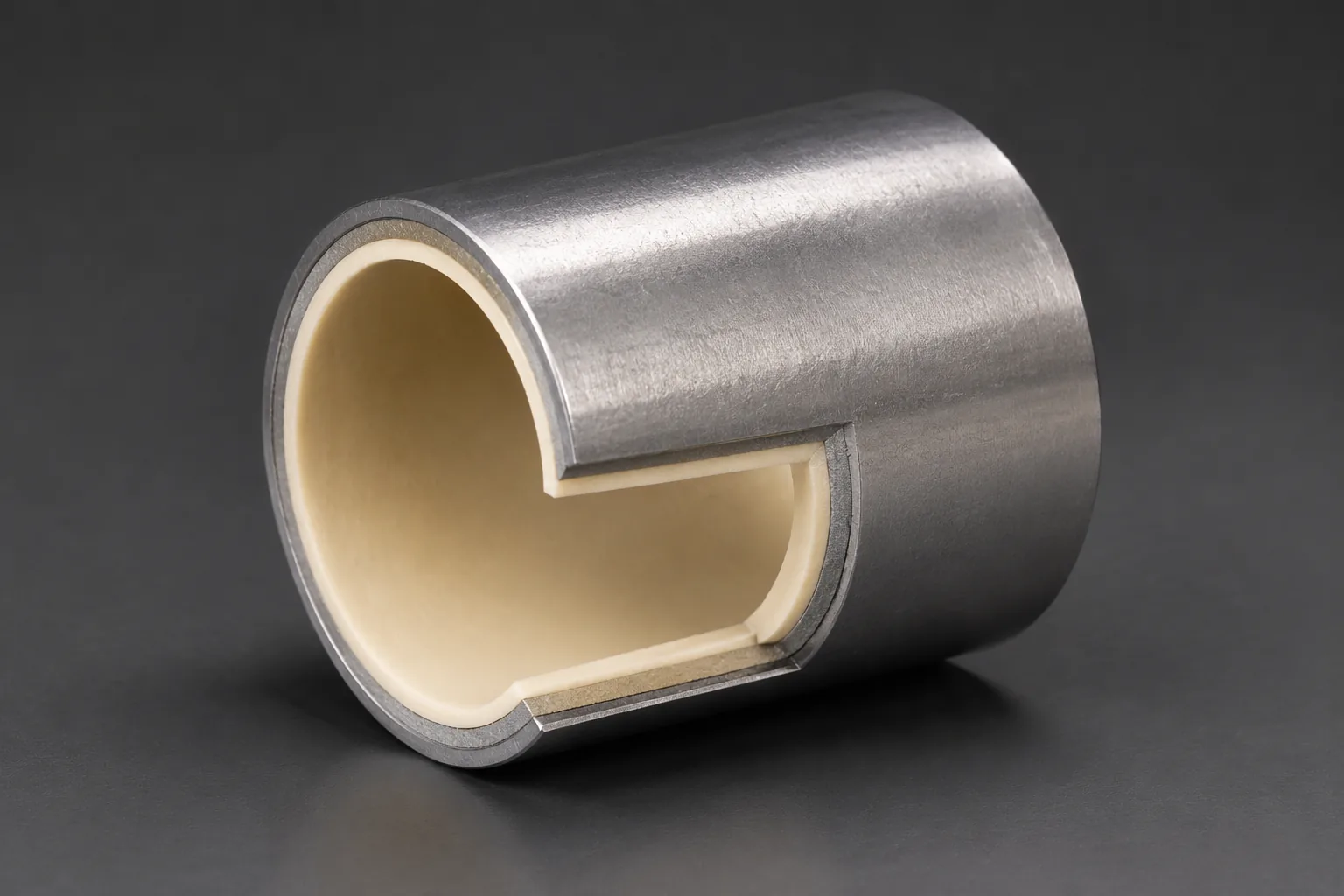
Composite bushings also resist corrosion and can handle edge loading better than some thin liners alone. Their weakness is the thin sliding layer: shaft roughness, abrasive contamination, and misalignment can shorten life, and the part is usually not repairable. Typical uses include automotive suspension and steering, aerospace linkages, marine and offshore pivot points, and industrial self-lubricating joints.
Rubber and Elastomeric Bushings
Rubber and elastomeric bushings are mainly vibration isolation and noise reduction parts, with limited articulation. They are not low-friction rotary bearings. Construction usually bonds rubber between inner and outer metal sleeves, and stiffness is tuned by the rubber compound and geometry.
These bushings absorb shock, isolate structure-borne noise, tolerate misalignment and contamination, and need no lubrication. Their limits include limited torsional travel, heat aging, ozone and chemical attack, and load-deflection behavior that must be tuned for each application. Typical uses include vehicle suspension and subframe mounts, engine mounts, pump and compressor isolation, and appliance mounts.
Ceramic and Graphite Bushings for Extreme Conditions
Ceramic bushings can handle high temperature, corrosion, and abrasion, and some grades offer low friction. They are brittle, however, and sensitive to thermal shock and impact. Graphite and carbon-graphite bushings are self-lubricating at high temperature and chemically inert, which suits dry running where oils would carbonize or contaminate the process.
Typical uses include furnaces, high-temperature conveyors, chemical pumps, and submerged or high-purity processes. Handling and installation loads must respect the brittle nature of these materials, and the housing design should avoid point loading.
Types of Bushings by Geometry and Design
Geometry is driven by load direction, housing design, assembly method, and available axial space. The same material can be supplied as a sleeve, flange, thrust washer, or spherical seat.
Sleeve and Plain Bushings
The sleeve is the baseline design: a simple cylindrical bushing with a plain bore. It offers low cost, a small radial envelope, a simple housing bore, and easy replacement. It does not provide axial location or misalignment compensation, so it needs a shoulder or a separate thrust face for axial loads.
A sleeve bushing is usually press-fit into a housing with interference. Retention can come from the interference fit, an adhesive, or a set screw. The housing bore and shaft finish must be correct for the intended clearance.
Flanged Bushings
A flanged bushing adds an integral radial flange that provides axial location and a thrust-bearing surface. The flange simplifies housing design by removing a separate shoulder, resists axial displacement, and helps control assembly depth.
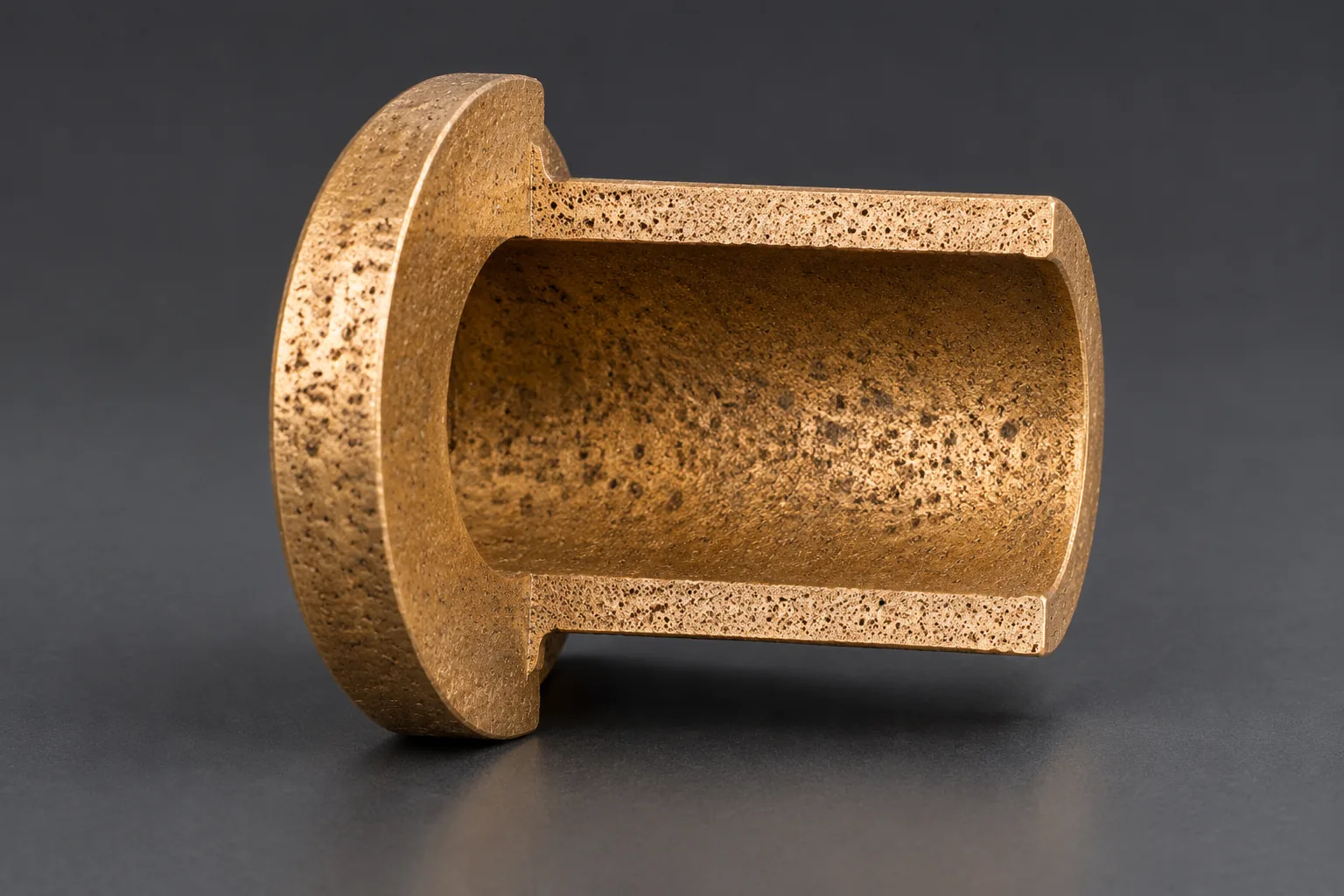
The flange adds cost and requires clearance for its thickness. Its thrust load capacity is generally lower than the radial capacity of the sleeve. Typical uses include linkage pivots, hinge points, motor and gearbox covers, and bores where axial float must be controlled.
Split, Wrapped, and Seam-Type Bushings
A split, wrapped, or seam-type bushing is formed from a strip or sheet into a cylinder, with or without a seam. It often includes a lubricating liner or a bronze layer. These bushings are economical, lightweight, easy to press in, and available in thin walls for space-restricted housings.
The split or seam reduces stiffness and load capacity, and seam orientation relative to the load direction matters. Typical uses include high-volume automotive and appliance assemblies, hinges, and light-duty pivots.
Thrust Washers and Thrust Bushings
Thrust washers and thrust bushings carry axial load rather than radial load. Forms include flat thrust washers, flanged thrust bushings, and combined radial-plus-thrust assemblies. Selection depends on thrust face area, lubrication access, and whether a separate radial bushing is required.
A common arrangement is a radial sleeve bushing paired with a thrust washer in the same joint. This separates the radial and axial load paths and makes replacement easier.
Spherical and Self-Aligning Bushings
A spherical or self-aligning bushing has a spherical outer surface or a spherical bore. This allows angular misalignment between the shaft and housing, so shaft deflection, housing misalignment, or frame flexure does not create severe edge loading.
These designs are more complex, need more radial space, and usually cost more. Many also require lubrication. Typical uses include steering and suspension linkages, heavy equipment pivot joints, and long shaft spans.
Clamped, Keyed, Tabbed, and Special-Profile Bushings
Clamped or split-clamp bushings tighten onto a shaft or into a housing without a press fit, which allows field adjustment and easier removal. Keyed or tabbed bushings use a key, tab, or flat to prevent rotation or axial movement in the housing. Hex, square, or D-bore bushings transmit torque or accept a non-rotating shaft profile.
Anti-rotation features are essential where vibration or torque would otherwise spin the bushing in its housing. The feature must be matched to the housing material and the expected load direction.
Types of Bushings by Lubrication Method
Lubrication method can influence service life as much as material choice. The practical groups are oil, grease, dry or self-lubricating, and water.
Oil-Lubricated and Oil-Impregnated Bushings
Oil film, oil grooves, oil holes, and oil-impregnated sintered structures all fall under this category. Oil lubrication generally supports higher speed and PV combinations than dry running, provided the film is maintained. Groove and hole placement should be in the unloaded region so the oil feed does not interrupt the load-carrying film.
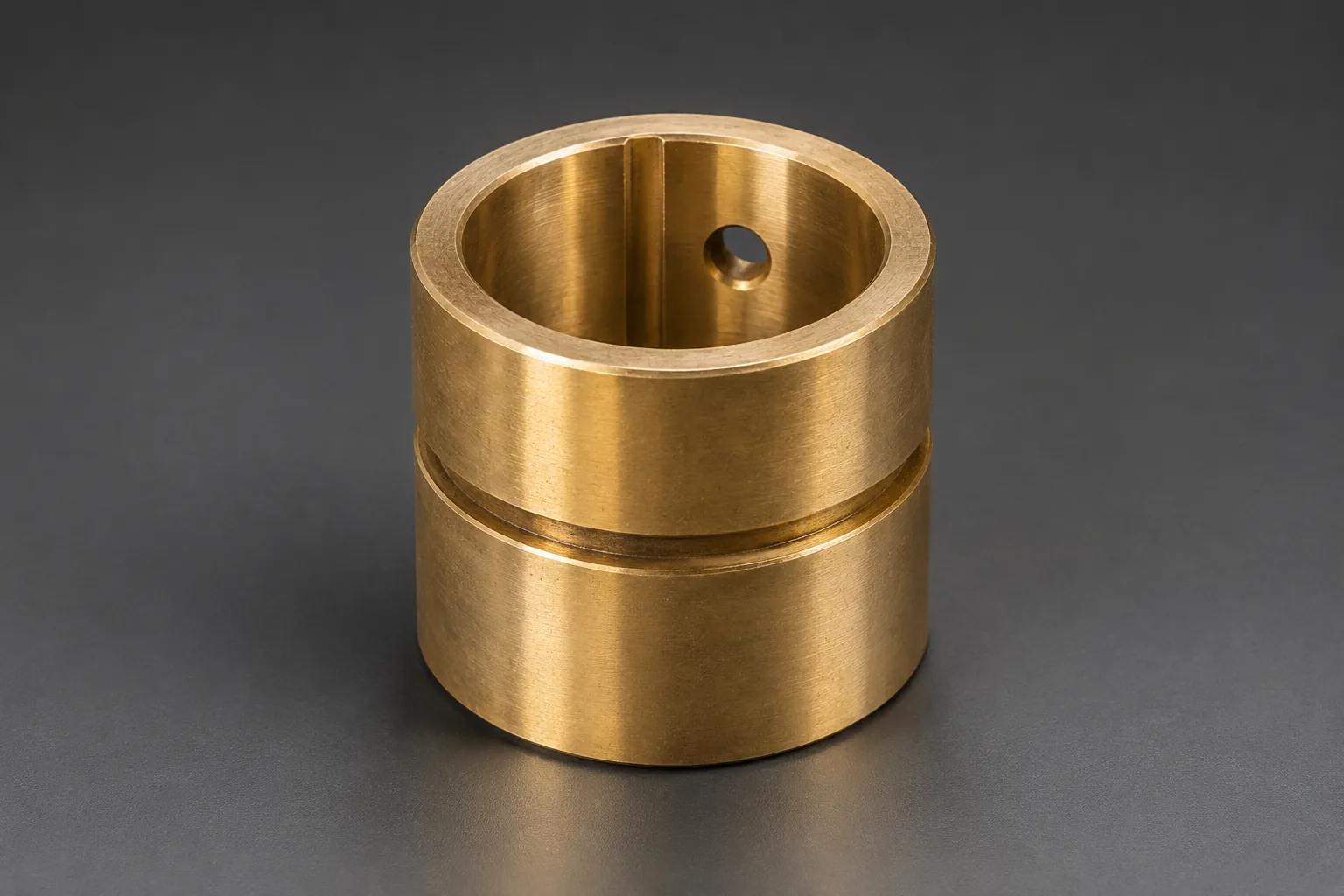
Maintenance includes oil level, oil cleanliness, and replenishment interval. Oil-impregnated bushings reduce the need for external oil feed, but they still depend on the right duty cycle and operating temperature.
Grease-Lubricated Bushings
Grease is used where oil cannot be retained or where a longer re-lubrication interval is required. A grease-lubricated bushing needs grease grooves, a lubrication fitting, or a reservoir. The grease selection must match the operating temperature and load.
Grease-lubricated bushings are common in pivot joints, off-highway equipment, and low-speed high-load applications. Over-greasing and contaminated grease can also cause problems, so the service method matters.
Dry-Running and Self-Lubricating Bushings
Dry-running bushings use solid lubricants such as PTFE, graphite, or MoS2, oil-impregnated porosity, or a polymer sliding layer. They remove the need for a lubrication system, run cleanly, and suit food, medical, and inaccessible locations.
Their limits include lower PV capacity, heat build-up, and sensitivity to shaft finish and contamination. Maintenance-free does not mean unlimited life; the wear rate must be calculated for the application, and the shaft and housing must be within the supplier’s specification.
Water-Lubricated Bushings
Water-lubricated bushings are used where water is the available or acceptable lubricant: marine stern tubes, hydro turbines, pumps, and food-processing washdown. Materials include rubber (cutlass type), composite, ceramic, and some bronze grades.
Design considerations include water flow rate, silt and abrasive content, and corrosion of the shaft and housing. Not all water-resistant materials are suitable for water-lubricated sliding contact, so the material grade and the water conditions must be checked together.
Types of Bushings by Load Direction and Motion
Radial bushings support load perpendicular to the shaft axis and are the most common type. Thrust bushings support load along the shaft axis. Combined-load bushings use a flange or spherical seat to carry both radial and axial components.
Motion type also changes the design. Continuous rotation, oscillating or rocking motion, reciprocating motion, and linear sliding each create different lubrication and wear behavior. Oscillating motion is generally harder on lubricant film formation and often requires a self-lubricating or embedded-lubricant design.
How to Choose the Right Bushing Type: Selection Checklist
Use this checklist before choosing a bushing type. PV, the product of contact pressure and sliding velocity, is a common way to compare severity, but it must be read for the specific material grade.
- Load: magnitude, direction, shock, and edge loading.
- Speed and PV: continuous or intermittent operation, compared with the material’s allowable PV.
- Temperature: ambient and frictional heat, plus thermal expansion mismatch between bushing and housing.
- Environment: dirt, moisture, chemicals, washdown, vacuum, and food-contact requirements.
- Shaft: hardness, surface roughness, and material, because these determine the wear partner behavior.
- Housing: bore tolerance, wall thickness, material, and available installation method.
- Lubrication and maintenance access: whether the joint can be re-lubricated, and how often.
- Misalignment and deflection: whether a self-aligning or spherical design is needed.
- Life target and total cost: initial price plus replacement labor and downtime, not just the unit price.
Selection must be confirmed by the supplier’s PV chart and clearance recommendation for the specific grade. A material that works in one housing may fail in another if the shaft finish, wall thickness, or interference fit changes.
Comparison of Common Bushing Types at a Glance
The table gives qualitative comparisons, not universal limits. Actual PV limits, temperature ranges, and hardness values vary by grade, wall thickness, clearance, and shaft finish, so use supplier data for the selected part.
| Bushing type | Load capacity | Speed and PV | Lubrication | Temperature | Corrosion resistance | Misalignment tolerance | Relative cost |
|---|---|---|---|---|---|---|---|
| Bronze and copper alloy | High | Moderate to high with oil | Oil or grease | Moderate to high | Low to moderate | Low | Moderate |
| Oil-impregnated sintered bronze | Moderate | Low to moderate | Self-lubricating oil | Moderate | Moderate | Low | Low to moderate |
| Steel and bimetallic | High | Moderate | Oil, grease, or liner | Moderate to high | Low unless coated | Low | Moderate |
| Polymer | Low to moderate | Low to moderate | Dry or grease | Low to moderate | High | Low to moderate | Low |
| PTFE-lined composite | Moderate to high | Moderate | Dry | Moderate | High | Low to moderate | Moderate |
| Rubber and elastomer | Application-specific | Low for continuous rotation | None | Low to moderate | Moderate to high | High | Low to moderate |
| Ceramic or graphite | Moderate | Low to moderate | Dry or water | High | High | Low | High |
Typical Applications by Industry
- Industrial machinery: motor and gearbox bearings, conveyors, pumps, and fans.
- Automotive and transport: suspension, steering, pedal, hinge, and seat mechanisms.
- Off-highway and agriculture: pivot joints, cylinder eyes, and linkage pins exposed to dirt and shock.
- Marine and offshore: stern tubes, deck equipment, and corrosion-exposed pivots.
- Food, pharmaceutical, and cleanroom: dry-running and washdown-compatible polymer or composite bushings.
- Energy and heavy equipment: high-temperature, high-load, and low-speed applications.
Standards, Tolerances, and Installation Notes
Relevant standards families include ISO 4379 for copper-alloy bushings, ISO 3547 for wrapped bushings, DIN 1850 for plain bearing bushes, and sintered bronze standards such as ISO 5755 and ASTM B438. Supplier datasheets define the exact material grade, dimensions, and tolerance class for the selected part. The exact designation and fit must be confirmed for the specific part; a generic catalog number does not guarantee interchangeability.
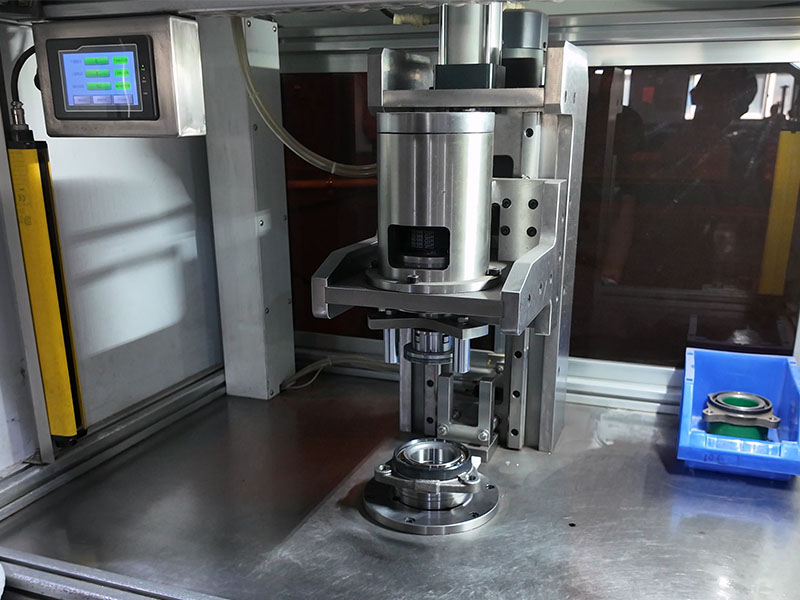
Housing and shaft tolerances determine clearance and interference. Press-fit bushings typically use an interference fit in the housing and a clearance fit on the shaft. Installation should use press tools that act on the non-working face, with guided insertion and no bore deformation. A burnished or reamed bore may be required after pressing.
After installation, check bore diameter, roundness, and clearance, especially for thin-walled and porous bushings. Exact fits depend on the bushing type, wall thickness, housing material, and application loads, so always confirm the values with the supplier.
Common Failure Modes and Maintenance Practices
Common wear modes include adhesive wear, abrasive wear, fretting, fatigue, and corrosion. Root causes include inadequate lubrication, wrong clearance, shaft roughness, contamination, misalignment, and overheating. Symptoms include increased clearance, noise, vibration, temperature rise, and visible scoring or discoloration.
Maintenance should cover the lubrication schedule, contamination exclusion through seals and boots, clearance checks, and planned replacement intervals. Replace the bushing when clearance exceeds the application limit or when liner wear-through is detected. Inspect the shaft as well as the bushing, because a worn or rough shaft can damage a new part.
Conclusion
Types of bushings are best understood as a set of design choices rather than a single part category. Material, geometry, lubrication, load direction, and mounting method work together. A bronze bushing with oil grooves, a dry-running PTFE-lined composite, and a rubber isolation mount may all be called bushings, but they solve different problems.
To choose safely, define the load and motion, the speed and PV demand, the temperature and environment, the shaft and housing condition, and the maintenance access. Then confirm the material grade, dimensions, clearance, and installation method with the supplier’s datasheet. That sequence keeps the bushing type matched to the application instead of relying on a generic catalog description. For application-specific selection or dimensional customization, confirm feasibility with the supplier’s technical team and the datasheet before ordering.
FAQs
Q1: What is the difference between a bushing and a bearing?
A: A bushing is a type of plain bearing, while the word bearing also covers rolling-element bearings and other designs. A bushing supports a shaft through a sliding contact surface, often with a lubricant film or a self-lubricating layer, and it usually has a simpler, thinner construction than a rolling bearing.
Q2: Which bushing material is best for high loads at low speed?
A: For high loads at low speed, a bronze, steel, or bimetallic bushing with reliable lubrication is often a practical starting point. The final choice depends on shock, shaft hardness, housing stiffness, and whether the joint can be re-lubricated; confirm the allowable PV and clearance with the supplier.
Q3: Are oil-impregnated bronze bushings maintenance-free?
A: Oil-impregnated sintered bronze bushings are self-lubricating for low-to-moderate duty, but maintenance-free does not mean unlimited life. Oil supply depletes, high temperature or washing can shorten service, and the bore and shaft finish must be controlled during installation.
Q4: Can I use a plastic bushing instead of a bronze bushing?
A: A plastic bushing can replace bronze in some light-load, low-speed, or corrosion-sensitive applications, but it is not a direct drop-in substitute. Check load, speed, temperature, creep, thermal expansion, shaft finish, and clearance before changing material.
Q5: What is the difference between a sleeve bushing and a flanged bushing?
A: A sleeve bushing is a plain cylinder that carries radial load and relies on a shoulder or separate part for axial location. A flanged bushing adds an integral flange that controls axial position and can carry limited thrust, at the cost of extra space and usually lower thrust capacity than radial capacity.
Q6: When should I choose a self-aligning or spherical bushing?
A: Choose a self-aligning or spherical bushing when shaft deflection, housing misalignment, or frame flexure would cause edge loading in a plain sleeve. These designs tolerate angular misalignment but need more radial space and usually require lubrication or a suitable liner.
Q7: How do I know when a bushing needs to be replaced?
A: Replace a bushing when clearance, noise, vibration, or temperature rise exceeds the application limit, or when inspection shows scoring, liner wear-through, or loss of lubrication. Inspect the shaft and housing as well, because a worn shaft can damage a new bushing.
Q8: What causes a bushing to spin in its housing?
A: A bushing can spin in its housing when the interference fit is too low, the housing bore is oversized or damaged, the bushing is installed with the wrong press tool, or torque and vibration exceed the anti-rotation design. Check bore size, roundness, retention features, and installation method before replacing the part.