Quick Answer: Types of pulleys fall into two broad groups: simple-machine pulleys used to change rope direction or gain mechanical advantage, and drive pulleys used with belts, ropes, or cables to transmit power, guide motion, or maintain tension. Common variants include fixed, movable, compound, block-and-tackle, snatch-block, V-belt, flat-belt, timing-belt, and wire-rope designs. Selection depends on the duty, transmission element, load path, shaft, bearing, and environment.
A pulley is a wheel with a groove or drive profile that works with a rope, cable, or belt. In everyday use, the word can mean a simple rope wheel, a sheave in a lifting block, or a belt-drive pulley on a machine. The differences matter because the same basic shape can serve very different duties: changing pull direction, carrying a load, transmitting power, guiding a belt, or holding tension.
Buyers and maintenance teams often need to identify a pulley type before they can compare materials, bearings, groove profiles, or replacement options. The sections below organize the common types by mechanical arrangement, by power transmission element, and by specialized function.
What Is a Pulley?
At its simplest, a pulley consists of a grooved or profiled wheel mounted on a shaft or bearing, with a rope, cable, or belt running in the groove or on the profile. The wheel may sit in a fixed bracket, a movable block, or a drive housing. The support structure carries the load and keeps the wheel aligned with the running line.
The core job is to redirect or transfer motion. A simple-machine pulley changes the direction of a pull. A drive pulley transfers power between a belt and a shaft. A guide or idler pulley supports and routes a belt without driving it. A tensioner pulley maintains operating tension or takes up slack. These functions can overlap, but they are not interchangeable in every application.
A pulley is not automatically a lifting device, and a belt pulley is not automatically a rope sheave. Identify the running element first – belt, wire rope, fiber rope, or chain – before selecting a type or comparing a replacement.
How Pulley Types Are Classified
Pulleys are grouped in several ways because one pulley can belong to more than one category. A grooved wheel in a crane block is a mechanical-arrangement pulley and a wire-rope pulley at the same time. A toothed wheel on a drive shaft is a power-transmission pulley and a timing-belt pulley. For practical selection, classify by the main duty and then confirm the details.
- By mechanical arrangement: fixed, movable, compound, block and tackle, and snatch block.
- By transmission or load element: V-belt, flat belt, timing belt, wire rope, and chain or other specialty drives.
- By function: drive, guide, idler, tensioner, redirect, or lifting.
The classification used below follows the main purpose first. A pulley that crosses categories should be checked against the application requirements for both its arrangement and its running element.
Types of Pulleys by Mechanical Arrangement
This group covers pulleys whose type is defined mainly by how the wheel, rope, and load are arranged. The key differences are whether the axle moves, whether the pull direction changes, and whether the system is intended to provide a mechanical advantage.
| Type | Axle or block movement | Main role | Typical use |
|---|---|---|---|
| Fixed pulley | Axle stays in place | Changes pull direction | Guidance and redirection |
| Movable pulley | Moves with load or rope | Can share load under ideal conditions | Lifting and pulling systems |
| Compound pulley | Combines fixed and movable wheels | Direction change plus load sharing | Rigging and mechanical advantage layouts |
| Block and tackle | Multiple fixed and movable blocks | Moves larger loads with smaller pull | Lifting and tensioned rigging |
| Snatch block | Side-opening block | Changes direction or adds a pull point | Recovery and temporary guidance |
Fixed Pulley
A fixed pulley has an axle or bracket that stays in place while the rope or belt moves over the wheel. Its main role is to change the direction of a pull, which is useful for lifting, guiding, or redirecting a line. In a simple fixed-pulley arrangement, the pulley does not by itself provide a mechanical advantage; it changes direction rather than multiplying force. When combined with a movable pulley in a compound system, the overall arrangement can provide an advantage.
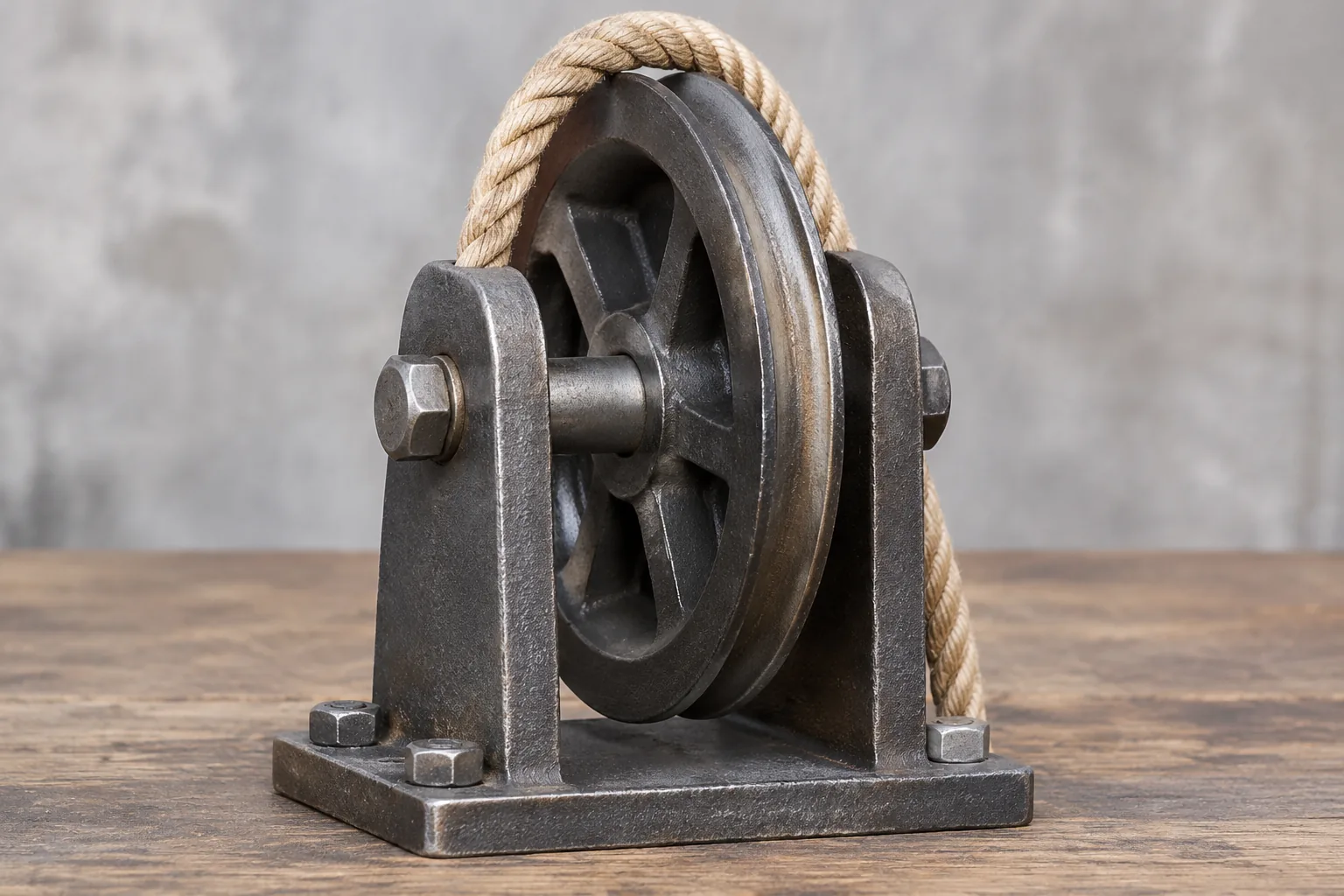
Use a fixed pulley where the line must be redirected and the load path is already defined. Do not treat a single fixed pulley as a force-reducing device.
Movable Pulley
A movable pulley travels with the load or with the rope as the load moves. It can share the load between parts of the rope under ideal conditions, so it is often used in lifting and pulling systems where reduced effort is wanted. The real benefit depends on friction, rope weight, the number of supporting rope parts, and the way the pulley is reeved.
A movable pulley is a system component, not a standalone guarantee of reduced effort. Check the complete arrangement before relying on a calculated advantage.
Compound Pulley
A compound pulley combines fixed and movable pulleys, or uses more than one wheel to combine a direction change with load sharing. It is a system arrangement rather than a single wheel type. Compound systems appear in lifting, rigging, and mechanical advantage layouts where the rope path passes over several wheels.
The actual advantage depends on the number of effective rope parts and the layout. Confirm the reeving and the rated components before using a compound pulley in a load-handling system.
Block and Tackle
A block and tackle is a pulley system made from one or more fixed blocks and one or more movable blocks. It uses multiple rope parts to move a larger load with a smaller pull and can also change the pull direction. The useful advantage depends on the number of effective rope parts, friction, rope path, and the efficiency of each sheave.
For lifting or tensioned rigging, use blocks with a published working load limit, inspect the assembly, and follow the manufacturer’s instructions and applicable safety requirements. Do not use an unrated block for overhead or safety-critical lifting.
Snatch Block
A snatch block is a pulley block with a side plate that opens or accepts a rope from the side. It can be attached to a rope mid-line or used to change direction in off-road recovery, rigging, and temporary guidance work. The side-opening feature saves time when the rope end is not free, but it also makes correct closure and pinning essential.
Match the snatch block to the rope diameter and the working load limit. Inspect the side plate, pin, sheave, and rope before use, and keep personnel clear of the load path.
Types of Pulleys by Power Transmission Element
In industrial drives, pulley often means a belt pulley or sheave rather than a simple rope wheel. The transmission element determines the groove or profile, the alignment requirement, and the type of power transfer. Do not mix a belt pulley with a wire-rope sheave or assume that similar outside diameters make two pulleys interchangeable.
V-Belt Pulley / Sheave
A V-belt pulley, also called a V-belt sheave, has one or more V-shaped grooves that mate with a V-belt. Power is transmitted by friction between the belt sides and the groove flanks. Key selection details include the groove profile, pitch or outside diameter, number of grooves, bore or bushing type, and the belt section it is designed to accept.
Use V-belt pulleys in friction drives where the belt and groove are matched, including industrial fans, pumps, compressors, and other belt-driven machinery. Confirm the belt section, groove count, alignment, and shaft fixing before installation. A multi-groove pulley also needs correct belt matching and parallel alignment across the grooves.
Flat Belt Pulley
A flat belt pulley has a cylindrical face, sometimes with a slight crown, and runs with a flat belt. The plain face relies on friction and alignment rather than a V-groove. Diameter, face width, crown, surface condition, and shaft mounting are the main details to check.
Flat belt drives are sensitive to alignment, tension, and surface condition. They appear in traditional flat-belt drives and in some conveying or sorting equipment. Confirm the pulley face and belt width together, and check that the belt runs centrally on the face.
Timing Belt Pulley
A timing belt pulley has teeth that mesh with a toothed synchronous belt. It transmits motion by tooth engagement rather than by friction alone, which suits drives that need synchronized movement, controlled positioning, or low-slip operation. The tooth profile, tooth count, pitch diameter, face width, and flanges must match the belt.
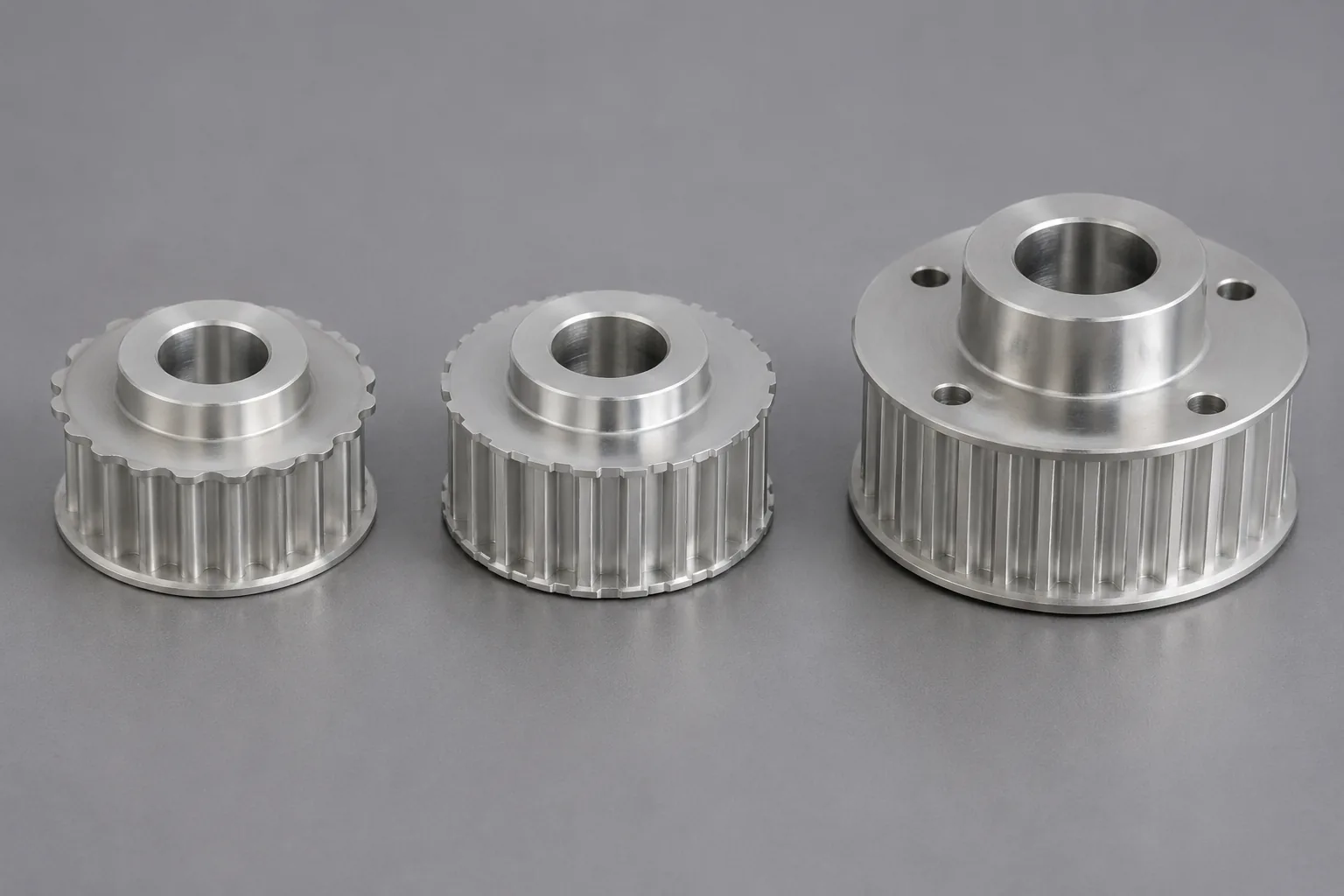
Timing belt pulleys are not interchangeable by diameter alone. The tooth profile and pitch must match the belt, and the shaft fixing and alignment must be correct for the drive.
Wire Rope Pulley / Sheave
A wire rope pulley, or sheave, has a groove shaped to support a wire rope. It guides or carries the rope in cranes, hoists, rigging, and lifting equipment. The rope diameter, groove profile, sheave diameter and its relationship to rope size, material, bearing, and rated assembly are all part of the selection.
Use a sheave designed for wire rope, not a standard belt pulley. Confirm that the groove matches the rope, that the sheave and block are rated for the duty, and that the assembly is inspected before lifting use.
Specialized Pulley Types
Some pulleys are named by function or material rather than by a strict mechanical class. These include idler and guide pulleys, tensioner pulleys, crowned pulleys, and pulleys made from nylon or other engineering plastics. The name usually points to the job the pulley performs in the system.
- Idler or guide pulley: supports and routes a belt or rope without driving it.
- Tensioner pulley: maintains operating tension or takes up slack in a belt drive.
- Crowned pulley: uses a curved face to help center a flat belt.
- Plastic or nylon pulley: uses a lightweight, low-friction or corrosion-resistant body for suitable light-duty applications.
Specialized pulleys still need the correct bore, bearing, groove or profile, and load rating for the application. Confirm the function in the system before using a specialized pulley as a substitute for a standard drive or lifting pulley.
Pulley Materials and Bearing Considerations
Common pulley materials include cast iron, steel, aluminum alloy, and engineering plastics such as nylon. Material choice follows load, speed, environment, and cost, not appearance alone. Cast iron and steel suit many heavy or rigid duties; aluminum reduces weight; engineering plastics can suit lighter loads or wet and corrosive exposure when the design supports it.
The bearing supports rotation and affects friction, noise, alignment, and service life. Pulley bearings may be plain or rolling, sealed or open, flanged or plain. A sealed rolling bearing is common where dust or water exposure must be limited, while a plain bearing may suit a simpler or lower-speed application.
Check the shaft fit, radial load, speed, duty cycle, and contamination exposure against the manufacturer’s data. High speed, heavy load, outdoor use, and corrosive conditions require a closer check of both material and bearing choice.
How to Choose the Right Type of Pulley
Start with the duty, then confirm the running element and the mechanical details. A pulley that looks correct by diameter can still be wrong for the belt, rope, shaft, or load path.
- Define the purpose: power transmission, guidance, tensioning, lifting, or direction change.
- Identify the running element: V-belt, flat belt, timing belt, wire rope, fiber rope, or chain.
- Check the load path and speed: confirm the pulley, shaft, bearing, and fixing are suitable for the duty.
- Match the interface: groove profile, pitch or diameter, face width, bore, bushing, keys, and available space.
- Check the environment: dust, water, heat, corrosion, and the required bearing sealing.
- Confirm ratings and instructions: for lifting or safety-critical use, use rated equipment and follow the manufacturer’s instructions and applicable standards.
When the application involves overhead lifting, never rely on an unmarked or unrated pulley. Confirm the working load limit, rope or belt match, inspection status, and complete assembly before use.
Common Mistakes and Exceptions
Most pulley selection errors come from treating a familiar shape as a universal part. A pulley is defined by its duty and interface, not by its outline alone.
- Confusing a simple-machine rope pulley with a belt-drive pulley or a wire-rope sheave.
- Selecting by outside diameter while ignoring groove profile, belt or rope size, or bore.
- Using an unrated block or sheave for overhead lifting or safety-critical rigging.
- Ignoring alignment, tension, friction, and environmental exposure.
- Assuming that a pulley with the same shaft size is interchangeable without checking the full assembly.
These points are risk checks, not a substitute for engineering calculation or the manufacturer’s application data. Where a pulley is part of a lifting system or a guarded drive, the complete assembly and its instructions govern safe use.
Conclusion
The main types of pulleys divide into simple-machine arrangements and power-transmission or lifting designs. Fixed, movable, compound, block-and-tackle, and snatch-block pulleys describe how the rope and load are arranged. V-belt, flat-belt, timing-belt, and wire-rope pulleys describe the running element and the interface that must match. Specialized idler and tensioner pulleys add function-specific roles.
For a safe choice, identify the duty first, then confirm the running element, groove or profile, shaft and bearing, load path, environment, and any required rating. Use manufacturer data for the specific pulley and assembly, and treat lifting or safety-critical equipment with the required inspection and load-limit controls. The right type of pulley is the one that matches the complete system, not just the wheel diameter.
FAQs
Q1: What is the difference between a pulley and a sheave?
A: A pulley is the general term for a grooved or profiled wheel used with a rope, cable, or belt; a sheave commonly refers to the grooved wheel itself, especially in lifting and rigging, while a pulley can also mean the complete assembly. The correct term depends on the industry, so confirm the interface rather than relying on the name alone.
Q2: What are the main types of pulleys?
A: The main types include fixed, movable, compound, block-and-tackle, snatch-block, V-belt, flat-belt, timing-belt, and wire-rope pulleys, plus idler, tensioner, and other specialized designs. They are grouped by mechanical arrangement, transmission element, or function.
Q3: What is a fixed pulley used for?
A: A fixed pulley is used to change the direction of a rope or cable pull while its axle stays in place. It is common for guidance and redirection and does not by itself provide a mechanical advantage in the simple fixed-pulley arrangement.
Q4: What is a movable pulley?
A: A movable pulley travels with the load or rope and can share the load between rope parts under ideal conditions. Its real benefit depends on friction, rope weight, and the complete reeving arrangement.
Q5: What is a snatch block?
A: A snatch block is a pulley block with a side plate that opens or accepts a rope from the side, so it can be attached mid-line or used to change direction in recovery and rigging work. Match it to the rope and working load limit, and confirm the side plate is closed and secured before use.
Q6: What is a V-belt pulley?
A: A V-belt pulley, or sheave, has one or more V-shaped grooves that mate with a V-belt to transmit power in a friction drive. The groove profile, diameter, groove count, and shaft fixing must match the belt and the application.
Q7: How do I choose a pulley bearing?
A: Choose a pulley bearing by matching shaft size, radial load, speed, duty cycle, sealing, and contamination exposure to the manufacturer’s data. A sealed rolling bearing suits many dusty or wet duties, while a plain bearing may suit a lower-speed or simpler design.