Quick Answer: Linear bearings guide a carriage or shaft along a straight path, while rotary bearings support a shaft turning about an axis. The required motion decides the family first; load direction, speed units, life basis, mounting accuracy, and lubrication then decide the specific type. Linear life is rated in running distance and rotary life in revolutions, so the two L10 figures cannot be compared directly. Many machines use both families in one drive train.
Comparing linear bearings vs rotary bearings starts with the motion each one has to support, not with the shape of the rolling element. A machine that positions a table along a rail and a machine that spins a shaft both need low-friction support, but they need different bearing families. This comparison covers rolling linear bearings and guides and rolling rotary bearings: how they are built, how load and speed are rated, what installation demands, and where each type fits. Plain bearings and specialty designs are outside the scope.
Linear Bearings vs Rotary Bearings: What Is the Core Difference?
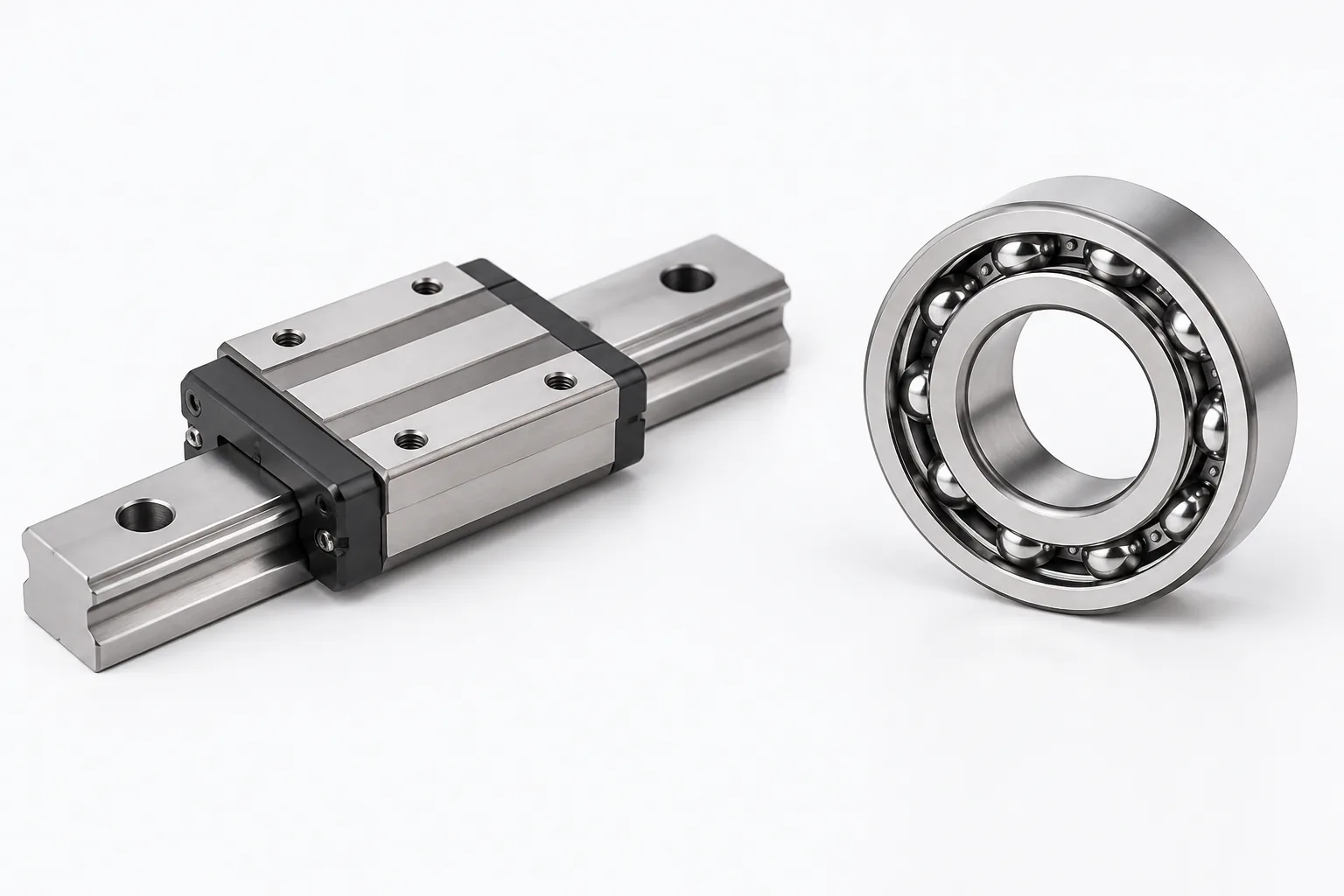
Linear bearings guide a carriage, bushing, or shaft along a straight track. The common rolling forms are a linear ball bushing running on a shaft, a profiled rail guide with a carriage on a rail, and a recirculating ball or roller guide. Rotary bearings support a shaft that turns about an axis. The common rolling forms are deep-groove ball, angular-contact ball, cylindrical roller, tapered roller, and thrust bearings.
The first selection split is the required motion path, not the rolling element shape. If the load must be guided along a track, a platform, or a shaft in straight travel, evaluate a linear guide first. If the load must be supported while it turns about an axis, evaluate a rotary bearing first.
| Comparison | Linear rolling bearings and guides | Rotary rolling bearings |
|---|---|---|
| Motion | Reciprocating or continuous straight travel along a rail or shaft | Rotation of a shaft about an axis between inner and outer rings |
| Common forms | Linear ball bushing, profiled rail guide, recirculating ball or roller guide | Deep-groove ball, angular-contact ball, cylindrical roller, tapered roller, thrust |
| Speed unit | Meters per second, plus stroke and reciprocations per minute | Revolutions per minute, with reference and limiting speed |
| Life unit | Total running distance, usually kilometers | Total revolutions, or running hours converted from revolutions |
| Typical duty | Positioning a platform or carriage along a track | Supporting a rotating shaft and holding its position |
The units already signal that the two families are rated on different duty. Linear travel is described in meters per second, and a reciprocating axis also needs stroke length and cycles per minute. Rotation is described in revolutions per minute, with a reference speed and a limiting speed for the specific bearing.
Some linear systems use recirculating rollers rather than balls. That changes stiffness and load capacity, but it does not change the motion path. Rotary bearings include both ball and roller designs, and their ability to carry radial load, axial load, or a combination depends on the type.
How Each Type Is Built and Where the Rolling Elements Move
A recirculating linear guide is a system rather than a single ring. It typically contains a rail or shaft, a carriage or bushing, recirculating balls or rollers, return channels that carry the rolling elements back to the start of the loaded zone, seals, and a lubrication arrangement. The return channels are what allow the carriage stroke to be longer than the carriage body itself.
A rotary bearing is compact by comparison. It typically contains an inner ring, an outer ring, a set of balls or rollers, and a cage that keeps the rolling elements spaced. The rolling elements run in a closed circular raceway between the rings, so motion is continuous rotation rather than repeated travel along a track.
Before comparing load figures, confirm which linear design is in use. A shaft-based bushing and a profiled rail guide have different mounting arrangements, different stiffness behavior, and different sensitivity to alignment, so their catalog values are not interchangeable.
Linear motion can also be produced by sliding bearings and other technologies. This comparison stays with rolling linear bearings and guides because their rating and life methods are the ones that can be set against rolling rotary bearings.
Speed and Life Metrics Are Not Directly Comparable
Both families use the term L10 and both publish a basic dynamic load rating C, which makes the numbers look comparable. They are not.
For a linear guide, L10 is the total running distance that 90% of a group of identical products are expected to reach before the first rolling fatigue flaking, under identical conditions. The result is a distance, usually stated in kilometers.
The governing standards are separate. ISO 14728-1:2017 sets out dynamic load ratings and rating life for linear motion rolling bearings; it was prepared by ISO/TC 4/SC 8, published in February 2017, and confirmed in 2022. ISO 14728-2:2017 covers basic static load ratings, static equivalent loads, and static safety factors for the same family. Rotary bearings follow ISO 281:2007 for dynamic load ratings and rating life, which defines the basic rating life at 90% reliability. That standard is still listed as current but is marked as pending revision.
The rating basis also differs between linear product types. A ball-type profiled rail guide commonly uses a 50 km basis:
L10 = (C / P)^3 x 50 km
A roller-type guide commonly uses a 100 km basis with a life exponent of 10/3:
L10 = (C / P)^(10/3) x 100 km
When you compare dynamic load ratings from different linear guide catalogs, check whether the published value is tied to a 50 km or a 100 km basis. A rating quoted on the shorter basis does not represent the same duty as one quoted on the longer basis.
Do not compare a linear life in kilometers with a rotary life in revolutions or hours without converting the actual duty cycle and confirming both rating bases. If the application combines both motions, calculate each bearing family separately and keep the results labeled with their units.
For rotary bearings, ISO 16281:2025 describes a modified reference rating life method that accounts for lubrication, contamination, the fatigue load limit, misalignment, operating clearance, and the internal load distribution. It does not cover wear or micropitting. It is a refinement of rotary life calculation, not a method for converting linear life into rotary life.
How Load Capacity and Stiffness Compare
Profiled rail guides can be arranged to carry loads in several directions. A four-way equal-load design is rated equally in the radial direction, the reverse-radial direction, and the two lateral directions. A rail guide can also resist pitch, yaw, and roll moments when the carriage supports an offset or cantilevered platform.
Rotary bearings vary by type. A deep-groove ball bearing can carry radial load and axial load in both directions, with low friction and good high-speed capability. A cylindrical roller bearing is aimed mainly at high radial loads. A thrust bearing is aimed mainly at axial loads. The bearing type and its catalog load ratios decide how much combined radial and axial load is acceptable.
Stiffness and capacity must come from the selected product datasheet, not from the category name. A linear bushing may not match a profiled rail guide in load direction or moment capability, and a small deep-groove ball bearing does not behave like a large tapered roller bearing.
One product-specific comparison is often quoted in linear guide literature: a circular-arc groove radius of about 52% of the ball diameter, with a claim that, under that specific contact geometry, one ball can carry about 13 times the load of a ball against a flat contact plane. Treat this as a property of that groove design, not as a general advantage of linear bearings over rotary bearings.
When a linear carriage carries an offset platform, evaluate the moment loads as well as the direct loads. For rotary bearings, evaluate the combined radial and axial load case against the type-specific load ratios in the catalog.
Speed, Acceleration, and Operating Conditions
Linear systems are usually limited by linear speed, acceleration, stroke length, and reciprocating frequency. Rotary systems are usually limited by reference speed and limiting speed. Match the unit to the motion: meters per second and reciprocations per minute for linear travel, revolutions per minute for rotation.
Friction is not a fixed property of rolling motion. It depends on bearing type, size, running speed, lubricant type, and lubricant quantity, so a single friction coefficient should not be assumed for a whole category.
Published limits show how much the numbers vary by product. One linear ball bearing series lists a maximum speed of 5 m/s. One manufacturer’s 6205 deep-groove ball bearing lists a 25 mm bore, 52 mm outside diameter, 15 mm width, 14.8 kN basic dynamic load rating, 7.8 kN basic static load rating, 18,000 r/min limiting speed, and 28,000 r/min reference speed.
Linear guide selection tables commonly include dynamic load capacity, maximum speed, maximum acceleration, temperature, and maximum length. The choice between a ball rail and a roller rail guide depends mainly on dynamic performance, stiffness, and load capacity requirements.
Operating conditions change the load assumptions. One linear guide manufacturer’s selection guidance calls for rail raceway hardness of 58-64 HRC to achieve the designed load capacity. That guidance gives load factors of 1-1.2 at 0.25 m/s or less, and 2-3.5 above 2 m/s with strong vibration or impact.
High-speed rotary bearings also need a minimum load. Without it, rolling element inertia and lubricant friction can cause harmful sliding instead of clean rolling. Maximum speed figures are product-specific and lubrication-dependent, so they should not be read as a universal category limit.
Installation and Alignment Requirements
Linear guide accuracy and life depend strongly on the mounting surface. Flatness, parallelism, and alignment between rails, or between shaft and carriage, set the starting point for load distribution. When multiple rails are not correctly aligned, the balls can experience differential sliding, friction rises, and abnormal wear follows.
Define the datum surface and the alignment tolerances before comparing load ratings. A guide that is correctly sized but poorly aligned can fail earlier than a smaller guide that is mounted correctly.
Rotary bearings are usually mounted between a shaft and a housing. Selection has to consider the radial and axial load combination, speed, internal clearance, shaft and housing fits, tolerances, lubrication, sealing, and shaft misalignment. Fits and internal clearance interact: a tight housing fit can reduce the internal clearance the bearing needs to run correctly.
Some self-aligning rotary bearing types tolerate a certain amount of misalignment, but the allowable amount must come from the specific product datasheet. It should not be transferred to a non-self-aligning type.
Application Examples and Combined Systems
Linear bearings and guides appear in CNC tables, industrial robot linear axes, packaging equipment, semiconductor equipment, automation conveyors, and measuring platforms. The common requirement is to position a load along a track and resist the moments produced by the moving platform.
Rotary bearings appear in motors, gearboxes, pumps, fans, wheel hubs, spindles, and other rotating shaft systems. The common requirement is to support a shaft, hold its position, and reduce rotational friction.
In many machines the two families are complementary rather than competing. In a ball-screw-driven linear axis, linear guides support and guide the worktable while angular-contact rotary bearings support the screw end. Some double-direction angular-contact thrust ball bearings intended for machine tool ball screw support are offered in shaft diameter ranges such as 8-30 mm and 12-60 mm depending on the series.
Use a linear guide when the requirement is to position a platform along a track and resist platform moments. Use a rotary bearing when the requirement is to support a rotating shaft and reduce rotational friction. When the drive train contains both a moving table and a rotating screw, select at the subsystem level and expect to use both.
How to Read a Rotary Bearing Datasheet in This Comparison
A rotary bearing datasheet is read through a small set of fields: bore, outside diameter, width, basic dynamic load rating, basic static load rating, reference speed, and limiting speed. The 6205 example above shows the pattern: 25 mm bore, 52 mm outside diameter, 15 mm width, 14.8 kN dynamic rating, 7.8 kN static rating, 18,000 r/min limiting speed, and 28,000 r/min reference speed.
Use catalog values only for the exact bearing and for the lubricant and operating conditions the manufacturer states. A rating published for one grease fill or one clearance class does not automatically apply to another.
Do not infer linear guide performance from a rotary bearing datasheet, or the reverse. The rating bases, the motion units, and the life units are different, and a direct numerical comparison will mislead the selection.
A single 6205 example is illustrative. It does not represent all rotary bearing sizes, all rotary bearing types, or all operating conditions.
Selection Checklist: Linear or Rotary?
- Start with the required motion: straight reciprocation or positioning, or rotation about a shaft axis.
- Check load direction and moment loads, not only the total load magnitude.
- Use the speed unit that matches the motion, and the life unit that matches the bearing family.
- Confirm the rating basis behind any linear dynamic load rating, including whether it is a 50 km or 100 km basis.
- Review mounting, alignment, lubrication, sealing, and the operating environment before finalizing the type.
- Check whether the machine needs both linear guides and rotary bearings in the same drive train.
A linear guide is the practical choice for track-guided positioning with platform moments. A rotary bearing is the practical choice for supporting a rotating shaft and reducing rotational friction. A combined system may be the correct answer even when the question asks for one bearing type.
Conclusion
The linear bearings vs rotary bearings decision is settled by the motion path first, then by load direction, speed, life basis, and mounting. Linear rolling bearings are rated for distance along a track; rotary rolling bearings are rated for revolutions about an axis. Their L10 values, load ratings, and speed limits belong to different systems and should be compared only inside the same family and the same rating basis. For a mixed drive train, size the linear guides and the rotary bearings as separate subsystems.
A safe next step is to write down the motion, the load directions including moments, the speed and stroke, the mounting arrangement, and the lubrication and sealing environment. Use those inputs to request the specific datasheet values for the candidate bearing, and confirm the rating basis before any comparison.
FAQs
Q1: Are linear bearings and rotary bearings interchangeable?
A: No. They serve different motion paths, so one is not a drop-in replacement for the other. A machine may use a linear guide for the moving table and a rotary bearing for the drive screw or rotating shaft; the two are usually complementary parts of the same system, sized separately.
Q2: Can linear bearings carry radial, side, and moment loads?
A: Some profiled linear rail guides can. Four-way equal-load designs are rated equally in the radial, reverse-radial, and two lateral directions, and rail guides can resist pitch, yaw, and roll moments when the carriage supports an offset load. Check the specific datasheet, because not every linear bushing or guide has four-way equal-load capability.
Q3: Why can’t L10 life be compared directly between linear and rotary bearings?
A: Linear L10 is based on total running distance, commonly kilometers, while rotary L10 is based on revolutions and can be converted to running hours. Linear dynamic ratings follow ISO 14728-1 and rotary dynamic ratings follow ISO 281. Compare life values only within the same bearing family and the same manufacturer rating basis; for linear guides, confirm whether the rating uses a 50 km or a 100 km basis.
Q4: Which type is better for high-speed applications?
A: The question has to be split by motion type, because linear speed is measured in meters per second and rotary speed in revolutions per minute. Use the product datasheet limits and the stated lubrication conditions. One linear ball bearing series lists a maximum speed of 5 m/s, while one manufacturer’s 6205 deep-groove ball bearing lists an 18,000 r/min limiting speed and a 28,000 r/min reference speed.
Q5: Do linear guides require precise alignment?
A: Yes. Linear guide accuracy and life depend on mounting-surface flatness, parallelism, and rail-to-rail alignment. Misalignment can raise friction and cause abnormal wear through differential ball sliding, so the datum surface and alignment tolerances should be defined before load ratings are compared.