Quick Answer: High-temperature bearings prevent failure by keeping lubrication, internal clearance, and cage and seal materials stable at the temperature actually reached by the bearing rings. That stability reduces relubrication events, unplanned stoppages, and shaft damage, which is where most cost savings come from. Savings are not automatic: they depend on matching the lubricant or solid lubricant, the heat-stabilization grade, and the internal clearance to the real speed, load, atmosphere, and contamination conditions.
Most bearings that fail in hot equipment were not undersized for load. They were selected against the oven setpoint instead of the ring temperature, or they kept a standard grease in a place where that grease could not survive. A high-temperature bearing specified for the actual duty removes that repeating cycle of relubrication, replacement, and lost production, which looks like a bearing problem but is really a specification problem.
This article explains the failure chain, the design routes that interrupt it, the checks that decide whether a high-temperature bearing will actually work, and where the cost savings come from.
Why High Temperatures Cause Bearing Failure
Heat rarely destroys a bearing in a single step. It starts a chain reaction: the lubricant loses base oil, oxidizes, or carbonizes; the film thins until asperities touch; friction adds more heat; and the internal clearance that was correct at assembly is consumed by thermal growth. Once that loop closes, the bearing usually fails long before its calculated fatigue life.
Three risks run in parallel, and each has to be handled separately:
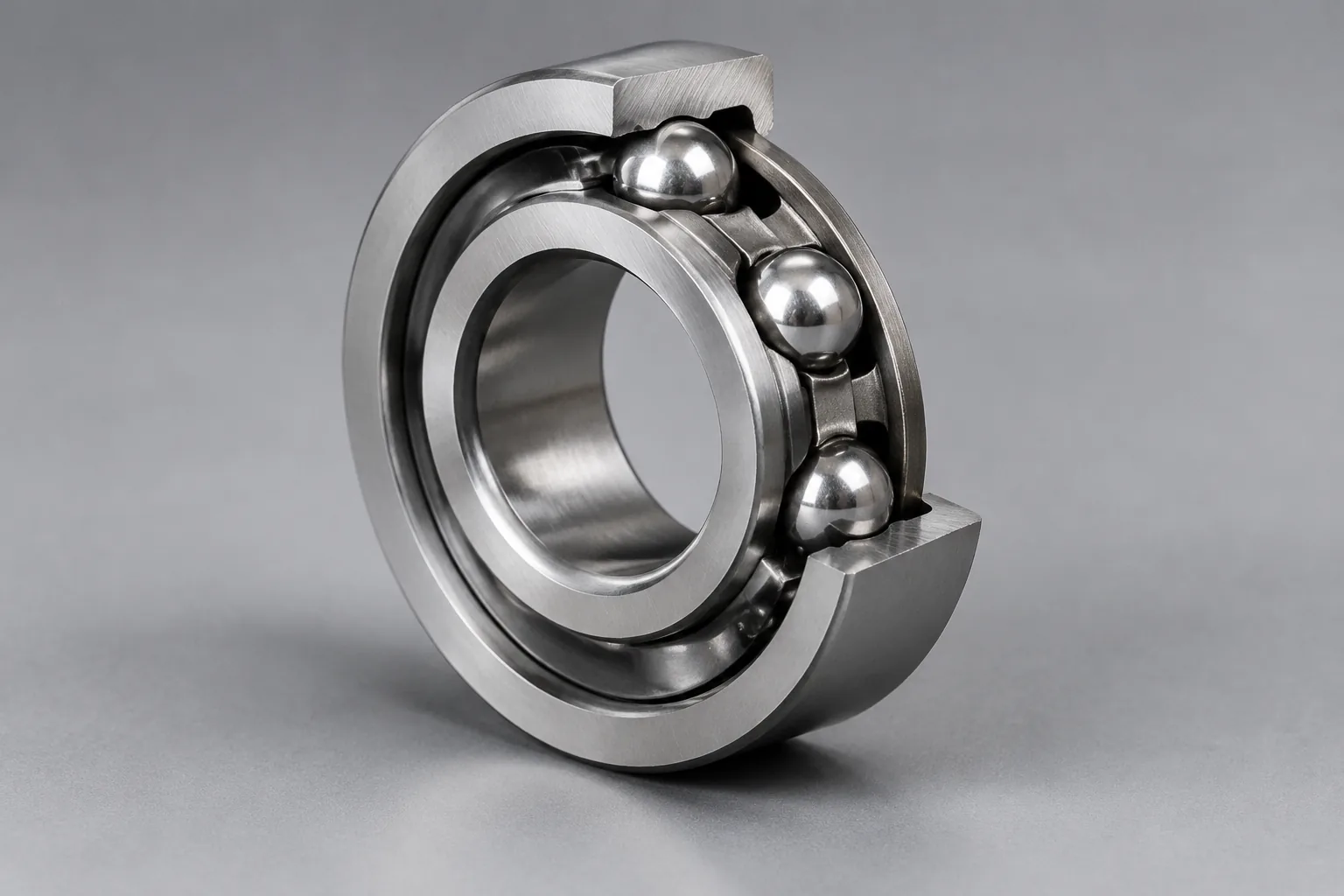
- Lubrication loss – grease bleeds out its base oil, hardens, or evaporates, and the rolling contacts run with an inadequate film.
- Dimensional change – rings soften or grow, and differential expansion between inner and outer ring eats the internal clearance.
- Component degradation – cages, seals, shields, and lubricant supply paths reach their material limits before the bearing steel does.
In maintenance records the same pattern appears as recognizable symptoms:
- Grease that has turned dark, hard, or carbonized on inspection.
- Relubrication intervals that have to be shortened again and again to keep the line running.
- The same position replaced on a repeating cycle while similar positions last much longer.
- Rising housing temperature, new noise or vibration, and unplanned downtime that arrives earlier each time.
A recurring replacement interval is evidence of a thermal specification problem, not proof that the bearing is undersized.
Failure Mechanism 1: Lubricant Breakdown and Loss of Film
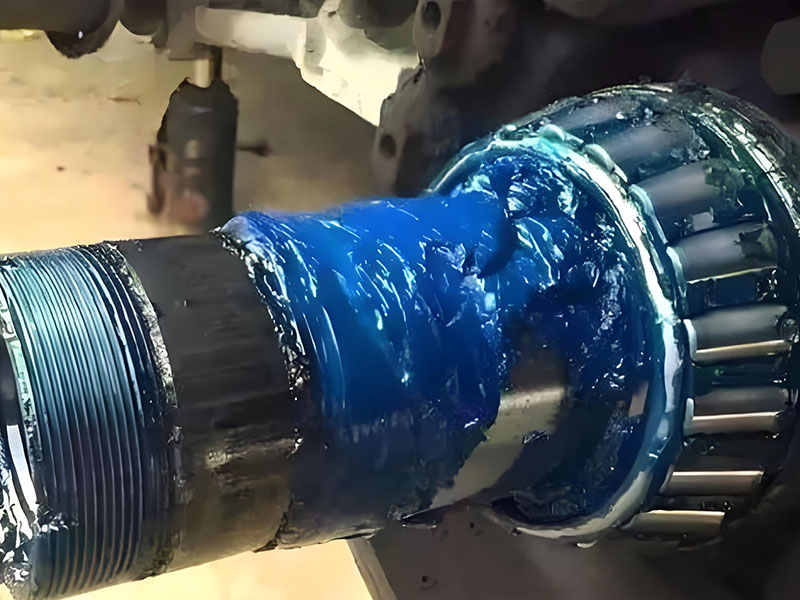
Conventional grease and oil are temperature-limited by their base oil and thickener. As temperature rises, base oil bleeds out faster, oxidation accelerates, and the thickener structure degrades. In the upper part of its range a grease may still be present in the housing but no longer able to build a film, which is why dry-running damage appears in bearings that were visibly greased.
In hot, slow duties the problem gets worse, not better. Low speed gives the contact little chance to build hydrodynamic film, and high temperature has already thinned the lubricant that is left. Bearings in furnaces, ovens, cooling beds, and dryer conveyors often run in exactly this combination: hot, dry, and slow.
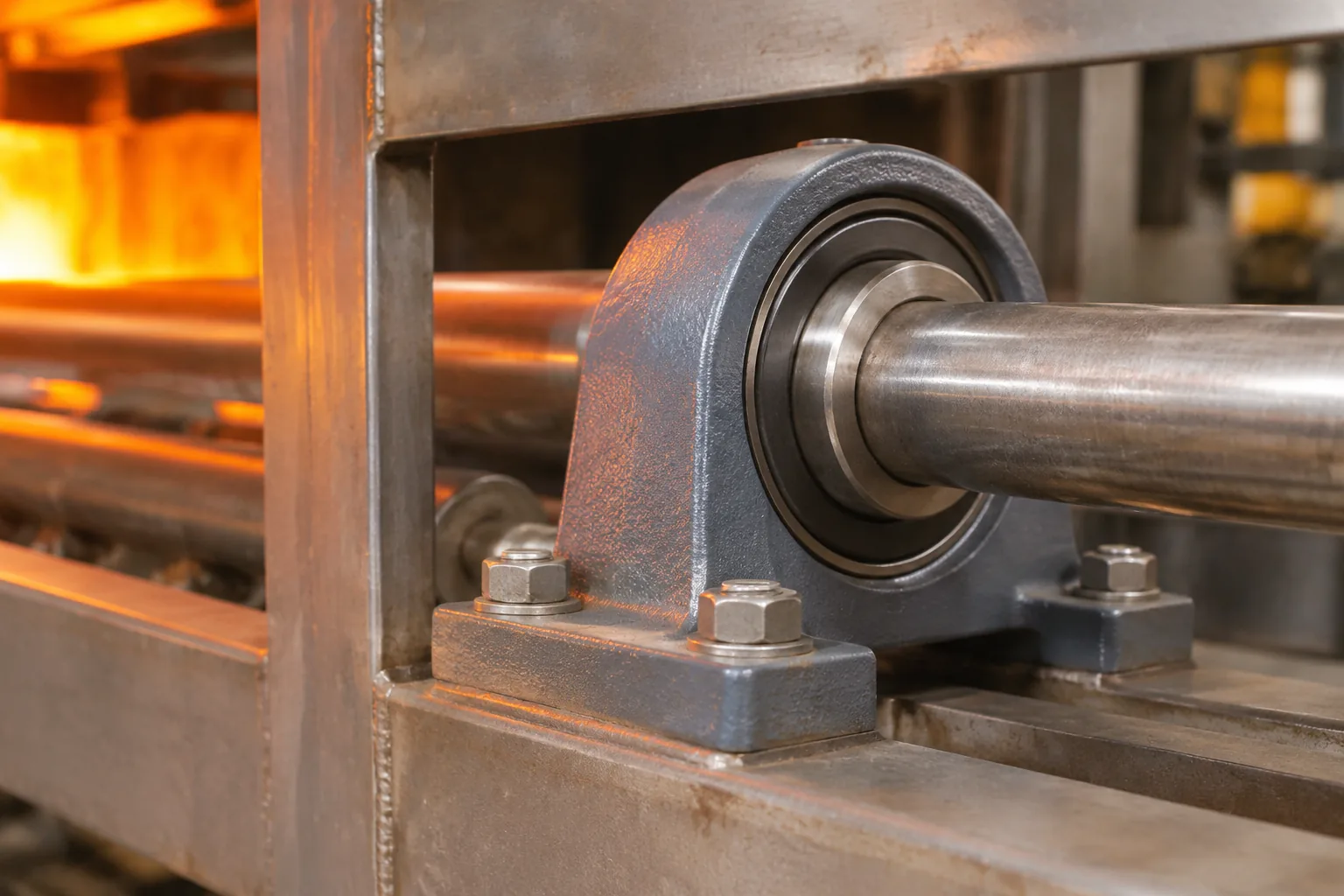
As a working approximation, within a grease’s rated temperature range, each additional 15°C of sustained operating temperature roughly halves its expected grease life. Two conditions matter:
- The relationship only holds inside the grease’s safe range. Beyond it, oxidation and carbonization take over and the estimate no longer applies.
- Adding more grease does not compensate. Excess grease increases churning losses, friction, and bearing temperature, which shortens life instead of extending it.
Where relubrication is impractical, or where the film is marginal no matter how much grease is supplied, solid lubricants and specially rated high-temperature greases become the realistic options. A solid-lubricant design transfers a thin film from a graphite cage, graphite plug, or solid spacer onto the rolling contacts, so lubrication continues without a grease reservoir. In one common approach, a synthetic high-temperature oil carries the bearing through the lower part of its range and gradually evaporates above roughly 200°C, leaving an adhering graphite film to take over.
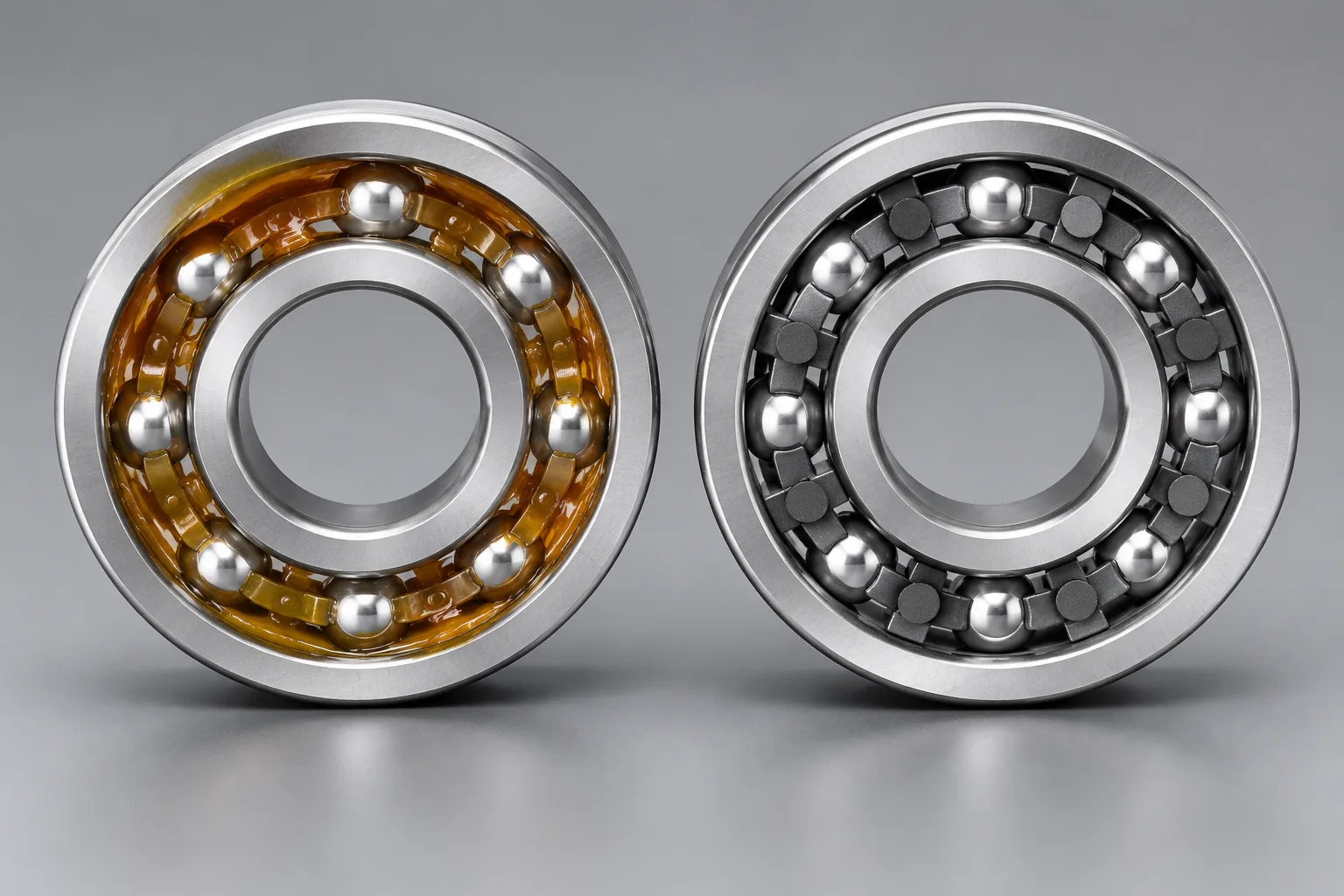
Solid-lubricant designs remove relubrication from the maintenance plan, but their speed, load, and atmosphere limits must be checked before they are specified.
Failure Mechanism 2: Dimensional Stability and Internal Clearance
Bearing steel is heat treated, and standard rings are stabilized for a defined maximum service temperature. Running above that limit risks permanent dimensional change, so the ring no longer holds its geometry or its preload. Heat stabilization is graded, and the grade must match the ring temperature, not the process setpoint:
| Stabilization grade | Maximum operating temperature |
|---|---|
| S0 | 150°C |
| S1 | 200°C |
| S2 | 250°C |
| S3 | 300°C |
| S4 | 350°C |
There is a trade-off hidden in that table. Higher stabilization grades generally cost some material hardness or load capacity, so a bearing stabilized for 350°C is not automatically a better choice for a 180°C duty. Select the lowest grade that covers the real ring temperature, measured under production conditions.
Internal clearance is the second half of the problem. When the inner ring runs hotter than the outer ring, it expands more, and that differential consumes radial clearance. If clearance is used up, friction and heat rise and seizure risk follows. Too much clearance brings its own penalties: poorer load distribution, more cage stress, and higher noise. Clearance is therefore selected together with stabilization, based on measured ring temperatures rather than ambient temperature, and it must account for fits and thermal growth of the shaft and housing as well.
Failure Mechanism 3: Cage, Seal, and Contamination Risks
A bearing is only as heat-resistant as its weakest component. Cages made of standard polymer or brass, elastomer seals, and grease supply paths all see the same temperature as the rolling contacts and may reach their limits first.
- Cages – metallic cages tolerate higher temperatures than most polymer cages; pure graphite cages are available for continuous operation at 350°C, and graphite and solid-lubricant cage designs also act as the lubricant source, releasing small quantities of graphite onto the rolling contacts during running.
- Seals and shields – elastomer seals must be compatible with both the temperature and any process chemical, steam, or cleaning agent present. A seal that hardens loses its lip contact and lets contamination in.
- Contamination – abrasive particles and moisture accelerate wear even when the temperature rating is adequate. In hot processes, airborne dust, oxide scale, and condensate are common and often overlooked.
Where incidental contact with food is possible, lubricant choice becomes a separate compliance question. Some graphite-cage designs carry a food-contact lubricant registration in the H1 category for incidental contact, but such approvals apply to a specific bearing and lubricant configuration and to the intended type of contact, so that status must be confirmed for the exact part rather than assumed from the fact that a bearing runs dry.
High-Temperature Bearing Designs That Prevent Failure
Several design routes exist, and they are not interchangeable. The right route is decided by temperature band and environment, not by catalog position.
| Design route | Typical temperature band | Suits | Watch-outs |
|---|---|---|---|
| High-temperature grease | Up to roughly 150-180°C; specially rated greases up to about 230°C | Accessible relubrication, moderate speeds, clean atmosphere | Grease life still falls steeply with temperature; interval must be planned |
| Solid graphite cage or graphite lubricating plugs | Approximately 250-350°C | Hot, dry, slow duties; relubrication impractical | Limited high-speed capability; graphite release is continuous and design-specific |
| Solid-lubricant spacer or coated elements | Up to approximately 350°C in vacuum; up to about 400°C for variants rated for atmosphere or vacuum | Vacuum, clean gas, or clean air duties at low speed | Atmosphere-specific; some variants are vacuum-only |
| Heat-stabilized steel bearing with high-temperature grease and heat-resistant seals | Band set by grease, seal, and stabilization grade | Retrofitting existing housings at moderate temperature | Needs the right clearance and seal material, not just a different grease |
A 350°C design is not simply a standard bearing with a different lubricant. It may combine a synthetic oil that evaporates above roughly 200°C to leave an adhering graphite film, increased internal clearance, special heat treatment, and a phosphated surface with a molybdenum disulfide coating. Practical retrofit work is easier when the high-temperature variant keeps standard metric boundary dimensions, because the housing and shaft need no modification. Where available, that interchangeability shortens downtime during the upgrade.
Temperature limits are model-specific and can change with atmosphere, speed, load, and the service life being targeted.
How to Select a High-Temperature Bearing for the Real Duty
Selection fails most often because the specification is written from the process setpoint rather than from the bearing. Work through these points in order:
- Measure the ring temperature. Use a contact probe or thermal image on the housing at the bearing position, in production conditions. Include radiant heat from the load or burners, and the transients at start-up and shutdown.
- Record the mechanical duty. Speed range, load direction and magnitude, duty cycle, reversing or shock loads, and whether the position idles hot before the line runs.
- Define the environment. Air, vacuum, steam, combustion gas, washdown, cleaning chemicals, dust, scale, or moisture. Atmosphere often rules out a design route before temperature does.
- Specify the bearing internals. Lubricant or solid-lubricant type, heat-stabilization grade, internal clearance, cage material, and seal or shield configuration, all tied to the measured temperature.
- Check mounting fits and thermal growth. Shaft and housing fits, alignment, and expected expansion at operating temperature, so the assembled clearance is still correct when hot.
- Decide the relubrication strategy. Access, interval, quantity, and grease type, or a deliberate choice of a lubricated-for-life design.
- Examine the life basis. Standard basic rating life describes fatigue at 90 percent reliability and does not account for wear, corrosion, electrical erosion, lubricant life, or thermal effects. For hot duties those are usually the governing mechanisms, so a supplier application review matters more than the headline L10 figure.
Do not select on a catalog maximum temperature alone. Select on the measured duty and the mechanism expected to end the bearing’s life.
How High-Temperature Bearings Reduce Cost
Cost savings in hot equipment rarely come from the unit price of the bearing. They come from what stops happening around it. A lifecycle comparison should capture:
| Cost line | What changes with a correctly specified high-temperature bearing |
|---|---|
| Bearing purchase price | Usually higher per piece; small share of total cost |
| Relubrication labor and grease | Reduced or eliminated where solid lubricant is used |
| Planned downtime | Fewer scheduled grease stops and shorter interventions |
| Unplanned downtime | Lower frequency of seizures and line stops |
| Shaft and housing damage | Fewer seized inner rings, so fewer shafts scrapped or reworked |
| Scrap and rework | Less product lost to interrupted process and temperature instability |
| Energy and friction | Correct grease quantity and clearance reduce churning and drag |
Published industrial retrofits follow a consistent pattern, and the reported figures are specific enough to check against your own line:
- Heat-treatment furnace conveyors – before the change, 434 bearings and 217 shafts were consumed over two years, with bearings replaced about once a year. After grease-lubricated bearings were replaced with graphite-lubricated high-temperature bearings, the plant reported five years without a bearing failure and only 13 shafts replaced. The initial investment was under 4,000 euros, and reported savings exceeded 60,000 euros over five years.
- Oven and fryer conveyor lines – the original bearings needed high-temperature grease every 16 weeks, and each regreasing cost 26 hours of planned downtime. After the change the line ran continuously, 24 hours a day, for five years, cutting about 150 labor hours a year and removing the high-temperature grease cost and the related planned stoppages.
- Bakery conveyors – routine maintenance intervals were extended from 6 months to 36 months, with payback measured in 6 months.
- Paper-mill combustion air units – heat-treated rings, a steel cage, C3 internal clearance, high-temperature grease, and heat-resistant fluoroelastomer seals extended average bearing life from about 4 months to more than 12 months, cutting annual total cost from $10,314 to $2,610, a saving of $7,704.
- Bench running at high temperature – at 300°C, 60 rpm, and up to 500 hours, a purpose-built high-temperature bearing has been reported to run nearly 200 hours longer than a comparable premium standard product before failure.
All of these results are application-specific. Reproduce the conditions, including temperature, speed, downtime definitions, and cost boundaries, before applying the numbers to your own line.
Installation and Maintenance Practices That Protect Savings
A high-temperature bearing only delivers if it is installed and maintained to the same standard it was specified to.
- Verify fits and alignment. Confirm shaft and housing fits, roundness, and alignment so that mounting error does not consume the internal clearance that was intended for thermal growth.
- Respect the lubricant quantity. Overgreasing raises churning losses, friction, and bearing temperature. Follow the specified fill and relubrication procedure rather than filling the housing.
- Base intervals on temperature. Derive relubrication intervals from measured operating temperature and actual duty, not from a generic calendar period.
- Watch the early warning signals. Trending housing temperature, vibration, and noise against equivalent positions catches film loss before seizure. Compare positions rather than relying on absolute values.
- Inspect grease condition. Color, hardness, and consistency tell you whether the lubricant is still doing its job, and whether the specification is wrong.
- Protect the seals. Keep contamination out, and use seals whose material matches the temperature and the process chemicals.
- Investigate repeats. A second failure at the same position should trigger a root-cause review of temperature, load, fit, and contamination, not just another replacement.
Limits and Exceptions: When High-Temperature Bearings May Not Save Costs
The specification has to match the real duty. Where it does not, a higher temperature rating changes nothing.
- Wrong root cause. If failures come from misalignment, poor fitting practice, contamination, or excessive load, a higher-temperature bearing will fail the same way.
- Atmosphere limits. Some solid-lubricant designs are intended for vacuum, others for air; a vacuum-rated variant in an oxidizing atmosphere, or the reverse, is a specification error.
- Speed limits. Solid-lubricant and graphite-cage designs are generally suited to low and moderate speeds. High-speed hot duties need a different route and often a different lubricant supply.
- Moisture and chemicals. Steam, washdown, and aggressive cleaning agents can attack cages, coatings, and seals even at temperatures the bearing is rated for.
- Life expectation. A high-temperature bearing is not an unlimited-life component. It has a defined lubricant life and a defined structural life at the stated conditions.
High-temperature bearings can prevent premature failure and can reduce total cost; they do not guarantee longer life in every application.
Conclusion
High-temperature bearings prevent failure by addressing the whole chain rather than one link: a lubricant or solid lubricant that survives the ring temperature, a stabilization grade and internal clearance that hold their geometry when hot, and a cage and seal package that does not expire first. Contamination control and correct installation keep those measures working.
The cost side follows from the same measures. Fewer relubrication events, fewer planned stoppages, fewer unplanned line stops, and fewer damaged shafts usually outweigh the higher unit price of the bearing by a wide margin. The documented retrofit results all share that structure, and all of them depend on the conditions they were achieved under.
The safe next step is to document the actual duty: measured ring temperature including transients, speed, load, atmosphere, contamination, mounting arrangement, and the maintenance access available. Use that record to request an application-specific high-temperature bearing review, and specify the lubricant, stabilization grade, clearance, cage, and seals against it.
FAQs
Q1: At what temperature does a bearing need a high-temperature design?
A: There is no single threshold, but sustained ring temperatures above roughly 100°C are treated as high-temperature service and usually require a change of lubricant, stabilization grade, or both. The decision point is the temperature at the rings under production conditions, including radiant heat and start-up transients, not the surrounding air temperature or the furnace setpoint.
Q2: Do high-temperature bearings still need relubrication?
A: It depends on the design. Grease-lubricated high-temperature bearings still need a planned interval, and that interval shortens sharply as temperature rises. Solid graphite and solid-lubricant designs are supplied lubricated for life and need no relubrication, but they are limited in speed and must be matched to the atmosphere. Confirm the intended maintenance strategy for the exact variant before writing it into a maintenance plan.
Q3: Will a high-temperature bearing always last longer than a standard one?
A: No. It lasts longer only when temperature was the governing failure cause and the rest of the specification is correct. If the original failures came from misalignment, contamination, poor fitting, or overload, a high-temperature bearing will show the same damage pattern. Diagnose the failed part before changing the specification.
Q4: Why do two bearings in the same oven fail at very different intervals?
A: Positions in the same equipment rarely see the same conditions. Distance from burners or the hot load, radiant heat, airflow, load angle, shaft fit, and local contamination all differ. Comparing temperatures and vibration across equivalent positions shows where the real duty is higher, which is usually where the specification needs to change.
Q5: What information should I prepare before asking for a high-temperature bearing selection?
A: Provide the measured ring or housing temperature in production including transients, speed range, load magnitude and direction, duty cycle, atmosphere and chemicals present, contamination sources, shaft and housing fits, available space, and whether relubrication is possible. With those inputs a supplier can match lubricant, stabilization grade, clearance, cage, and seals to the application instead of to a catalog maximum.