Quick Answer: A cam follower bearing pairs a heavy-section outer ring with needle or cylindrical rollers and a threaded stud. This integrated layout carries high radial loads in a small space, runs directly on a cam or track, and simplifies mounting. Sealed, pre-lubricated, crowned and eccentric variants extend the same basic design to different alignment, access and maintenance conditions. The right configuration depends on load, speed, mounting space, lubrication and contamination.
Cam follower bearings appear in cam drives, conveyors, packaging machinery, guidance systems and other mechanisms where a rolling wheel follows a track. Their practical advantages are not automatic. They depend on the selected series, outer-ring profile, stud size, lubrication, sealing and the conditions in which the bearing runs. Selection therefore starts with the duty cycle, not with a single headline rating.
What Are Cam Follower Bearings?
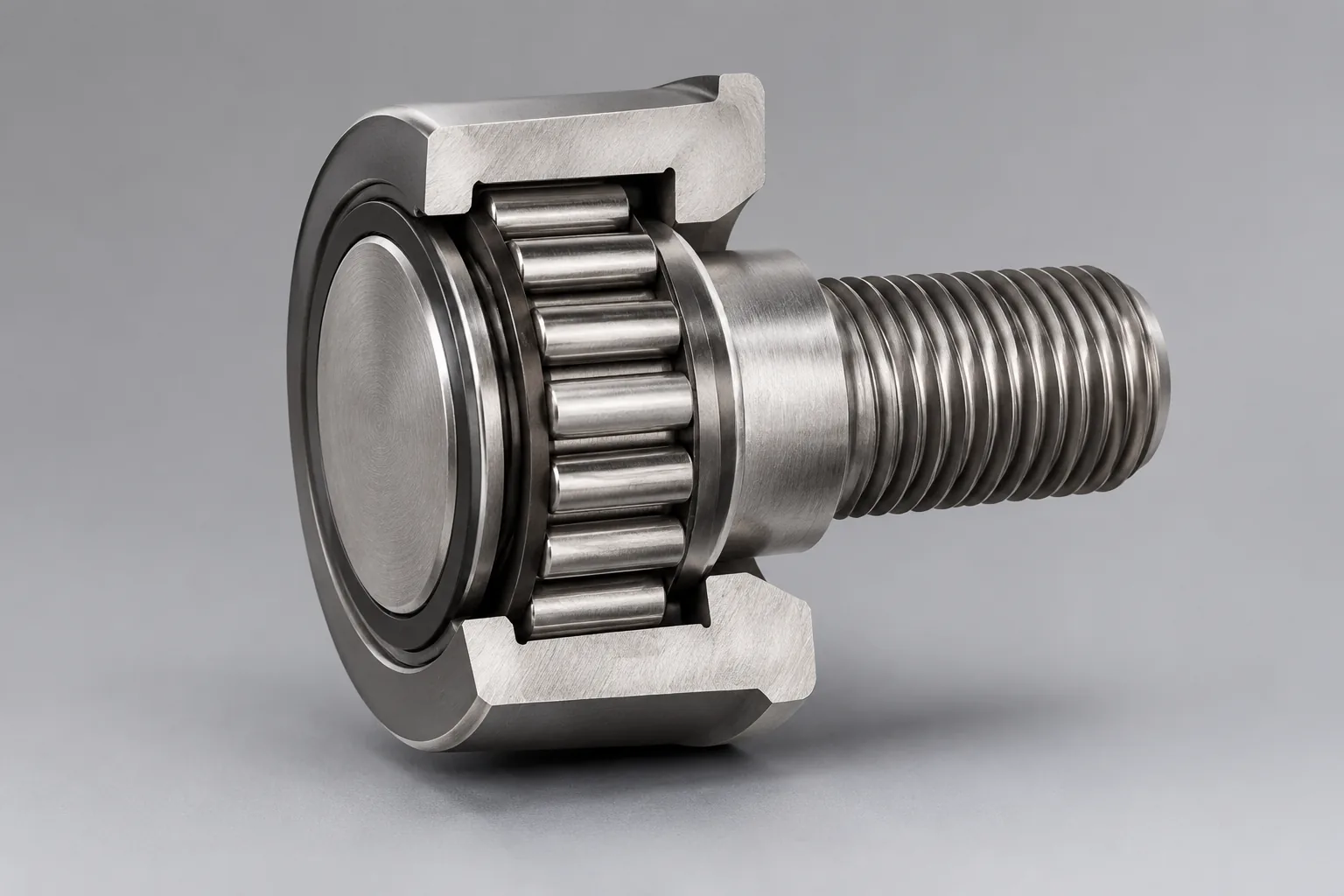
A cam follower bearing is a stud-type track roller. A threaded solid stud or pin carries a thick-walled outer ring, and needle rollers or cylindrical rollers run between the stud and that ring. The outer ring contacts the cam, track or guide surface directly. In many arrangements, the stud also acts as the mounting element, so the assembly does not need a separate shaft and inner ring.
The integrated form explains much of the bearing’s value. It puts the rolling function, the mounting thread and the outer running surface into one unit. That unit can be fixed to a machine frame with a hex nut or a comparable mounting detail, while the outer ring follows the adjacent surface. The definition also sets the limit: the stud, outer ring, rollers, cage, seal and grease all have to suit the duty, not just the envelope size.
High Radial Load Capacity in a Compact Assembly
Radial load passes from the track into the outer ring, through the rolling elements and into the stud. A thick outer ring resists bending and keeps the raceway supported, while needle or cylindrical rollers provide a broad rolling contact within a small radial depth. This is why a cam follower can carry a useful radial load in a package that fits close to a machine surface.
Capacity is not one number for the whole product family. Published ratings for representative series show a wide spread:
- A standard series reaches a dynamic rating of up to 67.7 kN.
- A heavy-duty inch series reaches up to 142 kN.
- A double-row full-complement cylindrical roller series reaches up to 90.3 kN.
- A micro series with 2-6 mm stud diameter and 4.5-12 mm outer diameter reaches up to 4.61 kN.
These are series maxima, not a rating for every size. Check the dynamic and static ratings for the exact item, and confirm that the stud, mounting plate and adjacent structure can carry the load path. Do not generalize one series rating to all cam follower bearings.
Improved Resistance to Shock and Impact Loads
The outer ring is usually the part that meets the cam or track, so it takes the contact load directly. A thicker wall helps the ring resist impact loading, distortion and bending stress when the load is intermittent or the track is not perfect. This is the reason cam follower outer rings are heavier in section than the outer rings of many ordinary radial bearings.
Impact resistance is useful in indexing drives, cam lifts, transfer mechanisms and other layouts where the contact is not perfectly smooth. It does not replace an application load calculation or a stud strength check. A bearing can have a strong outer ring and still be the wrong choice if the stud, thread or mounting surface is undersized for the shock.
Lower Friction and Smoother Rolling Motion
A rolling contact changes the motion at the track. Instead of a sliding shoe or a plain follower dragging over the surface, the outer ring rolls and the needles or cylindrical rollers roll inside the bearing. That reduces friction at the contact and supports smoother motion, especially at low to moderate speed.
Needle rollers are effective here because they create a long, narrow rolling contact in a small radial envelope. The result is less wear at the running surface than a sliding arrangement would produce, provided the track is clean and lubricated. Friction and wear still depend on lubrication, contamination, load and surface finish. A cam follower does not remove friction; it changes where the friction acts and how the surfaces wear.
Compact Size and High Rigidity
The threaded stud and the needle roller complement allow a rigid unit with a relatively small outer diameter. Needle rollers keep the outer-ring section shallow compared with the stud diameter, which helps in linkage ends, cam plates and narrow machine frames. A micro series can go as small as 2-6 mm stud diameter with a 4.5-12 mm outer diameter.
Compactness has a cost. Miniaturization reduces the available load capacity and the space for seals and grease. Verify the size against the radial load, shock load and required life rather than choosing the smallest unit that fits the hole.
Ready-to-Mount Integrated Design Reduces Part Count
A threaded solid stud can be attached directly to a machine component, often with a hex nut. The stud replaces a conventional inner ring in many arrangements, so the design does not need a separate shaft, inner ring and bearing housing. Factory grease and a ready-to-mount supply further reduce initial preparation.
The saving is real but limited to the mounting detail. Thread engagement, support rigidity, nut seating and stud strength still need checking for the specific application. A compact integrated unit does not make a weak frame stiff.
Flexible Mounting and Lubrication Access
Some cam follower designs provide hex sockets and lubrication ports at both ends of the stud. That allows installation and relubrication from the head or the threaded end, which helps where rear-side access is restricted. Certain series also place a grease nipple at the stud head and accept lubricant from either end.
Short-stud variants reduce the space needed on the stud side. One short-stud design reduces that stud-side mounting space by up to 34%. This can matter in tight assemblies, but the feature set depends on the series and suffix. Check the drawing for hex socket depth, lubrication path and thread length before relying on the space saving.
Pre-Lubricated and Sealed Options Reduce Preparation and Contamination Risk
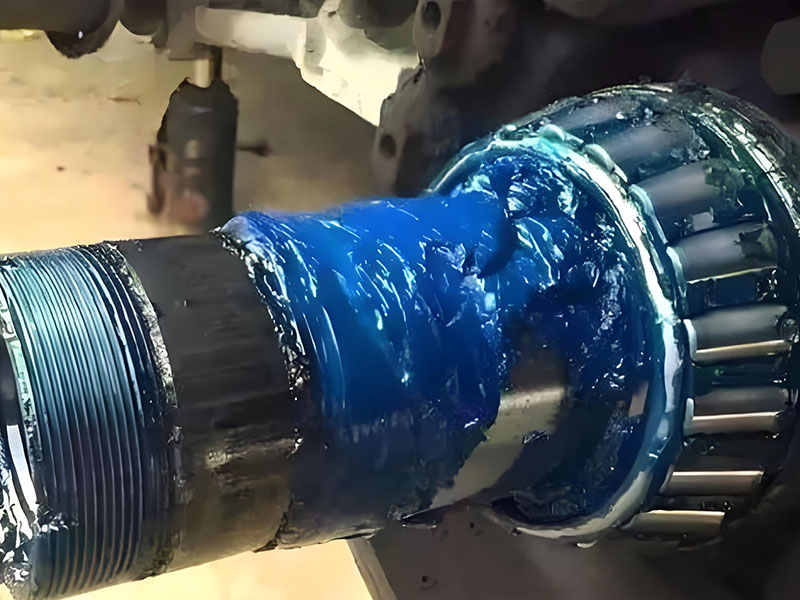
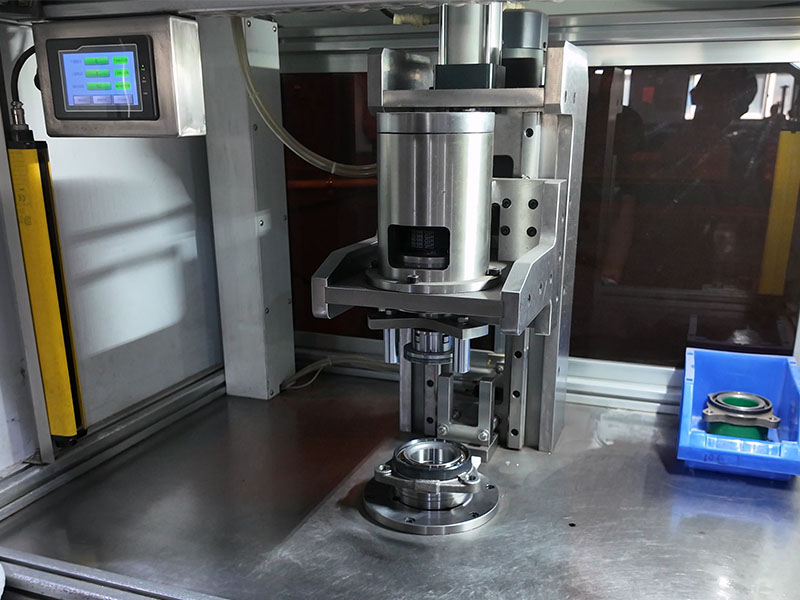
Many cam followers arrive factory-greased. One common fill is No. 2 lithium-soap grease; sealed variants may use a protected lip seal on both sides and a lithium-complex soap grease such as GA08. A UU suffix commonly denotes synthetic rubber seals intended to keep foreign matter away from the rolling elements. Protected lip seals on both sides can support a working temperature range of -30°C to +120°C in the relevant series.
Factory fill reduces the initial lubrication step, and seals help in dusty or wet surroundings. It does not make the bearing maintenance-free. Seal type, grease, speed and temperature limits must be matched to the application, and not all cam follower variants are sealed or pre-lubricated. A sealed bearing can also run hotter if the seal lip speed limit is exceeded.
Maintenance-Free Variants for Hard-to-Reach Locations
Solid-lubricant variants fill internal space with a lubricating material instead of relying only on grease. They can provide long-term maintenance-free operation where regular grease replenishment is difficult or access is restricted. A representative solid-lubricant range covers 5-20 mm stud diameter, 13-52 mm outer diameter and a dynamic rating of up to 20.7 kN.
These variants are not a universal substitute for grease. Load, speed, temperature and contamination still set the limit, and the manufacturer should confirm suitability for the actual operating conditions. Maintenance-free means the design reduces planned relubrication; it does not mean the bearing can be ignored after installation.
Tolerance of Minor Misalignment with Crowned Outer Rings
A crowned or spherical outer ring can absorb minor shaft or mounting misalignment and reduce edge loading when the bearing tilts relative to the track. The crowned profile spreads contact stress more evenly across the track instead of concentrating it at one edge. Axially guided versions can also accommodate slight misalignment, tilted operation or short-term axial loads.
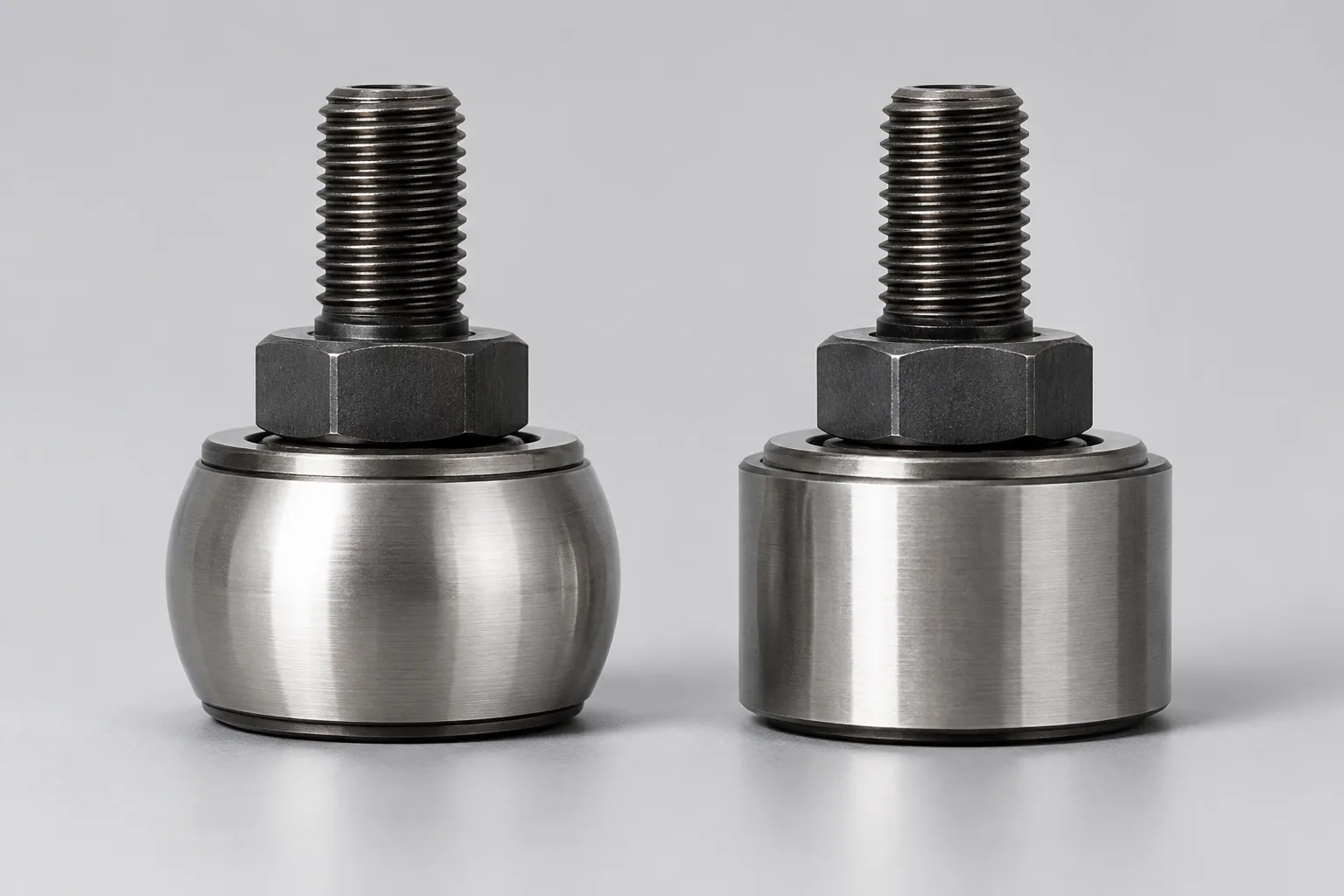
The advantage is profile-specific. A flat cylindrical outer ring is generally used where alignment is good and a larger contact area is wanted. A crowned ring is not a substitute for correcting large misalignment, and it does not remove the need to check track hardness and surface condition.
Eccentric Versions Simplify Position and Clearance Adjustment
An eccentric collar adjusts the position of the outer-ring running surface relative to the track. That allows track clearance, preload or roller position to be adjusted without relocating the mounting hole. It is useful during assembly or setup where a fine positional adjustment is needed.
An eccentric-collar series can cover 13-35 mm stud diameter, 22-90 mm outer diameter and a dynamic rating of up to 67.7 kN. The adjustment range is design-specific, and the feature is available only on eccentric variants. Check the eccentricity and the mounting instructions before setting preload or clearance.
Design Flexibility for Load, Speed, and Application Requirements
The cam follower family covers more than one load-speed compromise. Caged versions favor higher-speed rotation and help prevent needle skew. Full-complement versions maximize load capacity but usually have a lower permissible speed. Sealed or open, concentric or eccentric, crowned or cylindrical, miniature, short-stud, central-lubrication, maintenance-free and heavy-duty double-row types are all available configurations.
Selection starts with the dominant requirement. If speed and low skew matter most, a caged design is the logical starting point. If maximum radial capacity in a given envelope matters most, a full-complement design may be better, but the speed limit has to be accepted. The rest of the configuration then follows alignment, sealing, lubrication and mounting access.
Caged Versus Full-Complement Cam Follower Bearings
A cage separates the rollers and keeps them aligned. That reduces skew and supports higher-speed operation, but the cage occupies space that could otherwise hold more rollers. A full complement packs in as many rollers as possible, so it can carry a higher load, yet the rubbing between adjacent rollers and the lower speed limit have to be considered.
The choice should follow the dominant requirement: speed or maximum load. A high-speed application should not be specified with a full complement only because the load figure looks stronger. A heavily loaded low-speed application should not be pushed to a caged design without checking whether the cage and roller set can deliver the required life.
Application-Specific Configuration Options
- Outer-ring profile: crowned for minor misalignment; cylindrical for well-aligned tracks that need a larger contact area.
- Mounting: concentric stud for a fixed position; eccentric collar for clearance or preload adjustment.
- Protection and maintenance: sealed, pre-lubricated or solid-lubricant maintenance-free variants for different contamination and access conditions.
- Size and duty: miniature, standard, short-stud or heavy-duty double-row designs to match the available envelope and load.
Standardized Dimensions and Tolerances Support Specification and Replacement
ISO 7063:2018 specifies boundary dimensions, geometrical product specifications and tolerance values for needle roller bearing track rollers. Standardized dimensions help with drawing callouts, selection and replacement assessment. They give the designer a common envelope and a common way to compare tolerance data.
Standard dimensions do not by themselves guarantee full brand-to-brand interchangeability. A matching envelope can still hide differences in roller complement, internal geometry, seal, grease, load rating and stud detail. Use the standard as a specification aid, then verify the actual item data and the mounting interface.
How to Match Cam Follower Advantages to Application Requirements
Match the bearing to the application in a fixed order so that one attractive feature does not hide a limiting condition.
- Check radial load, shock load, speed and required life.
- Choose the outer-ring profile according to track alignment and contact requirements.
- Confirm stud size, mounting space and adjustment needs.
- Select sealing and lubrication based on contamination, access and maintenance interval.
- Verify dimensions and tolerances against the applicable standard and the manufacturer’s data for the exact item.
The result should be a balanced choice, not the highest load rating or the smallest envelope on its own. A bearing that is strong enough but impossible to lubricate is a poor design choice. A bearing that is easy to mount but has no margin for shock is equally risky.
Key Takeaways
- Cam follower bearings combine high radial load capacity, compactness and direct mounting in one unit.
- Sealed, pre-lubricated, maintenance-free, crowned and eccentric variants extend application flexibility.
- The final advantage depends on correct selection of series, outer-ring profile, lubrication and mounting configuration.
Conclusion
The advantages of cam follower bearings come from a coherent design: a stiff outer ring, a compact rolling element complement, a threaded stud and a broad choice of seals, greases and profiles. Those features can reduce part count, save radial space and simplify motion control, but each one carries a condition. Load, speed, alignment, contamination and maintenance access decide whether the advantage is realized.
Select the series and outer-ring profile for the duty, confirm the stud and mounting detail, and verify the rating and tolerance data for the exact item before ordering. That sequence keeps the benefits of cam follower bearings tied to the application rather than to a catalog headline.
FAQs
Q1: What is the main advantage of a cam follower bearing?
A: Its main advantage is the combination of a high radial load path and a compact, directly mountable body. The thick outer ring runs on the track, the needle or cylindrical rollers carry the load, and the threaded stud removes the need for a separate shaft and inner ring in many layouts.
Q2: Can cam follower bearings handle shock loads?
A: A thick outer ring improves resistance to impact and reduces distortion under direct contact, but the stud and mounting structure must still be checked. Shock capacity is not a single published figure that applies to every size or installation.
Q3: Do cam follower bearings need lubrication?
A: Many cam followers are factory-greased, and sealed variants delay contamination, but relubrication still depends on speed, load, temperature and dirt. Solid-lubricant variants can reduce planned maintenance where grease access is poor, provided the operating limits are confirmed.
Q4: What is the difference between crowned and cylindrical outer rings?
A: A crowned outer ring tolerates minor misalignment and reduces edge loading; a cylindrical ring suits well-aligned tracks and a larger contact area. Neither profile corrects a large alignment error.
Q5: How do I choose between caged and full-complement cam followers?
A: Caged versions generally suit higher speed because the cage limits roller skew; full-complement versions generally maximize load capacity at a lower permissible speed. Compare the ratings and speed limits for the exact size.
Q6: Are cam follower bearings interchangeable by dimensions alone?
A: No. Matching boundary dimensions is only the first check. Roller complement, internal geometry, seal, grease, load rating and stud detail can differ, so verify the actual item data before replacing one design with another.