Quick Answer: Low temperature bearings are rolling bearings engineered for reliable startup and running in cold or cryogenic conditions. They are not a separate standard category; they are application-engineered variants of rolling bearings. Their performance comes from low-temperature lubricants, matched materials, cages, seals, and internal clearance. Selection must separate the minimum startup temperature from the minimum continuous operating temperature, confirm medium compatibility, and validate torque, speed, and clearance at the real operating temperature.
Low temperature bearings face their hardest test at cold startup, when lubricant resistance is highest and clearance margin is tightest. A bearing that turns freely at room temperature can show slip, noise, or seal leakage after a cold soak. The useful question is not whether a bearing is labeled for low temperature, but whether the complete bearing system stays within its startup and continuous limits in the real medium and duty cycle.
That system view connects lubricant choice, material selection, cage and seal behavior, fits, internal clearance, and validation. Each choice changes the others, so a single catalog temperature cannot carry the decision.
What Are Low Temperature Bearings?
A low-temperature bearing is a rolling bearing adapted to start and run at low temperature or in a cryogenic medium. The adaptation usually combines a low-temperature lubricant or solid lubrication with special ring and ball materials, a compatible cage, suitable seals, and an internal clearance that remains workable after thermal contraction.
Published low-temperature grease guidance commonly treats temperatures below -20°C as the low-temperature application range. Deep-cryogenic designs go much further: some cryogenic ball bearing lines are listed from -74°C to -253°C, and LNG pump bearings can be rated to a minimum of -162°C at speeds up to 3,600 rpm.
It helps to separate two service classes:
- Cold-environment bearings work in cold ambient air, refrigerated rooms, freezers, cold-climate machinery, or outdoor equipment. Grease or solid lubrication usually remains part of the design.
- Deep-cryogenic bearings work in liquefied gases such as LNG, liquid nitrogen, liquid oxygen, liquid hydrogen, or liquid helium. The medium may provide only a very thin lubricating film, and material, cage, clearance, and cleaning requirements become more severe.
The classification should follow the actual minimum startup temperature, minimum continuous temperature, and medium temperature. Not every bearing marketed for low temperature is suitable for LNG, liquid nitrogen, liquid oxygen, liquid hydrogen, or liquid helium service.
Startup Temperature vs Continuous Operating Temperature
Two temperature limits matter, and they are not interchangeable. LTL means the low-temperature limit at which the grease still allows the bearing to start reliably. LTPL means the low-temperature performance limit for continuous, reliable operation.
A short cold start between LTL and LTPL can be acceptable when friction quickly warms the bearing back into its reliable operating range. Sustained operation below LTPL risks insufficient lubricant supply and serious bearing damage. A catalog minimum temperature may represent a startup torque limit rather than a continuous operating limit, so the datasheet wording has to be read closely.
Grease suppliers do not use a fully harmonized international definition of these low-temperature performance limits. Confirm both LTL and LTPL for the selected grease or solid lubricant, and record the expected cold-soak time, number of starts, and time needed to reach steady-state temperature.
How Low Temperatures Challenge Bearing Performance
Low temperature changes the lubricant first, then the fits and clearances, and finally the cage and seal behavior. The main effects are linked:
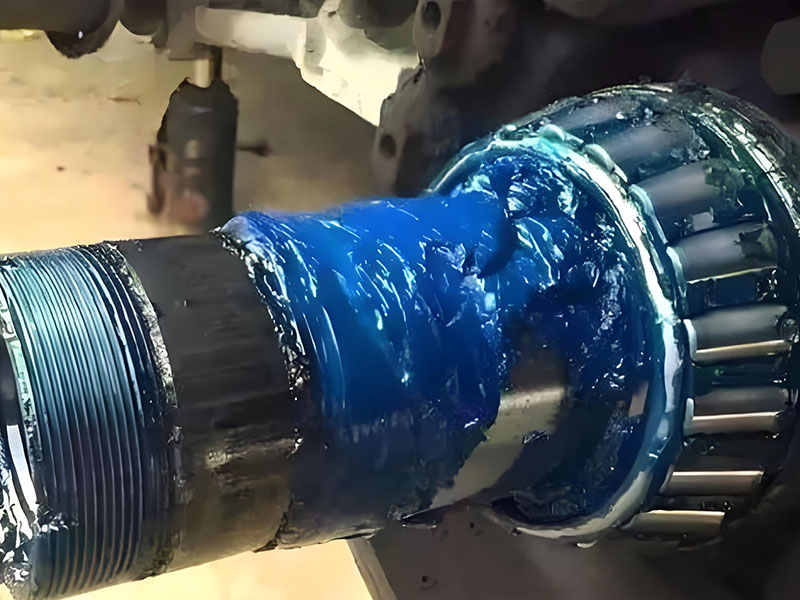
- Grease stiffness and startup torque. Cold-hardened grease can raise startup torque and contribute to rolling-element slipping, noise, and wear.
- Poor oil release. Base oil may be released too slowly, leaving the raceway in mixed or boundary lubrication during startup and low-speed running.
- Viscosity trade-off. Excessive base-oil viscosity increases friction, can impair oil supply, and raises wear and premature failure risk. Too little viscosity can fail to form a separating film.
- Thermal contraction. Different contraction rates change fits, internal clearance, and seal contact. Polymer cages and seals can harden or lose sealing force.
Evaluate cold startup torque, running torque, temperature rise, and steady-state operating temperature together. A value that looks safe at room temperature can be marginal after a long cold soak.
Benefits of Low Temperature Bearings
The benefits come from the combination of lubricant, material, cage, seal, and clearance design, not from low temperature alone. The practical value is reliable startup and running with lower torque, better lubricant supply, corrosion resistance, and reduced maintenance.
Lower Cold-Start Torque and Drive Power
Low-viscosity synthetic base oils and a high viscosity index reduce grease resistance at low temperature. Recommended base-oil properties include a low pour point and a high viscosity index. Lower startup torque can reduce drive-power demand and motor or starter sizing in cold climates.
Viscosity should not be reduced blindly because an oil film still has to separate the rolling contacts. Check startup torque at the lowest expected soak temperature, not only at room temperature, and confirm that the selected oil still provides wear protection at the running temperature.
More Reliable Lubrication and Less Wear
Ordinary grease can release too little base oil at low temperature. Low-viscosity synthetic base oils improve oil release and raceway replenishment, which reduces mixed and boundary friction during startup and low-speed operation. Stable lubricant performance supports longer bearing life when speed, load, and temperature are correctly matched.
Verify actual oil release and low-temperature torque behavior for the selected grease. A low pour point alone does not prove good oil release in a bearing.
Corrosion Resistance and Long Life in Cryogenic Media
Cryogenic bearings often use stainless steel rings and balls or silicon nitride ceramic balls. Self-lubricating fluoropolymer cages can eliminate external grease in some liquefied-gas pumps. In LNG pump service, LNG itself can act as the lubricant. Listed benefits include corrosion resistance, long life, and no external lubrication.
These benefits depend on medium compatibility, material selection, and surface condition. Confirm chemical compatibility with LNG, liquid nitrogen, liquid oxygen, liquid hydrogen, or liquid helium before selecting a design.
Reduced Maintenance and Relubrication
Solid-oil or polymer-matrix lubrication can retain oil inside the bearing and reduce relubrication needs. One solid-oil design is described as holding 2 to 4 times the oil volume of conventional grease-lubricated bearings and enabling relubrication-free operation. It suits cold storage, rapid temperature cycling, moisture, and access-limited equipment.
For food-processing applications, verify the lubricant registration. NSF H1 corresponds to lubricants for incidental food contact and relates to FDA 21 CFR 178.3570. A solid-oil product may have an NSF H1 food-approved variant, but a low-temperature grease or solid oil is not automatically food-safe unless it holds the required registration.
Verify the solid lubricant temperature range, speed limit, and compatibility with the bearing design.
Typical Applications
Applications range from cold ambient machinery to deep-cryogenic pumps and high-speed equipment. Each application changes the priority among startup torque, corrosion resistance, contamination control, food safety, and speed capability.
LNG and Deep-Cryogenic Pumps
These bearings serve LNG, liquid nitrogen, liquid oxygen, liquid hydrogen, and liquid helium pumps, submersible pumps, turbopumps, expanders, and cold boxes. Cryogenic media may provide only a very thin lubricating film, so the bearing needs special materials, cages, clearance, and surface treatment.
- LNG pump bearing example: minimum -162°C, maximum 3,600 rpm, stainless steel rings, stainless steel or silicon nitride balls, and a self-lubricating fluoropolymer cage.
- Cryogenic ball bearing example: -74°C to -253°C, silicon nitride balls, stainless steel rings, special clearance, and an anti-rotation notch to compensate for differential contraction.
Validate thermal contraction, medium compatibility, dry-running capability, and startup torque in the actual medium. Liquid oxygen service requires additional cleaning and material-compatibility controls beyond general low-temperature grease selection. Standard grease-lubricated bearings should not be assumed interchangeable with cryogenic pump bearings.
Cold Storage, Freezers, and Food Processing
Rapid temperature cycling, moisture, ice formation, and washdown conditions challenge lubricant retention and seal performance. Solid lubrication or sealed bearing units can reduce relubrication and contamination risk. A solid-oil design is positioned for rapid temperature change, moisture, and freezer equipment, with an NSF H1 variant available.
Verify food-safety registration, washdown chemical compatibility, and low-temperature seal flexibility. Food-contact risk requires NSF H1 or equivalent lubricant registration where applicable.
Cold-Climate Wind Turbines
Wind turbine main shafts and centralized lubrication systems need greases that pump and form a film at low ambient temperature. A lithium-soap mineral-oil grease with EP additives can form a good film down to -30°C and is positioned for wind turbine main shafts and centralized lubrication systems.
Low-temperature pumpability and water resistance are important in remote, cold, and wet sites. Bearing selection also has to consider slow rotation, high loads, and long relubrication intervals. Confirm grease pumpability in the centralized system, not only the bearing grease rating.
Outdoor Conveyors, Mining, Rail, and Polar Machinery
Cold startup, shock loads, contamination, and limited maintenance access dominate selection in these applications. Seals and cages have to remain functional at the lowest soak temperature. Grease choice should balance low-temperature torque with load-carrying and water-resistance requirements.
Consider cold-soak duration, number of starts, contamination level, and relubrication access before fixing the maintenance interval.
High-Speed Spindles, Fans, Pumps, and Semiconductor Equipment
Low-temperature performance has to be matched with speed capability, low torque, and lubricant cleanliness. A low-temperature grease can cover -60°C to +130°C, with short-term peaks to +150°C. It may use NLGI 2 consistency, a low-viscosity synthetic base oil, 18 cSt at 40°C, and an NDm capability up to 1,600,000. Listed applications include fans, pumps, machine-tool spindles, textile spindles, and small medical motors.
Semiconductor and precision equipment may require low-volatility or low-contamination lubrication, which has to be separately verified. High-speed operation can warm the bearing, so startup and steady-state conditions differ. Check NDm, grease fill, cage design, and thermal growth at operating speed.
Selection Checklist for Low Temperature Bearings
Selection should proceed from the real temperature profile to lubricant, materials, clearance, seals, speed, medium compatibility, and validation. No single catalog temperature is sufficient for a reliable selection.
Define the Real Temperature Profile
Record the minimum startup temperature, minimum continuous temperature, maximum temperature, cycling rate, cold-soak duration, and number of starts. Identify whether the temperature comes from ambient air, the process medium, thermal radiation, or heat generated by the bearing. Include mounting, press-fit, and operating thermal contraction effects.
Use the coldest expected soak condition for startup torque and the sustained condition for grease life. A rapid cycle can be more demanding than a steady low temperature because the bearing has less time to stabilize.
Select Lubricant Using LTL and LTPL
Choose a low-temperature grease or solid lubricant based on both startup and continuous limits. Prefer a high viscosity index, a low pour point, and a base oil that still forms a film at the target temperature. Typical low-temperature grease base oils fall in the ISO VG 10 to ISO VG 32 range, often PAO or diester with lithium soap.
Grease minimum operating temperature should be at least 20 K below the expected ambient temperature. Some greases form a good film down to -30°C; others cover -60°C to +130°C with an 18 cSt base oil at 40°C. Verify pumpability, oil release, and startup torque at the lowest site temperature, and check PAO or ester compatibility with seals and plastics.
A grease with a low pour point may still have poor low-temperature oil release or excessive startup torque.
Match Materials and Internal Clearance to Thermal Contraction
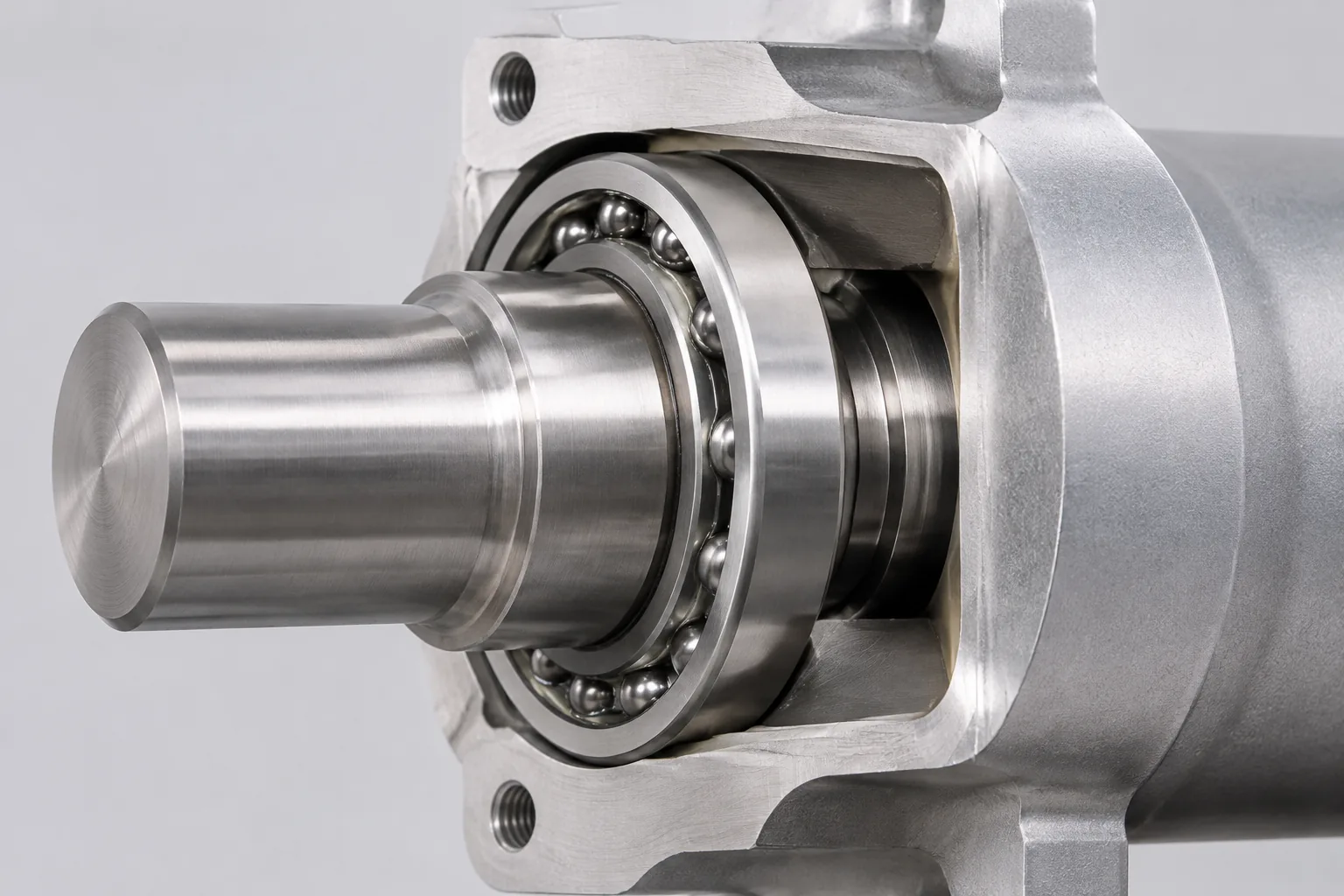
Different thermal expansion of shaft, housing, rings, balls, and cages changes fits and internal clearance at low temperature. Cryogenic bearings may use silicon nitride balls, stainless steel rings, special clearance, and anti-rotation features to manage differential contraction.
Interference fits reduce initial clearance, so the operating clearance should be calculated rather than taken only from a room-temperature catalog value. Interference fits can reduce initial clearance by roughly 70% to 90% of the interference amount. The usual target is a small positive operating clearance, close to zero but not negative.
Calculate clearance at the lowest operating temperature and at the steady-state operating temperature.
Verify Cages, Seals, and Polymer Compatibility
Cages and seals must not harden, crack, shrink, or lose sealing contact at the minimum temperature. Self-lubricating fluoropolymer cages are used in some cryogenic and LNG bearings. PAO and ester lubricants require compatibility checks with plastics, elastomers, and paints.
Verify seal lip material, spring energizer, cage material, and lubricant compatibility at the minimum temperature. Check plastic material compatibility before using PAO or ester oils.
Check Speed, Load, and Torque Limits
Lubricant speed capability has to be matched to bearing size and rotational speed using NDm. The usual definition is NDm = rotational speed × (bearing bore + bearing outside diameter) / 2. One low-temperature grease is rated up to NDm 1,600,000.
Check startup torque and running torque separately at low temperature. Under one low-temperature evaluation method, ASTM D1478/IP 186/93 limits are no more than 1,000 N·mm startup torque and 100 N·mm running torque. Treat quoted torque limits as test-condition values, not universal application limits.
Load capacity still has to be verified after material and clearance changes. High NDm capability does not guarantee low startup torque at very low temperature.
Confirm Media Compatibility and Corrosion Protection
Cryogenic liquids can act as thin-film lubricants but may also create corrosion, erosion, or contamination risks. LNG itself can act as the lubricant in LNG pump bearings, avoiding conventional grease. Cryogenic liquid films are very thin and require specially designed bearings.
Stainless steel rings, ceramic balls, and polymer cages may be needed for liquefied-gas service. Cleaning, degreasing, and material certification have to match the medium and industry requirements. Confirm compatibility with the actual liquid or gas, including oxygen cleaning requirements where applicable.
Validate with Standards and Application Tests
Use low-temperature torque tests for grease screening and bearing-level tests for the final design. ASTM D1478-20 measures the low-temperature torque of ball bearing grease below -20°C. ISO 281:2007 covers basic dynamic load ratings and rating life, with basic rating life corresponding to 90% reliability. ISO 16281:2025 covers modified reference rating life considering lubrication, contamination, fatigue load limit, misalignment, operating clearance, and internal load distribution.
Specify test temperature, soak time, speed, load, grease fill, and pass or fail torque limits. Validation should include cold startup, temperature cycling, running torque, vibration, and post-test inspection. A grease torque test alone does not validate a complete cryogenic bearing design.
Common Pitfalls and Exceptions
Most low-temperature failures come from treating one catalog value as the whole design case. These are the common exceptions to check:
- Do not treat a catalog minimum temperature as proof of continuous operation.
- Do not assume a low-temperature grease is food-safe or chemically compatible with cryogenic media.
- Do not select internal clearance only at room temperature when interference fits and thermal contraction are significant.
- Do not use an ordinary grease-lubricated bearing in LNG, liquid oxygen, liquid hydrogen, or liquid helium service without specific validation.
- Do not choose the lowest-viscosity lubricant without confirming oil-film formation and wear protection.
Escalate to application engineering when the bearing operates near LTL, in cryogenic media, or under rapid temperature cycling.
Conclusion
Low temperature bearings work as a system: the lubricant supplies the film, the materials and cage tolerate the cold, the seals keep the medium out, and the clearance keeps the rolling contact stable after contraction. The practical result is a bearing that starts, runs, and stays lubricated at the coldest point in the cycle, not just one that passes a room-temperature check.
Use the real temperature profile to screen the lubricant, then confirm LTL and LTPL, material and clearance behavior, seal and cage compatibility, speed and torque limits, and medium compatibility. When the application is cryogenic or cycles rapidly, validate the complete bearing design rather than relying on a single grease rating.
FAQs
Q1: What is a low-temperature bearing?
A: A low-temperature bearing is a rolling bearing adapted to start and run in cold or cryogenic conditions through low-temperature lubrication, matched materials, cage and seal design, and suitable internal clearance. It is an application-engineered bearing system, not a separate standard bearing category.
Q2: What temperature range do low-temperature bearings cover?
A: Cold-environment bearing practice commonly treats temperatures below -20°C as the low-temperature grease range. Deep-cryogenic designs extend much further: some cryogenic ball bearings are listed from -74°C to -253°C, and LNG pump bearings can be rated to a minimum of -162°C.
Q3: Can standard bearings operate below -20°C?
A: Sometimes, but not automatically. A standard bearing with standard grease may exceed its startup torque limit or lose lubricant supply after a cold soak. Check LTL and LTPL, seal and cage behavior, and operating clearance. For LNG, liquid oxygen, liquid hydrogen, or liquid helium, use a bearing designed and validated for that medium.
Q4: What is the difference between LTL and LTPL?
A: LTL is the low-temperature limit for reliable startup. LTPL is the low-temperature performance limit for continuous, reliable operation. A short cold start between the two can be acceptable when friction warms the bearing back into the reliable range, but sustained operation below LTPL risks lubricant starvation and damage.
Q5: Which grease is suitable for low-temperature bearings?
A: A suitable grease has a high viscosity index, a low pour point, and a base oil that still forms a film at the target temperature. Typical choices use ISO VG 10 to ISO VG 32 base oils, often PAO or ester with lithium soap. Verify LTL, LTPL, pumpability, oil release, and compatibility with seals and plastics.
Q6: Are low-temperature bearings food-safe?
A: Not automatically. Food-contact risk requires an appropriate registration such as NSF H1 or an equivalent standard where applicable. NSF H1 relates to lubricants for incidental food contact and FDA 21 CFR 178.3570. A solid-oil product may have an NSF H1 variant, but the specific lubricant and bearing configuration have to be confirmed.
Q7: How should internal clearance be selected for cryogenic service?
A: Calculate clearance at the lowest operating temperature and at steady-state temperature, including shaft, housing, ring, ball, and cage contraction. Interference fits can reduce initial clearance by roughly 70% to 90% of the interference amount. The target is usually a small positive operating clearance, close to zero but not negative.
Q8: What standards test low-temperature bearing grease?
A: ASTM D1478-20 measures the low-temperature torque of ball bearing grease below -20°C. One low-temperature evaluation method uses limits of no more than 1,000 N·mm startup torque and 100 N·mm running torque. ISO 281:2007 and ISO 16281:2025 support bearing life calculation. A grease torque test does not validate a complete cryogenic bearing design.
Q9: Why do cryogenic pumps use ceramic balls and stainless steel rings?
A: Silicon nitride balls and stainless steel rings resist corrosion and help manage differential thermal contraction in cryogenic service. Fluoropolymer cages can provide self-lubrication when the liquefied gas offers only a thin film. The combination supports thin-film operation, but medium compatibility, clearance, and cleaning requirements still have to be validated.
Q10: When is solid oil better than grease?
A: Solid oil is useful when relubrication access is limited, temperature cycles rapidly, moisture is present, or freezer equipment needs retained lubricant. One solid-oil design holds 2 to 4 times the oil volume of conventional grease lubrication and supports relubrication-free operation. Check its temperature range, speed limit, and bearing compatibility before use.