Quick Answer: Self-aligning ball bearings are used where shaft-to-housing alignment cannot be guaranteed or the shaft may deflect. They suit light-to-moderate loads and high-speed rotation in fans, blowers, textile machinery, conveyors, agricultural machinery, gearboxes, transmission shafts, simple woodworking machinery, and ventilators. Their double-row ball design compensates for angular misalignment, but they are not the first choice for heavy axial or thrust loads. Where load capacity is insufficient, spherical roller bearings are usually the better self-aligning option.
Self-aligning ball bearings earn their place in rotating equipment where alignment is imperfect and loads stay within ball-bearing limits. They are common in light-to-moderate duties, yet selection still depends on load direction and magnitude, speed, misalignment, sealing, and temperature. The useful question is not whether they self-align, but whether those conditions match the bearing’s capacity.
What Are Self-Aligning Ball Bearings Used For?
They are used where the shaft and housing cannot be held in precise alignment, or where the shaft bends under load. The bearing absorbs small angular movement instead of forcing the surrounding structure to resist it.
- Misalignment-tolerant duty: useful when mounting error, housing deformation, or shaft deflection is expected.
- Light-to-moderate load: suited to duties that stay within the capacity of a double-row ball bearing.
- High-speed rotation: low friction makes the type useful where speed is a primary operating condition.
- Application examples: fans, blowers, textile machinery, conveyors, material-handling systems, agricultural machinery, gearboxes, drives, transmission shafts, simple woodworking machinery, and ventilators.
They are not the first choice for heavy axial or thrust loads. When self-alignment is needed but the ball bearing’s load capacity is too low, spherical roller bearings are the usual next step.
How the Design Creates Self-Alignment
A self-aligning ball bearing has two rows of balls. The outer ring carries one common sphered raceway, while the inner ring has two raceway grooves. Because the inner ring, balls, and cage can swivel relative to the outer ring, the bearing can follow small angular misalignment instead of forcing the shaft or housing to correct it.
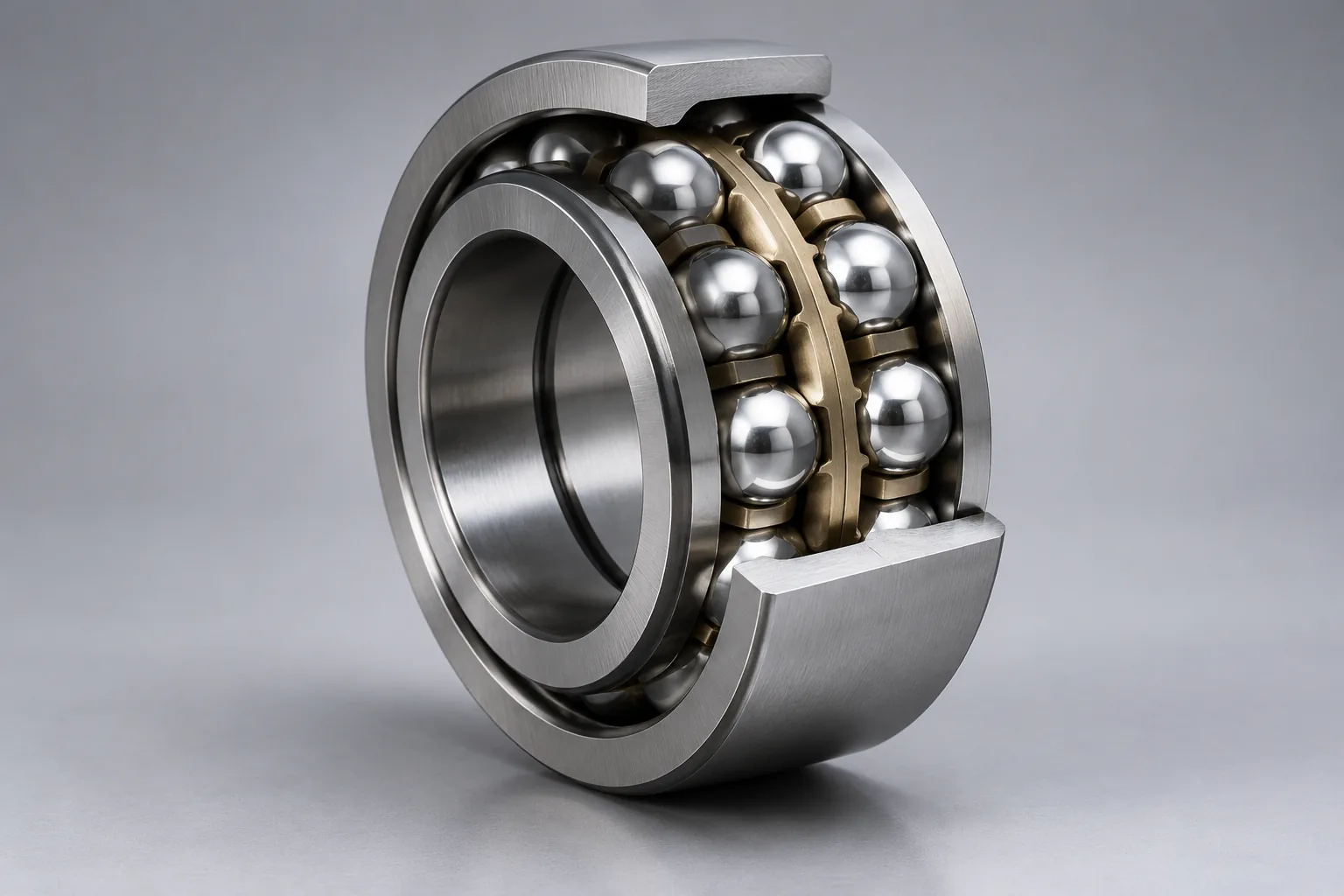
This movement covers both static and dynamic angular misalignment. Static misalignment may come from inaccurate mounting or a housing that is not square. Dynamic misalignment may come from shaft deflection during operation or housing deformation under load.
Swivel capability is finite. Under normal operating conditions with a rotating inner ring, open bearings commonly allow about 4° of swivel. Sealed bearings are often limited to about 1.5°. Treat these values as guidance rather than universal limits; the permissible angle depends on the bearing design and the surrounding components.
Typical Applications
The applications below are grouped by the problem they solve. In each case, confirm the actual load, speed, alignment, sealing, and temperature requirements for the selected bearing.
Fans and Blowers
Fans and blowers are a natural fit because they often run at high speed while the housing and shaft alignment may not be perfect. Low noise and vibration are valuable in these duties, and sealed variants can be considered where grease retention and contaminant exclusion matter. Verify the speed, load, and temperature ratings before selection.
Textile Machinery
Textile machinery often combines high-speed operation, light loads, and alignment uncertainty. A self-aligning ball bearing can reduce sensitivity to mounting error and shaft deflection in that combination. Choose open or sealed designs according to the operating environment and lubrication plan.
Conveyors and Material-Handling Systems
General conveyor equipment and material-handling systems can develop shaft deflection or imperfect shaft-to-housing alignment. Self-aligning ball bearings are useful in light-to-moderate conveyor duties where that movement must be absorbed. Sealed versions are worth considering where dust and contaminants are present, provided the speed and temperature limits remain acceptable.
Agricultural Machinery
Agricultural machinery often uses frames and shafts that deflect under load, and alignment can be difficult to maintain in the field. Self-alignment helps in those conditions. Sealed designs may help retain grease and exclude contaminants, but the selected seal, grease, and temperature range must be confirmed for the duty.
Gearboxes, Drives and Transmission Shafts
Gearboxes, speed reducers, and transmission shafts are common applications because shafts can bend and accurate alignment is not always practical. The bearing can follow small angular movement, but axial load limits still apply. Check the axial load direction and magnitude carefully because the small contact angle limits thrust capacity.
Simple Woodworking Machinery and Ventilators
Simple woodworking machinery and ventilators often combine light loads, moderate speeds, and alignment uncertainty. Self-aligning ball bearings can be a practical fit in those conditions. Avoid treating them as suitable for heavy cutting loads or severe shock loads without checking the bearing rating.
Key Benefits in Real Applications
The benefits below are application outcomes, not generic product claims. Each one depends on the design feature and on the operating conditions.
Compensates Mounting Error, Housing Deformation and Shaft Deflection
The sphered outer-ring raceway allows the bearing to accommodate angular misalignment. It compensates for both static and dynamic misalignment, so the arrangement is less sensitive to inaccurate mounting, housing deformation, and flexible shafts. The bearing reduces the penalty of imperfect alignment, but it does not remove the need to mount and locate it correctly.
Low Friction and Cooler High-Speed Operation
Self-aligning ball bearings generate less friction than many other rolling-bearing types. Lower friction supports cooler operation at high speed and reduces frictional heat. In the right duty, that can help extend bearing life and maintenance intervals, but lubrication and mounting still control the result.
Low Noise and Vibration
Low noise and vibration are useful benefits, particularly in fan applications. The result depends on mounting, shaft and impeller balance, lubrication, and the surrounding structure. A self-aligning bearing can tolerate some misalignment, but it cannot correct an unbalanced rotor or a loose housing.
Supports Radial Loads and Limited Bidirectional Axial Loads
The bearings can support radial forces and axial forces in both directions. Axial capacity is limited because the contact angle is small. Do not select them for heavy thrust loads or for applications where thrust capacity is the dominant design requirement.
Suits Light Loads and High Speeds
The low minimum-load requirement makes this type suitable for light-load, high-speed applications. It is often described as a high-speed, light-load alternative to spherical roller bearings. Verify the actual load and speed ratings for the specific bearing size and design rather than relying on the general type description.
Sealed Designs Reduce Relubrication and Contamination Risk
Sealed versions use contact seals on both sides to retain grease and exclude contaminants. Some sealed, grease-filled versions are lubricated for life and require no relubrication, but that is variant-specific. Confirm the selected variant and respect the grease temperature limit; sealed bearings are commonly rated to a lower temperature than open bearings.
Mounting Flexibility with Cylindrical or Tapered Bores
Self-aligning ball bearings are available with cylindrical or tapered bores and in open or sealed designs. Tapered-bore versions can be mounted with adapter sleeves. Adapter sleeves simplify installation and removal on smooth or stepped shafts, which is useful where mounting time or shaft condition is a constraint.
When Self-Aligning Ball Bearings Are Not the Best Choice
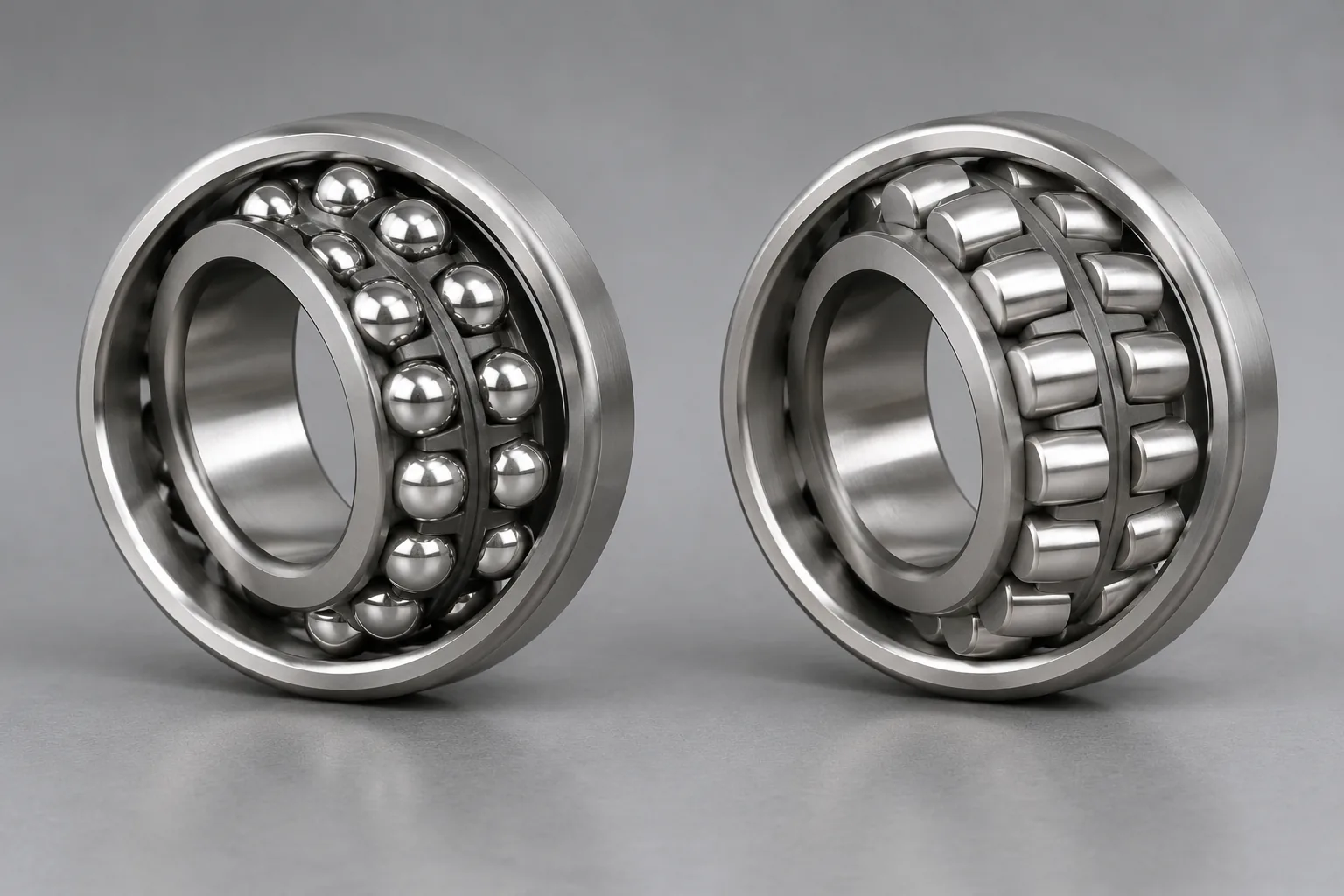
Choose spherical roller bearings when self-alignment is required but the load-carrying capacity of a self-aligning ball bearing is insufficient. Both types provide self-alignment, but the roller design carries greater load. Self-aligning ball bearings suit light loads and high speed; spherical roller bearings suit heavier loads and lower-speed rotation.
Temperature is another boundary. Typical temperature ranges are -30°C to +150°C for open bearings with brass cages, up to +120°C for glass-fiber-reinforced polyamide cages, and -30°C to +100°C for sealed bearings. For sealed bearings, the grease usually sets the limit. Confirm the cage, seal, and grease data for the exact variant.
Do not use self-aligning ball bearings for heavy axial loads or where thrust capacity is the dominant design requirement. If the application combines high thrust with misalignment, a different bearing arrangement is usually needed.
Selection Checklist: Matching the Bearing to the Application
Use the following checks before ordering. The type name alone is not enough to confirm suitability.
- Misalignment: Confirm the expected static and dynamic angular misalignment and how much the shaft or housing will deflect.
- Load: Check radial load, axial load direction, magnitude, shock, and vibration. Treat axial capacity as limited.
- Speed: Compare the operating speed with the selected bearing’s speed rating, not just the general type capability.
- Environment: Select bore type, open or sealed design, cage, clearance, and lubrication for dust, moisture, temperature, and maintenance access.
- Mounting: Confirm the mounting method and the available shaft and housing geometry, including whether a tapered bore and adapter sleeve are practical.
Common dimensional series include 12, 13, 22, and 23. Shaft-diameter coverage can start at 5 mm and reach 110 mm in some ranges, while broader assortments extend to 130 mm bore. Clearances commonly include C2, CN, C3, and C4.
Boundary dimensions are commonly organized under ISO 15:2017, and dimensional and geometrical tolerances under ISO 492. For a specific variant, confirm the load ratings, speed ratings, clearance, cage, seal, and permissible misalignment from the product data before ordering.
Conclusion
Self-aligning ball bearings are a practical choice when misalignment, shaft deflection, light loads, and high speed occur together. Their double-row ball design and sphered outer raceway absorb angular error, run with low friction, and support radial loads plus limited axial loads in both directions.
They are not a universal replacement for spherical roller bearings. When load capacity or thrust resistance is the limiting factor, the roller design is usually the safer choice. Check load direction and magnitude, speed, misalignment, sealing, clearance, lubrication, mounting, and temperature before selecting a variant.
FAQs
Q1: What are self-aligning ball bearings used for?
A: They are used in rotating equipment where shaft-to-housing alignment is uncertain or the shaft may deflect, especially with light-to-moderate loads and high speed. Common duties include fans, blowers, textile machinery, conveyors, agricultural machinery, gearboxes, transmission shafts, simple woodworking machinery, and ventilators.
Q2: Are self-aligning ball bearings good for high-speed applications?
A: Yes, they are often chosen for light-load, high-speed duties because they run with low friction and generate less heat than many other rolling-bearing types. Confirm the speed rating, lubrication, and temperature for the exact bearing, because high speed alone does not guarantee suitability.
Q3: Can self-aligning ball bearings take axial loads?
A: They can support axial loads in both directions, but the capacity is limited by the small contact angle. They are not suitable for heavy thrust loads. Check the axial load magnitude and direction against the selected bearing’s rating.
Q4: What is the difference between self-aligning ball bearings and spherical roller bearings?
A: Both compensate for misalignment, but self-aligning ball bearings suit lighter loads and higher speeds, while spherical roller bearings carry heavier loads at lower speed. Choose the roller type when the ball bearing’s load capacity is insufficient.
Q5: Do sealed self-aligning ball bearings need relubrication?
A: Some sealed, grease-filled versions are lubricated for life and need no relubrication, but not every sealed design is the same. Confirm the selected variant and keep operating temperature within the grease limit.
Q6: How much misalignment can a self-aligning ball bearing handle?
A: Common guidance is about 4° for open bearings under normal conditions with a rotating inner ring and about 1.5° for sealed bearings. These are not universal limits. The permissible angle depends on bearing design and surrounding components, so confirm it for the exact variant.