Quick Answer: Si3N4 ceramic bearings use silicon nitride as a rolling-element or ring material, not as a single bearing design. Hybrid ceramic bearings normally combine bearing-steel rings with bearing-grade Si3N4 rolling elements, while full ceramic bearings use ceramic rings and rolling elements. The material offers low density, high hardness, high stiffness and electrical insulation, but bearing capacity, clearance, lubrication, temperature limits and cost still depend on the complete bearing design.
Si3N4 ceramic bearings are specified when a standard steel bearing is limited by speed, electrical current, poor lubrication or contamination. The material choice changes mass, stiffness, thermal behavior and electrical resistance, so the bearing architecture matters as much as the chemical formula. This guide explains the difference between hybrid and full ceramic designs, the properties that drive performance, the standards used for bearing-grade silicon nitride, and the checks needed before replacement.
What Is Si3N4 and Why Use It in Bearings?
Si3N4 is the chemical formula for silicon nitride. In bearing applications it is not a complete bearing by itself. Bearing-grade silicon nitride usually has a microstructure of elongated beta-Si3N4 grains in a glass-phase matrix. That microstructure, together with tight control of flaws and surface defects, separates bearing-grade material from generic ceramic grade.
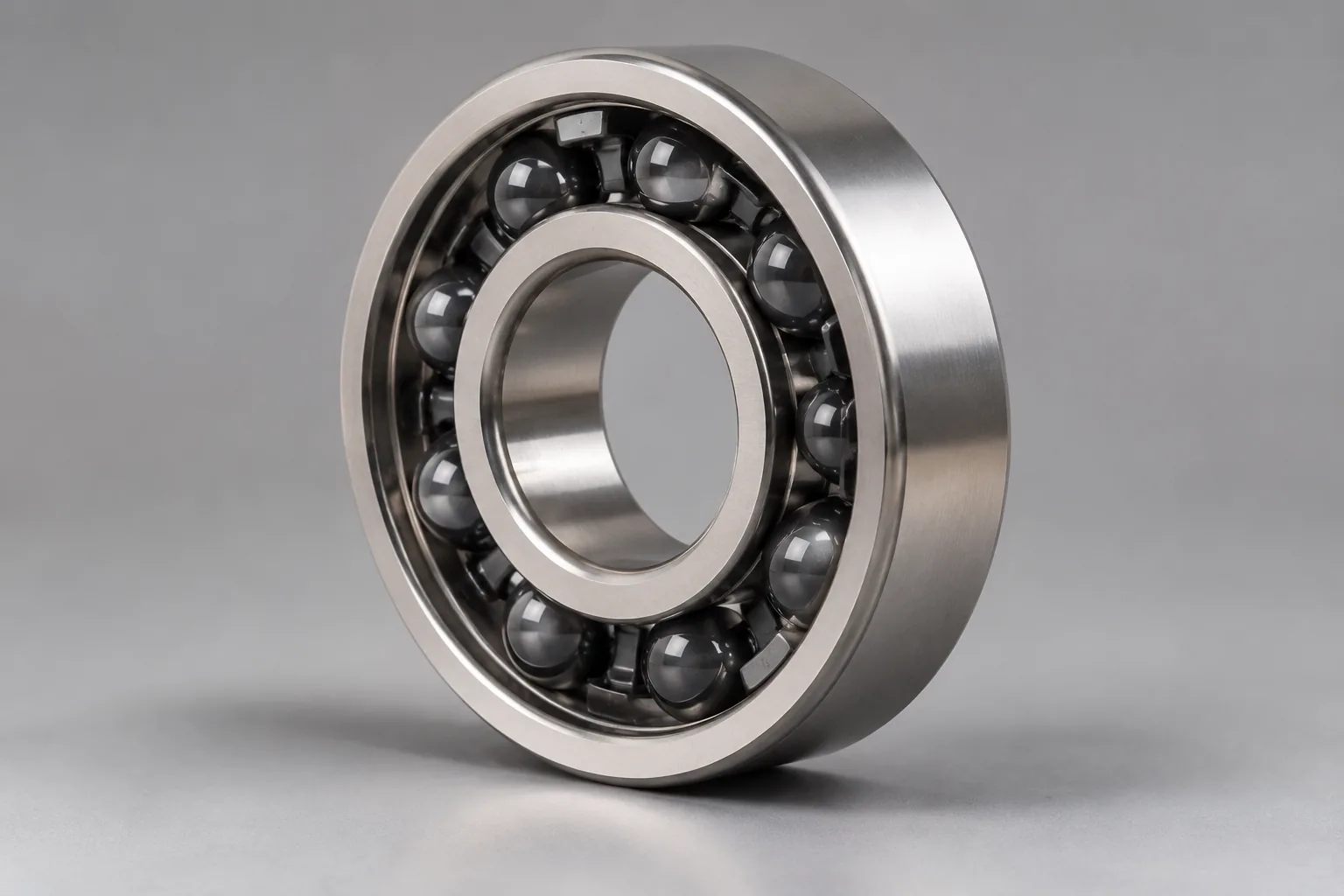
Si3N4 can appear in two main architectures. In a hybrid bearing, the inner and outer rings are usually bearing steel and the rolling elements are bearing-grade Si3N4. In a full ceramic bearing, the rings and the rolling elements are ceramic. The same chemical formula therefore covers different design rules, different fits and different load limits.
Engineers choose Si3N4 for several reasons: low rolling-element mass, high hardness, high elastic modulus, low thermal expansion, high electrical resistivity and non-magnetic behavior. Each benefit has a condition. For example, low mass helps high-speed operation, but it does not remove the need to calculate speed, lubrication and contact stress for the complete bearing.
Hybrid vs Full Ceramic Si3N4 Bearings
| Feature | Hybrid ceramic bearing | Full ceramic bearing |
|---|---|---|
| Rings | Usually bearing steel | Ceramic |
| Rolling elements | Bearing-grade Si3N4 | Ceramic |
| Typical use | High speed, electrical machines, poor lubrication | Applications that also need ceramic rings |
| Performance data | Use only hybrid data | Do not apply hybrid data |
A hybrid ceramic bearing is not the same product as a full ceramic bearing. Full ceramic bearings have different ring materials, brittleness, fits, tolerances, thermal expansion and allowable loads. Hybrid bearing performance data cannot be applied directly to full ceramic bearings.
Standard hybrid families can include deep groove ball, angular contact ball, cylindrical roller, double-row angular contact, super-precision and special designs. The family matters because a deep groove ball bearing and a cylindrical roller bearing use different contact geometry and different load paths.
Key Material Properties of Bearing-Grade Si3N4
Property values describe the material. They do not guarantee the performance of an assembled bearing. Rings, cage, seals, lubricant, clearance and mounting conditions can change the result. Different suppliers also report slightly different typical values.
Density, Hardness, and Elastic Modulus
| Property | Si3N4 | 100Cr6 bearing steel |
|---|---|---|
| Density | 3.2 g/cm3 | 7.9 g/cm3 |
| Density ratio | About 40.5% of steel | 100% |
| Hardness | 1,600 HV10 | About 700 HV10 |
| Hardness ratio | About 2.3 times steel | 1 |
| Elastic modulus | About 310 GPa | About 210 GPa |
Lower density reduces rolling-element mass and centrifugal load at high speed. Higher hardness supports wear resistance against hard particles. Higher elastic modulus increases stiffness but can raise contact pressure under equal load and geometry.
One manufacturer lists a Si3N4 density of 3.304 g/cm3, a Young’s modulus of 315 GPa and a Poisson’s ratio of 0.25. Typical material data includes Si3N4 fracture toughness of 7 MPa*m1/2 and flexural strength of 850 MPa. These values are material data, not bearing ratings.
Higher hardness and modulus do not automatically mean higher bearing load capacity or longer fatigue life. A harder material can also be less tolerant of impact and surface defects.
Thermal Expansion and Temperature Limits
Si3N4 has much lower thermal expansion than bearing steel. Published data gives about 3 x 10⁻⁶/K for Si3N4 and about 12 x 10-6/K for bearing steel. Another source lists 3.2 x 10⁻⁶/°C for Si3N4. Low thermal expansion can help stabilize clearance or preload at high speed, but temperature differences between rings and rolling elements must be checked.
Material temperature capability is not the same as assembled bearing continuous operating temperature. Typical material data gives maximum use temperatures of 1,300°C in oxidizing atmosphere and 1,600°C in neutral atmosphere. Published data gives bearing Si3N4 hardness of about 1,500 HV and a material usable temperature up to +700°C. Actual bearing temperature still depends on rings, cage, lubricant, seals and clearance.
Check clearance or preload at the actual operating temperature, especially in cryogenic, rapid temperature-change or large ring-to-rolling-element temperature-difference applications. Cages, seals, lubricants and ring materials often limit the bearing before Si3N4 does.
Electrical and Magnetic Properties
Published data gives Si3N4 resistivity of 10^12 ohm*m and steel resistivity of 0.4 x 10⁻⁶ ohm*m. The same data also gives Si3N4 dielectric strength of 15 kV/mm and relative permittivity of 8 at 1 MHz. In a hybrid bearing, Si3N4 rolling elements can interrupt the direct conductive path between the inner and outer rings and present high impedance to AC current.
Si3N4 rolling elements do not respond to magnetic fields. That can matter in magnetically sensitive equipment, but the complete bearing still includes steel rings and possibly a steel or metal cage.
An insulating bearing is not a complete motor shaft-current solution. Grounding, shielding, symmetric cables and possibly insulation at both bearing positions may still be required. Electrical design changes should be checked with the OEM.
How Si3N4 Improves Bearing Performance
Common claims about Si3N4 bearings come from several mechanisms. Separate the mechanism from a specific test result. A friction reduction measured in one high-speed test is not a guaranteed energy-saving value for every application.
High-Speed and Low-Friction Operation
Lower rolling-element mass reduces centrifugal force, inertia force, outer-ring contact stress and friction heating. Published data states that Si3N4 balls are about 60% lighter than steel balls. In a high-speed test, hybrid bearing friction torque was measured 5%-8% lower than comparable steel bearings. Published product data reports that hybrid bearings can increase limiting speed by up to 20%, and under the stated product conditions grease life can double and lifecycle cost can be reduced by up to 20%.
These values are test- and product-specific. Do not convert them into guaranteed savings for every application. Speed capability also depends on cage design, lubrication, ring material, preload and heat dissipation.
Electrical Insulation in Motors and Generators
Hybrid Si3N4 bearings are used to reduce the risk of electrical erosion, electrical pitting and fluting in inverter-driven machines. They are relevant to variable-frequency motors, generators and traction motors. Fast inverter switching can create bearing currents, and ceramic rolling elements change the electrical path.
The bearing is one part of a shaft-current mitigation strategy. Cable layout, grounding, filter design and machine topology can change the current that reaches the bearing. A hybrid bearing should not be treated as a substitute for a complete electrical design review.
Wear, Contamination, and Poor Lubrication
High hardness helps resist wear and plastic deformation from hard particles. Ceramic-to-steel contact is less prone to metal micro-welding than steel-to-steel contact. Hybrid bearings can perform better under boundary lubrication, insufficient lubrication and solid contamination in suitable applications.
These benefits depend on the application. Heavy contamination can still damage seals, cages and steel rings. Poor lubrication can still generate heat and wear. A hybrid bearing does not remove the need for the correct lubricant, quantity and relubrication interval.
Stiffness, Precision, and Load Considerations
Higher elastic modulus can increase bearing stiffness and reduce deflection under load, which supports spindle positioning accuracy. The same higher modulus can shrink the Hertzian contact area and raise contact pressure at equal load. In an equal-load example, a hybrid bearing contact pressure of 3.5 GPa was reported versus 3.1 GPa for an all-steel bearing, about 12% higher.
Bearing capacity and life must be calculated from the complete bearing design, not from material hardness alone. Do not infer higher dynamic or static load ratings solely from Si3N4 material properties.
Limitations and Design Risks
Si3N4 is a hard, low-ductility ceramic. Abnormal impact, mounting damage, internal defects or overload can cause failure behavior different from tough steel. A ceramic rolling element may fracture rather than dent or deform, so handling and installation matter.
Thermal expansion mismatch with steel rings can change operating clearance or preload. Hybrid bearings may cost significantly more than standard bearings. A published high-speed motor bearing case cites cost up to about 5 times that of a standard bearing. Electrical insulation claims require test frequency, test method and the full bearing configuration. Full ceramic bearings are not simply an upgraded hybrid bearing. Material temperature limits should not be used as bearing speed ratings or continuous bearing-temperature limits.
Recheck clearance, preload, lubrication, speed, load and fits when replacing an all-steel bearing with a hybrid bearing of the same boundary dimensions.
Standards and Quality Requirements for Si3N4 Bearing Components
The label ceramic or Si3N4 is not sufficient for bearing-grade procurement. Bearing-grade material requires controlled chemistry, microstructure, flaw population, surface quality and inspection. A generic ceramic ball can have the same chemical formula and still fail bearing requirements.
Relevant ISO and ASTM Standards
ISO 26602:2017 covers preprocessed Si3N4 material for rolling bearing balls and rollers. It was published in October 2017 and confirmed in 2023. It classifies preprocessed Si3N4 material into three classes by physical, mechanical and microstructural properties. ISO 3290-2:2014 covers finished Si3N4 balls for rolling bearings. It was published in September 2014 and confirmed in 2025.
ASTM F2094/F2094M-18a covers silicon nitride bearing balls and defines Class I, Class II and Class III material. ASTM F2730/F2730M-18a covers silicon nitride cylindrical bearing rollers. ISO 3643:2024 covers terminology and characteristics of surface defects on ceramic rolling elements. Bearing-grade Si3N4 used in super-precision bearings can conform to ISO 26602.
Procurement and Inspection Requirements
Procurement documents should specify hybrid or full ceramic construction. They should give the exact materials for rings, rolling elements, cage and seals. Where applicable, they should state the ISO 26602 material class and the ISO 3290-2 finished ball grade. They should also state dimensions, contact angle, precision class, fits, load ratings, speed ratings, lubrication, clearance or preload, and allowable temperatures.
Require non-destructive testing, surface-defect inspection, material batch traceability and inspection certificates. Require a calculated operating clearance or preload at the actual working temperature, not only a room-temperature clearance class. This is especially important when steel rings and ceramic rolling elements operate with a significant temperature difference.
How to Read Si3N4 Bearing Designations
Manufacturer suffixes and prefixes identify Si3N4 rolling elements or hybrid construction, but designation systems differ by manufacturer. Do not generalize one brand’s code across brands. A designation may also include precision, clearance, cage, seal and lubrication information.
SKF uses suffix HC to indicate Si3N4 rolling elements, and its current hybrid ceramic product tables also use HC5. In the SKF example 7022 CE GA/HC P4B VG275, HC indicates bearing-grade Si3N4 and P4B indicates dimensional and rotational accuracy based on ISO class 4 with tighter tolerances. In the SKF motor example 6205-2RZTN9/HC5C3WT, HC5 indicates hybrid ceramic construction and C3 indicates internal clearance greater than Normal.
NTN uses prefix 5S for ceramic rolling elements. The NTN example 5S-6207ZZC3/EM is a single-row deep groove ball bearing with a 35 mm bore, double steel shields, C3 clearance and motor grease. FAG uses prefix HC for hybrid bearings and offers open, .2RSR double sealed and .2ZR double shielded configurations. A generic ceramic description is not enough to confirm bearing-grade Si3N4.
Typical Applications and Development Milestones
Si3N4 bearings moved from specialized aerospace and machine-tool uses into broader industrial and electrical applications. The milestones explain why different industries adopted hybrid ceramic bearings.
MRC in the United States designed early hybrid ceramic bearings in the 1960s and 1970s. In 1984, SKF demonstrated that Si3N4 bearings could run long-term under solid lubrication and above 500°C. Around 1990, machine tools began using ceramic balls for lightweight high-speed performance. In the mid-1990s, inverter-induced bearing current damage drove hybrid ceramic bearing use in motors. Around 2000, hybrid bearings began to be used in pumps and compressors, including low-viscosity refrigerant-lubricated conditions.
Modern applications include machine tools, wind turbines, rail and EV traction motors, aerospace, compressors, pumps and vacuum pumps. Schaeffler acquired the ceramic-specialist company CERASPIN in 2022. CERASPIN is in Livange, Luxembourg, with more than 25 years of ceramic product experience. NASA’s R8 test bearing used 60NiTi rings and Si3N4 balls at 2,000 rpm for up to 5,000 hours for corrosive and high static-impact aerospace applications.
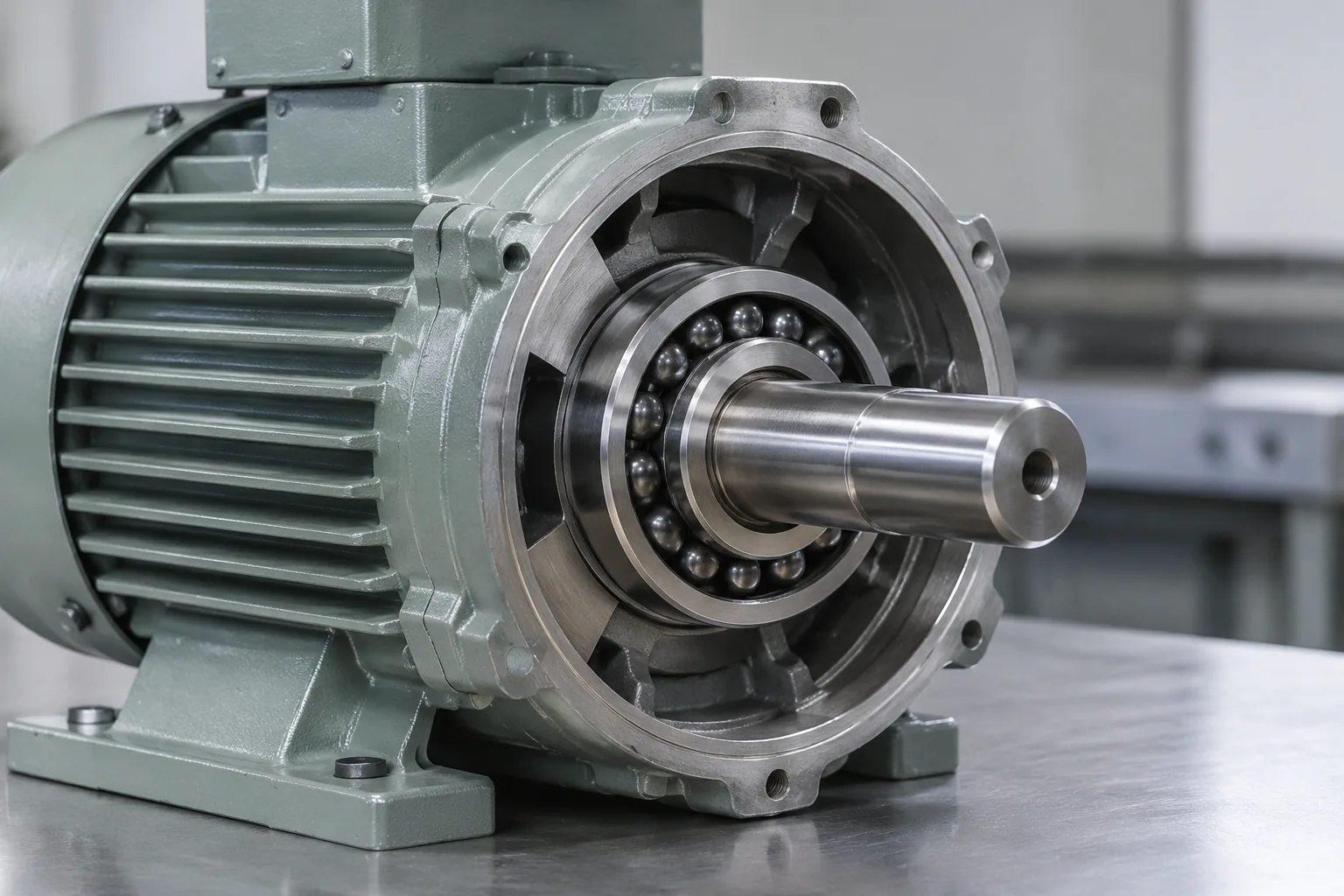
These application areas do not imply that every Si3N4 bearing is suitable for every duty. Load, speed, lubrication, contamination, temperature and electrical conditions still decide the final selection.
Selection Checklist: Specifications to Request
- Bearing architecture: hybrid ceramic or full ceramic.
- Exact materials for rings, rolling elements, cage and seals.
- ISO 26602 material class and ISO 3290-2 finished ball grade.
- Bore, outside diameter, width, contact angle, precision class and fit tolerances.
- Dynamic rating, static rating, fatigue load limit and calculation basis.
- Reference speed, limiting speed, lubrication method and specified lubricant.
- Radial clearance or preload class, plus calculated value at operating temperature.
- Allowable continuous and transient temperatures for the complete bearing.
- Electrical parameters with test frequency, test method and full bearing configuration.
- Non-destructive testing, surface-defect inspection, material batch traceability and inspection certificates.
- Application conditions: shock, contamination, temperature difference, shaft current, vibration and mounting.
Installation and Application Conditions to Verify
Check mounting and handling risk because Si3N4 is hard and low-ductility. Verify shock, vibration, contamination and thermal gradients in the target application. Confirm lubrication method and lubricant compatibility with cage, seal and ring materials. Check whether cage, seal, lubricant or steel rings will limit temperature or speed before Si3N4 does. For electrical applications, verify the complete shaft-current mitigation design, not only the bearing.
Use extra care when replacing steel rolling elements in applications with abnormal impact or installation damage risk. Follow the bearing maker’s mounting instructions for press fits, heating and alignment.
When Si3N4 Bearings Are a Good Fit, and When They Are Not
Good-fit indicators include high speed, electrical machinery, poor lubrication, contamination, stiffness or precision needs, non-magnetic rolling elements, or a need for dimensional replacement with revalidation. Poor-fit indicators include impact-heavy duty, cost-sensitive standard applications, unverified electrical mitigation requirements, or assumptions that material temperature equals bearing temperature.
Hybrid and full ceramic bearings require separate evaluation. Final selection should be based on application-specific load, speed, clearance, lubrication and life calculations. Many hybrid bearings can interchange with all-steel bearings of the same basic dimensions, but clearance, preload, lubrication, speed and load must be rechecked.
Conclusion
Si3N4 ceramic bearings are a material solution, not a universal replacement. The strongest case appears when low mass, electrical insulation, wear resistance or stiffness solves a defined problem, and when the complete bearing design supports that choice. Check the bearing architecture first, then verify load, speed, clearance, lubrication, temperature, electrical configuration and cost. A dimensional interchange is only the starting point. For a specific machine, confirm the calculated operating clearance or preload, the allowable temperature of the complete bearing and the shaft-current mitigation design before release.
FAQs
Q1: Are Si3N4 ceramic bearings better than steel bearings?
A: They are better only for specific requirements such as high speed, electrical insulation, poor lubrication, contamination or stiffness. They are not universally better. Impact, cost, thermal mismatch and contact pressure must be considered, and the complete bearing design still determines load capacity and life.
Q2: What is the difference between hybrid and full ceramic Si3N4 bearings?
A: A hybrid bearing uses steel rings with Si3N4 rolling elements. A full ceramic bearing uses ceramic rings and ceramic rolling elements. Do not apply hybrid performance data to full ceramic bearings because ring material, brittleness, fits, tolerances, thermal expansion and allowable loads differ.
Q3: Can Si3N4 hybrid bearings replace steel bearings with the same dimensions?
A: Many hybrid bearings can interchange with all-steel bearings of the same basic dimensions, but the replacement must be rechecked. Confirm clearance, preload, lubrication, speed, load, fits and operating temperature before use. A dimensional match alone does not prove equivalent performance.
Q4: Are Si3N4 bearings electrically insulating?
A: Si3N4 rolling elements have high resistivity and interrupt the direct conductive path in hybrid bearings, and they provide high impedance to AC current. An insulating bearing is not a complete motor shaft-current solution. Grounding, shielding, cable layout and machine design still matter, and some equipment may need insulation at both bearing positions.
Q5: What temperature can Si3N4 bearings withstand?
A: Si3N4 material data may show high temperature capability, but the assembled bearing temperature is limited by rings, cage, seals, lubricant and clearance. Specify allowable continuous and transient temperatures for the complete bearing, not only the ceramic material. Check the actual operating temperature and thermal gradient.
Q6: How should I specify bearing-grade Si3N4 quality?
A: Reference ISO 26602 for preprocessed material and ISO 3290-2 for finished balls where applicable. Specify material class, ball or roller grade, tolerances, non-destructive testing, surface-defect inspection and batch traceability. Do not accept a generic ceramic or Si3N4 label without inspection requirements.
Q7: Are Si3N4 bearings magnetic?
A: Si3N4 rolling elements do not respond to magnetic fields, which can be useful in selected magnetically sensitive applications. The complete bearing still includes steel rings and possibly a steel or metal cage, so evaluate the whole assembly rather than the ceramic rolling element alone.