Quick Answer: Dental bearings are miniature precision ball-bearing assemblies installed inside dental high-speed air-turbine handpieces, speed-increasing contra-angle handpieces, and other rotating dental instruments. They support the turbine rotor or drive shaft so the bur rotates with low friction and stable motion under radial and axial loads. Bearing geometry, material, cage, lubrication, and fit all influence speed stability, runout, noise, vibration, cutting stability, and service life.
Dental bearings sit at the center of handpiece performance. They are small enough to fit inside a turbine chamber, yet they carry the loads and speed that make precise cutting possible. A useful way to judge a dental bearing is to look beyond its bore and outside diameter: the cage, lubricant, shield, tolerance group, and sterilization exposure matter just as much.
Where Dental Bearings Are Used
Rotating dental instruments use bearings wherever a shaft or rotor must turn with low friction and controlled position. The duty is not the same across instrument types, so the bearing specification changes with the handpiece design.
High-Speed Air-Turbine Handpieces
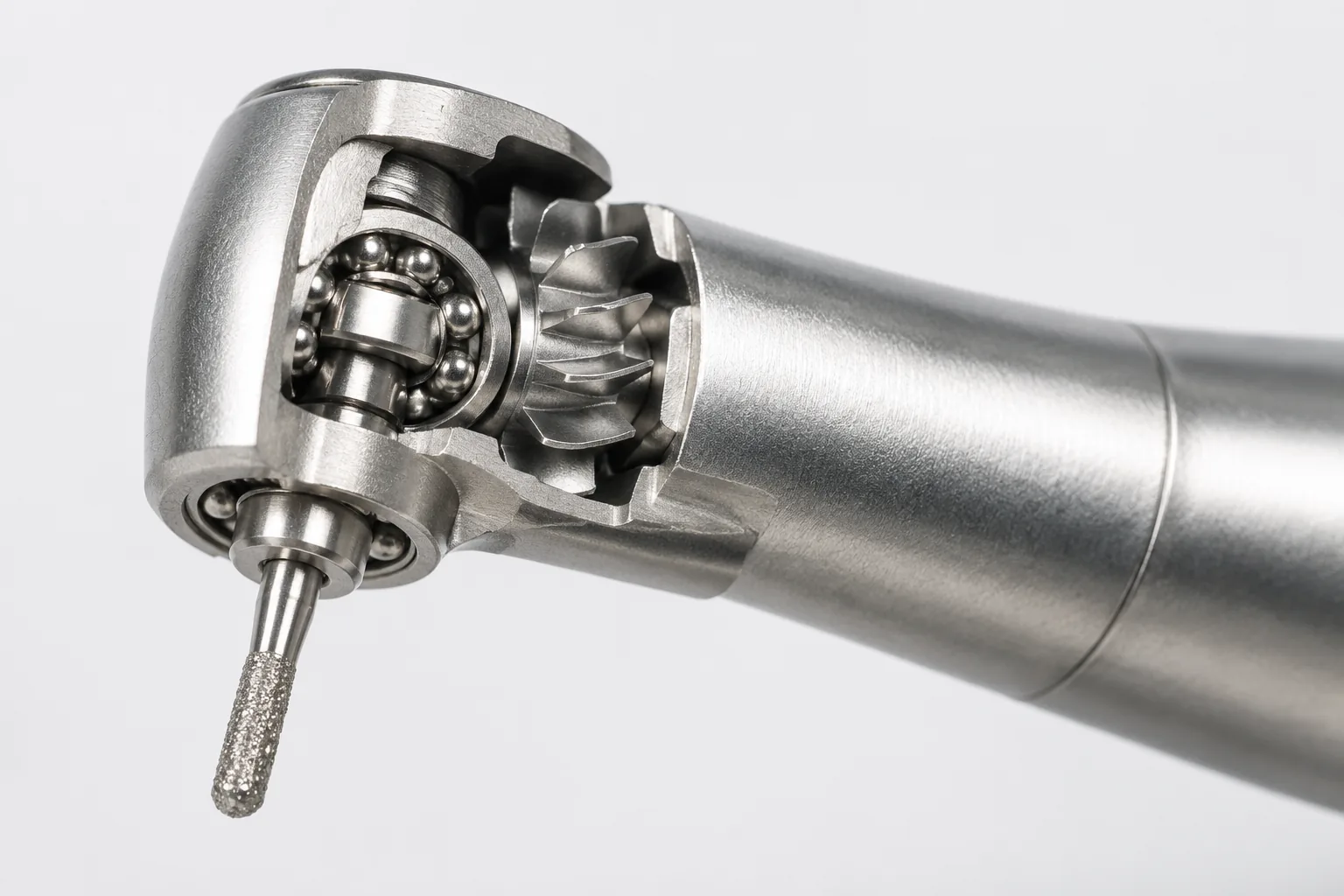
In an air-turbine handpiece, the bearing is part of the turbine assembly that supports the rotating bur. The turbine is driven by compressed air, and the bearings locate the rotor while it turns at high speed. Bearing condition directly affects speed, radial runout, vibration, noise, cutting stability, and service life. A bearing that is worn, contaminated, or poorly fitted can make a handpiece feel rough or cut inconsistently even when the air supply is normal.
Speed-Increasing and Other Rotating Dental Instruments
Speed-increasing contra-angle handpieces and other rotating dental instruments also use bearings to support a shaft at high speed. The requirements vary by instrument design, load, speed, and sterilization exposure. A bearing that suits one handpiece may not suit another with a different shaft, housing, preload, or cleaning cycle.
How Dental Bearings Work
The bearing provides a controlled interface between a rotating shaft and a stationary housing. It carries load, maintains position, and allows rotation with low friction. In a dental handpiece, that basic function is applied in a very small package and at very high speed.
Basic Bearing Components
Most dental bearings have four core components: an inner ring, an outer ring, balls, and a cage or retainer. The inner ring usually fits the shaft, and the outer ring fits the housing. The balls roll between the raceways, and the cage keeps them spaced and guided. Optional shields or seals can be added to limit contamination entry or to help retain lubrication. The exact arrangement depends on the handpiece design and the bearing type.
Load Support and Rotation
Dental bearings support radial and axial loads while allowing high-speed rotation. Radial load acts across the shaft, while axial load acts along it. Common catalog structures for dental handpiece bearings include deep groove ball bearings, angular contact ball bearings, integral angular contact bearings, and shielded angular contact bearings. These are cataloged dental bearing structures, not a universal taxonomy that applies to every handpiece.
Effect on Handpiece Performance
Bearing condition and fit are linked to speed stability, radial runout, vibration, noise, cutting stability, and service life. Stable bearing-to-shaft and bearing-to-housing fits help reduce turbine vibration, noise, and irregular speed. A loose or misaligned fit can allow movement that shows up as runout or vibration, while contamination or poor lubrication can increase friction and heat.
Common Dental Bearing Types
Dental bearings can be organized by raceway geometry and by mounting shape. No single type is universally best; the correct choice depends on the handpiece design, load direction, speed, and sterilization requirements.
Deep Groove Ball Bearings
Deep groove ball bearings are a common miniature ball bearing structure used in rotary dental equipment. The deep raceway grooves allow the bearing to carry combined radial and axial loads in a compact envelope. Specific load ratings or speed limits should be taken from the named product data, not assumed from the general type.
Angular Contact Ball Bearings
Angular contact ball bearings are used in dental handpiece bearings where axial and radial support must be managed together. The contact angle and internal geometry influence how the bearing carries load. Preload, orientation, and fit are design-specific and should not be generalized across handpieces.
Integral Angular Contact Bearings
Integral angular contact designs appear in dental bearing catalogs as one available structure. They combine functions in a way that can simplify the bearing arrangement in some handpieces. An integral design should not be treated as interchangeable with a standard angular contact bearing without confirmation from the handpiece or bearing manufacturer.
Shielded Angular Contact Bearings
Shielded angular contact bearings are listed among dental handpiece bearing structures. A shield is a design feature that may affect contamination protection and lubrication retention. The actual performance depends on the specific shield design, clearance, and operating conditions, so the shield should be part of the matched specification.
Straight, Flanged, Grooved, and Special Shapes
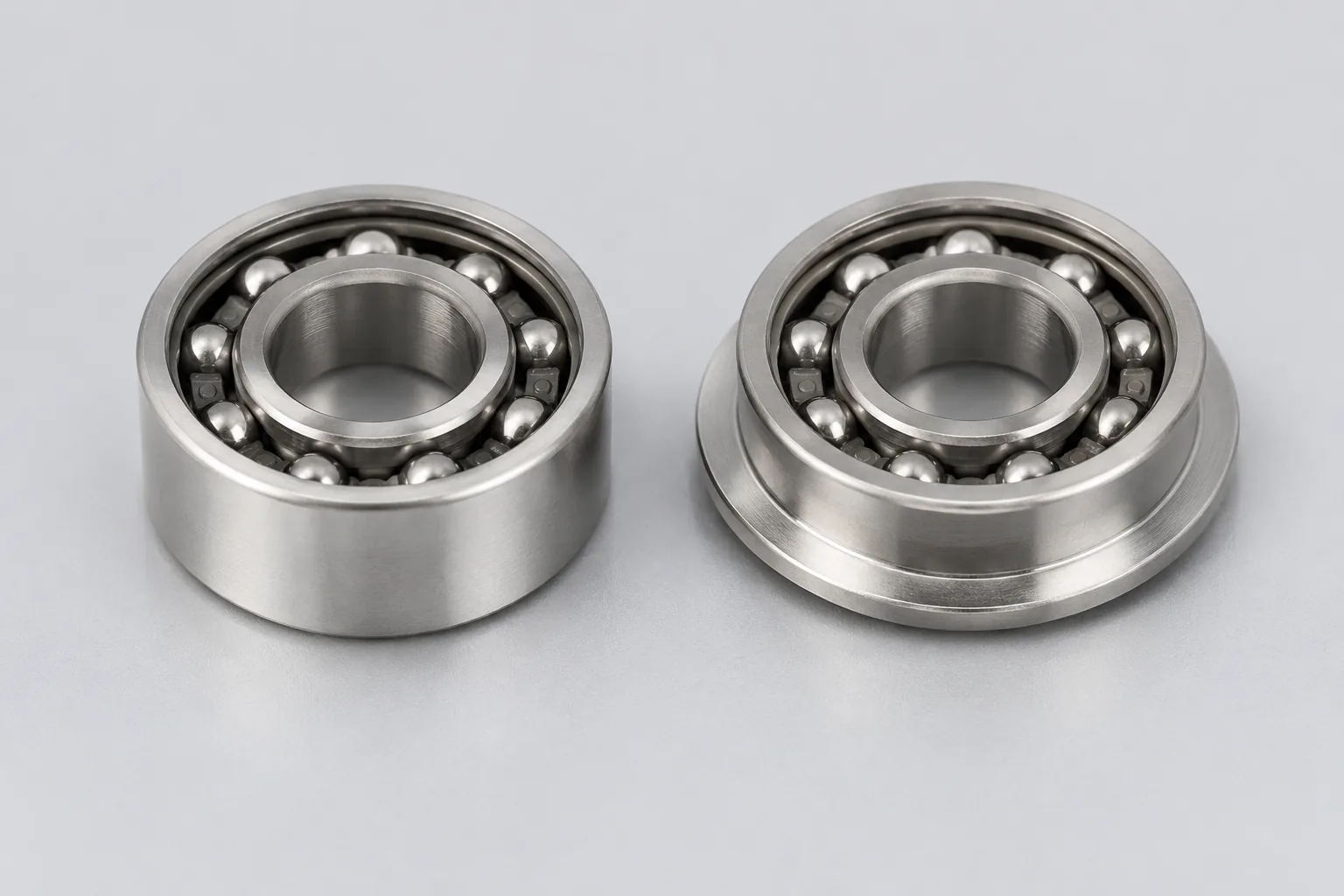
Dental bearing catalogs include straight, flanged, grooved, and special outer shapes. Shape and flange dimensions are part of handpiece-specific mounting, so they should be matched to the handpiece design. A flanged bearing, for example, may use its flange for axial location, and the flange outside diameter and thickness must fit the bearing seat.
Materials and Construction
Material choices affect corrosion resistance, noise, wear, and sterilization compatibility. They also interact with the cage, lubricant, and shield, so the bearing should be assessed as a system rather than as a set of separate parts.
Rings and Balls: Stainless Steel and Hybrid Ceramic
Balls in dental bearings are commonly either stainless steel or ceramic. A hybrid ceramic bearing uses ceramic balls running in steel inner and outer rings. It is not an all-ceramic bearing, and the phrase should not be read as meaning that every component is ceramic. Ceramic balls are associated with low weight, wear resistance, corrosion resistance, low friction, and thermal shock resistance in high-speed dental applications. These properties can be useful, but the surrounding rings, cage, and lubricant still determine the bearing’s overall suitability.
Cages and Corrosion-Resistant Steels
Polyamide-imide (PAI) cages are used in dental bearings intended to withstand autoclave environments. Corrosion-resistant stainless steels are important because dental bearings are repeatedly cleaned and sterilized. One dental bearing material, ES1 stainless steel, is described as having a corrosion-rate indicator in the passive region about one-tenth that of conventional SUS440C stainless steel. In one product coding system, T52C indicates a polyamide-imide cage.
Lubrication
Dental bearings may use dental-specific oil or grease. The lubrication choice must match the handpiece manufacturer’s requirements and the sterilization exposure. A lubricant that performs well in one handpiece may not be approved for another, and a universal lubricant or lubrication interval should not be assumed without model-specific evidence. In one product coding system, CF1X denotes a food-grade special oil and BF7N denotes a special grease.
Speed, Precision, and Sterilization Requirements
Dental bearings are ultra-high-speed precision components that also face repeated sterilization. Speed and precision determine how smoothly the handpiece runs, while sterilization exposure determines how well the materials and lubrication survive the service cycle.
Ultra-High-Speed Operation
Standard dental high-speed bearings can operate in the hundreds of thousands of rpm range. One standard dental high-speed bearing line is listed for 450,000-500,000 rpm. Published dental bearing data also states that stable rotation at 500,000 rpm can be maintained through optimized cage design and precision. A seal-actuated quick-stop bearing for air-turbine handpieces is described as reaching 400,000 rpm when air is supplied. At these speeds, cage design, precision, and balance are critical.
Precision Tolerances and Fit
Dental bearing precision involves bore tolerance and shaft fit, not only outside diameter. One dental bearing series uses a special tolerance class described as ABEC 7 plus bore ABEC 9. Its inner bore tolerance is listed as -0.0025 mm to 0 mm, with optional subgroups of -0.0025 to -0.00125 mm and -0.00125 to 0 mm. Correct shaft and housing fits are important for low vibration, low noise, and long life.
Sterilization and Corrosion Resistance
Dental bearings must tolerate repeated cleaning, lubrication, thermal disinfection, and steam sterilization. Moisture, heat, and cleaning agents can attack bearing materials and lubricant, so material and cage selection should be connected to the actual sterilization cycle. Not all dental bearings are autoclavable under all conditions; suitability depends on the bearing and handpiece design. As an example, some ceramic-ball turbine handpieces are listed as suitable for autoclaving up to 135°C / 275°F. Polyamide-imide cages are intended for high-pressure steam sterilization environments.
Sizes, Tolerances, and Configurations
Dental bearings are miniature, handpiece-specific components. Dimensional context helps readers understand why a small difference in width, flange, or bore tolerance can matter.
Standard Micro Bearing Dimensions
Named catalog examples show typical miniature dimensions without implying universal interchangeability.
| Bearing code | Inner diameter | Outer diameter | Width |
|---|---|---|---|
| SR144X10Ah26T52YZS | 3.175 mm | 6.350 mm | 2.779 mm |
| SR144X12Ah26T52CZS | 3.175 mm | 6.350 mm | 2.380 mm |
These values identify the examples only. A bearing with the same bore and outside diameter can still differ in width, cage, lubrication, shield, or tolerance subgroup.
Flanged Variants
Flanged dental bearings use a flange for axial location or mounting in the handpiece. Flange outside diameter and flange thickness are part of the dimensional match.
| Bearing code | Flange outside diameter | Flange thickness |
|---|---|---|
| SFR144X10Ah26T52YZS | 7.518 mm | 0.787 mm |
| SFR144X12Ah26T52CZS | 7.518 mm | 0.584 mm |
A flange that is close in diameter but different in thickness may not seat correctly, so the complete mounting geometry should be checked.
Catalog Breadth and Handpiece Coverage
Dental bearings are not one-size-fits-all parts. One dental handpiece bearing catalog lists 43 bearing types. That breadth reflects the number of handpiece sizes and shapes in service, not a claim that any listed bearing fits any handpiece.
How to Specify or Match a Dental Bearing
Matching a dental bearing starts with the handpiece, not with a generic bearing size. Use the handpiece manufacturer’s parts list or service documentation whenever available.
- Handpiece model and revision, if listed.
- Shaft diameter and bearing seat or housing dimensions.
- Flange, groove, or special outer-shape requirements.
- Preload method and bearing arrangement.
- Cage type, shield or seal, and lubrication.
- Sterilization and cleaning conditions.
- Tolerance class and bore subgroup, where specified.
Matching inner and outer dimensions alone is not enough to establish interchangeability. A bearing with the same bore and outside diameter may still differ in flange, width, preload, cage, lubrication, shield, or tolerance subgroup. The safe approach is to match the complete specification to the handpiece design and to confirm any substitution with the handpiece or bearing manufacturer.
Failure Signs and Maintenance Considerations
Bearing-related symptoms should be read as diagnostic clues, not as proof that the bearing alone has failed. Other handpiece components can produce similar signs.
Common Failure Symptoms
Increased noise, increased vibration, radial runout, reduced speed, heat, and unstable bur rotation are signs associated with bearing problems. These symptoms can also come from other handpiece components, so bearing failure should not be diagnosed from one symptom alone.
Typical Contributing Factors
Contaminants, corrosion, inadequate lubrication, installation misalignment, and loads beyond the design envelope are commonly associated factors. No single factor should be stated as the definitive cause without inspection.
Maintenance and Replacement Planning
Cleaning, lubrication, and sterilization practices should follow the handpiece manufacturer’s instructions. Replacement planning depends on the handpiece model, operating conditions, and maintenance practice. A universal replacement interval should not be published without source-backed, model-specific evidence. Use OEM service manuals for maintenance schedules and approved lubricants.
Design Features for Contamination Control
Some dental bearings include design features for contamination control. A quick-stop bearing with an airflow-responsive seal is one example. The seal lifts during air supply so the bearing can reach 400,000 rpm, and it contacts the inner ring when air stops, providing rapid braking and an anti-retraction function. This design concept shows how bearing geometry and sealing can be integrated into the handpiece’s operating cycle.
Standards and Test Context
Dental bearing performance is evaluated within the handpiece system, not only as a standalone dimensional part. A bearing can meet its own dimensions and still perform poorly if the handpiece fit, air supply, or sterilization process is unsuitable.
ISO 14457 for Dental Handpieces and Motors
ISO 14457:2017 is the standard for dentistry handpieces and motors, covering requirements and test methods. It applies to straight and contra-angle handpieces, high-speed air-turbine handpieces, air motors, electric motors, and prophylaxis handpieces. ISO 14457 is not a separate dental bearing dimension standard. The standard was published in October 2017 and confirmed in 2023; ISO lists it as current but under planned revision.
Related Reference Standards
ISO 14457 references related standards for dental rotary instrument shanks, handpiece connector coupling dimensions, and hand-transmitted vibration measurement. Related standards cited by ISO 14457 include ISO 1797, ISO 3964, and ISO 5349-1. These standards explain the handpiece-level context; they are not direct bearing specifications. Verify the latest editions and revision status before relying on them for design or procurement.
Key Takeaways
- Dental bearings are miniature precision components whose material, geometry, fit, lubrication, and sterilization compatibility all affect handpiece performance.
- Dimensional similarity does not guarantee interchangeability.
- Correct shaft and housing fits, cage design, and lubrication are part of the bearing specification.
- Selection, maintenance, and replacement decisions should be based on handpiece-specific documentation.
Conclusion
Dental bearings are easy to describe as small ball bearings, but that description misses the decisions that matter. The bearing must support the rotor or shaft at high speed, hold its position, survive repeated cleaning and sterilization, and match the handpiece’s mounting geometry. Material, cage, lubricant, shield, tolerance subgroup, and fit all belong to the same specification. When a handpiece shows noise, vibration, runout, heat, or unstable rotation, inspect the full assembly and use the handpiece manufacturer’s documentation before choosing a replacement. The safe next step is to confirm the complete bearing specification against the handpiece model rather than matching bore and outside diameter alone.
FAQs
Q1: Are dental bearings the same as standard miniature bearings?
A: They share basic ball bearing construction, but dental bearings are specified for handpiece speed, fit, lubrication, and sterilization exposure. A standard miniature bearing with similar dimensions may not match the cage, shield, preload, or tolerance subgroup required by the handpiece.
Q2: Can I replace a dental bearing by matching only its inner and outer diameters?
A: No. Bore and outside diameter are only part of the match. Flange or groove shape, width, preload, cage, lubrication, shield, and tolerance subgroup can also differ, so the complete handpiece specification should be confirmed.
Q3: Are ceramic dental bearings fully ceramic?
A: A hybrid ceramic dental bearing uses ceramic balls in steel inner and outer rings. It is not an all-ceramic bearing. The steel rings, cage, and lubricant remain part of the bearing system and affect corrosion resistance and service life.
Q4: How often should dental handpiece bearings be replaced?
A: There is no universal replacement interval. Replacement planning depends on the handpiece model, operating conditions, and maintenance practice. Follow the handpiece manufacturer’s service documentation and inspect the assembly when noise, vibration, runout, heat, or speed loss appears.
Q5: What causes a dental bearing to fail early?
A: Contaminants, corrosion, inadequate lubrication, installation misalignment, and loads beyond the design envelope are common contributing factors. A single symptom does not prove bearing failure, so other handpiece components should also be checked.
Q6: What should I check before ordering a replacement dental bearing?
A: Confirm the handpiece model, shaft and housing dimensions, flange or groove requirements, preload method, cage type, lubrication, shield or seal, tolerance class, and sterilization conditions. Use the handpiece manufacturer’s parts list or service documentation whenever available.