Selecting between a radial ball bearing and a thrust ball bearing is a fundamental engineering decision that directly impacts equipment reliability and service life. While both are rolling‑element bearings sharing basic components, they are designed for entirely different load directions. Making the wrong choice leads to premature failure, unplanned downtime, and increased maintenance costs.
Choose radial ball bearings for forces perpendicular to the shaft; choose thrust ball bearings for forces parallel to the shaft.
This guide explains the key differences between radial and thrust ball bearings—covering design principles, load characteristics, speed capabilities, and practical selection criteria. Engineers and procurement specialists will gain the technical understanding needed to specify the correct bearing for their application.
What Are Ball Bearings?
Ball bearings are a type of rolling‑element bearing designed to reduce friction and enable smooth rotation between moving parts. All ball bearings share four basic components:
- Inner Ring – Mounts onto the rotating shaft
- Outer Ring – Fits into the housing
- Rolling Elements (Balls) – The spherical components that facilitate rolling motion
- Cage (Retainer) – Spaces the balls evenly to prevent contact and ensure smooth operation
In thrust ball bearings, these four components are arranged into a three‑piece assembly: a shaft washer, a housing washer, and a ball‑cage unit.
Radial Ball Bearings: Design and Load Characteristics
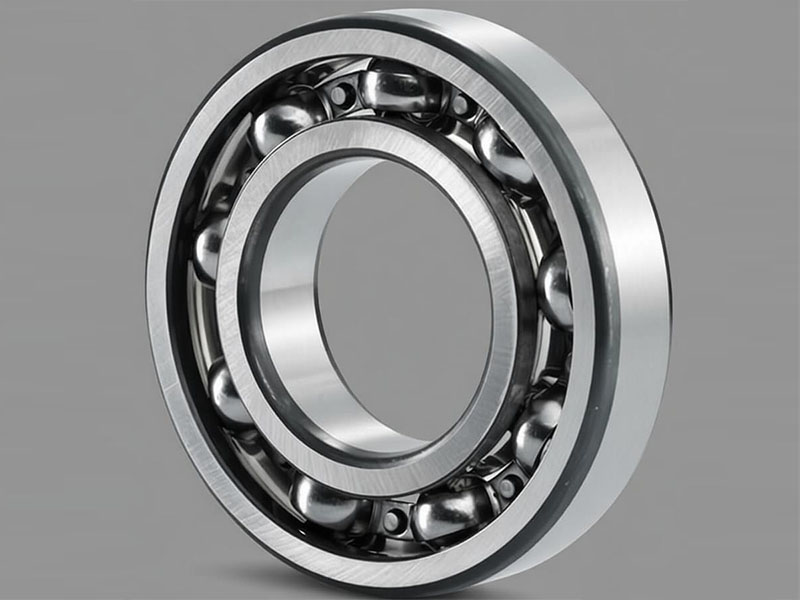
Radial ball bearings, most commonly the deep groove ball bearing are designed primarily to support radial loads—forces acting perpendicular to the shaft axis. When a belt drives a pulley or a mounted component exerts downward pressure on a rotating shaft, a radial bearing carries that perpendicular force.
The defining characteristic of a radial ball bearing is the deep, continuous raceway groove on both the inner and outer rings. This groove closely conforms to the shape of the balls, creating a stable contact geometry that efficiently transmits radial forces.
Radial ball bearings are optimized for perpendicular forces, but they can also accommodate a limited amount of axial load (force parallel to the shaft). Typically, a deep groove radial ball bearing can support an axial load up to approximately 20–30% of its rated radial load, depending on the bearing series and operating conditions. This dual capability makes them highly versatile and explains why they are the most widely used bearing type across industrial applications.
Typical applications include:
- Electric motors
- Gearboxes and industrial gear drives
- Conveyor systems
- Pumps and compressors
- Automotive wheel hubs
Thrust Ball Bearings: Design and Load Characteristics
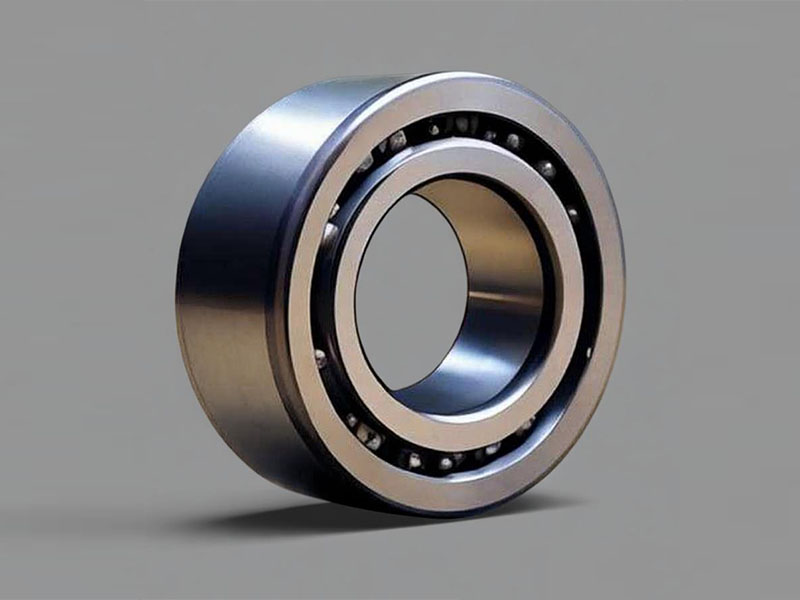
Thrust ball bearings are specialists. They are engineered exclusively to handle axial (thrust) loads—forces applied parallel to the shaft axis. Where radial bearings distribute force across the side of rotating components, thrust bearings manage the pushing or pulling force that travels along the length of a shaft.
A typical thrust ball bearing consists of three separate components: two race washers (a shaft washer and a housing washer) and a ball‑and‑cage assembly. The shaft washer rotates with the shaft; the housing washer remains stationary. This separable construction simplifies installation and maintenance.
Thrust ball bearings are available in single‑direction and double‑direction configurations. Single‑direction bearings handle axial force from one side only. Double‑direction bearings, using an additional set of rolling elements, can accommodate axial loads from both directions.
Thrust ball bearings have a contact angle of approximately 90 degrees, meaning the load is transmitted directly along the bearing axis. They can support high axial loads, but their radial load capacity is negligible. Applications requiring axial load support should never rely on a thrust bearing to manage significant radial forces.
While thrust ball bearings achieve lower friction than many other bearing types, their operating speed is limited compared to radial bearings. At high rotational speeds, centrifugal force pushes the balls outward against the raceway, increasing stress and friction at the contact points. This thermal effect restricts thrust bearings to low‑to‑moderate speeds, particularly under heavy loads.
Typical applications include:
- Automotive clutch release systems
- Vertical shafts in agricultural machinery and pumps
- Turntables and rotary tables
- Machine tool spindles requiring axial stability
Radial vs Thrust Ball Bearings: Key Differences
The following table summarizes the critical differences that engineers must evaluate before selecting a bearing for a mechanical system.
| Feature | Radial Ball Bearing | Thrust Ball Bearing |
|---|---|---|
| Primary load direction | Perpendicular to shaft (radial) | Parallel to shaft (axial) |
| Secondary load capability | Limited axial load (20–30% of radial rating) | Negligible radial load |
| Contact angle | Approximately 0 degrees | Approximately 90 degrees |
| Speed capability | High | Low to moderate |
| Typical applications | Motors, gearboxes, conveyors | Clutches, vertical shafts, turntables |
Understanding the different load types of radial and thrust ball bearings is fundamental to proper specification. Applying an axial load to a radial bearing beyond its rated capacity, or subjecting a thrust bearing to radial forces, inevitably leads to accelerated wear and premature failure.
How to Select Between Radial and Thrust Ball Bearings
When selecting between radial and thrust ball bearings, engineers should follow a systematic approach based on application requirements.
Step 1 – Analyze the load direction. Determine the primary direction of force acting on the bearing. If the majority of the load is perpendicular to the shaft, a radial ball bearing is the correct choice. If the majority of the load is parallel to the shaft (pure or dominant axial load), a thrust ball bearing is required.
Step 2 – Evaluate operating speed. Consider the rotational speed of the application. High‑speed applications (electric motors, turbines, high‑rpm spindles) favor radial ball bearings due to their superior speed capability. Low‑to‑moderate speed applications with high axial loads (clutches, vertical pumps, indexing tables) are well‑suited to thrust ball bearings.
Step 3 – Consider environmental and operational factors. For applications with both significant radial and axial forces, a standard radial bearing may be inadequate and a thrust bearing alone is insufficient. Engineers should consider angular contact bearings or tapered roller bearings, which feature a contact angle between 0 and 90 degrees. Exposure to contaminants such as dust, moisture, or corrosive chemicals can affect bearing life regardless of type—proper sealing and lubrication are critical. Always verify installation dimensions before specifying a type.
Common Selection Mistakes
Even experienced engineers occasionally make the following errors when specifying bearings:
- Using a radial bearing for pure high axial loads. While radial bearings can handle some axial force, heavy or continuous axial loads require a dedicated thrust bearing for reliable long‑term operation.
- Assuming all bearings labeled “thrust” handle radial loads. Thrust ball bearings are not designed for radial forces. Installing one in an application with significant radial loading will cause rapid failure.
- Overlooking speed limitations. A thrust bearing selected for high axial load capacity may overheat and fail when the application demands moderate‑to‑high rotational speeds.
- Ignoring combined loads. Applications with both radial and axial loads require careful engineering. In many cases, engineers use a radial bearing and a thrust bearing together as a supported arrangement, or select an angular contact bearing with the appropriate contact angle for combined loading.
Frequently Asked Questions (FAQ)
Q1: What is the main difference between radial and thrust ball bearings?
A1: The fundamental difference lies in the load direction each bearing is designed to support. Radial ball bearings handle forces perpendicular to the shaft; thrust ball bearings handle forces parallel to the shaft.
Q2: Can a radial ball bearing support axial (thrust) loads?
A2: Yes, to a limited extent. Deep groove radial ball bearings can accommodate moderate axial loads—typically up to 20–30% of their rated radial load—in addition to their primary radial load capacity. For pure or heavy axial loads, a dedicated thrust bearing is required.
Q3: Why can’t thrust ball bearings operate at high speeds?
A3: Under high rotational speeds, centrifugal force pushes the balls outward, increasing contact stress and friction between the balls and raceways. This generates excess heat and accelerates wear, limiting thrust bearings to low‑to‑moderate speeds.
Q4: What type of bearing should I use for combined radial and axial loads?
A4: For applications requiring both radial and axial load support—such as gearbox shafts or screw drives—engineers typically use angular contact ball bearings or tapered roller bearings. These bearings incorporate a contact angle that enables them to handle combined loading effectively.
Q5: What is the contact angle in ball bearings?
A5: The contact angle is the angle between the line connecting raceway contact points and a plane perpendicular to the bearing axis. Radial bearings have a nominal contact angle of 0 degrees; thrust bearings have a contact angle of 90 degrees. This angle determines how forces are transmitted through the bearing.
Q6: What materials are ball bearings manufactured from?
A6: Standard ball bearings are typically made from high‑carbon chromium steel (such as GCr15 or SAE 52100). For applications requiring corrosion resistance—such as food processing, marine equipment, or chemical environments—stainless steel bearings are the preferred material choice.
Conclusion
Selecting the correct bearing type is not a matter of preference but a requirement based on load direction. Radial ball bearings are the correct choice for perpendicular forces, and they can handle a limited amount of axial load. Thrust ball bearings are designed exclusively for parallel forces and should not be subjected to radial loads. By following the selection steps outlined above—analyzing load direction, evaluating speed, and considering environmental factors—engineers can avoid common mistakes and ensure reliable, long‑lasting equipment performance.