Quick Answer: Choosing ball bearings is a step-by-step engineering decision. Start with load direction, speed, duty cycle, environment, and available space; then select the bearing type, boundary dimensions, load rating, sealing, lubrication, clearance, fits, and precision. Confirm the complete part number and buy through a traceable channel. Published ratings are a starting point, not a substitute for application review. Safety and reliability depend on the whole arrangement.
A ball bearing is a rolling-element bearing with inner and outer rings, balls, and a cage. The balls roll on raceways to support radial and axial loads while a lubricant film separates the rolling contact. Because a bearing can look correct and still be wrong for the duty cycle, choosing ball bearings is mainly a process of matching the design to load, speed, space, environment, and maintenance practice.
Define the Duty Cycle Before Looking at a Catalog
Selection starts with performance and operating conditions, not with a catalog page. A bearing that suits one pump, conveyor, or motor may fail in another machine with the same shaft diameter because the load direction, speed, temperature, contamination, and target life are different.
Operating data to collect before selection
Record the following inputs before comparing types or asking for a quotation:
- Shaft diameter and housing bore.
- Available axial width and mounting orientation.
- Radial load and axial load in both directions.
- Maximum and continuous speed.
- Starting, shock, and peak loads.
- Target life and reliability.
- Operating temperature range.
- Contamination, moisture, washdown, and chemical exposure.
- Shaft and housing material, hardness, and tolerances.
- Noise, vibration, and stiffness limits.
- Maintenance method and relubrication access.
Separate steady loads from peak or shock loads. Both dynamic life and static safety may need checking, especially when the machine starts under load or holds a heavy load while stationary. Note whether the bearing must locate the shaft axially, allow axial displacement, or accommodate misalignment between shaft and housing.
These inputs match the formal selection items used in bearing catalogs. A standard catalog selection chapter, such as catalog 2203/E, commonly covers bearing selection, load rating and life, bearing load calculation, boundary dimensions, tolerances, fits, internal clearance, allowable speed, lubrication, sealing, and materials.
Use a formal selection sequence
Follow a repeatable order so that no interface is chosen before the duty cycle is understood:
- Define performance and operating conditions.
- Choose bearing type and arrangement.
- Select boundary dimensions.
- Select lubrication.
- Check operating temperature and speed.
- Define fits.
- Choose internal structure.
- Address sealing, mounting, and dismounting.
A catalog such as HR 1 lists the main selection factors as installation space, load magnitude and direction, bearing arrangement, speed, precision, axial displacement capability, self-aligning capability, noise, stiffness, friction, mounting and dismounting, sealing, and lubrication.
Document the assumptions with the machine record. A replacement or second-source review can then preserve the original design intent instead of selecting by bore size alone.
Know when a standard calculation is not enough
Escalate to an application engineer when there is significant misalignment, preload, unusually large clearance, a special coating, or an abnormal load distribution. Standard rating calculations assume a load distribution and geometry that may not represent those conditions.
Do not treat a catalog life calculation as a complete validation of wear, corrosion, electrical erosion, sealing, or lubrication performance. For critical or unusual duty cycles, request a documented application review rather than relying on a generic selection table.
Use standard rating calculations only when geometry, load distribution, alignment, and lubrication are within the manufacturer’s assumptions. ISO 76 notes that standard static rating calculations may not give satisfactory results under significant misalignment, preload, abnormal clearance, special coatings, or non-standard load distribution.
Choose the Ball Bearing Type by Load Direction and Application
The type decision should follow the dominant load direction, the need for axial location, misalignment tolerance, speed, stiffness, and available space. Do not choose a ball bearing solely because it has the required bore. Check whether its load-carrying mechanism suits the application.
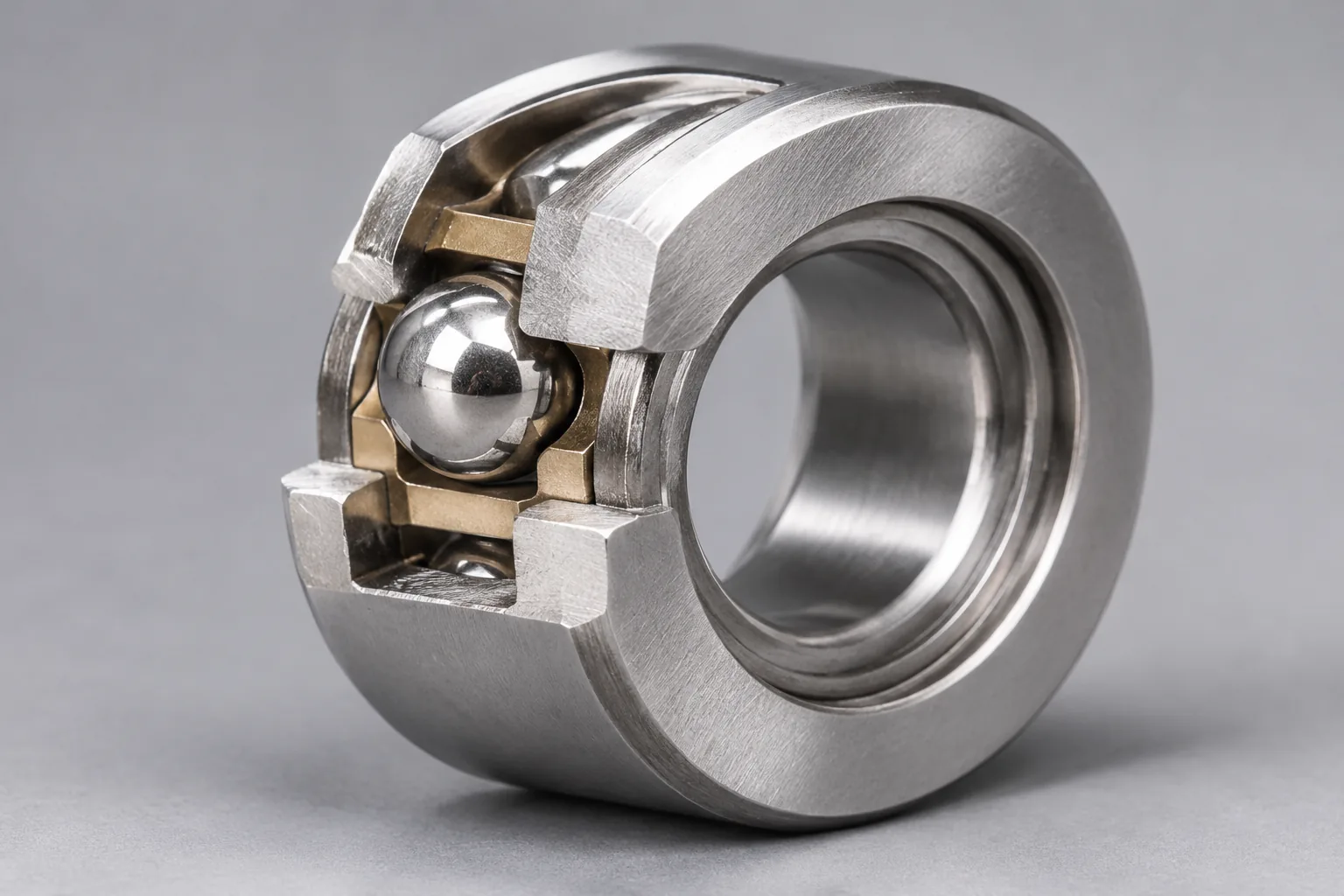
Deep-groove ball bearings: general-purpose radial and axial load capability
Use deep-groove ball bearings for combined radial and axial loads in both directions, low friction, and high-speed general-purpose applications. They are a common starting point for motors, pumps, conveyors, and light-to-medium machinery, but the specific series and suffix still must be checked.
Do not assume every deep-groove bearing in the same bore size has the same load rating, clearance, sealing, or speed capability. A common 25 mm bore example still needs a full specification check; the product-table examples later in this guide show why.
Angular-contact ball bearings: combined loads and axial stiffness
Use single-row angular-contact ball bearings where radial and axial loads act together and a defined contact angle is acceptable. A single-row bearing normally carries axial load in one direction, so two-direction axial location generally requires a paired or opposed arrangement.
Use double-row angular-contact bearings when both axial directions and higher radial loads must be carried in a compact axial space. Match contact angle to the axial-load requirement: a larger contact angle generally increases axial load capacity. Common contact angles are 15°, 25°, 30°, and 40°, and the 32..-BD and 33..-BD double-row series use a 30° contact angle.
Confirm the required preload, axial clearance, and pairing arrangement with the manufacturer when specifying angular-contact bearings.
Self-aligning ball bearings: misalignment tolerance with limited axial capacity
Use self-aligning ball bearings where shaft or housing misalignment is expected or where shaft deflection may occur. Their axial load capacity is limited, so do not use them as a substitute for an angular-contact or thrust bearing when axial load is significant.
Check the actual permitted misalignment against the manufacturer’s data rather than assuming unlimited self-alignment. Under normal load, published guidance for self-aligning ball bearings gives an allowable dynamic misalignment of approximately 0.07-0.12 rad, equivalent to 4-7°.
Thrust ball bearings: axial load only
Use thrust ball bearings only for predominantly axial loads; they are not intended to carry radial load. Choose single-direction thrust bearings for axial load in one direction and double-direction thrust bearings for alternating axial load. Verify that the housing and shaft arrangement can accommodate the axial space and mounting requirements.
Ball versus roller and radial versus thrust classification
Use ball bearings where low friction, high speed, and moderate load capacity are the priorities. Do not automatically use them for heavy loads merely because the envelope is available. Balls contact the raceways at points, which usually allows higher speed but generally lower load capacity than roller bearings with line contact.
Use contact angle as an initial screen: bearings with a contact angle from 0° to 45° are mainly radial, while bearings with a contact angle greater than 45° up to 90° are mainly thrust. Where loads are heavy or shock-loaded, compare ball bearings with roller bearing options before finalizing the machine envelope.
Fit the Boundary Dimensions and Diameter Series to the Machine
A bearing is defined by more than its bore. Outside diameter, width, chamfer, and diameter series determine the space envelope and influence load capacity. Use the machine envelope and required load capacity together to select a series, then confirm the final dimensions against the shaft and housing design.
Check bore, outside diameter, and width together
Confirm the required bore d, outside diameter D, and width B. A matching bore can correspond to different outside diameters, widths, and load ratings. Do not order by bore size or by a familiar series number alone. Check shaft and housing dimensions, fillet radii, and axial space before approving a substitute.
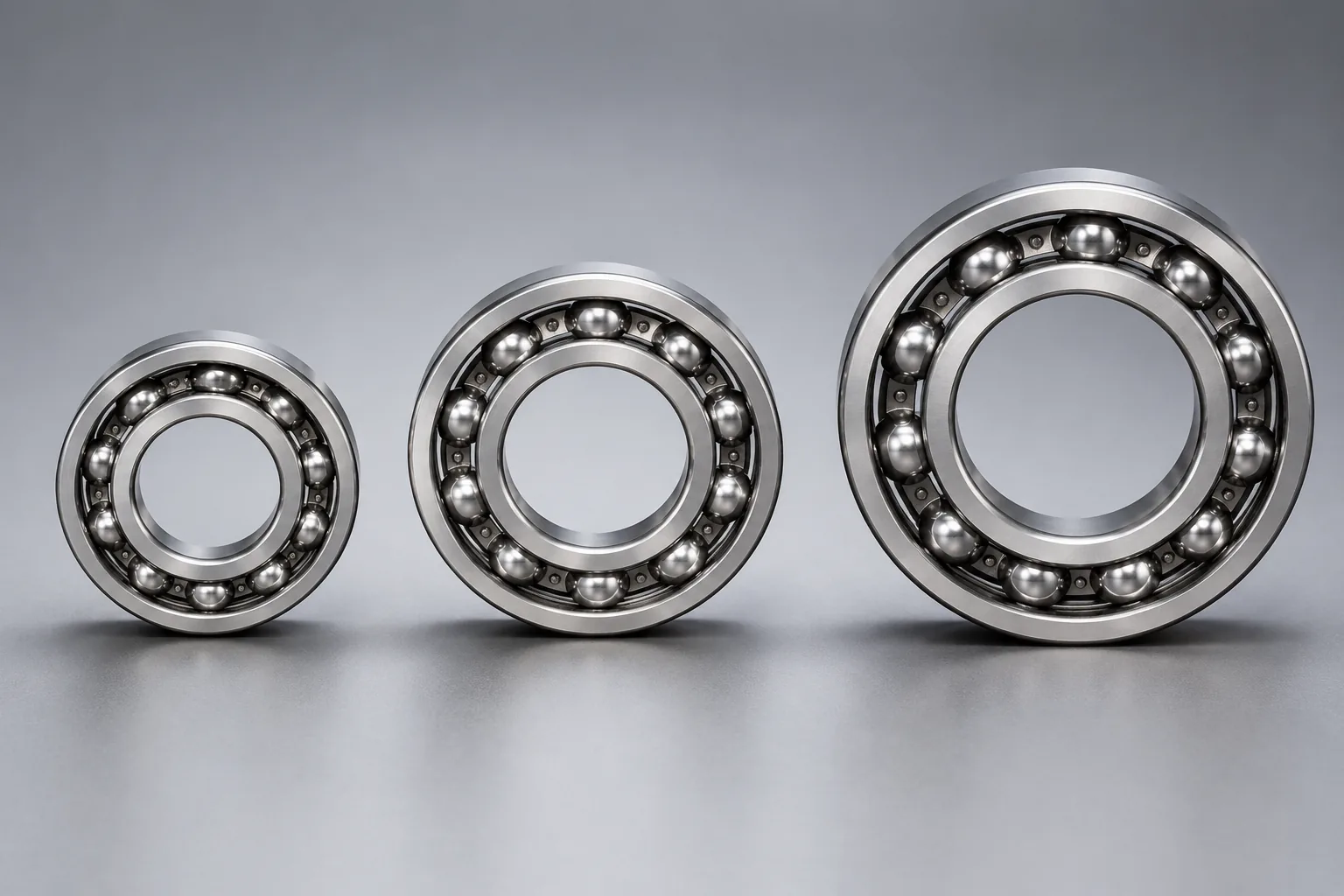
Bearing product tables normally list principal dimensions as bore d, outside diameter D, and width B. The 6205 and 6206-RZ examples show how a change from 25 mm to 30 mm bore also changes outside diameter, width, load rating, and speed ratings.
Use ISO diameter series as a space-and-capacity guide
Compare diameter series 7, 8, 9, 0, 1, 2, 3, and 4 when balancing space against load capacity. A larger diameter series generally uses more radial space but can provide greater load capacity; confirm the actual value in the product table for the selected bearing.
ISO 15:2017 specifies preferred boundary dimensions for radial bearings in those diameter series. It was published in July 2017 and confirmed in 2022. Treat ISO boundary dimensions as a starting envelope, not as proof of load rating, precision, clearance, or sealing performance. Use the current manufacturer product table for the selected series.
Verify Load Rating, Life, and Static Safety
Use dynamic ratings for rotating-duty fatigue life and static ratings for peak or stationary loads. Check both life and static safety when the application includes shock, high load at low speed, or long stationary periods. Document the load assumptions and the method used for the calculation.
Basic dynamic load rating and L10 life
Use the basic dynamic load rating C and the equivalent dynamic load P to estimate basic rating life. For ball bearings, the common basic life equation is L10 = (C/P)^3 in millions of revolutions. Convert to hours with L10h = 10^6/(60n) x (C/P)^3, where n is speed in r/min.
Treat the resulting L10 life as a 90% reliability fatigue life, not a guarantee against wear, corrosion, contamination, or electrical damage. ISO 281:2007 defines the calculation of basic dynamic load rating and basic rating life. It also provides for modified rating life that can include reliability, lubrication conditions, lubricant contamination, and fatigue load.
Radial bearings use Cr and thrust bearings use Ca. The basic dynamic load rating C is the load under which a sufficiently large group of identical bearings reaches a basic rating life of 1 million revolutions. Use a corrected rating life when reliability, lubrication, contamination, or fatigue loading differs materially from the basic assumptions.
ISO 16281:2025 covers modified reference rating life for rolling bearings under loads in any direction; ISO 17956:2025 covers effective static safety factor calculation for such bearings. ISO 281 does not cover wear, corrosion, or electrical erosion, so fatigue life calculations must be supplemented by checks of sealing, moisture, current, and lubrication.
Static load rating and shock-load safety
Check basic static load rating C0 and equivalent static load P0 for stationary loads, very slow rotation, shock, and high-load events. Use the static safety factor to assess the risk of permanent raceway deformation. Do not use dynamic life alone to approve an application that experiences heavy shock or long stationary loading.
ISO 76:2006 specifies calculation of basic static load rating and equivalent static load and gives static safety factor guidance for heavily loaded applications. It also notes that standard calculations may be unsatisfactory with significant misalignment, preload, abnormal clearance, special coatings, or abnormal load distribution.
Read product-table examples correctly
Use product-table examples to show that dimensions, load ratings, speed ratings, seals, and clearance are separate specification items. Compare the complete specification, not just the bore or series, when evaluating a lower-cost offer or a proposed substitute.
| Catalog example | Bore d | Outside diameter D | Width B | Basic dynamic rating C | Basic static rating C0 | Reference speed | Limiting speed |
|---|---|---|---|---|---|---|---|
| 6205 | 25 mm | 52 mm | 15 mm | 14.8 kN | 7.8 kN | 28,000 r/min | 18,000 r/min |
| 6206-RZ | 30 mm | 62 mm | 16 mm | 20.3 kN | 11.2 kN | 24,000 r/min | 12,000 r/min |
| 6215-2RS1/C3 | 75 mm | 130 mm | 25 mm | 68.9 kN | 49 kN | Not listed | 3,200 r/min |
The 6215-2RS1/C3 example also shows double contact seals, grease lubrication, and C3 radial clearance. Check whether a quoted speed is a reference speed or a limiting speed before comparing offers.
Check Speed and Temperature Limits Before Finalizing the Type
Speed capability is not a single catalog number. It depends on bearing size, internal clearance, cage, seals, lubrication, and heat dissipation. Check operating temperature and speed together because grease life and bearing temperature interact.
Reference speed versus limiting speed
Treat reference speed and limiting speed as different indicators and compare like with like. Do not compare a reference speed from one supplier with a limiting speed from another as if they were the same rating. Confirm the allowable speed for the actual lubricant, seal type, clearance, and thermal conditions.
For the 6205 example, the reference speed is 28,000 r/min and the limiting speed is 18,000 r/min. Final permissible speed may be lower than the catalog value when contact seals, high temperature, poor heat dissipation, or high load are present. Where speed is close to the catalog limit, request a thermal and lubrication review.
Thermal checks for high speed and high load
Check load ratio P/C, mean diameter dm = (D + d)/2, and speed index together rather than looking only at shaft speed. Use manufacturer grease-life and speed data for the actual bearing and lubricant. Reduce speed or change lubrication and sealing if the combined thermal margin is inadequate.
High-temperature variants and their limits
Use temperature-stability suffixes only when the operating temperature genuinely requires them. Ring stability suffixes include S1 up to approximately 150°C, S2 to 200°C, S3 to 250°C, and S4 to 300°C. These suffixes indicate ring dimensional stabilization only. Seals, cages, and lubricants must still meet the temperature requirement separately.
Select Sealing and Lubrication for the Environment
Sealing and lubrication are part of the bearing specification, not accessories added after the bearing is chosen. The environment determines whether an open, shielded, or contact-sealed bearing is appropriate. Grease selection must follow temperature, speed, load, moisture, food-contact requirements, and relubrication capability.
Open, shielded, and contact-sealed bearings
Use open bearings where the machine provides its own lubrication and sealing system. Use shielded bearings where the main need is to retain grease and exclude larger particles without adding much seal friction. Use contact-sealed bearings where solid contamination or moisture must be excluded more aggressively, while accepting higher friction and lower speed capability.
Protection capability generally ranks as contact-sealed bearings, then shielded bearings, then open bearings. Common suffix patterns include Z and 2Z for single and double metal shields, RS1 and 2RS1 for single and double NBR contact seals, and RZ and 2RZ for single and double non-contact NBR seals. Z and 2Z shields are non-contact and mainly retain lubricant and block larger particles. RS1 and 2RS1 seals are contact elastomer seals and are better at blocking solid contaminants and moisture.
Check the meaning of the suffix because different manufacturers use different letters for similar features. Contact seals add friction and heat and may limit speed; do not select them solely for maximum protection without checking speed and temperature.
Grease selection and contamination control
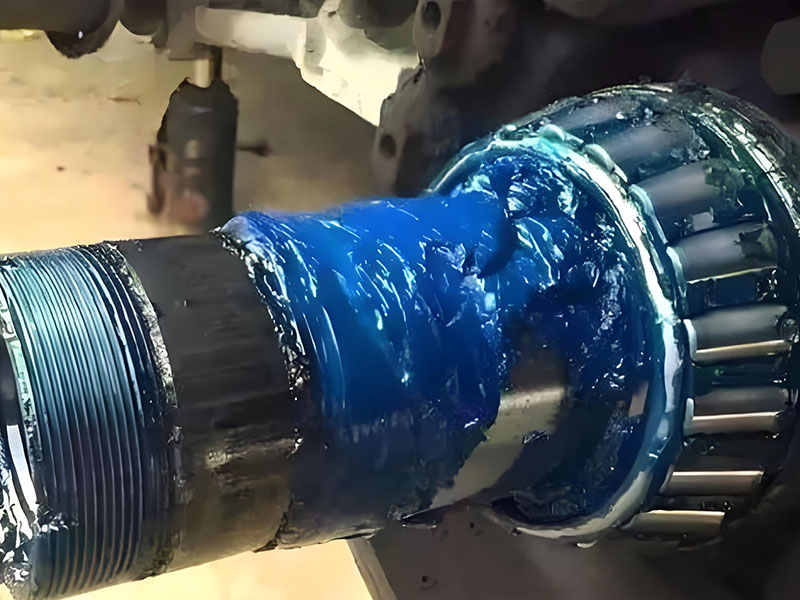
Select grease by operating temperature, speed, load, water exposure, food-contact requirements, and relubrication method. Do not assume two greases can be mixed merely because they have the same NLGI grade. Treat contamination control as a life issue, not a housekeeping issue; specify seals, breathers, and lubrication practices accordingly.
Published maintenance data attribute premature bearing failures to inadequate lubrication (about 36%), poor mounting or fits (about 16%), contamination (about 14%), and fatigue (about 34%). Lubrication plus contamination account for about 50% of premature failures. RS1 seals and suitable lubricants have an operating temperature range of -40°C to +120°C.
For food equipment, check whether the grease is NSF H1 registered and whether the housing and seal design meets the required hygiene standard. NSF H1 registration applies to the lubricant; it does not by itself qualify the bearing housing or seal for a specific food-contact application. Use NSF H1 and EHEDG references only after confirming the specific food-contact and cleaning regime with the equipment designer.
Limits of prelubricated sealed bearings
Sealed or shielded bearings are often factory-filled with grease, but lubricated for life applies only to the design service life and specified operating conditions. Do not wash prelubricated double-sealed bearings or heat them above the seal limit before installation. For RS1-sealed bearings, do not heat above 120°C before mounting.
Where temperature, speed, or contamination exceeds the design assumptions, provide a relubrication or replacement plan. A sealed bearing is not maintenance-free under any temperature, load, or contamination condition.
Specify Internal Clearance, Fits, and Precision
Clearance, fit, and precision are linked. An interference fit reduces internal clearance, and running temperature changes the effective clearance. Select clearance and fit from the application, not as default upgrades. Use the relevant ISO standards and the manufacturer’s product data to verify the final combination.
Internal clearance grades
Compare C1, C2, CN (normal), C3, C4, and C5 in order from smaller to larger radial internal clearance. Use larger clearance where high inner-ring temperature, heavy interference fit, heavy or shock load, high speed, or tight fits on both rings reduce operating clearance. Do not treat C3 or C4 as an automatic sign of higher quality; an unnecessarily large clearance can increase noise and reduce load distribution quality.
ISO 5753-1:2009 specifies radial internal clearance values for radial bearings and is the reference for checking CN, C3, and C4 clearances.
Fits, creep, and clearance reduction
Avoid loose fits that allow creep, fretting, vibration, and heat. Avoid excessive interference that reduces internal clearance, causes abnormal heat, or can crack the bearing ring. Estimate clearance loss after mounting and account for the running temperature difference between inner and outer rings.
Interference fit can reduce radial internal clearance by approximately 70% to 90% of the interference amount. During normal operation, the inner ring and rolling elements are typically 5-10°C hotter than the outer ring. Loose fits can cause creep, fretting, vibration, and heat, while over-tight fits can cause insufficient clearance, abnormal heat, or ring cracking.
Precision grades and when they are justified
Choose precision by actual runout, speed, positioning, and noise requirements, not by a general preference for a higher grade. Common precision grades are normal or P0, P6, P5, P4, P3, and P2. Check that the shaft and housing tolerances can support the selected precision grade.
ISO 492:2023 is the current standard for radial rolling bearing dimensions and geometrical accuracy. It was published in August 2023 as the 6th edition, has 48 pages, and replaces ISO 492:2014. Higher precision is justified by measured runout, speed, or positioning requirements, not by the belief that it automatically improves all applications.
Match Materials and Special Features to Harsh or Special Environments
Standard bearing steel suits most general machinery. Moisture, corrosion, vacuum, high temperature, food processing, variable-frequency motor drives, and very high-speed spindles may require a different material or internal design. Treat material, coating, cage, lubricant, and seal as a system. Do not use a special feature as a substitute for correcting an unsuitable operating environment.
Standard steel, stainless steel, and hybrid ceramic options
Use standard through-hardened bearing steel for normal industrial conditions with adequate lubrication and sealing. Consider stainless or coated variants where corrosion resistance is required, subject to the manufacturer’s load and life data. Consider hybrid ceramic bearings where electrical insulation, lower rolling-element density, high hardness, wear resistance, or poor-lubrication tolerance is valuable.
Hybrid bearings commonly use bearing steel rings and bearing-grade silicon nitride Si3N4 rolling elements. Silicon nitride provides electrical insulation, lower density, high hardness, wear resistance, and better tolerance of poor lubrication. It can help isolate shaft and housing electrically in AC or DC motors and generators, reducing current damage through the rolling contact.
Food, washdown, and high-temperature environments
For food equipment, verify both the lubricant registration and the housing and seal design against the hygiene requirement. For high-temperature applications, check ring stability, cage material, seal material, and grease limit separately. For washdown or wet environments, specify sealing and housing protection rather than relying on a general stainless description.
Food-grade greases may carry NSF H1 registration, and hygienic designs may follow EHEDG requirements. Use those references only after confirming the specific food-contact and cleaning regime with the equipment designer.
Decode the Complete Part Number Before You Compare Offers
A complete bearing designation can include type, dimension series, bore, sealing, clearance, cage, precision, material, lubrication, and special treatment. Compare the full suffix string, not just the base number. Use the manufacturer’s current catalog and cross-reference data when converting between brands.
Basic designation and bore code
Read the basic designation as type plus dimension series plus bore code, then add the relevant suffixes. Use the standard bore-code convention as a check, but confirm the actual d, D, and B in the product table. Common bore codes are 00 = 10 mm, 01 = 12 mm, 02 = 15 mm, and 03 = 17 mm. From code 04 onward, common metric bore is usually the code multiplied by 5 mm, so 05 = 25 mm.
Do not assume that a larger bore code automatically identifies every other dimension or rating.
Suffixes and cross-brand differences
Check seal or shield, clearance, cage, precision, lubrication, and special-treatment suffixes separately. Do not translate suffixes letter for letter between brands. Verify a proposed replacement against the original manufacturer’s specification and the replacement manufacturer’s catalog.
Common suffix patterns include 2RS1 and 2Z for seals or shields. Other manufacturers may use DD, DDU, DDW, or VV for seals and Z or ZZ for shields. A suffix may look similar across brands but denote a different seal material, contact type, clearance, or lubrication; use the manufacturer’s cross-reference table.
Packaging and appearance alone usually cannot reliably identify counterfeit bearings.
Buy Through Verifiable Channels and Document the Specification
Counterfeit or misrepresented bearings are a specification risk, not only a purchasing risk. Use authorized distributors and retain traceability documents for critical equipment. Require evidence of the exact standard, rating, clearance, precision, lubrication, and origin rather than accepting a general quality claim.
Authorized channels and authenticity checks
Buy from authorized distributors and verify their current authorization when the application is critical. Use manufacturer authentication services or contacts where counterfeit risk exists. Do not rely on packaging appearance alone as proof of authenticity.
The World Bearing Association Stop Fake Bearings project lists member brands including Schaeffler/FAG, Timken, JTEKT, NSK, SKF, NTN, and NACHI, and provides authorized-channel and anti-counterfeit contacts. Use those listings to check the supply path, and request the latest authorization certificate from the distributor for critical orders.
What to put in the RFQ and purchase record
State the complete manufacturer part number, required clearance, precision, sealing, lubrication, and any special treatment. Require batch or traceability code, country of origin, authorized-distributor evidence, and material or inspection documents where applicable. Keep the application assumptions and the selected bearing specification with the equipment record.
Useful procurement records include the full manufacturer model, manufacturing batch or traceability code, country of origin, authorized-distributor proof, material or inspection documents, grease designation, precision and clearance grade, and applicable industry certifications. A claim that a bearing is an ISO standard size, or that the seller is ISO certified, does not prove that the bearing meets the required load life, material, precision, and consistency. Request the specific standard number, scope, manufacturer data, and verifiable certificate.
Use a Final Selection Checklist
A short checklist prevents the most common omissions: load direction, speed, life, sealing, clearance, fit, lubrication, part-number suffixes, and supplier verification. Complete it before the RFQ and review it again before approval.
Before requesting a quotation
Confirm shaft diameter, housing bore, available width, radial load, axial load in both directions, maximum and continuous speed, starting or shock load, target life, operating temperature, contamination and moisture exposure, shaft and housing material and tolerances, mounting orientation, noise or vibration limits, and maintenance method. Select a candidate type and arrangement, then verify dimensions, load rating, speed rating, clearance, precision, sealing, and lubrication. Write the complete part number and all required suffixes in the RFQ.
Before approving a substitute or installing the bearing
Compare the complete specification, not only the bore and outside diameter. Verify seal or shield type, clearance, precision, cage, grease, and temperature limits. Confirm that the selected bearing is suitable for the actual mounting method, fit, and environment. Retain the approved specification and traceability records for future replacement.
Avoid Common Ball Bearing Selection Mistakes
- Choosing by bore size alone while ignoring outside diameter, width, series, load rating, and suffixes.
- Assuming all deep-groove bearings are interchangeable because they share a basic series number.
- Using C3 or a higher precision grade as a default upgrade without checking noise, clearance, fit, and cost effects.
- Treating a sealed bearing as maintenance-free under any temperature, speed, or contamination condition.
- Comparing reference speed with limiting speed, or comparing load ratings without checking the equivalent load and life assumptions.
- Ignoring axial load direction when selecting angular-contact or thrust bearings.
- Buying from an unverified channel without traceability documents.
- Assuming an ISO dimensional standard or a seller’s ISO certified claim proves load life, material, precision, and consistency.
Conclusion
Choosing ball bearings well comes down to matching the full specification to the duty cycle. Define load direction, speed, life, temperature, contamination, and maintenance constraints first; then select type, dimensions, rating, sealing, lubrication, clearance, fits, and precision. Verify the complete part number, compare like-for-like ratings, and buy through a traceable channel. The safe next step is to complete the pre-RFQ checklist, request the manufacturer’s current data for the exact suffix, and review any substitute against the original application assumptions.
FAQs
Q1: Is bore size enough to choose a ball bearing?
A: No. Bore size only fixes one part of the shaft interface. You also need outside diameter, width, load rating, speed rating, sealing, clearance, precision, and the full suffix. Two bearings with the same bore can have different outside diameters, widths, ratings, and seals, so the housing and axial space must be checked before ordering.
Q2: When should I choose angular-contact instead of deep-groove?
A: Choose angular-contact when combined radial and axial loads require a defined contact angle or greater axial stiffness. A single-row angular-contact bearing normally carries axial load in one direction, so two-direction location usually needs a paired or opposed arrangement. A deep-groove bearing is often the general-purpose starting point, but it still must be checked for the actual load and speed.
Q3: Can I replace a C3 bearing with CN?
A: Not without checking the mounted clearance. Interference fits, running temperature, speed, and load can reduce operating clearance. A CN bearing may be correct in a light, cool application, but a C3 or C4 bearing may be needed where high inner-ring temperature or heavy interference reduces clearance. Confirm the clearance grade against the application and the relevant clearance standard.
Q4: Are sealed bearings maintenance-free?
A: No. A sealed or shielded bearing may be factory-filled with grease, but lubricated for life applies only to the design service life and specified operating conditions. High temperature, high speed, contamination, or moisture can shorten grease life. Do not wash prelubricated double-sealed bearings or heat them above the seal limit.
Q5: How do I compare reference speed and limiting speed?
A: Compare the same indicator on both offers. Reference speed and limiting speed are different ratings, so a reference speed from one supplier should not be compared with a limiting speed from another. Final permissible speed also depends on size, clearance, cage, seals, lubricant, load, and heat dissipation.
Q6: What should an RFQ include?
A: Include the complete part number with all suffixes, required clearance and precision, sealing, lubrication, special treatment, quantity, and any traceability or inspection documents. Also state the application data that affects the selection, such as load direction, speed, temperature, environment, and target life. A base number alone is not enough for a critical order.
Q7: Can I mix greases with the same NLGI grade?
A: Not automatically. The NLGI grade describes consistency, not thickener compatibility, base oil, additive package, or temperature capability. Mixing incompatible greases can soften or harden the lubricant and change its performance. Use the bearing and lubricant manufacturer’s compatibility data, and when in doubt, clean and refill with the specified grease.
Q8: How can I check a suspect counterfeit bearing?
A: Use authorized channels and ask for current distributor authorization, batch or traceability records, and country of origin. Packaging and appearance alone are usually not reliable proof. Where counterfeit risk exists, use the manufacturer’s authentication service or counterfeit-reporting contact before the bearing enters a critical application.