Quick Answer: 440C, 304, and 316 stainless steel bearings are not interchangeable grades of one material. 440C is the hardened martensitic choice for rings and balls, giving the highest load, speed, and precision among the three. 304 is austenitic, with good general corrosion resistance but low bearing hardness. 316 adds molybdenum for the strongest chloride pitting resistance, yet full-316 bearings remain low-load, low-speed products. Choose by the dominant requirement: rolling performance, cost and general corrosion, or chloride and chemical resistance.
This 440C vs 304 vs 316 stainless steel bearings comparison treats the three names as different material families, not three hardness levels of the same bearing. That difference changes how each bearing carries load, resists corrosion, holds tolerance, and responds to a magnet. The sections below cover the material standards, hardness limits, load and speed trade-offs, corrosion behavior, and component construction that matter when you specify a stainless steel bearing.
Quick Comparison: 440C vs 304 vs 316 Bearings
The quickest way to separate the three grades is to compare what each material can do in a bearing, not only how it resists rust.
| Property | 440C | 304 | 316 |
|---|---|---|---|
| Material family | Martensitic stainless steel | Austenitic stainless steel | Austenitic stainless steel with molybdenum |
| Hardenable by heat treatment | Yes | No significant quench hardening | No significant quench hardening |
| Typical bearing hardness | HRC 58-65 balls; HRC 58-62 rings | About HV 170, roughly HRC 3 | Upper limit about HRC 39, but still soft |
| Corrosion resistance | Moderate; better than 52100 | Good general resistance | Strongest chloride pitting resistance of the three |
| Load, speed, and precision | Highest of the three | Low | Low; often semi-precision |
| Magnetic response | Normally magnetic | Essentially nonmagnetic when annealed | Essentially nonmagnetic when annealed |
| Typical role | Rings, balls, raceways | Cages, shields, retaining rings; full-304 low-load bearings | Low-load marine, food, chemical, and washdown bearings |
The table is a starting point, not a substitute for the bearing’s load rating. A full-316 bearing is not simply a 440C bearing with better corrosion resistance; its raceways and balls are softer, and its load, speed, and precision limits are lower.
Material Standards and Chemical Composition
Grade names map across standards, but a purchase order should use the full designation, not only the short name. Chemistry explains why 440C can be hardened while 304 and 316 remain austenitic and soft.
440C Stainless Steel
440C is a martensitic stainless steel. Common designations are AISI 440C, UNS S44004, EN 1.4125 / X105CrMo17, and SUS440C. Its typical chemistry is carbon 0.95-1.20%, chromium 16-18%, and molybdenum 0.75% max. A typical nominal composition is about 1% carbon, 17% chromium, and 0.5% molybdenum.
The high carbon and chromium content lets bearing rings and balls be through-hardened to a martensitic structure, which is the basis for its rolling-contact performance. AMS 5618 is one material specification used for 440C bearing materials.
304 Stainless Steel
304 is an austenitic stainless steel. Common designations are AISI 304, UNS S30400, EN 1.4301 / X5CrNi18-10, and SUS304. Its typical chemistry is carbon 0.08% max, chromium 18-20%, and nickel 8-10.5%.
The austenitic structure gives 304 good general corrosion resistance, but it cannot be quench-hardened to bearing hardness. In standard 440C bearings, 304 is often used for cages, shields, and retaining rings rather than for the raceways or balls.
316 Stainless Steel
316 is an austenitic stainless steel with molybdenum. Common designations are AISI 316, UNS S31600, EN 1.4401 / X5CrNiMo17-12-2, and SUS316. Its typical chemistry is carbon 0.08% max, chromium 16-18%, nickel 10-14%, and molybdenum 2-3%.
Molybdenum improves resistance to localized corrosion, especially chloride pitting. 316 remains austenitic, so it is not a hardenable bearing race material. It is selected for corrosion resistance, not for high rolling-contact strength.
Do not treat a stainless steel bearing as a single material specification. The grade of each component and the standard behind it belong in the purchase specification.
Hardness and Heat Treatment
Hardness matters because repeated rolling contact concentrates stress near the raceway surface. A hard, stable martensitic structure resists plastic deformation, wear, and rolling-contact fatigue.
Typical 440C bearing data lists balls at HRC 58-65 and rings at HRC 58-62 after heat treatment. For 304, typical material data is about HV 170, roughly HRC 3, while hardened 440C is about HV 700. A 316 material table may show an upper limit around HRC 39, but that does not make a full-316 bearing a precision-bearing-grade product. It remains a soft, low-load bearing.
304 and 316 are austenitic. They can gain some strength from cold working, but they cannot be quench-hardened to the same bearing hardness as 440C. Final hardness acceptance should use the selected manufacturer’s datasheet and the agreed heat-treatment specification, not a generic grade assumption.
Load Capacity, Speed, and Precision
440C is the preferred race and ball material among these three because it combines hardness with adequate corrosion resistance for rolling contact. 304 and 316 bearings are normally limited to lower loads and lower speeds.
Reported comparisons vary: 440C bearing ratings may be about 30% below same-size 52100, or about 80-85% of 52100, depending on product design, heat treatment, and rating method. A full-316 bearing may be about 15% of the load capacity and about 6% of the allowable speed of a 440C bearing. These percentages are design-specific, not universal conversion factors.
316 bearings are often positioned as semi-precision, low-speed products because the softer material is harder to grind to the same tolerance as 440C. For selection, use the actual dynamic and static load ratings, limiting speed, tolerance class, clearance, lubrication, and sealing data for the bearing you intend to buy. A material name alone does not define those limits.
Corrosion Resistance: 440C vs 304 vs 316
440C resists corrosion better than 52100 bearing steel, but it is less resistant than 304 and 316. 304 performs well in many general corrosive exposures. 316 usually gives the best resistance to chloride pitting because it contains 2-3% molybdenum; 304 has no intentional molybdenum addition.
PREN is a rough ranking tool. The formula is PREN = %Cr + 3.3 x %Mo + 16 x %N. Average values are about 19 for 304 and about 25 for 316/316L. A higher PREN suggests better resistance to chloride pitting, but it does not predict bearing life, because life also depends on load, speed, lubrication, seals, clearance, temperature, and contamination.
316 is not immune to seawater. It is most defensible above the waterline, in flowing seawater, or where routine freshwater rinsing is possible. Stagnant, oxygen-depleted, crevice, or sediment-covered conditions can still cause pitting and crevice corrosion. The same caution applies to food, chemical washdown, and marine-adjacent applications: check oxygen availability, flow, temperature, deposits, lubricant, and seal design before selecting the material.
Magnetic Properties and Material Identification
440C is martensitic and normally magnetic. 304 and 316 are essentially nonmagnetic in the annealed condition, but cold working can make them slightly magnetic.
A magnet test can support a rough check, but it is not a material certification method. Cold-worked 304 or 316 can show a magnetic response and should not be rejected solely on a magnet test. Use mill certificates, material test reports, or chemical analysis for final verification.
Bearing Construction: Not All Parts Use the Same Stainless Steel
Not all parts of a stainless steel bearing use the same grade. A standard 440C ball bearing may use 440C for the inner ring, outer ring, and balls, with a 304 cage, 304 shields, and 304 retaining rings. A full-304 series changes the rings, balls, and cage to 304. A full-316 bearing applies the same idea with 316 rings, balls, and cage.
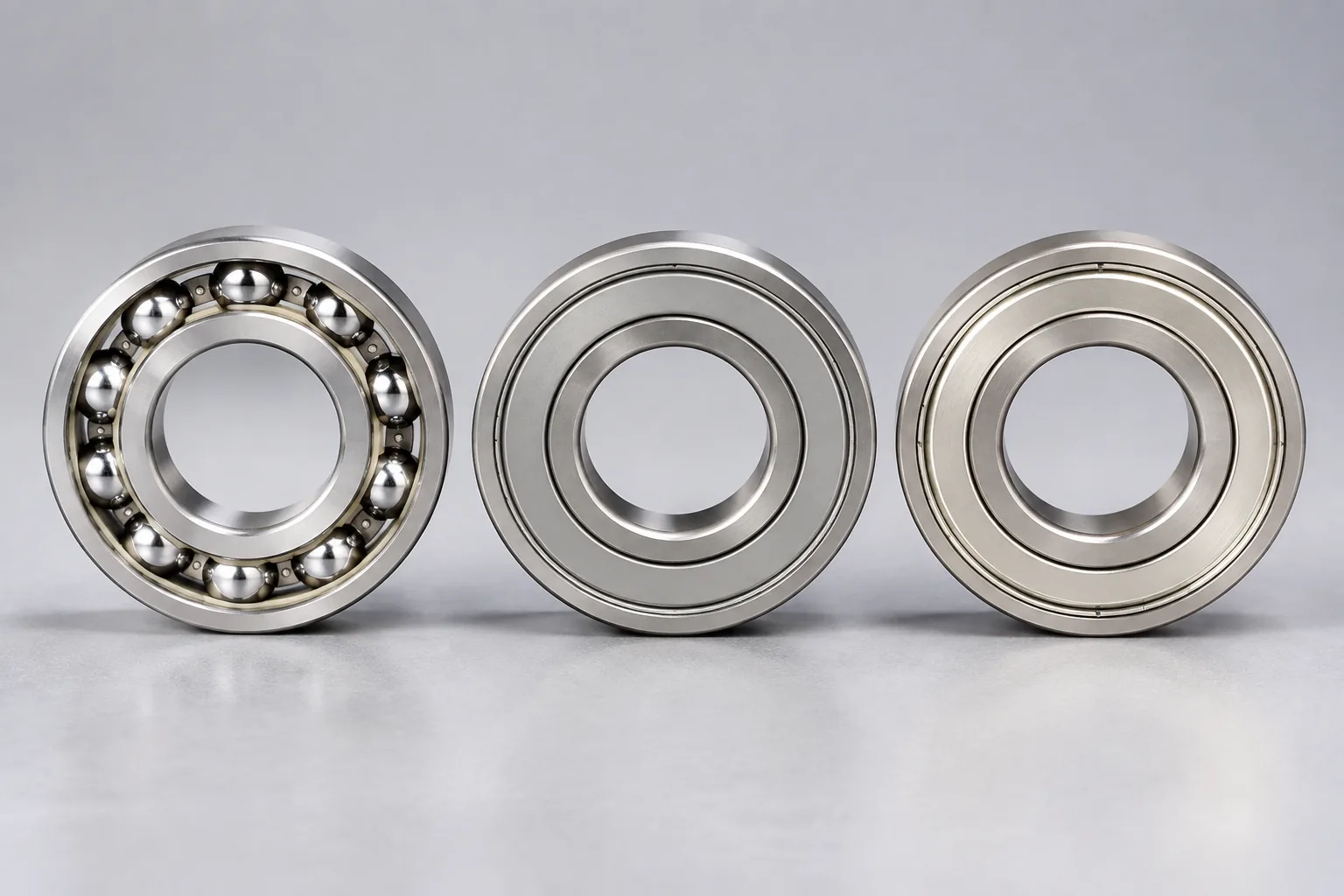
These configurations are not equivalent. A 440C bearing with a 304 cage keeps hard 440C raceways and balls while using 304 where corrosion resistance and formability matter more than rolling contact strength. A full-304 or full-316 bearing moves the softer austenitic grade into the raceways and balls, so load, speed, and precision limits change.
Procurement documents should list the material for the inner ring, outer ring, balls, cage, shields, seals, and fasteners separately, rather than asking only for a stainless steel bearing.
Selection Guide by Application
Match the material to the dominant requirement. Choosing by corrosion resistance alone can leave the bearing understrength for the load, or over-specified for a low-load application.
Choose 440C When Load, Speed, and Precision Matter Most
Use 440C when rolling fatigue life, hardness, load capacity, speed, and dimensional precision are the main concerns. It accepts moderate corrosion resistance that is better than 52100 but below 304 and 316. Typical fits include precision instruments, motors, pumps, and general industrial applications with moderate corrosion exposure.
Choose 304 When General Corrosion Resistance and Cost Matter More Than Load
Use 304 when the environment is more corrosive than 440C can handle but loads and speeds are low. 304 is often selected for cages and shields rather than highly loaded raceways. A full-304 bearing should be considered only for low-load, low-speed corrosion applications, and its actual dynamic load rating and limiting speed should be confirmed for the specific product.
Choose 316 When Chloride or Chemical Corrosion Dominates
Use 316 for salt spray, chloride, food, chemical washdown, or marine-adjacent low-load applications. Accept lower load, lower speed, and often semi-precision capability. Check crevice, stagnation, temperature, and lubrication conditions before specifying 316 for seawater.
316 is most defensible above the waterline, in flowing seawater, or where routine freshwater rinsing is possible. Do not select 316 solely because it is called marine grade for continuous immersion or stagnant seawater service.
Common Misconceptions and Limitations
- Stainless steel does not mean rust-proof. 440C, 304, and 316 all have corrosion limits, and 440C is the least resistant of the three.
- 304 and 316 are not hardenable to 440C bearing hardness. They are austenitic grades that remain soft compared with hardened 440C.
- 316 corrosion resistance comes with load, speed, and precision penalties. The gain in chloride resistance is paired with lower load, lower speed, and often lower precision.
- Higher PREN does not automatically mean longer bearing life. PREN ranks pitting resistance, not fatigue life under load.
- A magnet test is not a grade certificate. Use material certificates or chemical analysis when the grade must be verified.
- A material name does not define the whole bearing. Rings, balls, cage, shields, seals, and fasteners may use different grades.
Procurement and Specification Checklist
- Specify the grade and standard for every bearing component, not only for the rings.
- State the heat treatment and hardness requirements for 440C races and balls.
- Require dynamic and static load ratings, limiting speed, tolerances, clearance, lubrication, and sealing details.
- Define the corrosion environment: salt spray, chloride, chemical, washdown, humidity, immersion, flow, and temperature.
- Request material certificates and dimensional inspection records as needed.
- Use AISI, UNS, EN, or SUS grade names in the specification; cite AMS 5618 for 440C when applicable and ISO 683-17:2023 for bearing steels.
Conclusion
The 440C vs 304 vs 316 stainless steel bearings comparison comes down to one dominant requirement. 440C is the choice when rolling fatigue life, hardness, load, speed, and precision matter most, with moderate corrosion resistance. 304 fits low-load, low-speed applications that need better general corrosion resistance than 440C when cost is a larger constraint than the extra chloride resistance of 316; compare current 304 and 316 pricing for the specific bearing. 316 is the choice for chloride, salt spray, food, chemical washdown, and marine-adjacent low-load service, but it is not a universal solution for continuous immersion or stagnant seawater. Confirm actual load ratings, limiting speed, tolerance, lubrication, seals, and the material of every bearing component before you order.
FAQs
Q1: Is 440C stainless steel rust-proof?
A: No. 440C is more corrosion resistant than 52100 bearing steel, but it is less resistant than 304 and 316, and salt or chloride solutions can still attack it. Use 440C where load, speed, and precision matter and corrosion exposure is moderate, not where the bearing will face continuous salt or chemical attack.
Q2: Can 304 or 316 bearings be hardened?
A: Not to 440C bearing hardness by quenching. 304 and 316 are austenitic, so they gain some strength from cold working but remain soft compared with hardened 440C. A full-304 or full-316 bearing is therefore a low-load, low-speed product, even if its corrosion resistance is better.
Q3: Which is more corrosion resistant, 304 or 316?
A: 316 is usually more corrosion resistant, especially against chloride pitting, because it contains 2-3% molybdenum. Average PREN values are about 19 for 304 and about 25 for 316/316L. 304 still offers good general corrosion resistance and may be adequate when chlorides are low and cost is a larger constraint.
Q4: Are 316 bearings suitable for continuous seawater immersion?
A: Not as a blanket choice. 316 can resist some marine exposure, but stagnant, oxygen-depleted, crevice, or sediment-covered conditions can still cause pitting and crevice corrosion. It is most defensible above the waterline, in flowing seawater, or where routine freshwater rinsing is possible; check temperature, flow, oxygen, deposits, lubricant, seals, and the actual bearing ratings before use.
Q5: Are stainless steel bearings magnetic?
A: 440C is normally magnetic because it is martensitic. 304 and 316 are essentially nonmagnetic in the annealed condition, but cold working can make them slightly magnetic. A magnet test is only a rough check, so use mill certificates, material test reports, or chemical analysis when the grade must be verified.
Q6: Can 304 or 316 bearings handle high loads?
A: Generally no, not compared with 440C. The softer austenitic grades have lower load and speed limits, and a full-316 bearing may carry only a small fraction of the load of a 440C bearing. Check the specific product’s dynamic and static load ratings and limiting speed rather than applying a general ratio.
Q7: What material is the cage in a 440C stainless bearing?
A: A common construction uses a 304 cage with 440C rings and balls, and 304 shields and retaining rings may also be used. Some designs use other materials, so confirm the drawing or material certificate for the exact bearing. A full-304 series would use 304 for the rings, balls, and cage.
Q8: Does higher PREN mean longer bearing life?
A: No. PREN ranks resistance to chloride pitting, not fatigue life. Bearing life also depends on load, speed, lubrication, seals, clearance, temperature, and contamination, so use PREN as a screening value and confirm the actual bearing ratings for the application.