Quick Answer: A flange mounted bearing is a bearing unit carried in a flanged housing that bolts to a machine face, panel or bulkhead.
The flange sits perpendicular to the shaft axis, so the unit mounts flat against a surface instead of on a horizontal base.
The assembly combines a housed bearing insert, a seal and a shaft locking device, which simplifies mounting and alignment on frames and side plates.
A flange mounted bearing is a housed bearing unit fixed to a machine by bolts through a flange rather than by a base that rests on a horizontal surface. That single design decision, mounting flat against a panel, side plate or bulkhead, explains much of the difference between this unit and other mounted bearings. The sections below cover how the unit works, what it contains, the common flange styles, material and sealing options, selection criteria, installation and maintenance, and the applications where a flanged unit makes sense.
How a Flange Mounted Bearing Works
In a flange mounted unit the flanged housing carries the bearing and is bolted through its mounting holes to a machine face, frame or bulkhead. Load travels from the shaft into the bearing inner ring, through the rolling elements to the outer ring, into the housing, and then through the flange and bolts into the machine structure. Because the flange is perpendicular to the shaft axis, radial and thrust reactions are spread across the mounting surface instead of being concentrated at a base.
Many flange mounted units use a self-aligning insert, where a spherical outside diameter on the bearing insert seats in a matching spherical bore in the housing. This allows a small angular misalignment between shaft and housing without loading the bearing edges. The range is limited, so the mounting face still has to hold the shaft square within the capability of the unit.
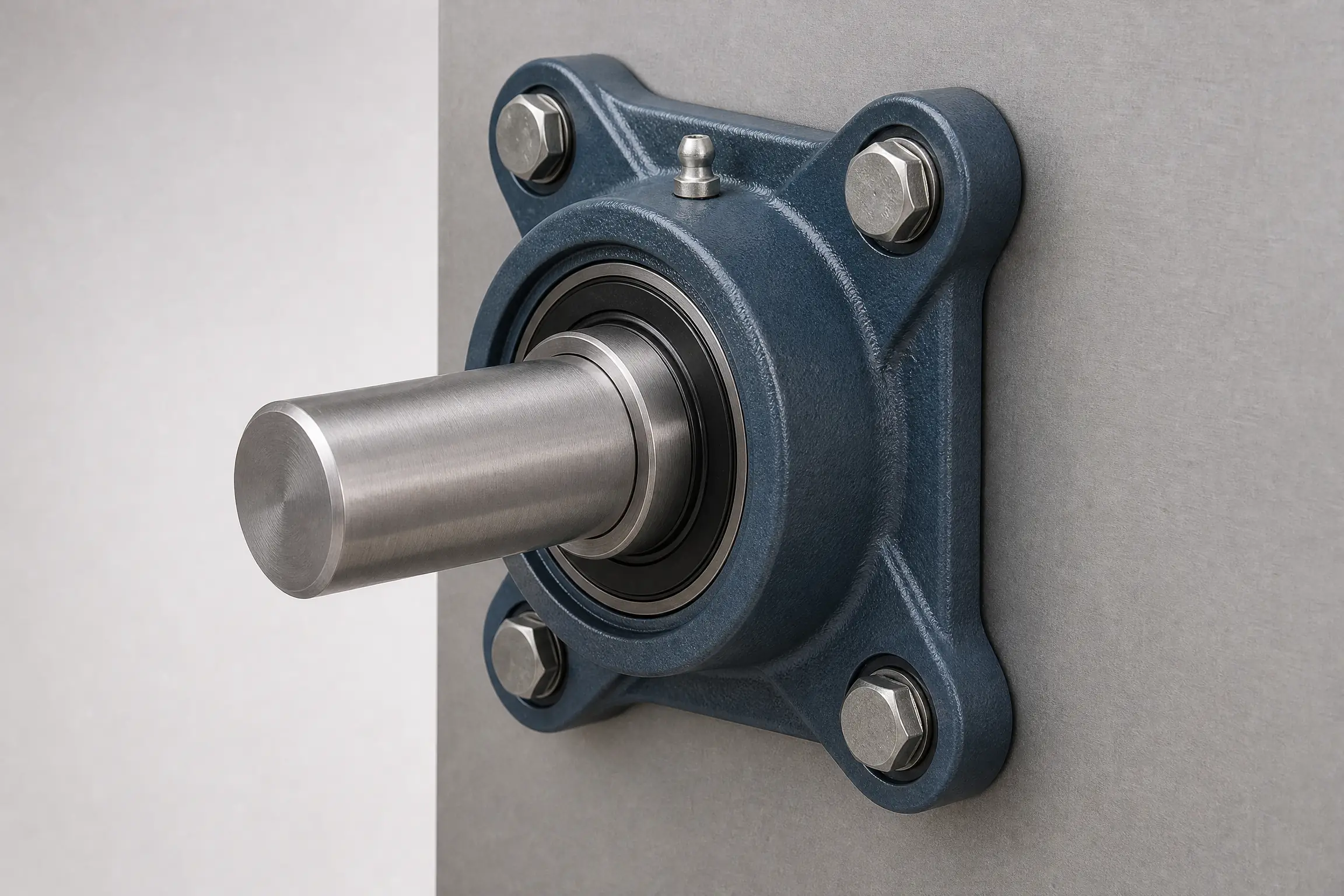
Shaft locking is handled in one of three common ways:
- Set screws grip the shaft through point contact and need a shaft hard enough to resist indentation.
- An eccentric locking collar wraps the shaft and tightens as the collar is rotated against the shaft.
- An adapter sleeve on a tapered bore spreads the grip over a larger area for a firmer hold.
Each method sets its own demand on shaft finish, hardness and axial holding, so the locking device should match the axial load and any reversing duty in the application.
Key Components of a Flange Mounted Bearing Unit
A flange mounted bearing is assembled from a small number of parts that work as one piece:
- Bearing insert: usually a deep groove ball bearing with a spherical outside diameter that matches the housing bore, so it can self-align in the seat.
- Flanged housing: carries the insert, provides the flange face and holds the mounting holes.
- Seals: contact seals, labyrinth seals or metal covers keep dust and moisture away from the rolling elements.
- Lubrication fitting: a grease nipple or similar point on the housing allows relubrication on units that accept it.
- Shaft locking device: set screws, an eccentric collar or an adapter sleeve.
- Mounting holes: two, three or four holes whose spacing and bolt size must match the mating panel.
Common Types of Flange Mounted Bearings
Flange mounted bearings are grouped first by the number and arrangement of the mounting holes.
- Two-bolt flange: an oval outline with the bolt holes on one axis, used where the flange has to stay narrow.
- Three-bolt flange: a triangular bolt pattern for mounting spaces that do not suit two or four holes.
- Four-bolt flange: a square or circular outline with four fixing points, which spreads load across more bolts.
Catalogues also separate round and square flanges. The difference is the outline and the bolt arrangement rather than the bearing inside, and the two are listed as distinct items with their own hole spacing.
Housing construction is a second split. Cast housings are rigid and hold alignment well under load, while pressed steel housings are lighter and used in less demanding positions. Polymer housings appear where corrosion resistance and washdown cleaning matter more than stiffness.
Flange Mounted Bearing vs. Other Mounted Bearings
The mounting direction is the clearest difference between this unit and other housed bearings.
| Unit type | Mounting direction | Where it fits |
|---|---|---|
| Flange mounted unit | Bolts through a flange to a surface perpendicular to the shaft axis | Panels, side plates and bulkheads where the shaft passes through a frame |
| Pillow block | Bolts a base to a surface parallel to the shaft | Long shaft runs that follow a frame or conveyor |
| Take-up unit | Slides in a guide to change shaft position | Belt and chain tensioning where position has to be adjusted |
| Flanged ball bearing | Uses a flange formed on the bearing itself | Locating a bearing axially in a bore, not a separately housed unit |
A pillow block and a flange mounted bearing can carry similar loads; the choice usually comes down to the surface available for mounting and the direction the shaft has to run. A take-up unit is chosen when the shaft position must move. A flanged ball bearing with an integral flange is a different product family, because the flange is part of the bearing rather than part of a separate housing.
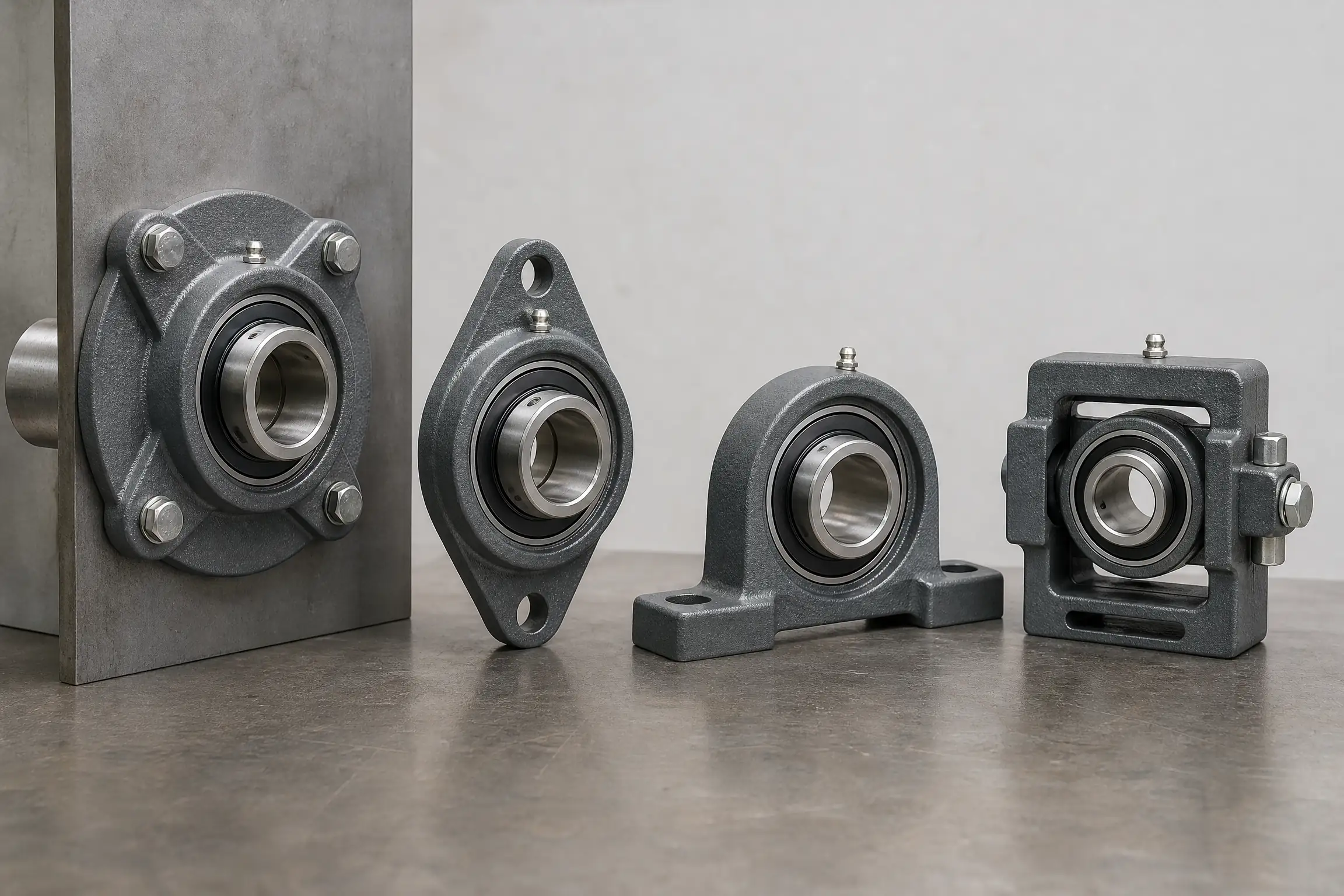
Selection trade-offs are practical: space around the shaft, the direction of the load, the amount of misalignment to absorb, and how easily the unit can be reached for inspection and relubrication.
Materials and Environmental Considerations
Housing material sets much of the rigidity, weight and corrosion resistance of the unit. Grey cast iron and ductile iron are common for general industrial duty, cast steel appears where shock or impact is expected, pressed steel serves lighter and more cost-sensitive designs, and stainless steel or engineering polymer suits wet, washdown or food-handling areas. The bearing insert is normally made from through-hardened bearing steel, with stainless variants for corrosive environments.
Sealing follows the environment. Contact seals keep fine dust and moisture out but add friction, labyrinth seals run without contact and suit higher speeds, and metal covers protect the seal from coarse debris and water spray.
Temperature affects both grease and seal material. A unit working in an oven, a cold store or outdoors needs a lubricant and seal combination rated for that range, and the applicable figure belongs to the specific unit rather than to a general rule. Mounting face condition matters as much: an uneven, painted or flexible panel can distort the flange when the bolts are tightened, which changes bearing clearance and seal contact.
How to Choose the Right Flange Mounted Bearing
Work through the operating conditions before looking at a catalogue page.
- Load: determine the magnitude and direction of the load, whether radial, axial or combined. Reversing or shock loads put extra demand on the locking device.
- Shaft: check diameter, tolerance and hardness. The locking method must suit the shaft material and finish, and an adapter sleeve needs a shaft that accepts its bore range.
- Flange pattern: confirm the number of holes, the hole spacing and the bolt size, then check the clearance available around the unit for tools and for the housing outline.
- Speed and temperature: continuous speed and operating temperature define the insert, grease and seal that can be used.
- Environment: dust, water, washdown chemicals and outdoor exposure decide housing material and seal type.
- Alignment: judge how much angular misalignment the shaft to panel relationship may have. A self-aligning insert covers small misalignment, not large angles.
- Mounting face: check plate thickness and rigidity. Thin sheet may need a backing plate or reinforcement so the flange seats without distortion.
Allowable load, speed and temperature figures are specific to each unit and configuration, so they should be taken from the data for the unit being considered, together with the bolt and panel strength of the machine it goes onto.
Installation and Maintenance Basics
Most problems with a flange mounted bearing start at installation. The mounting face should be flat, clean and free of burrs, paint ridges and weld spatter so the flange seats without being pulled down onto a high point. Bolts are tightened evenly, working across the pattern, to the torque given in the unit or machine specification; uneven tightening can distort the flange and change the bearing fit.
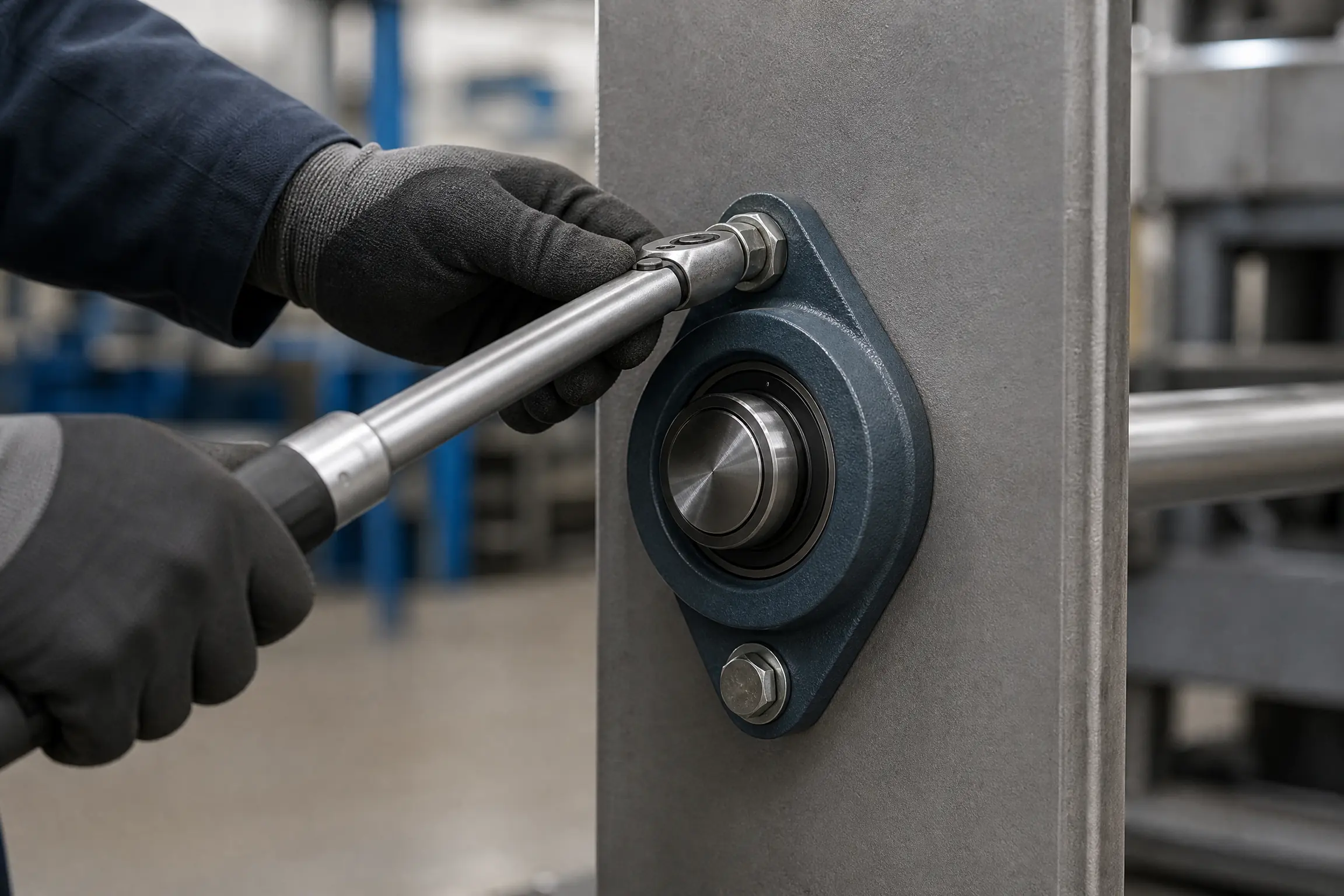
The shaft should be clean and free of nicks and burrs, and the unit should slide or press into place without force. The locking device is then secured to its specified setting, whether that is set screw torque, collar rotation or sleeve drive-up. After mounting, check alignment and run the machine briefly to watch for vibration, a fast temperature rise and unusual noise before full service.
Relubricable units take a first fill where required and periodic grease through the housing fitting. Greases are not interchangeable, so the lubricant type and replenishment interval should come from the unit data and the actual speed, temperature and contamination level. Sealed inserts are not relubricated.
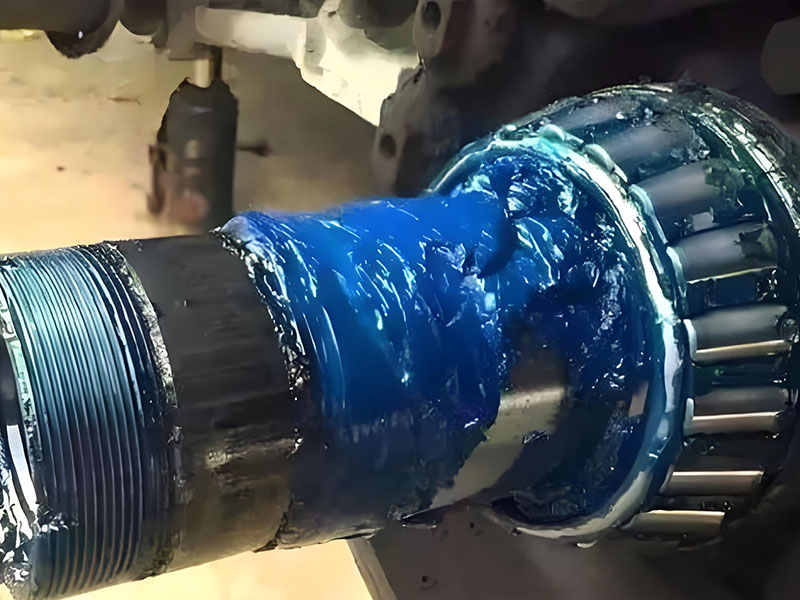
Common reasons these units are replaced include excessive vibration, noise, elevated temperature and erratic shaft behavior. Typical causes include contamination, corrosion, excessive load, overheating, and lubrication problems such as the wrong grease or too little of it. Lubricant failure can leave blue or brown discoloration on bearing surfaces, which helps separate a lubrication problem from a mechanical one. Diagnosis means inspecting the failed unit and its damage pattern against the operating history of the machine, then removing the cause; changing the bearing without correcting the cause leads to a repeat failure. A loose locking device or a housing bore that has lost its grip can also let the insert or shaft move and wear.
Typical Applications
Flange mounted bearings appear wherever a rotating shaft has to pass through a panel or run alongside a frame.
- Conveyors: the unit bolts to the side frame so the shaft lines up with the pulley or roller.
- Fans and blowers: the shaft passes through a casing panel, and the flange mounts directly to that panel.
- Agricultural machinery: outdoor, dusty and wet duty calls for a more robust housing and better sealing.
- Packaging and food processing lines: washdown requirements lead to stainless or polymer housings with suitable seals.
The usual reason to choose a flange mounted bearing over a pillow block is the mounting surface itself. A vertical side plate, a bulkhead or a machine panel gives a flat face for the flange, while a base-mounted unit would need a horizontal seat and more space around the shaft.
Conclusion
A flange mounted bearing solves a specific mounting problem: it puts a sealed, self-aligning housed unit directly onto a panel, so a shaft can pass through a side plate, bulkhead or frame without a base. Choosing between two, three and four-bolt flanges, between cast, pressed steel, stainless or polymer housings, and between set screw, eccentric collar and adapter sleeve locking follows the load, the shaft, the mounting face and the environment. The safe next step is to confirm load direction, shaft condition, bolt pattern and sealing requirement before ordering, then check alignment, lubrication and locking tightness at installation and during service.
FAQs
Q1: What is the difference between a flange mounted bearing and a flanged bearing?
A: A flange mounted bearing is a housed unit: a bearing insert held in a separate flanged housing that bolts to a machine surface. A flanged bearing usually means a bearing with a flange formed on its own outer ring or housing, used to locate the bearing against a shoulder or in a bore. The housed unit carries shaft loads through a bolted housing, while the integral flange mainly sets axial position.
Q2: Can a flange mounted bearing carry axial loads?
A: It can carry a limited axial load, and the amount depends on the bearing insert and the shaft locking method. Set screws, an eccentric collar and an adapter sleeve hold the shaft differently, so the permissible thrust belongs to the data for the specific unit. Where thrust is significant, confirm the insert, the housing and the mounting bolts can take the reaction, or use a bearing arrangement designed for combined loads.
Q3: Which is better, a two-bolt or a four-bolt flange?
A: Neither is better in general. A two-bolt oval flange suits narrow mounting areas, while a four-bolt square or round flange spreads load across more fixing points and suits stiffer, more heavily loaded installations. Decide from the load magnitude and direction, the rigidity of the mounting face, the bolt positions available and the clearance around the unit.
Q4: How do I lubricate a flange mounted bearing?
A: Units that accept relubrication have a fitting on the housing; grease is added through it, following the supplier’s schedule for the application. Sealed inserts are supplied lubricated and are not relubricated. Replenishment intervals depend on speed, temperature, contamination and grease type, so they should come from the unit data rather than a general rule.
Q5: What causes a flange mounted bearing to fail?
A: The usual causes are lubrication problems, contamination, corrosion, excessive load and overheating, often in combination. Excessive vibration and noise are common reasons these units are replaced. Inspect the failed unit and its damage pattern, compare it with the machine history, and correct the cause, because fitting a new unit without removing the cause leads to a repeat failure.