Quick Answer: A flange mounted bearing is a pre-assembled unit consisting of an insert bearing mounted in a flanged housing. It is designed for applications where the shaft axis is perpendicular to the mounting surface. Selection depends on four factors: load magnitude, space constraints, environmental conditions, and total lifecycle cost. Key decisions include flange housing series (F, FA, FB, FC, FL, FS), insert bearing locking method (UC/SA/SB for setscrew, UK for adapter sleeve, or UE/UEL for eccentric collar), and housing material. This guide covers the complete selection process from understanding the mounted bearing family to calculating L10 life.
Flange mounted bearings are widely used in conveyor systems, agricultural equipment, HVAC units, pumps, and automotive assemblies.
Unsure which bolt pattern fits your load, which locking method works best for your shaft, or how mounting surface flatness affects service life? This guide provides clear answers.
What you will learn in this guide:
- The mounted bearing family structure
- Flange housing options and bolt patterns
- Insert bearing locking methods (setscrew, adapter sleeve, eccentric collar)
- Complete unit designation reading (UCF, UKF, UELF, etc.)
- The L.E.S.C. selection framework (Load, Environment, Space, Cost)
- Critical dimensions, material choices, and performance specifications
- Installation best practices and common mistakes to avoid
What Is a Flange Mounted Bearing?
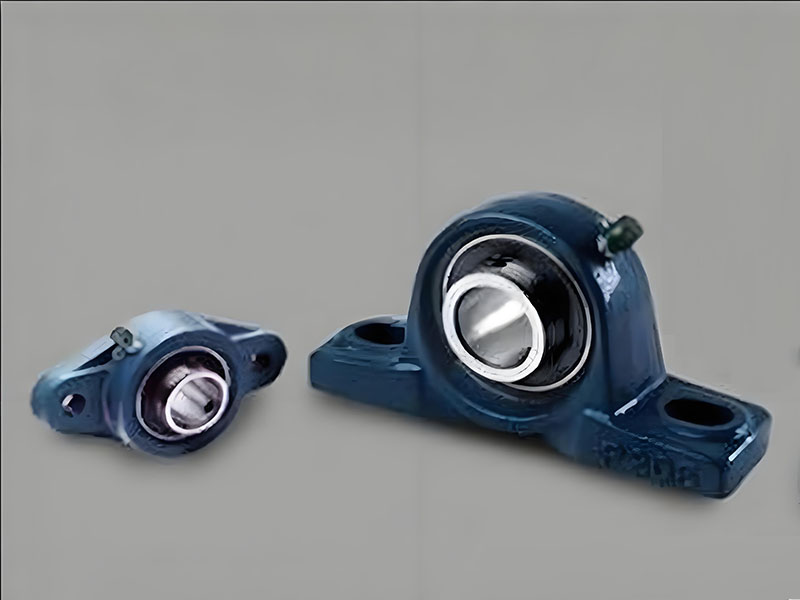
A flange mounted bearing belongs to the mounted bearing product family. Its housing includes a flange that enables bolting onto a surface perpendicular to the shaft axis. The shaft runs at a right angle to the mounting plane.
Every flange mounted bearing unit contains two elements:
- Insert bearing – a sealed ball bearing with a spherical outer ring that provides self-alignment.
- Flanged housing – a casing that holds the insert bearing and provides mounting holes with 2, 3, or 4 bolts.
The spherical outer ring fits into a matching concave surface inside the housing. This design tolerates minor shaft-to-housing misalignment. The complete assembly can be unbolted and removed, making replacement faster than press-fit bearing arrangements.
Mounted Bearing Family Overview
Flange mounted bearings are one of four main types in the mounted bearing family. The table below shows where they fit:
| Mounted Bearing Type | Housing Series | Common Combinations | Mounting Orientation |
|---|---|---|---|
| Pillow Block | P, PA, PH | UCP, UKP, UEP | Horizontal surface with shaft parallel to mounting face |
| Flange Mounted | F, FA, FB, FC, FL, FS | UCF, UKF, UELF | Vertical or perpendicular surface with shaft perpendicular to mounting face |
| Take-up | T | UCT, UKT | Tensioning systems such as conveyor belts |
| Hanger | HA | UCHA | Overhead or suspended mounting |
This guide focuses exclusively on flange mounted bearings, which are defined by their housing series: F, FA, FB, FC, FL, and FS. The other types (Pillow Block, Take-up, Hanger) are not covered here.
Flange Housing Series: F, FA, FB, FC, FL, FS
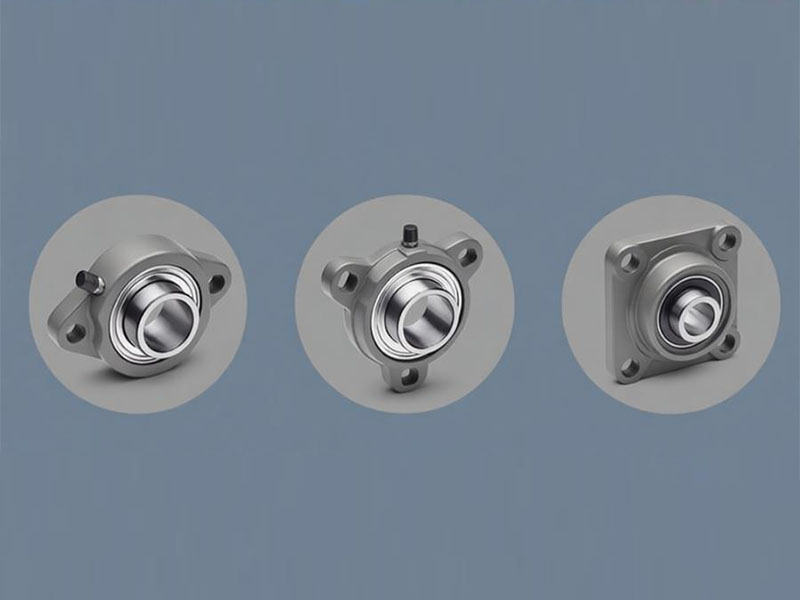
Flange mounted bearings are available in six housing series: F, FA, FB, FC, FL, and FS. Each designation describes a specific flange shape and bolt pattern. When combined with an insert bearing series (UC, UK, or UE), these form complete unit codes such as UCF, UKF, UELF, or UCFL.
F Series: Square 4-Bolt Flange
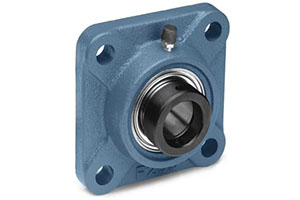
The F housing has a square shape with four bolt holes positioned radially around the bearing center. This is the most widely used flange type.
Key attributes:
- High structural rigidity and good vibration resistance
- Symmetrical bolt pattern for even load distribution
- Offered in standard-duty (UCF 200) and heavy-duty (UCF 300) versions
Critical warning: mounting surface flatness directly affects life. A 0.1mm deviation reduces bearing life by 30%. A 0.2mm deviation cuts life by 55%.
Example: UCF204 equals UC204 insert bearing with setscrew locking and 20mm bore plus F housing.
FA Series: Narrow Square 4-Bolt Flange
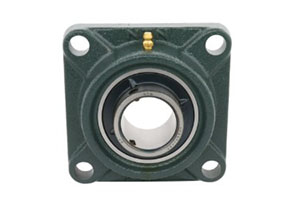
The FA housing maintains a 4-bolt square pattern but with a narrower footprint than the standard F. Use this when space is tight but you still need 4-bolt capacity.
FB Series: Round 4-Bolt Flange
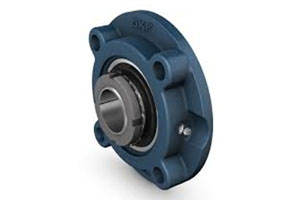
The FB housing uses a round profile with four bolt holes. Choose this when a round housing shape fits better aesthetically or clears surrounding components more effectively.
FC Series: Round 3-Bolt Flange
The FC housing is round with three bolt holes spaced at 120 degrees.
Advantages:
- Triangular bolt layout provides better stability than 2-bolt designs
- Well-suited for vertical mounting or triangular bolt patterns
Example: UCFC equals UC bearing plus FC housing.
FL Series: Oval 2-Bolt Flange
The FL housing has an oval or diamond shape with two bolt holes. A straight line through the hole centers passes through the bearing axis.
Characteristics:
- Compact design fits narrow machine frames
- Major limitation: not recommended for high-vibration or heavy axial thrust applications
- Failure mode: housing ears may crack or bolts may loosen under moment loads
Real-world example: A food processing conveyor used a UCFL204 with 20mm bore under 2.8 kN radial load, 8 Hz vibration with 0.5mm amplitude, running 16 hours per day. The housing ears cracked at 2,200 hours (roughly 3 months). Switching to a UCF204 extended service life beyond 14,000 hours with no failures.
FS Series: Slotted 4-Bolt Square Flange
The FS housing is a square 4-bolt flange with slotted mounting holes. This allows adjustable positioning during installation, which is useful when alignment is challenging or mounting hole locations vary.
Quick Selection Guide for Flange Housings
| Operating Condition | Recommended Series |
|---|---|
| Loads above 5 kN or significant vibration | F with 4-bolt square |
| Limited space under 50 mm width and loads below 3 kN | FL with 2-bolt oval |
| Vertical shaft orientation or triangular bolt pattern | FC with 3-bolt round |
| Adjustable mounting position needed | FS with slotted holes |
Insert Bearing Types: UC, SA, SB, UK, UE, UEL
The bearing element inside the housing is the insert bearing. It is a deep groove ball bearing with a spherical outer diameter for self-alignment. Insert bearings are categorized by shaft locking method.
Why does locking method matter in flange bearing selection? The locking method determines how securely the bearing grips the shaft, affecting performance under reversing loads, vibration, and various shaft conditions. Choosing the wrong method can lead to shaft damage, bearing loosening, or premature failure.
Locking Method Comparison
| Locking Method | Series | Mechanism | Ideal Application |
|---|---|---|---|
| Setscrew | UC (metric), SA/SB (inch) | Setscrews in the extended inner ring bite into the shaft | General use with most common and economical option |
| Adapter Sleeve | UK | Tapered sleeve expands between shaft and bearing bore | Plain shafts without keyways, high vibration, maximum concentricity |
| Eccentric Collar | UE (metric), UEL (extended inner ring) | Offset collar rotated to clamp the shaft | Reversing loads, moderate vibration, simpler installation |
UC Series: Setscrew Locking
The UC series represents the industry standard for insert bearings. Its extended inner ring carries one or two setscrews that lock directly onto the shaft.
Key points:
- Most widely used and cost-effective locking method
- Available in metric (UC) and inch-system (SA, SB) bores
- UC200 series for normal-duty and UC300 series for heavy-duty
- Wide inner ring gives good shaft support
Example: UC204 has a 20mm bore.
SA and SB are inch-system versions. SA is for standard duty, while SB is for heavy duty with a thicker inner ring.
UK Series: Adapter Sleeve Locking
The UK series locks via an adapter sleeve. A tapered sleeve drives between the shaft and bearing bore, expanding to create a tight fit.
Advantages:
- Best concentricity among all locking methods
- Resists fretting corrosion in demanding conditions
- Works on plain shafts with no keyway needed
- Handles vibration and impact well
Note that the adapter sleeve is a separate purchase item.
Example: UKF205 equals UK205 insert bearing plus F205 housing and fits a 20mm shaft.
UE and UEL Series: Eccentric Collar Locking
The UE and UEL series use an eccentric collar. Rotating the offset collar clamps it onto the shaft.
When to choose:
- Reversing loads because the collar grips tighter under reverse torque
- Easier to install than setscrew types
- UEL adds a longer inner ring for extra shaft support
Example: UELF204 equals UEL204 bearing plus F204 housing.
Complete Unit Designations: How to Read the Code
The full unit code follows a simple pattern:
Insert Bearing Series + Housing Series = Complete Unit
| Insert Bearing | Housing | Complete Unit | Meaning |
|---|---|---|---|
| UC | F | UCF | Setscrew bearing with square 4-bolt flange |
| UC | FL | UCFL | Setscrew bearing with oval 2-bolt flange |
| UK | F | UKF | Adapter sleeve bearing with square 4-bolt flange |
| UEL | F | UELF | Eccentric collar bearing with square 4-bolt flange |
| UC | FC | UCFC | Setscrew bearing with round 3-bolt flange |
| UC | T | UCT | Setscrew bearing with take-up housing (not a flange type) |
Bore size decoding: the last two digits indicate bore size. In UCF204, “04” means 20mm (multiplying 04 by 5). In inch-series UCF204-12, “-12” means 3/4 inch.
Key Selection Factors: The L.E.S.C. Framework
Use this four-factor framework to guide every selection:
| Factor | What to Examine | Why It Matters |
|---|---|---|
| L Load | Size and direction of radial, axial, or moment loads. Check required dynamic (C) and static (C0) ratings. | Under-rated bearings fail early while over-rated bearings add cost without benefit. |
| E Environment | Moisture, chemicals, heat, or contamination present. | May force use of stainless steel, plastic housings, or special seals. |
| S Space | Available envelope, especially height above mounting surface (H) and overall length. | The bearing must physically fit and clear adjacent parts. |
| C Cost | Total lifetime cost including purchase price, maintenance, replacement labor, and downtime. | A low initial price often costs more over time if the bearing fails early. |
Important Dimensions
Check these five critical dimensions against your equipment drawings before ordering:
| Dimension | What It Measures | Critical For |
|---|---|---|
| Bore diameter | Shaft size the bearing fits | Must match exactly. UCF204 has a 20mm bore. |
| Height above surface (H) | Vertical distance from mounting face to shaft center | Clearance. UCF204 has H = 15mm. |
| Overall length (L) | Total housing length | Frame space. UCF204 has L = 86mm. |
| Bolt hole spacing (J) | Center-to-center distance between mounting holes | Bolt pattern match. UCF204 has J = 64mm. |
| Bolt hole size (N) | Mounting hole diameter | Determines bolt size. UCF204 uses M10 bolts. |
Housing Material
| Material | Properties | Best Used For |
|---|---|---|
| Cast iron | Good vibration damping and economical | General industrial use |
| Pressed steel | Lightweight and low cost | Light loads only |
| Plastic (nylon, PTFE, acetal) | Corrosion-resistant and lightweight with up to 40% lower cost than stainless steel and up to 80% lighter | Food, chemical, and washdown environments |
| Stainless steel | Corrosion-resistant and high strength | Marine, pharmaceutical, and food processing |
Plastic housings offer maintenance-free operation, no lubrication needed, and excellent corrosion resistance.
Bearing and Housing Features
Alignment Features
- Self-aligning – All insert bearings have a spherical outer ring that compensates for shaft misalignment. This is essential when mounting errors or shaft deflection are possible.
- Offset hole patterns – Available on some 3-bolt FC housings for additional alignment flexibility.
Maintenance Features
- Relubricatable – Most flange units include a grease fitting for periodic relubrication, extending service life.
- Split housing – Some housings split into two halves, letting you replace the bearing without removing the shaft.
- Seal options – Various seal types such as K-type and triple lip protect against contamination in wet or dirty environments.
Performance Specifications
Maximum Speed
Speed limits depend on bearing type, lubrication, and load. Insert ball bearings typically run faster than roller or plain bearings. Always check the manufacturer’s published speed ratings.
Bearing Life (L10)
L10 represents the life that 90% of identical bearings in a group will reach or exceed.
L10 = (C/P)^3
Where:
- L10 = rating life in millions of revolutions
- C = basic dynamic load rating
- P = equivalent radial load
To convert to hours:
L10 hrs = 16667/N x (C/P)^3
Where N = shaft speed in rpm.
Median Life (L50) is the life 50% of bearings will reach or exceed. L50 is typically no more than five times L10.
Bearing Loads
Radial and axial (thrust) loads act together. Follow these rules:
- If axial load is under half the radial load, use radial load only for selection.
- If axial load is half or more of the radial load, use total load (radial plus axial) as equivalent radial load.
Basic Dynamic Load Rating (C) – A calculated constant radial load that identical bearings can endure for one million inner-ring revolutions with the outer ring stationary.
Basic Static Load Rating (C0) – The load that produces 609,000 psi contact stress on the most heavily loaded ball. At this stress, permanent deformation reaches about 0.01% of ball diameter.
Equivalent Radial Load (P):
P = XFr + YFa
Where:
- Fr = radial load
- Fa = axial load
- X and Y = geometry-based factors from the manufacturer’s catalog
Operating Temperature
Temperature limits come from the cage, seal, and grease. Above 300°F (149°C), grease may leak past the seal lip. For high-heat applications, use special high-temperature grease or solid lubricants.
Lubrication
- Manual lubrication – Uses a grease fitting on the housing to supply lubricant to friction points. Regular maintenance extends bearing life.
- Self-lubricating bearings – Made from oil-impregnated bronze or graphite alloys, these need no external lubrication. Best for hard-to-access locations.
Installation and Maintenance Tips
Before installation:
- Surface preparation – clean the mounting surface. It must be flat and free of burrs or debris.
- Pre-installation inspection – check that all equipment is clean and in good condition.
- Lubrication – apply the specified lubricant. Over-greasing causes overheating.
Installation rules:
- No impact loading
- No hammer strikes directly on the bearing
- Apply force only through the ring being mounted, never through the rolling elements
Cleanliness – keep the bearing and surrounding area clean. Contamination is a leading cause of early failure.
Flatness check – the housing must sit fully flat on the mounting surface. Any gap distorts the housing and can cause fracture.
Common Selection Mistakes
- Choosing 2-bolt for high vibration – FL housings cannot handle high vibration or heavy axial thrust.
- Ignoring surface flatness – a 0.1mm deviation cuts bearing life by 30% and 0.2mm by 55%.
- Mixing locking methods – UC, UK, and UE bearings have different bore geometries and are not interchangeable.
- Skipping L10 calculation – catalog ratings alone do not guarantee service life. Always compute L10 = (C/P)^3.
- Using pressed steel for heavy loads – pressed steel housings suit light loads only.
- Wrong housing series – selecting FL with 2-bolt when F with 4-bolt is needed.
- Bore size errors – confirm bore size. UCF204 has 20mm while UCF204-12 has 3/4 inch.
Typical Applications
- Conveyor systems – roller supports, drive shafts, material handling
- Agricultural machinery – combines, balers, tillers
- Industrial fans and blowers – fan shafts in HVAC and ventilation
- HVAC systems – heating, cooling, and air handling equipment
- Pumps and compressors – industrial fluid and air handling
- Food processing – stainless steel or plastic housings for washdown areas
- Mining and construction – heavy equipment in harsh conditions
- Automotive – various vehicle assemblies
- Textile machinery – high-speed spindles and rollers
Conclusion
Selecting the right flange mounted bearing starts with the L.E.S.C. framework: Load, Environment, Space, and Cost.
Quick Reference
| Decision Point | Recommendation |
|---|---|
| Loads over 5 kN or high vibration | F series with 4-bolt square |
| Tight space with loads under 3 kN | FL series with 2-bolt oval |
| Vertical mounting | FC series with 3-bolt round |
| Standard applications | UC with setscrew locking |
| Plain shafts with high vibration | UK with adapter sleeve locking |
| Reversing loads | UE/UEL with eccentric collar locking |
| Corrosive or washdown environments | Plastic or stainless steel housing |
Final checklist:
- Always check mounting surface flatness. A 0.1mm deviation costs you 30% of bearing life.
- Run the L10 = (C/P)^3 calculation to confirm your choice meets the required service life.
- Verify all five critical dimensions before ordering.
For technical support, product specifications, or custom solutions, reach out to our engineering team through our website.
FAQs
Q1: What distinguishes UCF from UCP?
A1: UCF = UC bearing with F flange housing where the shaft is perpendicular to the mounting face. UCP = UC bearing with P pillow block housing where the shaft is parallel to the mounting face.
Q2: What does UKF stand for?
A2: UKF = UK series bearing with adapter sleeve locking plus F flange housing.
Q3: Can a UC bearing fit an FL housing?
A3: Yes, that combination is labeled UCFL.
Q4: Which locking method handles reversing loads best?
A4: UE/UEL with eccentric collar secures more firmly under reversing torque than setscrew types.
Q5: Why does mounting surface flatness matter so much?
A5: A 0.1mm gap reduces bearing life by 30% while 0.2mm reduces it by 55% due to housing distortion.
Q6: What makes UK series unique?
A6: UK bearings mount on plain shafts without keyways. The adapter sleeve expands to lock the bearing, delivering the highest concentricity and resisting fretting corrosion.
Q7: How do I read the “04” in UCF204?
A7: “04” means 20mm bore by multiplying 04 by 5. In inch-series UCF204-12, “-12” means 3/4 inch.
Q8: Are plastic flange bearings a good option?
A8: Yes. They are up to 40% more cost-effective than stainless steel, up to 80% lighter, and require no lubrication.
Q9: How is L10 bearing life calculated?
A9: L10 = (C/P)^3 gives life in millions of revolutions. For hours: L10 hrs = 16667/N x (C/P)^3.
Q10: Which flange housing series is most common?
A10: The F series with square 4-bolt is the industrial standard for rigidity and vibration resistance.
Q11: What separates UC200 from UC300 series?
A11: UC200 is for normal-duty while UC300 is for heavy-duty.
Q12: What are the four mounted bearing types?
A12: Pillow Block (P/PA/PH), Flange Mounted (F/FA/FB/FC/FL/FS), Take-up (T), and Hanger (HA).