Quick Answer: Cam followers usually fail because the application, installation, or maintenance allows lubrication loss, contamination, overload, misalignment, or excessive speed before the bearing reaches its rated life. The outer ring, rollers, stud, seals, lubricant, mounting, and track act as one system, so a damaged raceway does not prove a material defect. Classify the damage first, then trace the operating condition that caused it.
Cam follower damage is often reported as a bearing failure, yet the bearing is only one part of the working system. The outer ring runs on a track, the stud carries bending load, seals keep the wrong material out, and grease must reach both the internal rolling contact and the outside surface. A useful failure review therefore starts with the damage pattern and works back to lubrication, contamination, load, alignment, mounting, speed, temperature, corrosion, and track condition. That sequence separates a real material problem from an application problem.
Classify the Damage Before Asking Why Cam Followers Fail
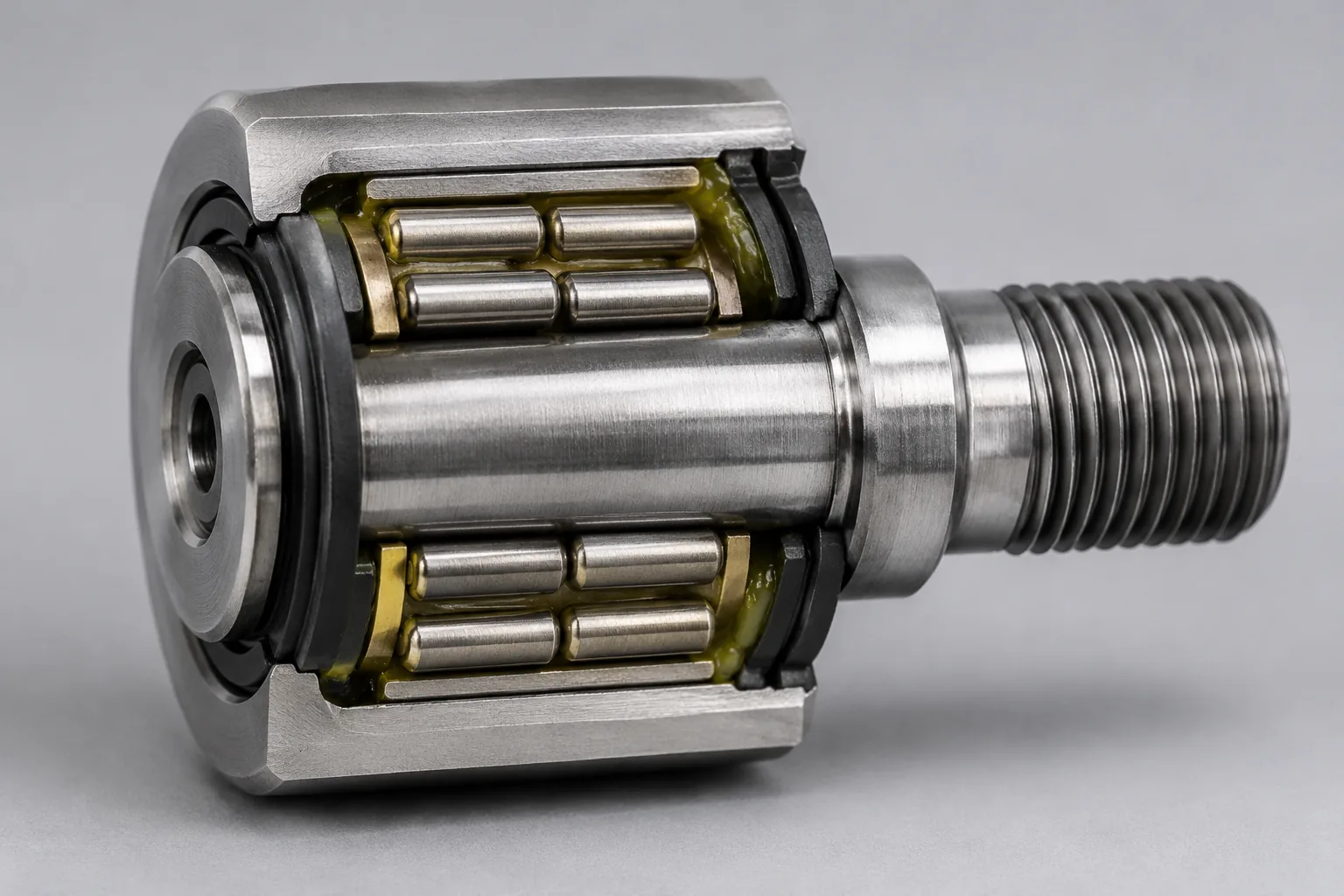
Cam follower performance depends on the outer ring, rolling elements, stud, seals, lubricant, housing support, and mating track. A wear mark on the outer ring can come from a soft track; a spall can begin at an indentation; a loose stud can tilt the outer ring. Do not assume a material defect from the spalling location alone.
ISO 15243:2017 (second edition, March 2017; 53 pages; developed by ISO/TC 4/SC 4 and confirmed in 2022) provides a consistent damage vocabulary. It groups bearing damage into six main categories:
- Rolling contact fatigue
- Wear
- Corrosion
- Electrical erosion
- Plastic deformation
- Fracture and cracking
Use those categories to organize an inspection report. Electrical erosion is relevant only when stray current is present, so do not force it into a diagnosis without evidence of current flow. When visual inspection cannot distinguish lubrication, contamination, overload, or material origin, escalate to cross-section examination, metallography, scanning electron microscopy, chemical analysis, or spectral analysis.
Lubrication Loss and Missed Relubrication
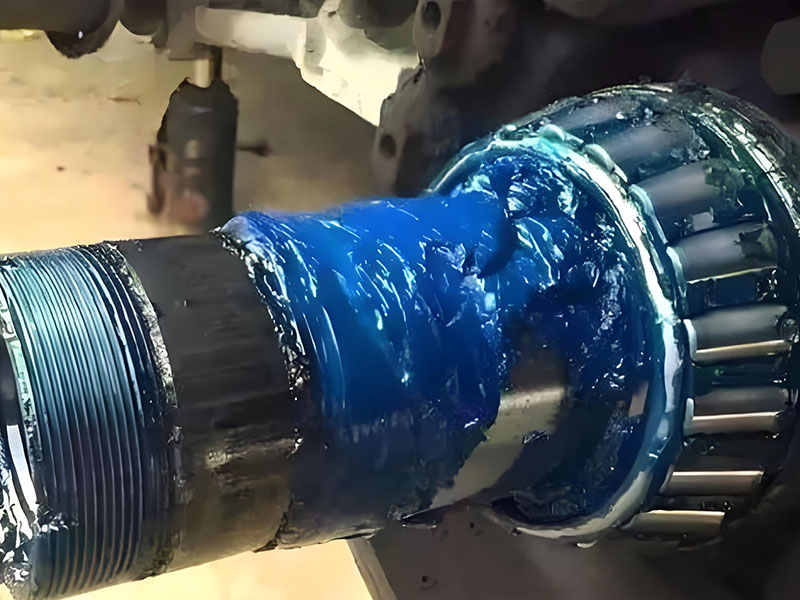
Grease leakage from inside the cam follower causes inadequate lubrication and early failure. Standard seals mainly block dust; they do not fully prevent grease leakage or liquid ingress. An initial grease fill is not a substitute for periodic relubrication. Relubrication is required for full service life, and the interval must shorten with contamination, moisture, high speed, temperatures above 70°C (160°F), and full-complement rollers.
The outer ring and track contact also need grease. Poor track lubrication causes premature wear even when the internal bearing is healthy. Some sealed designs may limit relubrication options; verify the product-specific maintenance method.
Contamination and the Wrong Seal for the Environment
Hard particles that enter the rolling contact create indentations in the raceway. The indentation edges become local stress concentrations, and spalling or fatigue can start there. Water ingress causes rust, pitting, and lubricant degradation. Ordinary rubber seals on cam followers are dust seals, not liquid seals.
Cutting fluid, coolant, and washdown liquids can pass a dust seal, especially when the seal is worn or the shaft is wet. In machine-tool or wet applications, using a dust seal as if it were a liquid seal increases grease loss and contamination risk. Standard dust seals can still be adequate in dry, dusty conditions when relubrication is maintained.
Overload, Impact, and Selecting by the Wrong Load Rating
The cam follower outer ring is not fully supported by a bearing housing. It contacts the track over a small area, so the ring deflects elastically and redistributes internal load. The working load must not exceed the catalog maximum dynamic radial load Fr or maximum static radial load F0r.
Do not select only by the needle roller dynamic rating. Check outer ring deformation, track capacity, and stud bending stress. Shock loads, repeated peak loads, and vibration can produce plastic deformation, fatigue spalling, and fracture.
Misalignment, Edge Loading, and Axial Thrust
Misalignment or excessive moment load creates edge loading and harmful plastic deformation at the roller and raceway contact. Any misalignment also generates axial thrust between the outer ring and flange or end plate. Excessive thrust raises operating temperature and can damage standard seals.
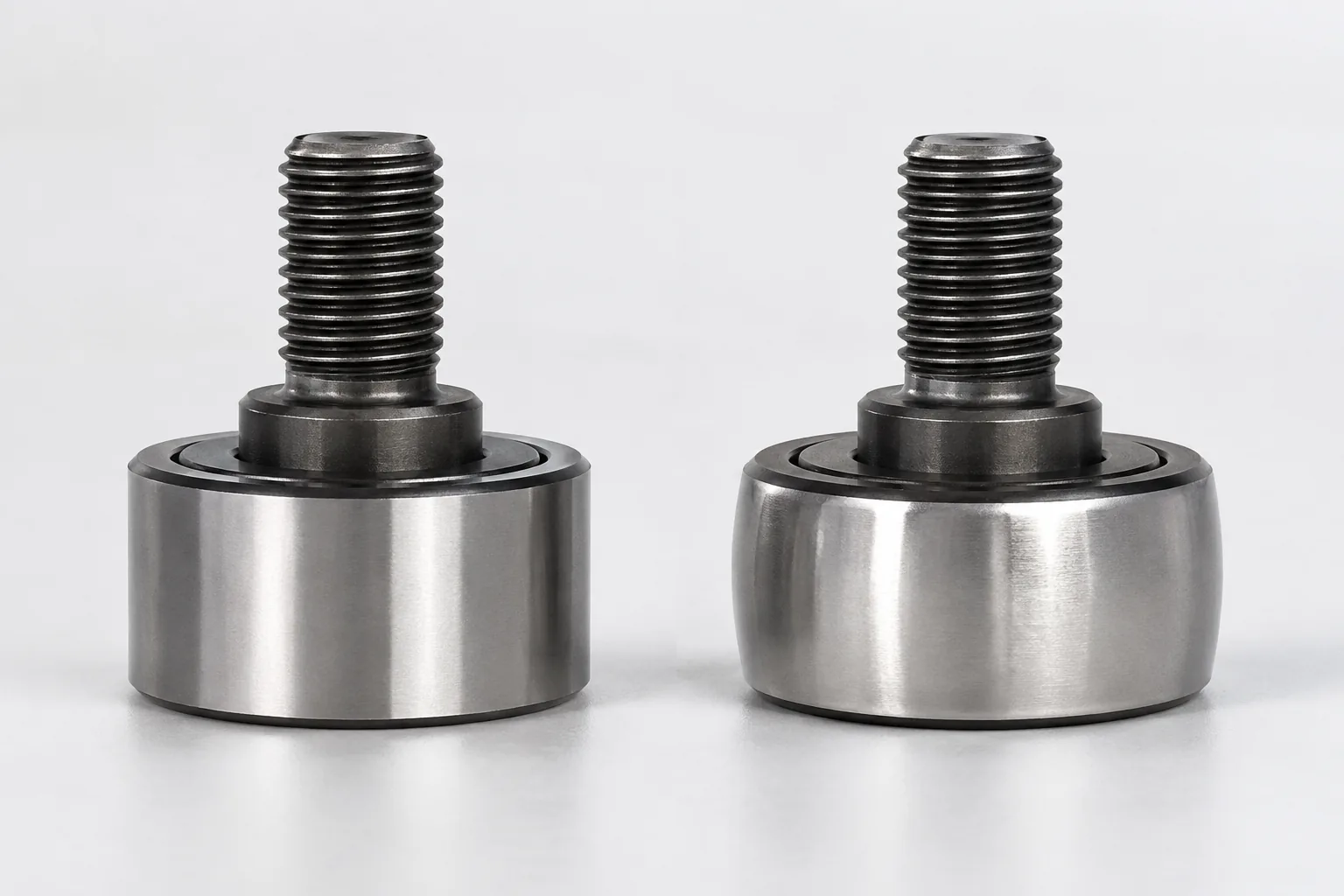
One published initial misalignment limit is 0.001 in/in, approximately 1 mrad or 0.057°. Use the current product data for the actual limit. A crowned outer ring suits misalignment, curved tracks, or axial thrust. In a well-aligned application, a crowned outside diameter can accelerate track wear, so match the profile to the actual track geometry.
Mounting, Clamping, and Stud Support Errors
Insufficient support of the stud shoulder increases bending stress and outer ring tilt. The end plate should seat against a housing boss or flat support surface, and the housing hole should be drilled and reamed to the recommended tolerance. When press-fitting a tight stud, apply force at the center of the flange, not on the flange edge or outer ring.
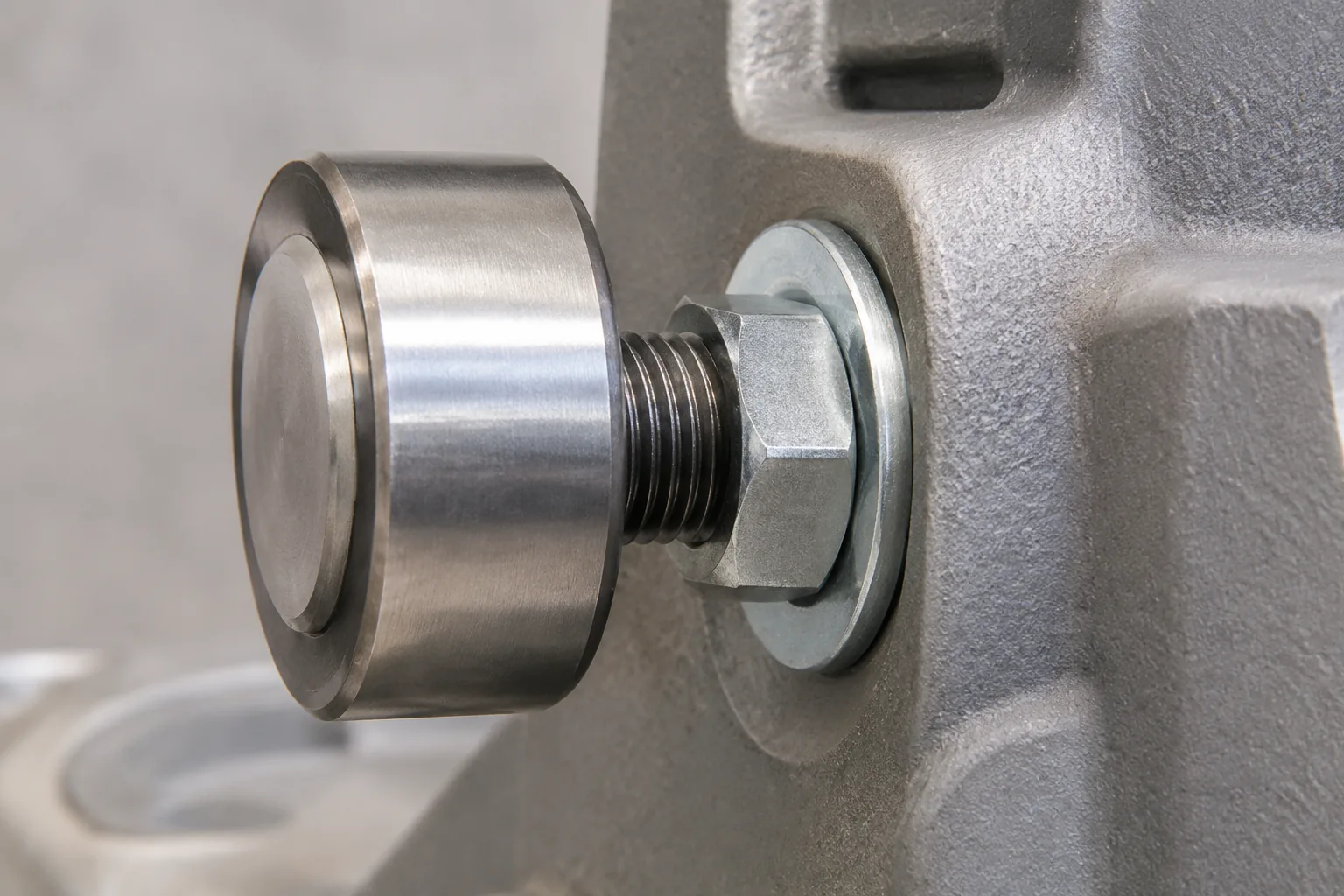
Maximum recommended clamping torque is based on lubricated threads. For dry threads, one catalog allows up to about twice the lubricated-thread torque. Ignoring thread condition can cause under-clamping or stud damage. Actual torque values are product-specific; use the current catalog table.
Speed, Acceleration, and Skidding
Continuous operation above the catalog speed limit can overheat the cam follower and cause premature failure. Excessive acceleration or deceleration makes the outer ring slide on the track instead of rolling. Sliding wear can progress from uniform wear to flat spots on the outer ring and eventual failure.
Light load can also reduce traction and cause skidding. A cam follower needs enough load to maintain pure rolling, especially during high-speed indexing, rapid starts, stops, and reversing motion. One engineering estimate uses a typical outer ring and track friction coefficient of μ = 0.10; use it only as a calculation assumption, not as a measured site value.
Temperature Limits of Grease and Seals
Temperature limits come from both the bearing and the lubricant. A common standard cam follower range is -20°F to +250°F (-29°C to +120°C), with short-term peaks up to +300°F (150°C). A general range for some designs is -30°C to +140°C, but design variants can be lower: certain PPSKA/PPA KR types are limited to +100°C, and PWKR…2RS and PWKRE…2RS types to +120°C.
The grease limit may be lower than the bearing limit and must be checked separately. High-temperature ovens, baking lines, high-speed heat rise, and hot machinery all need a margin between operating temperature and the grease limit. Over-temperature degrades grease and seals, leading to lubrication loss and failure.
Corrosion in Wet, Marine, and Chemical Environments
Standard steel cam followers can rust and pit in salt water, mild chemicals, and washdown environments. Corrosion pits create stress concentrations and can degrade lubricant condition. A thin dense chrome coating about 0.0001 in (2.54 μm) thick is used for resistance to salt water and mild chemicals.
Washdown, marine exposure, chemical splash, and high humidity all raise the risk. Verify chemical compatibility; such a coating is not a universal corrosion solution.
Track and Mating Surface Failures Can Mimic Cam Follower Failure
The cam follower outer ring runs directly on the track. Track hardness, surface roughness, contact width, lubrication, and load capacity all affect life. Track capacity must be considered separately from the bearing dynamic load rating. A softer, rougher, or under-supported track may fail before the cam follower, causing wear or indentation on the outer ring.
Custom tracks, cam profiles, and curved rails deserve the same review. Crowned and flat outer rings must match the track geometry and alignment.
Selection Errors: Cage Type, Seals, and Outer Ring Profile
Cage-type cam followers suit higher speed. Full-complement types have higher load ratings but are generally for lower speed and high load. Full-complement types need more frequent relubrication and may generate more friction and heat at high speed. Seal type and outer ring profile must match the environment, load direction, and track geometry.
A Practical Failure-Review Checklist
- Check lubrication history and grease condition; confirm the relubrication interval and seal compatibility.
- Inspect for contamination, water ingress, rust, and cutting fluid attack.
- Verify actual load against Fr and F0r, including shock and stud bending; check track capacity.
- Measure alignment and mounting support; confirm the press-fit and clamping torque procedure.
- Review speed, acceleration, and temperature against catalog limits.
- Classify damage per ISO 15243 and escalate to laboratory analysis when the root cause is unclear.
Use product-specific catalog values for the final judgment. A field failure review and a warranty inspection should reach the same conclusion only when the measured conditions support it.
Prevention: Design and Maintenance Actions
Prevention starts in selection and continues through assembly and service. For a new design, retrofit, or maintenance program, address the full load path and the operating environment:
- Select the cam follower by system load, track capacity, stud stress, speed, temperature, and environment, not by roller rating alone.
- Specify the correct seal, grease, coating, and outer ring profile for the application.
- Define a relubrication schedule and contamination-control measures.
- Control mounting alignment, housing support, press-fit method, and thread lubrication during assembly.
- Monitor for flat spots, overheating, grease leakage, and abnormal noise before catastrophic failure.
Conclusion
Cam follower failure is rarely explained by one bad batch of steel. The repeatable causes are lubrication loss, contamination, overload, misalignment, weak mounting, excessive speed or acceleration, temperature, corrosion, and a track that cannot carry the load. Classify the damage, verify the operating conditions, and correct the system cause. Replacing the follower without fixing that cause usually produces the same failure again.
FAQs
Q1: How can I tell whether the cam follower or the track failed first?
A: Look for matching damage on the outer ring and track. A track that is soft, rough, under-supported, or poorly lubricated can wear or indent the outer ring. If the track shows the original damage pattern and the follower shows a matching mark, the track may be the root cause. Confirm with track hardness, profile, alignment, and load capacity, not by the follower alone.
Q2: Why does a sealed cam follower still fail from grease loss?
A: Because the seal is mainly a dust barrier. Grease can still migrate past worn seals, and the outer ring and track contact can lose lubricant even when the internal bearing looks sealed. Confirm grease condition, seal wear, and the external track lubrication path.
Q3: How often should cam followers be relubricated?
A: There is no universal interval. Set the interval from the product-specific requirement and shorten it for contamination, moisture, high speed, temperatures above 70°C (160°F), and full-complement rollers. Inspect grease condition at each service and adjust the schedule from observed leakage, water entry, and wear.
Q4: Are standard cam follower seals oil-tight or liquid-tight?
A: Usually no. They are primarily dust seals; they reduce dust entry but do not guarantee oil-tight or liquid-tight performance. For coolant, washdown, or oil exposure, specify a seal system and housing protection suited to the fluid, and confirm the product’s sealing rating.
Q5: Can a cam follower fail even when the roller load rating looks sufficient?
A: Yes. The roller rating does not cover outer ring deformation, track capacity, or stud bending. A follower can pass the roller load calculation and still fail because the track is too soft, the stud is under-supported, or the shock load exceeds the static limit. Check the whole load path.
Q6: How much misalignment can a cam follower tolerate?
A: Treat 0.001 in/in, about 1 mrad or 0.057°, as an initial published limit, not a universal allowance. The real limit depends on outer ring profile, load, track width, seal clearance, and thrust. Measure alignment in the installed assembly and use the product-specific catalog value.
Q7: Should I choose a crowned or flat outer ring?
A: Choose crowned when the track is curved or alignment and axial thrust cannot be controlled. Choose flat when the track is straight and well aligned; a crowned ring in a well-aligned application can raise contact stress and accelerate track wear. Confirm with track geometry and load direction.
Q8: Can over-tightening the stud cause cam follower failure?
A: Yes. Excess torque can stretch or damage the stud, crush the mounting face, or distort the outer ring and seal area. Under-tightening is also a risk because the stud can move and tilt. Use the specified torque for the actual thread condition and confirm that the end plate has full support.
Q9: Why does a cam follower outer ring develop flat spots?
A: Flat spots usually indicate sliding rather than rolling. Rapid acceleration or deceleration, too little load, a low-friction track, or operation above the speed limit can break traction. Check the motion profile and the minimum load during each part of the cycle.
Q10: Can a cam follower fail from light load?
A: Yes. Very light load can provide too little traction for the outer ring to roll cleanly, so skidding and wear begin. The effect is worse at high acceleration or on a slippery track. Confirm that the application maintains enough load through the full stroke.
Q11: What is the maximum temperature for a standard cam follower?
A: There is no single maximum for all standard cam followers. One common range is -20°F to +250°F (-29°C to +120°C), with short-term peaks up to +300°F (150°C); other designs use a general -30°C to +140°C range but may be limited to +100°C or +120°C by seal or material. Use the exact product limit and the grease limit.
Q12: Can standard cam followers be used in washdown or coolant exposure?
A: Standard steel and standard dust seals are usually a poor match for continuous washdown or coolant exposure. Water can enter, grease can wash out, and rust or pitting can follow. Use a sealed or coated variant suited to the fluid, confirm chemical compatibility, and maintain relubrication.
Q13: Is a full-complement cam follower always stronger and better?
A: No. It has a higher load rating, but it is not automatically better. Full-complement designs generally run at lower speed, need more relubrication, and can generate more friction and heat. Select for the actual speed, load, lubrication, and contamination conditions.
Q14: How can I prevent repeat cam follower failures?
A: Find the root cause before replacing the part. Check lubrication and grease condition, contamination and water ingress, actual load against Fr and F0r, track capacity, alignment, stud support, press-fit and clamping procedure, speed, acceleration, and temperature. Then change the design or maintenance action that caused the first failure.