Selecting the correct needle roller bearing dimensions is more than matching a shaft diameter to a part number. When radial space is limited and load conditions are poorly defined, even a correctly sized bearing can fail prematurely. Compact cross‑section is the defining feature of a needle bearing—but that advantage disappears if bore diameter, outer diameter, or roller geometry are measured incorrectly, or if speed and load requirements are misinterpreted.
This guide follows a five‑step engineering process: precision measurement of critical dimensions, load and speed calculation, bearing type selection based on combined data, verification of internal clearance tolerance class and fit, and final specification review. No marketing claims. Only validated methods for engineers, maintenance technicians, and procurement specialists.
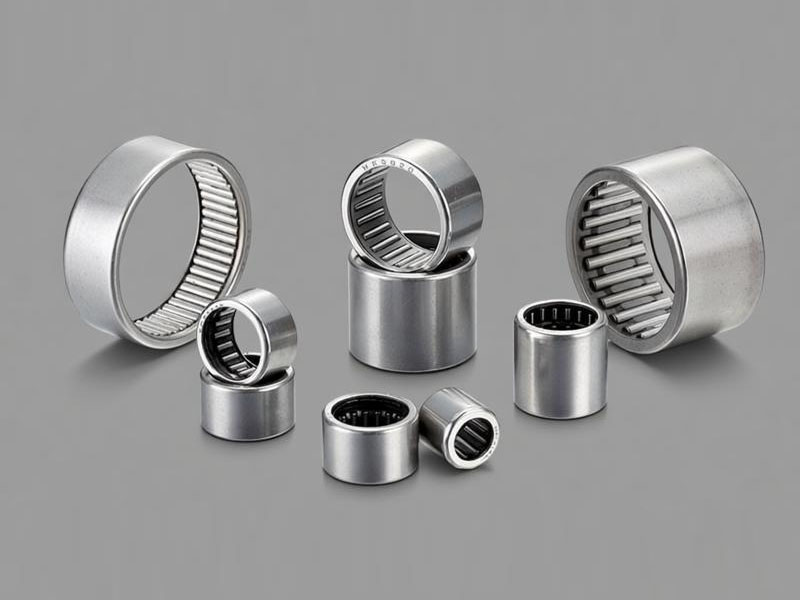
Measure Critical Dimensions for Needle Bearing Sizing
You have two options. If the existing bearing is intact and its markings are readable, use Method A. If the marking is worn off or the bearing is missing, proceed with Method B.
Method A — Identify by Reference Number
Most needle bearings have a part number stamped on the outer ring or shield. Clean the surface thoroughly and use a magnifying glass. Once you have the code, cross‑reference it against manufacturer catalogs. Suffixes indicate variations: 2RS (double rubber seals), ZZ (metal shields), C3 (increased internal clearance).
Example: HK1216‑2RS → drawn cup needle bearing, 12 mm bore, 16 mm width, double rubber seals.
Method B — Manual Precision Measurement
Tools required: digital caliper (0.01 mm resolution), micrometer, magnifying glass.
| Dimension | What to Measure | Engineering Guideline |
|---|---|---|
| Bore Diameter (d) | Inner ring hole that fits onto the shaft | Measure at 2–3 points; use the narrowest reading |
| Outer Diameter (D) | Outer ring surface contacting housing bore | Measure near outer ring edge where wear is minimal |
| Width (B or C) | Overall axial height | Keep caliper parallel to bearing faces |
| Needle Roller Diameter & Length | Individual roller dimensions | Use micrometer; 0.01 mm deviation alters load distribution |
Common Metric Dimension Table (HK Series Example)
| Series | Bore (mm) | OD (mm) | Width (mm) |
|---|---|---|---|
| HK0808 | 8 | 12 | 8 |
| HK1012 | 10 | 14 | 12 |
| HK1216 | 12 | 18 | 16 |
| HK1522 | 15 | 21 | 22 |
| HK2026 | 20 | 26 | 26 |
Pro Tip: Always measure to the nearest 0.01 mm. Avoid worn zones. Compare your measured (d, D, B) against ISO standard tables before proceeding.
Calculate Load, Speed, and Service Life
Dimensions alone are insufficient. You must quantify the mechanical demands that the bearing will experience.
Radial vs. Axial Load Quantification
For combined loads, the equivalent dynamic bearing load P is calculated using:
P = X・Fr + Y・Fa
where Fr = actual radial load (N), Fa = actual axial load (N). X and Y are factors specific to the bearing series. For pure radial needle bearings with no axial load capacity, Fa must be zero or near zero. X and Y values depend on the ratio Fa/Fr and the bearing series; refer to ISO 281 or the manufacturer’s dimension tables.
Basic Load Ratings
- Dynamic Load Rating (C): The constant radial load under which a group of identical bearings achieves a rated life of one million revolutions.
- Static Load Rating (C₀): The radial load that produces a permanent deformation of 0.0001 × roller diameter.
Basic Rating Life Calculation
For needle roller bearings (line contact), the basic rating life L₁₀ (in millions of revolutions) is:
L₁₀ = (C / P)10⁄3
Example: If a bearing has C = 25 kN and the equivalent load P = 5 kN, then L₁₀ = (25/5)10⁄3 ≈ 53.33 ≈ 195 million revolutions. If your application requires a specific life, select a bearing with a dynamic load rating C that satisfies this equation under your actual load P.
Speed Limits and Lubrication
Caged needle bearings can operate at significantly higher speeds than full‑complement designs because the cage prevents roller‑to‑roller contact. For high‑speed continuous operation (above 50 % of the manufacturer‘s limiting speed), oil lubrication is generally preferred over grease.
Life Adjustment Factors
The basic rating life can be adjusted for real‑world conditions using factors a₁ (reliability), a₂ (material), and a₃ (lubrication, contamination, temperature). For critical machinery, applying these factors prevents undersized selections.
Match Dimensions and Load Conditions to the Correct Needle Bearing Type
Now combine your measured dimensions (d, D, B) with load and speed requirements.
Drawn Cup Needle Roller Bearings (HK / BK Series)
- Best for: Compact housings, moderate radial loads, cost‑sensitive applications
- Characteristics: Thin‑walled stamped steel outer ring; shaft serves as raceway (must be ≥58 HRC, ground)
- Selection criterion: Housing bore not hardened; simple press‑fit installation
Machined Ring Needle Bearings
- Best for: Heavy‑duty applications, high shock loads, higher speeds
- Characteristics: Outer and inner rings machined from bearing steel; integral flanges for axial guidance
- Selection criterion: Larger cross‑section required; higher rigidity and precision
Thrust Needle Bearings (AXK Series with Washers)
- Best for: Purely axial loads in limited axial space (steering columns, transmission thrust washers)
- Characteristics: Needle and cage assembly between two hardened washers
- Selection criterion: Significant axial force; radial space not constrained
Combination Bearings
- Best for: Combined radial + axial loads in one compact package
- Selection criterion: Complex loads in space‑efficient equipment
Full Complement vs. Caged Designs
| Feature | Full Complement (No Cage) | Caged Design |
|---|---|---|
| Load | Highest (maximum rollers) | Moderate |
| Speed Capability | Lower (friction between rollers) | Higher (cage maintains separation) |
| Typical Application | Oscillating motion, slow rotation, heavy presses | Continuous high speed (gearboxes, electric motors) |
| Friction Moment | Higher | Lower |
Consider Internal Clearance, Tolerance Class, and Shaft Fit
Even correctly sized bearings fail if clearance, tolerance, or fit are mismatched.
Internal Clearance (C0, C2, C3, C4)
Internal clearance is the total free movement of rolling elements before mounting. Wrong clearance → overheating (too tight) or excessive play (too loose).
| Code | Clearance Level | Typical Application |
|---|---|---|
| C2 | Less than standard | Low‑friction applications with minimal thermal expansion (e.g., instrument needle bearings) |
| C0 (CN) | Normal standard | General industrial applications, moderate temperatures |
| C3 | Greater than normal | Higher speeds, shaft expansion under heat |
| C4 | Greater than C3 | Large temperature differentials, press fits on thin shafts |
Tolerance Class (P0, P6, P5)
- P0 (Normal): Sufficient for 95 % of industrial applications
- P6: Tighter bore/OD tolerances; recommended for higher speeds or closer fits
- P5: High precision; used in precision gearboxes (less common for standard needle bearings)
Shaft and Housing Fits
- Rotating shaft: Shaft j6 or k6; housing H7
- Stationary shaft: Shaft h6; housing J7 or K7
- Thin‑walled drawn cup bearings: Press fit into housing (recommended housing N6 or P6)
Consult ISO 286 or the manufacturer’s technical documentation for specific values.
Verify Selection With Technical Specifications
Before finalizing, verify suffix codes, seating conditions, and interchangeability.
Bearing Suffix Codes at a Glance
| Suffix | Meaning | Selection Note |
|---|---|---|
| 2RS | Double rubber seals | Dusty or moist environments |
| ZZ / 2Z | Metal shields | Moderate protection, low torque |
| C3 | Increased internal clearance | Higher speeds or heat dissipation |
| TN | Polyamide cage | Lightweight, max 120 °C |
| M | Machined brass cage | Heavy‑duty, higher temperature tolerance |
Cross‑Referencing Alternative Part Numbers
To replace an existing bearing:
- Record the complete marking (prefixes and suffixes)
- Compare bore (d), outer (D), width (B) against ISO dimension tables
- Match clearance and sealing via suffix codes
Maintaining a cross‑reference database of competitor part numbers (SKF, NSK, INA, Timken) is a practical procurement strategy.
Frequently Asked Questions (FAQ)
Q1: What is the difference between needle bearing and needle roller bearing?
No functional difference. Both terms refer to bearings using cylindrical rollers with a length‑to‑diameter ratio >3:1.
Q2: Can I use a needle bearing without an inner ring?
Yes, e.g., HK series. The shaft itself serves as raceway and must be hardened ≥58 HRC and ground to Ra 0.1–0.2 μm.
Q3: How do I know if my existing needle bearing has failed?
Overheating (discolored lubricant/rings), unusual noise (scraping or rumbling), excessive shaft play, visible spalling or cracks on raceway.
Q4: What causes a needle bearing to overheat?
Inadequate internal clearance (too tight for operating temperature), insufficient lubrication, excessive preload, misaligned housing bores, or exceeding speed limits.
Q5: What is the maximum speed of a needle roller bearing?
Depends on type, lubrication, and temperature. Caged drawn‑cup bearings can exceed 10,000 rpm in well‑lubricated, low‑load applications. Full‑complement designs have lower limits. Always consult manufacturer speed tables.
Q6: How do I cross‑reference needle bearing part numbers?
Collect the full marking, compare d/D/B against ISO charts, then match suffixes (2RS, C3, etc.) for sealing and clearance.
Conclusion
Proper needle bearing selection requires four integrated actions: accurate measurement of d, D, B and needle roller geometry; quantification of radial/axial load and speed; correct matching of design type (drawn cup vs. machined ring; full complement vs. caged) to those operating parameters; and verification of internal clearance (C2, C0, C3, C4), tolerance class (P0/P6/P5), and shaft/housing fits per ISO standards.
Each of the five steps presented here is designed to be applied systematically—from picking up a caliper to cross‑referencing a competitor‘s part number with a verified equivalent. When all factors are correctly aligned, the selected needle bearing delivers its intended service life without premature wear, seizure, or unplanned downtime.
DUHUI Bearing has manufactured precision needle bearings and automotive hub units for two decades. For engineers and procurement specialists requiring technical consultation—including cross‑reference support, custom dimension verification, and application‑specific clearance recommendations—our technical team provides documentation and specification sheets upon request.