Quick Answer
Cylindrical roller bearings use cylindrical rolling elements that create line contact with raceways, delivering extremely high radial load capacity—far exceeding ball bearings of the same size. They offer the highest speed capability among all roller bearing types, with limiting speeds close to ball bearings. Their separable design simplifies installation and maintenance. However, they have very limited misalignment tolerance (approximately 0.001 radian / 0.06°), limited axial load capacity (except NJ/NUP types), and are prone to roller skidding under high-speed, light-load conditions. Choose them for heavy radial loads in well-aligned, stable systems like gearboxes, electric motors, and pumps.
Not all bearings are created equal. When your application demands heavy radial loads, high rigidity, and reliable performance in a well-aligned system, cylindrical roller bearings are often the answer.
Unlike ball bearings, which use point contact, cylindrical roller bearings use line contact—the rolling elements are cylinders, not spheres. This simple difference gives them dramatically higher radial load capacity but also introduces trade-offs you need to understand.
What makes cylindrical roller bearings different from ball bearings? Can they handle axial loads? How much misalignment can they tolerate? This article answers these questions by breaking down what cylindrical roller bearings are, how they work, and—most importantly—their advantages and disadvantages.
What Is a Cylindrical Roller Bearing and How Does It Work?
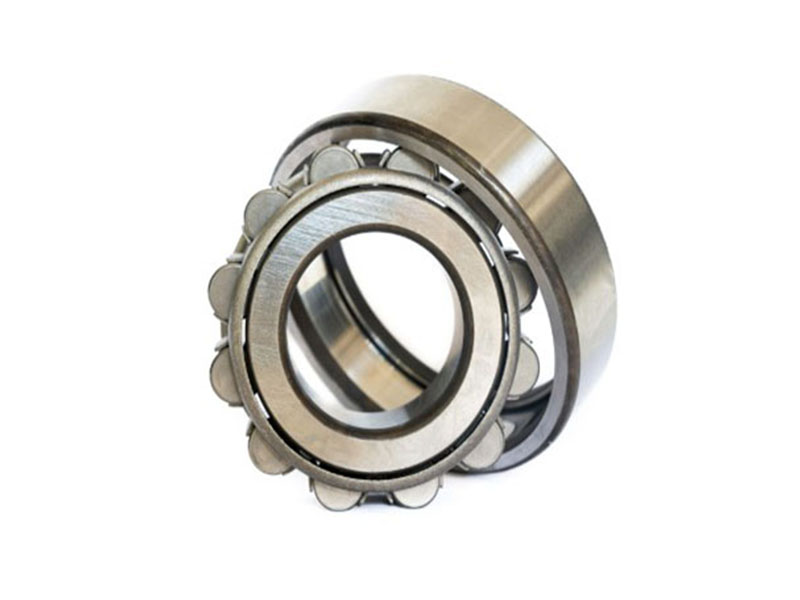
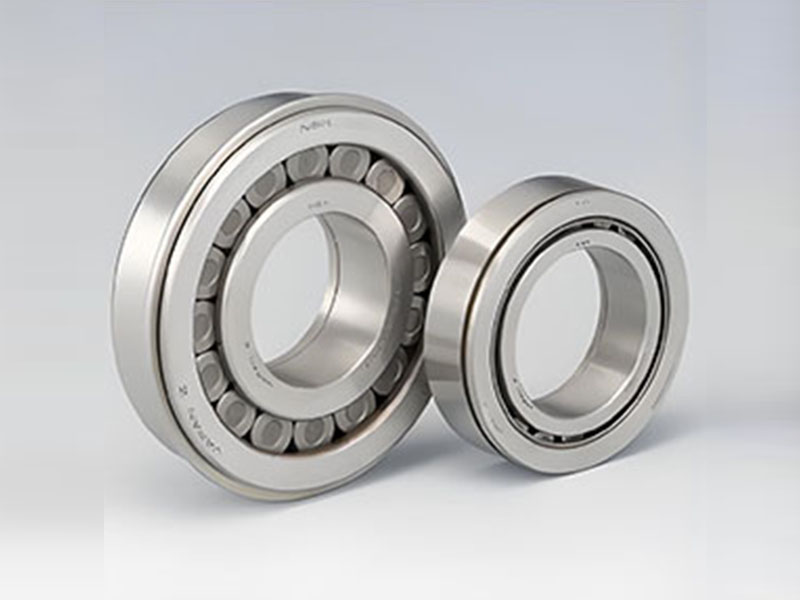
A cylindrical roller bearing is a rolling-element bearing that uses cylindrical rollers as the rolling elements, arranged between an inner ring and an outer ring. The rollers create line contact with the raceways—meaning the load is distributed across a line rather than a single point.
Basic structure: An inner ring, an outer ring, cylindrical rollers, and a cage (retainer) that prevents rollers from contacting each other.
Main types (single-row):
- NU type: Outer ring has two integral flanges; inner ring has no flanges. The inner ring, rollers, and cage can be separated from the outer ring. Suitable as free-end bearing—accommodates axial displacement in both directions.
- N type: Inner ring has two integral flanges; outer ring has no flanges. The outer ring, rollers, and cage can be separated from the inner ring. Suitable as free-end bearing—accommodates axial displacement in both directions.
- NJ type: Outer ring has two integral flanges; inner ring has one integral flange. Can sustain limited axial loads in one direction.
- NF type: Inner ring has two integral flanges; outer ring has one integral flange. Can sustain limited axial loads in one direction.
- NUP type: Outer ring has two integral flanges; inner ring has one integral flange and one separable loose flange. Suitable as fixed-end bearing—locates the shaft axially in both directions.
Double-row designs (NN, NNU): Two rows of rollers provide higher radial stiffness and load-carrying capacity than single-row designs.
Full complement design: No cage—contains the maximum number of rollers for extremely high radial load capacity and rigidity. However, speed capability is significantly reduced, and they can only manage axial loads in one direction.
Cage materials:
- Machined brass: -40°C to 250°C; self-lubricating; used in heavy industrial applications
- Pressed steel: Up to 300°C; cost-effective
- Polyamide (nylon): -40°C to 120°C; highest speed capability; used in precision applications
Precision grades: Conform to ISO 492 and DIN 620 standards, with grades ranging from P0 (normal) → P6 → P5 → P4 → P2 (highest precision).
How it works: The cylindrical rollers roll between the inner and outer ring raceways. Because the contact is a line rather than a point, the load is distributed over a much larger area. This enables significantly higher radial load capacity than ball bearings of the same size. However, the rollers can only roll along a single axis—they cannot accommodate angular misalignment like ball bearings can.
Load handling:
- Radial loads: Primary function—extremely high radial load capacity due to line contact
- Axial loads: Limited—standard types (NU, N) cannot carry axial loads; NJ and NF types can carry limited axial loads in one direction; NUP types can carry axial loads in both directions
- Axial displacement: NU and N types accommodate axial displacement in both directions—ideal for compensating thermal expansion
Speed capability: Cylindrical roller bearings offer the highest speed capability among all roller bearing types. With cages, single-row designs can achieve limiting speeds virtually identical to ball bearings of the same size. However, full complement designs have significantly lower speed limits.
Separability: Cylindrical roller bearings are separable—the inner ring, outer ring, and roller/cage assembly can be mounted and dismounted independently. This simplifies installation, maintenance, and inspection.
Advantages of Cylindrical Roller Bearings
Pro 1. Extremely high radial load capacity
Line contact distributes loads over a larger area than point contact. Cylindrical roller bearings can carry significantly higher radial loads than ball bearings of the same size. Double-row and four-row designs handle extreme radial loads—four-row bearings are used in rolling mill work rolls and backup rolls.
Pro 2. Highest speed capability among roller bearings
Cylindrical roller bearings offer the highest speed ratings of any roller bearing type. Single-row designs with cages achieve limiting speeds virtually identical to ball bearings—making them suitable for high-speed applications like electric motors, gas turbines, and machine tool spindles.
Pro 3. High stiffness and rigidity
Line contact provides excellent radial stiffness. Double-row designs offer even higher rigidity, making them ideal for machine tool spindles and precision applications where deflection must be minimized.
Pro 4. Separable design for easy installation and maintenance
The inner ring, outer ring, and roller/cage assembly can be mounted and dismounted independently. This simplifies installation, inspection, and maintenance—particularly valuable in large machinery where handling complete assemblies is difficult.
Pro 5. Accommodates axial displacement (NU/N types)
NU and N types allow the shaft to move axially in both directions relative to the housing. This compensates for thermal expansion and manufacturing tolerances—critical in applications with significant temperature variations.
Pro 6. Excellent fatigue and shock resistance
Cylindrical roller bearings offer greater fatigue and shock resistance than ball bearings. They are well suited for vibratory applications like vibrating screens and crushers.
Pro 7. Long service life
Low friction, high load capacity, and robust design contribute to long service life. Premium-grade cylindrical roller bearings, with optimized internal geometries and advanced steel cleanliness, can deliver significantly extended service life in demanding applications.
Disadvantages of Cylindrical Roller Bearings
Con 1. Cannot accommodate angular misalignment
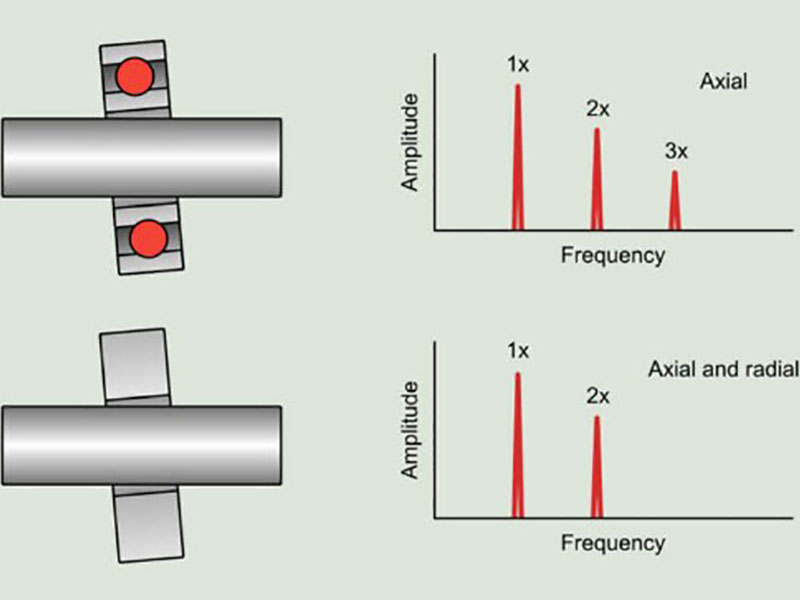
Cylindrical roller bearings are extremely sensitive to angular misalignment between the shaft and housing. Permissible misalignment is approximately 0.001 radian (0.06°). Misalignment causes edge stresses between rollers and raceways, leading to reduced fatigue life, increased vibration, and premature failure.
Con 2. Limited axial load capacity
As outlined in the load handling section above, standard cylindrical roller bearings are primarily designed for pure radial loads. NU and N types cannot carry axial loads; NJ and NF types are limited to one direction; only NUP types handle both directions. When axial loads are applied to types not designed for them, the friction between roller ends and flanges drastically reduces bearing life. If your application requires significant axial load capacity, angular contact ball bearings or tapered roller bearings are better choices.
Con 3. Higher friction than ball bearings
Line contact creates higher rolling friction than the point contact of ball bearings. The high rubbing velocity between adjacent rollers is the primary reason for speed limitations in some designs.
Con 4. Roller skidding under high-speed, light-load conditions
In high-speed, lightly loaded applications, rollers may slide instead of roll—this is called skidding. Skidding causes excessive wear, burns on raceways and rolling elements, and is one of the primary failure modes of cylindrical roller bearings. Studies show skidding accounts for approximately 34–37% of cylindrical roller bearing failures in high-speed applications.
Con 5. Requires precise alignment and installation
Because misalignment tolerance is so limited, cylindrical roller bearings demand precise shaft and housing alignment. The separable design, while beneficial for maintenance, means components must be carefully handled and correctly positioned during assembly—improper installation significantly reduces service life.
Con 6. Sensitive to contamination and lubrication failure
Contamination is one of the most common causes of cylindrical roller bearing failure. Lubrication failure leads to smearing (scuffing) on roller surfaces and raceways. Sealed versions (2RS) provide protection against contaminants, water, and dust while retaining lubricant, but sealed designs have reduced speed capability.
Conclusion
Cylindrical roller bearings are the go-to choice for heavy radial loads in well-aligned, stable systems. Their line contact design delivers exceptional load capacity, high stiffness, and speed capability unmatched by other roller bearing types.
Choose cylindrical roller bearings when:
- Loads are primarily radial with limited or no axial components
- High radial stiffness and rigidity are required
- High rotational speeds are needed—they offer the highest speeds among roller bearings
- Shaft alignment can be precisely controlled—misalignment tolerance is very limited
- You need to accommodate thermal expansion—NU/N types allow axial displacement
- Applications include gearboxes, electric motors, pumps, compressors, machine tool spindles, and rolling mills
Consider alternatives when:
- Axial loads are significant—use angular contact ball bearings or tapered roller bearings
- Misalignment cannot be avoided—use self-aligning ball bearings or spherical roller bearings
- Space is extremely limited—use needle roller bearings
- Lowest possible friction is critical—ball bearings offer lower friction
Understanding the trade-offs—radial load capacity vs. misalignment tolerance, speed capability vs. axial load capacity, and separability vs. installation complexity—is the key to making the right selection.
At DUHUI Bearing, we have been manufacturing automotive and industrial bearings since 2003, serving customers in over 60 countries. Our cylindrical roller bearings are produced to international standards (ISO 492, DIN 620) with precision grades up to P5 and above. Whether you need standard sizes or custom configurations, we are here to help you find the right bearing solution for your application.
Frequently Asked Questions (FAQs)
Q1: Can cylindrical roller bearings handle axial loads?
Standard cylindrical roller bearings (NU, N types) are primarily designed for pure radial loads and cannot carry axial loads. NJ and NF types can carry limited axial loads in one direction. NUP types can carry axial loads in both directions. If your application requires significant axial load capacity, angular contact ball bearings or tapered roller bearings may be better choices.
Q2: What is the main difference between cylindrical roller bearings and ball bearings?
The core difference is contact type. Cylindrical roller bearings use line contact (rollers), while ball bearings use point contact (balls). Line contact distributes loads over a larger area, giving cylindrical roller bearings significantly higher radial load capacity. However, ball bearings have lower friction, higher speed capability in some cases, and can accommodate angular misalignment better. Cylindrical roller bearings are interchangeable with ball bearings of the same size—for example, an NU310 shares the same bore as a 6310 ball bearing.
Q3: How much misalignment can a cylindrical roller bearing tolerate?
Very little. Permissible misalignment is approximately 0.001 radian (0.06°). Even small misalignments cause edge stresses between rollers and raceways, leading to reduced fatigue life, increased vibration, and premature failure. For applications where misalignment is unavoidable, consider self-aligning ball bearings or spherical roller bearings.
Q4: What is the speed capability of cylindrical roller bearings?
Cylindrical roller bearings offer the highest speed capability among all roller bearing types. Single-row designs with cages can achieve limiting speeds virtually identical to ball bearings of the same size. However, full complement designs (without cages) have significantly lower speed limits due to increased friction between rollers.
Q5: What are the typical applications of cylindrical roller bearings?
Cylindrical roller bearings are used in gearboxes and transmissions, electric motors and generators, pumps and compressors, machine tool spindles, rolling mills and steel equipment, railway vehicle axle boxes, internal combustion engines and gas turbines, and mining and construction machinery.
Q6: What is the difference between NU, NJ, and NUP type bearings?
NU type: Outer ring has two flanges; inner ring has no flanges. Accommodates axial displacement in both directions—suitable as a free-end bearing. NJ type: Outer ring has two flanges; inner ring has one flange. Can sustain limited axial loads in one direction. NUP type: Outer ring has two flanges; inner ring has one fixed flange and one separable loose flange. Can sustain axial loads in both directions—suitable as a fixed-end bearing.
Q7: What are the common failure modes of cylindrical roller bearings?
Common failure modes include: Skidding—rollers slide instead of roll under high-speed, light-load conditions, causing wear and burns on raceways. Skidding accounts for approximately 34–37% of failures in high-speed applications. Misalignment—edge stresses from angular misalignment reduce fatigue life. Contamination—abrasive particles accelerate wear. Lubrication failure—leads to smearing (scuffing) on roller surfaces and raceways. Overload—exceeding rated capacity causes premature fatigue failure.
Q8: What is the difference between full complement and cage-guided cylindrical roller bearings?
Full complement bearings have no cage and contain the maximum number of rollers. They offer extremely high radial load capacity and rigidity but have significantly lower speed limits and can only manage axial loads in one direction. Cage-guided bearings have a cage that separates rollers, reducing friction and allowing much higher speeds—with limiting speeds virtually identical to ball bearings.
Q9: How do I choose the right cylindrical roller bearing type?
- Need axial displacement in both directions? → NU or N type (free-end bearing)
- Need limited axial load capacity in one direction? → NJ or NF type
- Need axial location in both directions? → NUP type (fixed-end bearing)
- Need maximum radial load capacity, speed is not critical? → Full complement design
- Need high speed and good load capacity? → Cage-guided single-row design
- Need maximum radial stiffness? → Double-row design (NN/NNU)