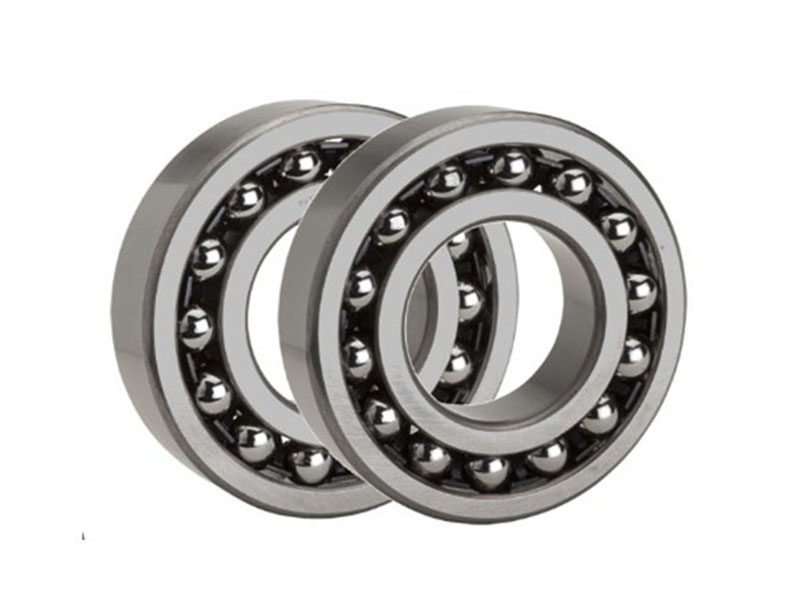
What are self-aligning ball bearings? How do they differ from standard ball bearings in handling shaft misalignment? Self-aligning ball bearings are a specialized type of rolling bearing designed to accommodate angular misalignment between the shaft and housing. With a double-row ball configuration and a spherical raceway on the outer ring, these bearings allow the inner ring to tilt relative to the outer ring, compensating for shaft deflection, mounting errors, or structural deformation during operation.
Construction of Self-aligning Ball Bearings
The design of self-aligning ball bearings consists of five primary components that work together to achieve misalignment compensation and low-friction operation.
Outer ring. The outer ring features a single concave spherical raceway that accommodates two rows of balls. This spherical shape is the defining feature of self-aligning ball bearings—it allows the inner ring to pivot within the outer ring when misalignment occurs.
Inner ring. The inner ring has two deep uninterrupted raceway grooves that hold the two rows of balls. These raceways are precisely machined to ensure smooth rolling contact. Self-aligning ball bearings are available with either cylindrical or tapered bores, with tapered bores (suffix K) typically featuring a taper of 1:12 for mounting on adapter sleeves.
Rolling elements and cage. Two rows of balls serve as the rolling elements. The balls are held in position by a cage, which maintains proper spacing and prevents contact between balls. Common cage materials include stamped steel, polyamide PA66, and machined brass, each selected based on speed, temperature, and lubrication requirements.
Seal. Self-aligning ball bearings are available as open (without seals), with single-side rubber seals (RS), double-side rubber seals (2RS), or metal shields (ZZ). Rubber seals provide better contamination protection but increase friction slightly, while metal shields offer lower friction but reduced sealing effectiveness. Sealed and shielded variants retain lubricant and are suitable for various operating environments.
Advantages and Disadvantages of Self-aligning Ball Bearings
Understanding both the strengths and limitations of self-aligning ball bearings is essential for proper application selection.
Advantages
- Misalignment compensation. The most significant advantage of self-aligning ball bearings is their ability to tolerate angular misalignment. They can typically compensate for misalignment of up to 3 degrees, accommodating both static and dynamic misalignment caused by shaft deflection, mounting inaccuracies, or housing deformation. This reduces stress on mechanical components, simplifies installation, and extends machine life.
- Extended service life and low heat generation. Self-aligning ball bearings generate less friction than most other rolling bearing types. The balls contact the rings at single points, creating low friction and minimal heat generation. This enables the bearings to run cooler even at high speeds, extending both bearing life and maintenance intervals.
- Light load performance. These bearings have low minimum load requirements and perform exceptionally well under light load conditions.
- Low noise. The loose conformity between the balls and the outer ring produces low noise levels, making self-aligning ball bearings well suited for applications such as fans and household appliances where noise reduction is important.
- Low friction. Self-aligning ball bearings have among the lowest friction levels of all rolling bearing types, which contributes to their high-speed capability and energy efficiency.
Disadvantages
- Limited axial load capacity. Self-aligning ball bearings are primarily designed for radial loads. While they can accommodate some axial load in both directions, their axial load capacity is relatively low compared to angular contact bearings. For applications requiring substantial axial load support, other bearing types such as angular contact ball bearings or tapered roller bearings should be considered.
- Not suitable for heavy loads. These bearings are optimized for light to moderate load conditions. When heavy loads are required, spherical roller bearings—which offer similar self-aligning properties but with higher load capacity—are the appropriate choice.
- Lower speed limits than deep groove ball bearings. The double-row design and spherical raceway geometry result in lower maximum operating speeds compared to deep groove ball bearings of similar size.
- Larger dimensions. Due to their double-row configuration and spherical outer ring, self-aligning ball bearings are generally bulkier than deep groove ball bearings with the same bore diameter.
Applications of Self-aligning Ball Bearings
Self-aligning ball bearings are used across a wide range of industries where shaft misalignment is unavoidable or difficult to prevent.
- Automotive industry. These bearings are used in transmission shafts and certain vehicle components where shaft bending or misalignment may occur during operation.
- Mining and construction equipment. The self-aligning capability makes these bearings suitable for heavy machinery operating under vibration, shock loads, and imperfect alignment conditions, such as crushers, conveyors, and screening equipment.
- Textile machinery. Textile equipment often involves long shaft runs where perfect alignment is difficult to maintain. Self-aligning ball bearings accommodate minor misalignment while maintaining smooth operation.
- Material handling and conveyors. Conveyor systems benefit from the bearings ability to handle misalignment caused by long belt spans and structural deflection.
- Agricultural machinery. Equipment such as combine harvesters, irrigation systems, and seeding machines often operate in dusty, uneven terrain. Self-aligning ball bearings, particularly sealed variants, withstand contamination and compensate for alignment variations.
- Other common applications include fans, blowers, pumps, food processing equipment, and electric motors.
Selection Criteria for Self-aligning Ball Bearings
Selecting the appropriate self-aligning ball bearing requires evaluation of several operational parameters.
- Misalignment angle. Verify that the required misalignment compensation does not exceed the bearing’s rated angle, typically up to 3 degrees. Larger misalignment may require spherical roller bearings or alternative alignment solutions.
- Speed requirements. Different series of self-aligning ball bearings have different speed ratings. Consult manufacturer specifications to ensure the selected bearing meets application speed requirements. For very high-speed operations, unsealed bearings may be more appropriate than sealed variants.
- Load types and magnitude. Determine both radial and axial loads that the bearing will experience. Self-aligning ball bearings are suitable for applications where radial loads are dominant and axial loads are light. For heavy axial loads, angular contact or tapered roller bearings are better options.
- Lubrication type. Select the appropriate lubricant based on operating temperature range, speed, and environmental conditions. For high-temperature applications, specialized greases with appropriate viscosity and oxidation resistance are necessary.
- Seal type. Choose between open bearings (for controlled environments where separate lubrication systems are used), RS/2RS rubber seals (for dust and moisture protection), or ZZ metal shields (for high-speed applications with moderate contamination exposure).
- Dimensions and mounting. Select the appropriate bore size based on shaft diameter, and choose between cylindrical bore (for direct mounting) or tapered bore (for use with adapter sleeves). Consider space constraints to ensure proper fit within the housing.
Comparison with Deep Groove Ball Bearings and Angular Contact Ball Bearings
When selecting a bearing type for a specific application, engineers often compare self-aligning ball bearings with two common alternatives: deep groove ball bearings and angular contact ball bearings. Each type has distinct characteristics in terms of misalignment tolerance, load handling, speed capability, and typical applications.
The table below summarizes the key differences.
| Parameter | Self-aligning Ball Bearings | Deep Groove Ball Bearings | Angular Contact Ball Bearings |
|---|---|---|---|
| Misalignment compensation | Up to 3 degrees | Minimal (0.05–0.1 degree) | Minimal (0.05–0.1 degree) |
| Radial load capacity | Moderate | High | Moderate to high |
| Axial load capacity | Low (bidirectional) | Moderate (bidirectional) | High (unidirectional; paired bearings for bidirectional) |
| Speed capability | Moderate to high | Very high | High |
| Friction | Very low | Very low | Low to moderate |
| Typical applications | Conveyors, fans, textile machinery, agricultural equipment | Electric motors, household appliances, general machinery | Machine tool spindles, pumps, gearboxes, high-speed applications |
| Internal design | Double row, spherical outer ring raceway | Single row, deep raceway grooves | Single row, angled raceway contact |
Self-aligning ball bearings vs. deep groove ball bearings. Deep groove ball bearings are the most widely used rolling bearing type due to their high speed capability, low friction, and ability to accommodate both radial and moderate axial loads. However, they are highly sensitive to misalignment. Even a small angular error of 0.1 degree can significantly reduce their service life. Self-aligning ball bearings trade some speed and axial load capacity for misalignment tolerance. Therefore, when precise alignment cannot be guaranteed—such as in long shaft systems, vibrating equipment, or applications with flexible housings—self-aligning ball bearings are the more reliable choice.
Self-aligning ball bearings vs. angular contact ball bearings. Angular contact ball bearings are designed for combined loads, particularly high axial loads in one direction. They have a contact angle (typically 15°, 25°, or 40°) that allows them to support substantial axial forces while maintaining high speed capability. However, they have virtually no misalignment tolerance and are usually mounted in pairs or sets to accommodate bidirectional axial loads. Self-aligning ball bearings, in contrast, are not suitable for heavy axial loads but offer the unique advantage of automatic misalignment compensation. For applications where axial loads are dominant or very high speeds are required, angular contact ball bearings are preferred. For applications where shaft deflection or mounting inaccuracies are unavoidable and radial loads are light to moderate, self-aligning ball bearings provide a simpler, more forgiving solution.
In practice, the choice among these three bearing types depends on the relative importance of alignment precision, load direction, speed, and installation conditions. No single type is universally superior; each serves a distinct set of engineering requirements.
Conclusion
In summary, self-aligning ball bearings are a practical choice for applications where moderate misalignment, light to moderate radial loads, and quiet operation are required. Their combination of self-aligning capability, low friction, and compact design makes them distinct from deep groove ball bearings and spherical roller bearings.
Frequently Asked Questions about Self-aligning Ball Bearings
Q1: How do self-aligning ball bearings handle misalignment?
A1: Self-aligning ball bearings handle misalignment through a concave spherical raceway on the outer ring. This geometry allows the inner ring, balls, and cage assembly to pivot within the outer ring when shaft deflection or misalignment occurs. The bearing automatically adjusts its internal orientation, maintaining smooth operation without requiring precise alignment during installation. Typical self-aligning ball bearings can accommodate up to 3 degrees of angular misalignment.
Q2: What are the temperature limits for self-aligning ball bearings?
A2: Standard steel self-aligning ball bearings with NBR rubber seals typically operate within -40°C to +100°C, with brief exposure up to +120°C. High-temperature variants with specialized lubricants and cage materials can extend this range. For applications exceeding these limits, consult manufacturer specifications for custom configurations.
Q3: How should I select the right bearing size?
A3: Start by determining the shaft diameter, which directly determines the required bearing bore size. Then verify that the selected bearings dynamic and static load ratings meet or exceed application requirements. Consider space constraints in the housing, speed requirements, and operating environment. Finally, check the manufacturer’s product tables for availability and dimensional specifications.
Q4: How often do self-aligning ball bearings need maintenance?
A4: Maintenance intervals depend on operating conditions. For normal applications, grease replenishment every 3-6 months is typical. Sealed bearings with factory-installed grease (2RS type) are often maintenance-free for their operational life. High-speed or high-temperature applications require shorter lubrication intervals, while low-speed, clean-environment applications may extend intervals. Regular inspection of temperature, vibration, and noise levels helps identify potential issues before failure occurs.
Q5: Can self-aligning ball bearings handle both axial and radial loads?
A5: Yes, but with limitations. Self-aligning ball bearings are primarily designed for radial loads. While they can accommodate some axial load in both directions, their axial load capacity is significantly lower than that of angular contact ball bearings or tapered roller bearings. For applications with substantial axial load requirements, other bearing types are more suitable.
Q6: Are self-aligning ball bearings more expensive than standard ball bearings?
A6: Generally, yes. Self-aligning ball bearings are typically more expensive than standard deep groove ball bearings of comparable size. The additional cost comes from their more complex double-row design, spherical outer ring raceway, and tighter manufacturing tolerances required to ensure proper self-aligning function. However, this higher initial cost may be offset by reduced installation precision requirements, lower maintenance needs, and extended service life in applications where misalignment is unavoidable.
Q7: When should I choose a spherical roller bearing over a self-aligning ball bearing?
A7: Spherical roller bearings offer higher load capacity and greater robustness, making them suitable for heavy-load, medium-to-low-speed applications such as crushers, rolling mills, and heavy construction equipment. Self-aligning ball bearings are better suited for light-load, high-speed applications where lower friction, lower heat generation, and quieter operation are priorities. Both bearing types provide self-aligning capability—the choice depends primarily on load magnitude and operating speed.