Quick Answer
Self-aligning ball bearings feature a spherical outer ring raceway that allows them to compensate for shaft misalignment up to 3 degrees (open type) or 1.5 degrees (sealed type). They offer the lowest friction of any rolling bearing, run quietly, and perform well under light loads at high speeds. However, they have extremely limited axial load capacity due to their small contact angle, cannot transmit torque, and have lower load capacity and speed limits than deep groove ball bearings. Choose them when misalignment is unavoidable and loads are primarily radial and light.
Self-aligning ball bearings are the go-to solution when shafts don’t line up perfectly. Whether it’s installation error, shaft deflection under load, or a housing that’s slightly off, these bearings keep things running smoothly where others would fail.
What makes them special? A spherical raceway in the outer ring. This lets the inner ring, balls, and cage rotate freely around the bearing center, automatically adjusting to angular misalignment. Think of it as a built-in “mechanical eye” that finds its balance even when the shaft is slightly crooked.
This article breaks down what self-aligning ball bearings are, how they work, and—most importantly—their advantages and disadvantages. Whether you’re dealing with transmission shafts, conveyor systems, or fan assemblies, understanding these trade-offs will help you make the right choice.
What Is a Self-Aligning Ball Bearing and How Does It Work?
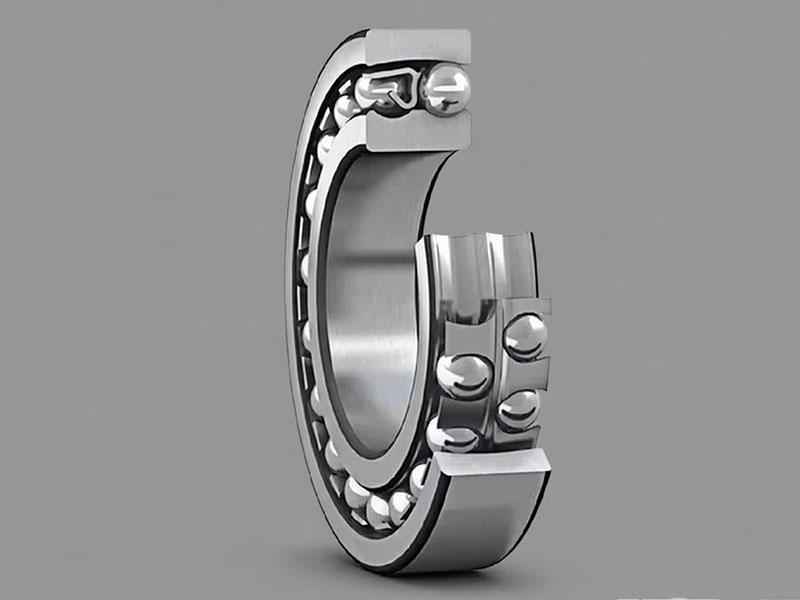
A self-aligning ball bearing is a double-row ball bearing with a spherical outer ring raceway and two deep, uninterrupted raceway grooves in the inner ring. The outer ring’s spherical raceway has no traditional groove—it’s a smooth, curved surface. The inner ring carries two rows of balls.
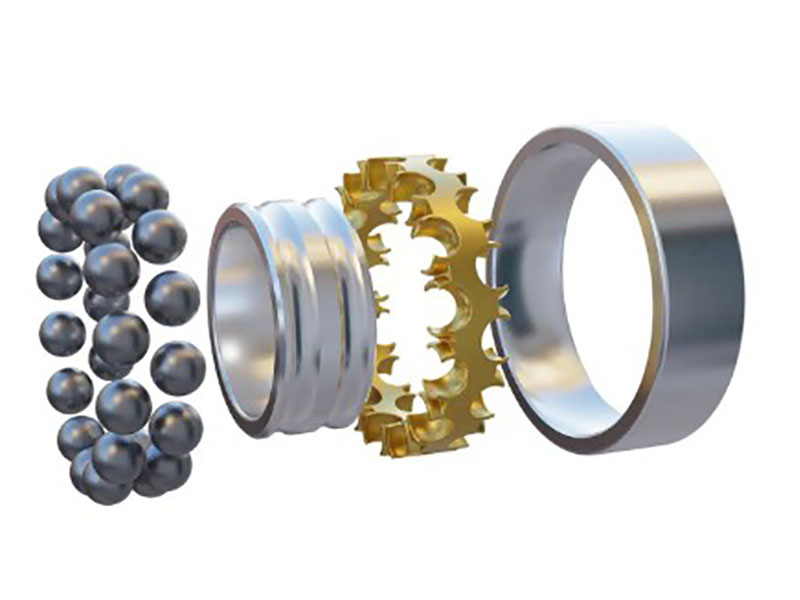
Basic structure: An outer ring (spherical raceway), an inner ring (two deep grooves), two rows of steel balls, a cage, and optional seals.
Main types:
- Cylindrical bore: Standard mounting on straight shafts
- Tapered bore (1:12 taper): Allows mounting with adapter sleeves for easy installation and removal
- Open type: No seals; maximum misalignment capability
- Sealed type (2RS): Rubber seals on both sides for contamination protection
Sealing configurations:
- Open: No seals; allows up to 3 degrees of misalignment
- Sealed (2RS): NBR rubber seals; operating temperature -40°C to +100°C (briefly up to 120°C); misalignment limited to 1.5 degrees due to seal constraints
Materials:
- Rings and balls: High-carbon chromium steel
- Cages: Pressed steel, glass fiber reinforced polyamide (PA66), or machined brass
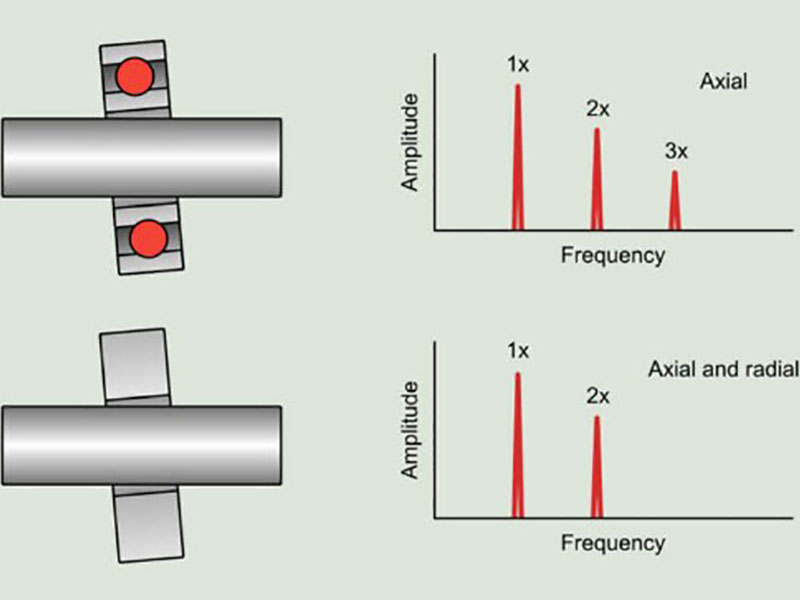
How it works: The center of the outer ring’s spherical raceway coincides with the bearing center. This allows the inner ring, balls, and cage assembly to tilt freely around the bearing center. When the shaft is misaligned, the inner ring rotates to a new angle while the outer ring stays fixed in the housing—the spherical interface absorbs the angular error.
Misalignment tolerance:
- Open type: Up to 3 degrees (depending on series)
- Sealed type (2RS): 1.5 degrees (seal constraints)
- Some series (108, 126, 129): 3 degrees; series 12, 22: 2.5 degrees
- NSK permits dynamic misalignment of approximately 0.07 to 0.12 radian (4 to 7 degrees) under normal loads
Load handling:
- Radial loads: Primary function—excellent radial load capacity
- Axial loads: Very limited due to small contact angle; can handle minor axial loads in both directions but generally cannot withstand pure axial loads
- Torque: Cannot transmit torque—this is by design; the spherical interface that enables self-alignment also prevents torque transmission
Speed capability: Moderate speed capability—lower than deep groove ball bearings due to structural constraints. However, SKF notes they offer excellent high-speed performance relative to other self-aligning types.
Advantages of Self-Aligning Ball Bearings
Pro 1. Exceptional misalignment compensation
This is the defining advantage. As explained in the working principle section above, the spherical outer ring raceway allows the bearing to accommodate up to 3 degrees of static and dynamic misalignment (open type) without affecting performance. Sealed types handle up to 1.5 degrees. This capability reduces stress on mechanical components, simplifies installation, and extends machine life. When shafts bend under load or alignment is difficult—as with transmission shafts—these bearings keep running.
Pro 2. Lowest friction of any rolling bearing
SKF explicitly states that self-aligning ball bearings produce lower friction than any other type of rolling bearing. Low friction means less heat generation, cooler operation, and higher energy efficiency. This makes them ideal for applications where heat buildup is a concern.
Pro 3. Long service life with low maintenance
Low friction translates to lower operating temperatures, which extends lubricant life and maintenance intervals. Sealed versions come pre-lubricated and reduce maintenance requirements while prolonging bearing service life. Ultra-clean steel can extend bearing life by up to 80%.
Pro 4. Low noise and vibration
The loose conformity between balls and the outer ring produces low noise levels. Glass fiber reinforced polyamide cages further reduce noise, vibration, and friction. This makes self-aligning ball bearings suitable for noise-sensitive applications like fans and household appliances.
Pro 5. Excellent light-load performance
Self-aligning ball bearings have low minimum load requirements and perform exceptionally well under light loads with high-speed rotation. SKF highlights “excellent light load performance” as a key feature. When the load is light and speed is high, these bearings shine.
Pro 6. Bidirectional axial load capacity (limited)
While axial capacity is limited, self-aligning ball bearings can handle minor axial loads in both directions. The small contact angle allows some thrust capacity—just not much. For applications with occasional light axial thrust, a single bearing handles both directions without complex pairing arrangements.
Pro 7. High rotational accuracy and stability
The self-aligning capability delivers high rotational accuracy and stability. The bearing automatically finds its optimal running position, maintaining precise rotational movement even when the shaft isn’t perfectly aligned.
Pro 8. Cost-effective self-aligning solution
NSK describes self-aligning ball bearings as “relatively inexpensive bearings with self-aligning capabilities”. Compared to spherical roller bearings (which offer similar misalignment tolerance but handle heavier loads), self-aligning ball bearings are significantly more affordable while still providing the alignment compensation many applications need.
Disadvantages of Self-Aligning Ball Bearings
Con 1. Extremely limited axial load capacity
Because self-aligning ball bearings have a small contact angle, their axial load capacity is extremely limited. They are generally not suitable for applications with large thrust forces. If axial loads are expected, NSK recommends using thrust bearings with aligning seats instead.
Con 2. Lower load capacity than conventional ball bearings
Self-aligning ball bearings have lower load-carrying capacity than deep groove ball bearings of comparable size. The spherical outer ring raceway and double-row design trade some load capacity for misalignment tolerance. For heavy loads, spherical roller bearings are the better choice.
Con 3. Lower speed limits than deep groove ball bearings
Due to their structural design, self-aligning ball bearings have relatively low limiting speeds. They operate at lower maximum speeds compared to deep groove ball bearings. While SKF notes “excellent high-speed performance” among self-aligning types, deep groove bearings still offer higher speed capability.
Con 4. Sealed types have reduced misalignment tolerance
Adding seals comes at a cost. Sealed (2RS) self-aligning ball bearings have their misalignment tolerance reduced from 3 degrees to 1.5 degrees. The rubber seals physically constrain the bearing’s internal tilt capability. If maximum misalignment compensation is critical, open types are the better choice.
Con 5. Misalignment beyond limits causes rapid failure
Despite the “self-aligning” name, these bearings cannot tolerate unlimited misalignment. Exceeding the catalog limit creates stress concentrations at the raceway edges, generates abnormal heat and audible noise, and significantly reduces service life. Common causes include a bent shaft or a spherical seat/housing that constrains the bearing’s self-alignment. Stay within the rated limits.
Con 6. Cannot transmit torque
Self-aligning ball bearings cannot transmit torque. The spherical interface that enables self-alignment also prevents torque transfer—this is actually by design. If your application requires torque transmission, you’ll need a different bearing type.
Conclusion
Self-aligning ball bearings solve a problem that other bearings can’t: keeping rotating equipment running when shafts don’t line up perfectly. Their ability to compensate for up to 3 degrees of misalignment makes them invaluable in applications where installation is difficult, shafts bend under load, or alignment simply can’t be held to tight tolerances.
Choose self-aligning ball bearings when:
- Misalignment is unavoidable—installation tolerances are loose, or shafts deflect under load
- Loads are primarily radial with only minor axial components
- High speed and light load are the operating conditions
- You need a cost-effective bearing with self-aligning capability
- Applications include transmission shafts, conveyors, fans, pumps, and agricultural machinery
Consider alternatives when:
- Axial loads are significant—use angular contact or thrust bearings
- Heavy radial loads are present—use spherical roller bearings
- Maximum speed is critical—deep groove ball bearings offer higher limits
- Torque transmission is required—self-aligning bearings cannot transmit torque
For most applications where misalignment is the primary concern and loads are moderate, self-aligning ball bearings offer an optimal balance of performance, cost, and reliability. Understanding their limitations—particularly the extremely limited axial capacity and inability to transmit torque—is the key to successful application.
At DUHUI Bearing, we have been manufacturing automotive and industrial bearings since 2003, serving customers in over 60 countries. Our self-aligning ball bearings are produced to international standards with precision grades up to P5 and above. Whether you need standard sizes or custom configurations, we are here to help you find the right bearing solution for your application.
Frequently Asked Questions (FAQs)
Q1: How much misalignment can a self-aligning ball bearing tolerate?
Open type bearings tolerate up to 3 degrees (depending on series). Sealed (2RS) types are limited to 1.5 degrees. Some NSK designs accommodate dynamic misalignment of approximately 0.07 to 0.12 radian (4 to 7 degrees) under normal loads. Exceeding these limits causes raceway edge damage, elevated heat and noise, and shortened life.
Q2: Can self-aligning ball bearings handle axial loads?
Yes, but very limited. Due to their small contact angle, self-aligning ball bearings have extremely limited axial load capacity. They can handle minor axial loads in both directions but are generally not suitable for applications with large thrust forces. If axial loads are expected, consider thrust bearings with aligning seats.
Q3: What is the difference between self-aligning ball bearings and deep groove ball bearings?
Self-aligning ball bearings: Spherical outer ring raceway; tolerates up to 3 degrees of misalignment; double-row design; lowest friction of any rolling bearing; extremely limited axial capacity; lower speed limits. Deep groove ball bearings: Straight raceways; requires precise alignment (0.05–0.1 degrees); single or double row; moderate axial capacity (25–35% of C₀); higher speed capability.
Q4: What is the difference between self-aligning ball bearings and spherical roller bearings?
Self-aligning ball bearings: Point contact (balls); suited for light loads with high-speed rotation; lower cost. Spherical roller bearings: Line contact (rollers); suited for heavy loads with low-speed rotation; significantly higher load capacity; higher cost. Choose ball type for light/high-speed; roller type for heavy/low-speed.
Q5: What are the typical applications of self-aligning ball bearings?
Self-aligning ball bearings are used in transmission shafts where shafts may bend, conveyor systems, fans and blowers, agricultural machinery, gearboxes, electric motors, pumps and compressors, textile machinery, mining and metallurgy equipment, paper and cement plants, and wind power equipment.
Q6: What special considerations apply to sealed (2RS) self-aligning ball bearings?
Sealed types have misalignment tolerance reduced from 3 degrees to 1.5 degrees. However, seals provide superior contamination protection, keep lubricant in, and extend service life. Operating temperature range: -40°C to +100°C (briefly up to 120°C) for NBR seals. Choose sealed when contamination is a concern; choose open when maximum misalignment compensation is required.
Q7: What is the operating temperature range for self-aligning ball bearings?
For bearings with NBR rubber seals: -40°C to +100°C (briefly up to 120°C). For open bearings with standard steel: typically -30°C to +120°C depending on lubrication. High-temperature applications require special heat stabilization and high-temperature grease.
Q8: What are the common failure modes of self-aligning ball bearings?
Misalignment exceeding limits: Causes elevated heat and noise, localized raceway edge damage, and shortened life. Overload: Premature fatigue failure from exceeding rated capacity. Contamination: Abrasive particles accelerate wear and spalling. Fretting/false brinelling: Vibration at rest causes surface indentations. Prevention: Stay within misalignment limits, select correct load rating, use proper seals, ensure tight fits, and perform regular condition monitoring.
Q9: When should I choose self-aligning ball bearings over other types?
Choose self-aligning ball bearings when misalignment is unavoidable (installation tolerances, shaft deflection), loads are primarily radial with only minor axial components, high speed with light load is required, and you need a cost-effective self-aligning solution. Typical applications: transmission shafts, conveyors, fans, agricultural equipment. For heavy axial loads, choose angular contact or thrust bearings. For heavy radial loads, choose spherical roller bearings.