Quick Answer: Machine tool spindles are built mainly around angular-contact ball bearings, cylindrical roller bearings, tapered roller bearings, and double-direction angular-contact thrust ball bearings, with hybrid ceramic angular-contact versions for higher speed. Hydrostatic air bearings and magnetic bearings cover ultra-high-speed, light-load, or ultra-precision work. Each type matters for a different reason: speed, radial stiffness, combined load capacity, or axial location. The right choice follows the spindle’s load case, speed, precision, lubrication, and thermal behavior, not a single best type.
The types of bearings used in machine tool spindles decide how the machine actually behaves in a cut. They set how fast the spindle can turn, how much cutting force it can absorb, how tightly the tool holds position, and how much heat reaches the workpiece. Two spindles with the same motor and control can perform very differently because of what sits inside the bearing housing.
This guide covers the bearing types found in machine tool spindles, what each one contributes, where its limits sit, and how to match a type to a real load case. Rolling bearings come first, then the non-contact options used in special high-speed work.
Why Spindle Bearings Are Critical To Machine Tool Performance
Supporting a rotating shaft is only the visible job. The spindle itself drives machining efficiency and machining accuracy, which puts its bearings among the most critical mechanical elements in the whole machine tool. A bearing set that is fast but flexible, or stiff but thermally unstable, limits the process no matter how good the rest of the machine is.
Manufacturer guidance on spindle bearings keeps repeating the same list of demands: high speed, high stiffness, high accuracy, low vibration, and low noise. Those demands pull against each other. Stiffer preload improves accuracy and rigidity but adds friction and heat; higher speed thins the lubricant film and raises centrifugal loading on the rolling elements.
Thermal growth ties the whole problem together. A 1 m long spindle with a 10 °C temperature rise expands by about 120 μm, which is enough to shift tool position and change part size. Friction, preload level, lubrication, and cooling therefore become accuracy issues, not just durability issues.
Bearing arrangement choices complete the picture. Angular-contact pairs locate the shaft axially, cylindrical roller bearings carry radial load, and a floating position lets the shaft extend as it warms. Each decision trades stiffness against thermal freedom.
Main Bearing Types Used In Machine Tool Spindles
Rolling-bearing spindle solutions come down to a small family of designs. Industry technical guides list four main rolling types for machine-tool spindles: angular-contact ball bearings, double-direction angular-contact thrust ball bearings, cylindrical roller bearings, and tapered roller bearings in fewer cases. Other manufacturer summaries group the common rolling bearings as angular-contact ball bearings, cylindrical roller bearings, and tapered roller bearings.
Outside the rolling family, two non-contact designs appear where rolling bearings reach their limits:
- Hydrostatic air bearings, which float the shaft on an externally supplied air film.
- Magnetic bearings, which levitate the rotor on controlled electromagnetic force.
Spindle bearing schemes are selected by stiffness, friction, accuracy, speed capability, lubrication, and sealing. That list explains why no single design dominates: a scheme is strong in one area and compromised in another.
Angular-Contact Ball Bearings
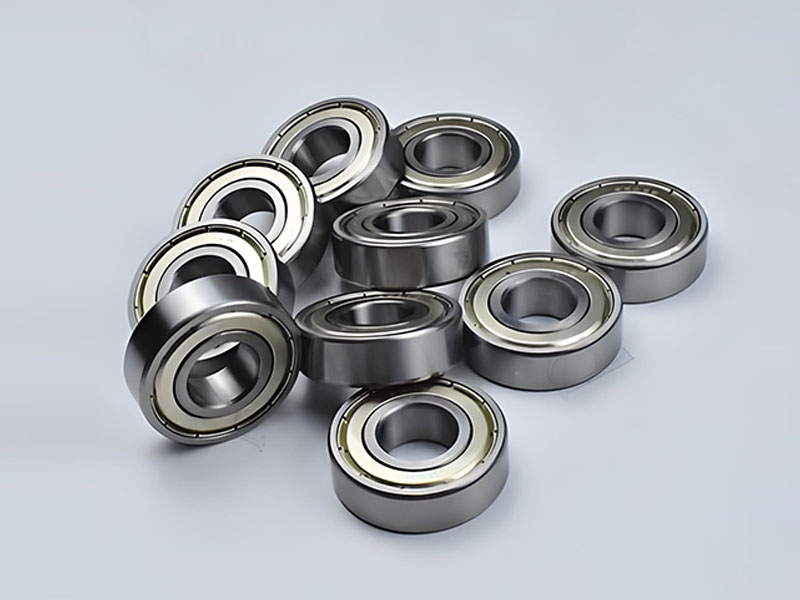
Angular-contact ball bearings carry radial load together with axial load in one direction. Because radial load produces an axial component, these bearings are normally used in pairs or multi-bearing sets rather than alone. Their significance in a spindle is the combination of high speed, precise axial location, and preload-controlled stiffness. Preload raises the stiffness of a single-row bearing, which is why the type is so common in spindles that must hold rotational accuracy.
Contact angle is the specification to read first. A larger contact angle generally increases axial load capacity, while a smaller angle suits higher speed. Typical high-precision spindle bearings are offered with 15° and 25° contact angles, and machine tool spindles commonly run P5 or higher precision grades with preload set to the operating conditions.
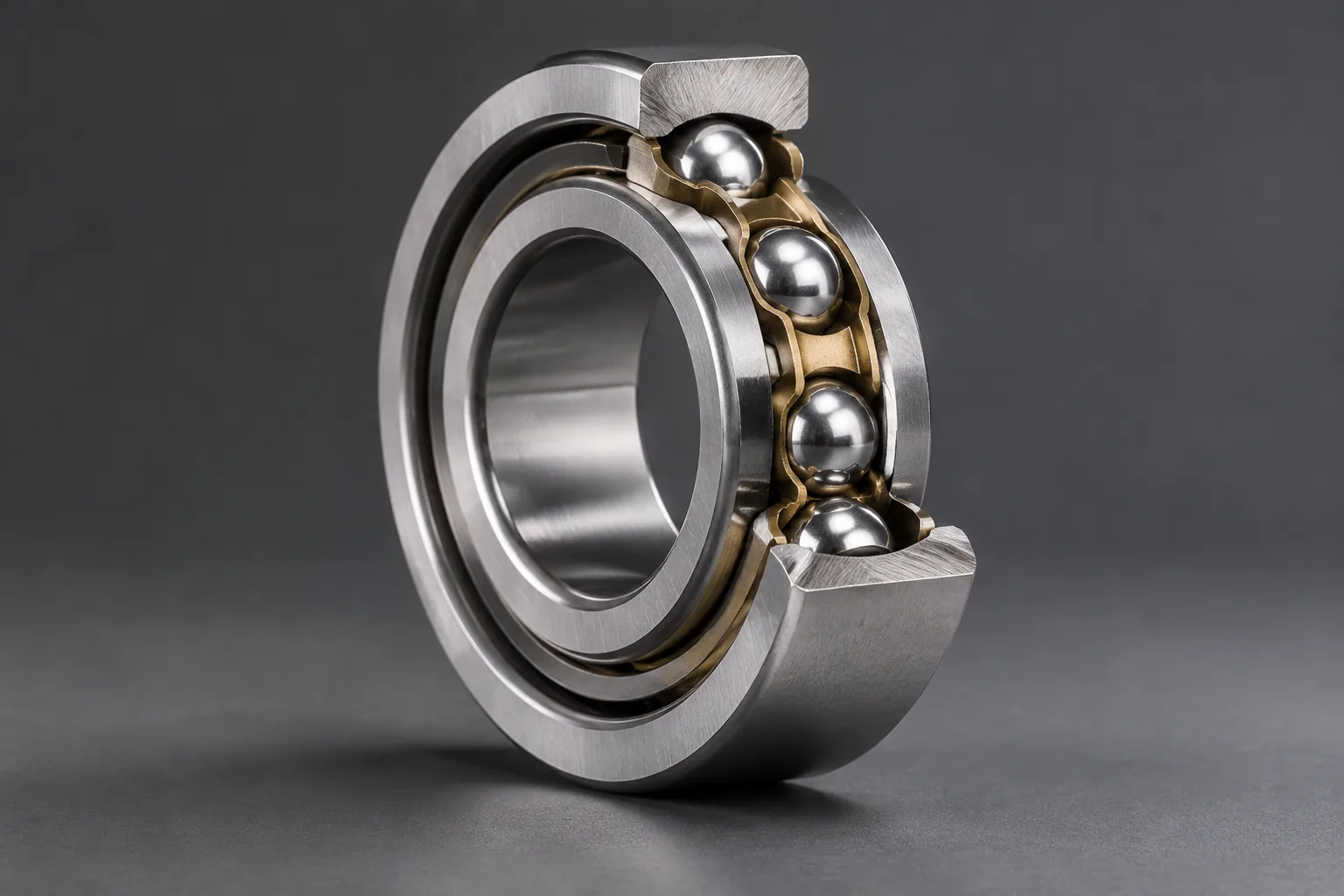
Load capacity is still improving. One manufacturer reports that an ultra-high-speed, high-load angular-contact design raises maximum load capacity by up to 15% and static load rating by 15% compared with the previous generation, while keeping the high-speed character of the type. The trade-off remains: angular-contact ball bearings generally give lower radial stiffness than roller bearings of comparable size.
Pairing And Preload Arrangements: DB, DF, And DT
Pairing is what makes an angular-contact bearing usable as a spindle location element. Three arrangements cover most designs:
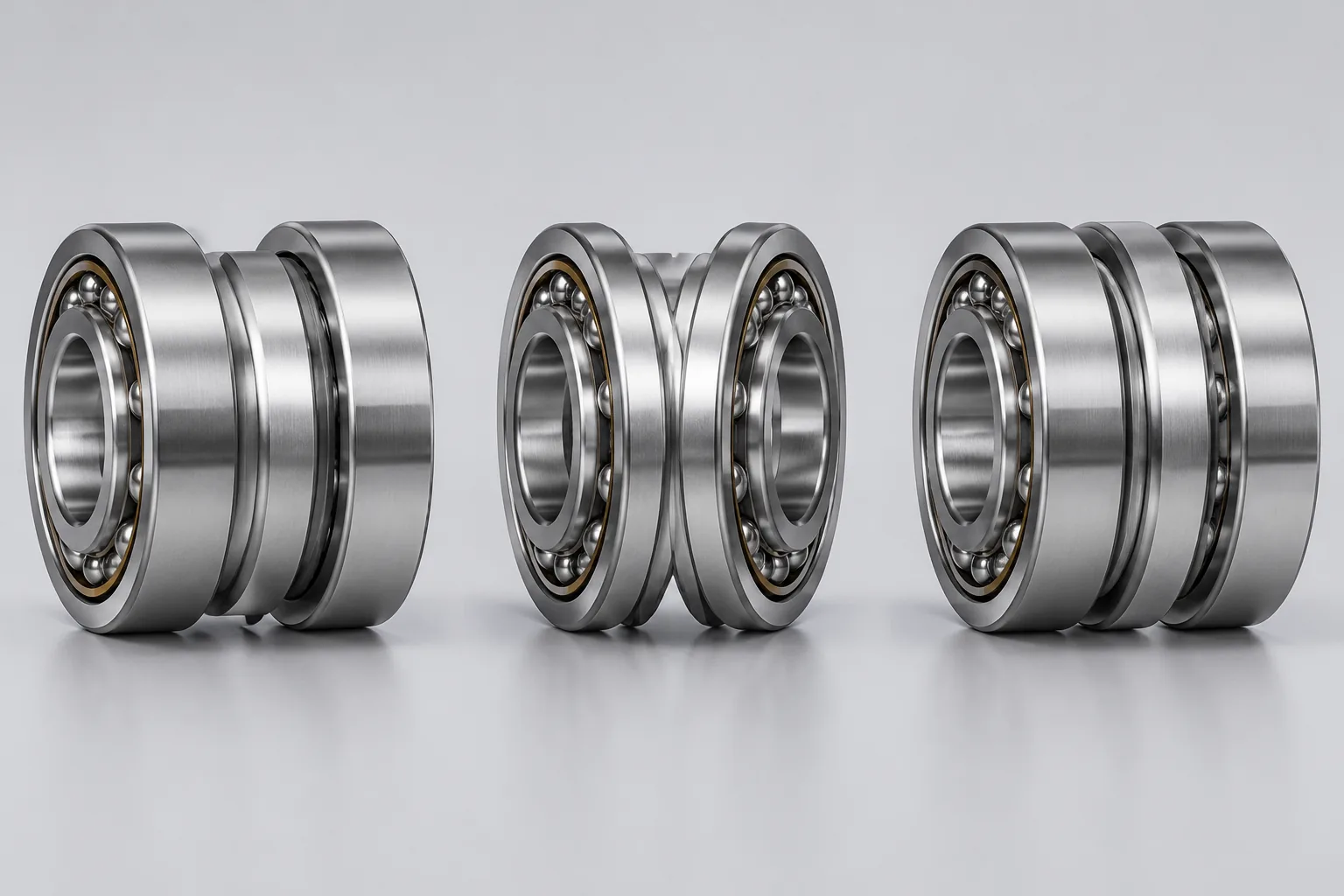
- DB, back-to-back: carries bidirectional axial load, provides a wider support span, and gives higher tilting stiffness against moment loads.
- DF, face-to-face: also carries bidirectional axial load, and is relatively more tolerant of mounting misalignment.
- DT, tandem: both bearings share load in the same direction, which suits larger one-direction axial loads.
Preload must then be set deliberately. It increases stiffness and axial location accuracy, but excessive preload raises friction and heat and can cap the achievable speed. The arrangement and the preload value belong to the same decision.
Hybrid Angular-Contact Ball Bearings
A hybrid bearing keeps steel rings and replaces the rolling elements with ceramic, commonly silicon nitride in machine tool spindle products. The significance is mass. Lighter rolling elements reduce centrifugal loading at speed, which supports higher speed, lower temperature rise, and a more stable preload state.
Thermal behavior improves as well. Ceramic rolling elements expand about 29% as much as steel rolling elements, so preload is less sensitive to the temperature difference between inner and outer rings. That matters on a spindle that runs hot at the tool end.
The concept is already used in production machines. On 29 March 2016, a bearing manufacturer reported a spindle solution for an Italian CNC machining center builder based on sealed ultra-precision hybrid angular-contact ball bearings, targeting very high speed together with stiffness, load capacity, and service life. Hybrid bearings carry a higher purchase cost than all-steel angular-contact bearings, so they are chosen where speed and thermal stability justify it.
Cylindrical Roller Bearings
Cylindrical roller bearings handle the radial side of the job. They deliver very high radial stiffness and radial load capacity and are specified for the highest precision and very high radial load conditions in main spindles.
Single-row and double-row designs are both available, and many spindle cylindrical roller bearings use a 1:12 tapered bore. The tapered bore lets a technician adjust internal clearance or preload precisely by moving the bearing to a defined axial mounting position.
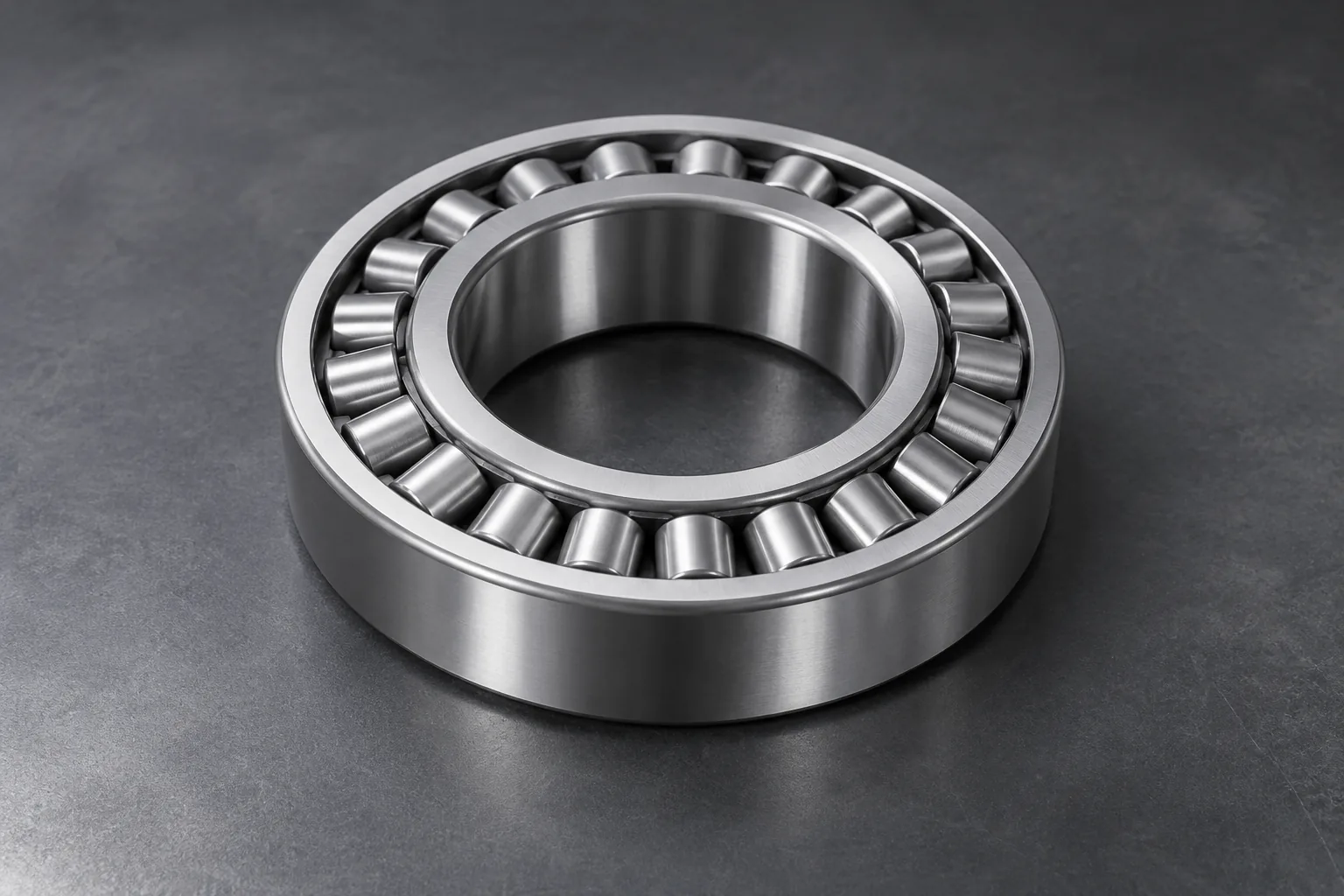
The second role is thermal. These bearings are often used as a floating support at the rear of the spindle, allowing axial growth when the shaft heats up. One documented layout uses two 70 CE series angular-contact ball bearings at the working end and an N 10 AK series single-row cylindrical roller bearing at the drive end to absorb thermal expansion.
Speed capability keeps developing. An NU-type cylindrical roller bearing for spindles, with a ceramic inner ring and air-oil lubrication, reached dmn = 3.25 x 10^6, where dmn is the bearing pitch diameter in millimeters multiplied by the inner-ring speed in min^-1. On 4 October 2024, another manufacturer announced a high-precision single-row cylindrical roller spindle bearing focused on grease life and limiting speed, with mass production planned for 2025.
The limits are clear. Axial load capability is limited, so axial location must come from another bearing, and high-speed running places demanding requirements on lubrication and heat management.
Tapered Roller Bearings
Tapered roller bearings carry large combined radial and axial loads with high stiffness and high load capacity. That makes them the natural choice for lathes, turn-mill machines, and heavy-cutting spindles where load capacity and rigidity matter more than top speed.
The constraint sits inside the bearing. Sliding contact between the roller large end and the rib adds friction, so ultra-high-speed operation needs optimized internal geometry, cage design, and lubrication. A test bearing with a 100 mm bore, air-oil lubrication, a ribbed outer ring and multi-nozzle air-oil supply, with a resin cage located by an outer-ring spacer, reached dmn = 1.25 x 10^6. That is respectable for the type, but below what angular-contact ball bearings achieve in the same application.
Expect more friction and heat generation and generally lower speed capability, and plan cooling and lubrication accordingly.
Double-Direction Angular-Contact Thrust Ball Bearings
This type carries bidirectional axial load and provides the axial location of the spindle. It is rarely used alone. The common pattern combines a cylindrical roller bearing for radial support with a double-direction thrust bearing for axial support, so each load path gets a bearing suited to it.
The payoff is stiffness in both directions at once: high axial stiffness, high radial stiffness, and high rotational accuracy. One documented spindle uses BTA A/HC series double-direction angular-contact thrust ball bearings with ceramic balls together with a single-row cylindrical roller bearing, with the combination aimed at high stiffness.
The cost is system complexity. Parts count is higher, assembly needs care, and preload control across two different bearing types is more involved than in a spindle built only from angular-contact ball bearings.
Hydrostatic Air Bearings
Hydrostatic air bearings form a non-contact film from an external air supply. The result is very low friction, low vibration, low noise, and very high speed, with no rolling contact to wear. Typical uses are micro-tool machining, precision grinding, and high-speed attachment spindles.
Published specifications for one machining center attachment spindle show how narrow that application window is:
- Maximum speed 150,000 min^-1, with a maximum tool diameter of 1 mm.
- Axial load capacity 40 N, radial load capacity 20 N.
- Axial static stiffness 1.8 N/μm, radial static stiffness 1.0 N/μm.
- Air supply pressure 0.49 MPa, air consumption 90 L/min.
- Motor rated power 0.6 kW, spindle mass 5 kg without tool holder.
Read those numbers as a design statement: air bearings are built for light, precise, very fast work, and they depend on a continuous supply of clean, stable compressed air. They are not a route to heavy cutting.
Magnetic Bearings
Magnetic bearings support the rotor by electromagnetic force with no rolling contact at all, which suits high-precision, high-speed spindles beyond the normal operating range of rolling bearings. They need no lubrication, and radial and axial sensors can monitor rotor position, cutting force, unbalance, vibration, and thermal expansion.
The system is more than a bearing. It requires sensors, power electronics, an active controller, and backup bearings for power failure or fault conditions. Their significance is contact-free, monitored high-speed operation; their cost is control complexity and a support system that a mechanical bearing never needs. Do not treat them as a drop-in replacement for a rolling bearing in an existing housing.
Comparison Of Spindle Bearing Types
| Bearing type | Primary significance in a spindle | Main limitation |
|---|---|---|
| Angular-contact ball bearing | High speed, combined radial and axial load, precise axial location, adjustable preload | Lower radial stiffness than comparable roller bearings |
| Hybrid angular-contact ball bearing | Higher speed, lower centrifugal loading, improved thermal stability | Higher cost than all-steel versions |
| Cylindrical roller bearing | Very high radial stiffness and radial load capacity, usable as a thermally free support | Limited axial load capability, demanding high-speed lubrication |
| Tapered roller bearing | High combined load capacity and high rigidity for heavy cutting | More friction and heat, generally lower speed capability |
| Double-direction angular-contact thrust ball bearing | Accurate bidirectional axial location, often combined with radial cylindrical roller bearings | More complex bearing arrangement and preload control |
| Hydrostatic air bearing | Very high speed, low vibration, nearly friction-free operation | Low load capacity and stiffness, continuous clean-air requirement |
| Magnetic bearing | Contact-free, lubrication-free operation at very high speed with active monitoring | Requires active control, sensors, power electronics, and backup bearings |
Selection Factors For Machine Tool Spindle Bearings
Start with the load case, not with a favorite bearing type. Radial load, axial load direction, combined load, impact load, and load magnitude decide which designs are even eligible. A spindle that sees heavy interrupted cuts and one that mills with a 1 mm tool have almost nothing in common.
Then work through the rest of the decision:
- Speed and stiffness: match bearing type and contact angle to the required speed, rigidity, and axial location accuracy.
- Preload strategy: fixed preload, spring preload, or an adjustable arrangement, chosen with the thermal picture in mind.
- Heat and thermal growth: account for friction, temperature rise, and the need for a floating bearing or other thermal compensation.
- Lubrication and sealing: select them together with the bearing type, because high-speed capability and contamination resistance both depend on the pair.
- System cost: mounting complexity, part availability, purchase cost, and maintenance access for the complete spindle.
Manufacturer selection guidance reduces to the same set: stiffness, friction, accuracy, speed capability, lubrication, and sealing, balanced against the demands of high speed, high stiffness, high accuracy, low vibration, and low noise.
Precision Grades, Standards, And Vibration Evaluation
Precision grade controls dimensional accuracy, running accuracy, and how repeatable the preload is, so it directly affects vibration and the usable speed of the spindle. Machine tool spindles commonly use P5 or higher precision angular-contact combinations.
Two standards frameworks are worth knowing:
- ISO 492:2023 sets out dimensional and geometric features, deviation limits, and tolerance values for radial rolling bearings; the sixth edition was published on 16 August 2023.
- ISO/TR 17243 gives spindle vibration evaluation methods by drive type: part 1 (2014) for spindles with built-in drives at 600-30,000 min^-1, part 2 (2017) for direct-drive and belt-driven rolling-bearing spindles at 600-30,000 r/min, and part 3 (2020) for gear-driven rolling-bearing spindles at 600-12,000 r/min.
Use the grade and the vibration acceptance criteria together. A precision grade on paper does not guarantee a quiet spindle if mounting, preload, or lubrication is wrong.
Lubrication, Sealing, And Thermal Management
Lubrication decides speed capability, friction, heat, grease life, and maintenance interval. High-speed cylindrical roller and tapered roller spindle bearings may need metered air-oil supply and optimized cage design, while sealed angular-contact ball bearings run on a defined grease fill.
Sealing is a production issue, not a detail. Non-contact seals can block coolant without reducing spindle speed, and the effect on reliability can be large: in one automotive engine plant case, a bearing change reduced failures by 78%, with an estimated annual saving of €190,992. Wide-series sealed angular-contact ball bearings are quoted with 3 times the pre-filled grease capacity of conventional series and 1.7 times the grease life of conventional open series.
Designations carry this information. In the example 80 BNR 20 H TYN V1V DBB EL P4, P4 indicates the precision grade and DBB indicates the bearing arrangement, so the ordering code itself records the preload and pairing decision.
Thermal management closes the loop. Hybrid bearings, controlled preload, and a floating bearing position all help keep preload stable as the spindle heats and grows.
Typical Spindle Bearing Layouts And Application Examples
Layouts repeat because they solve recurring problems. Common patterns include:
- High-speed machining centers and multi-tasking machines: a duplex angular-contact ball bearing set at the front, with either a duplex angular-contact set or a cylindrical roller bearing at the rear, as a manufacturer stated on 11 November 2010.
- High-stiffness spindles: cylindrical roller bearings for radial support combined with double-direction angular-contact thrust ball bearings for axial support.
- Heavy-cutting lathes and turn-mill machines: tapered roller bearings for combined-load capacity and rigidity.
- Ultra-high-speed micro-machining: hydrostatic air bearings for light loads at very high speed.
- Very high-speed precision spindles: magnetic bearings with active control and backup bearings.
Two documented examples show the rolling-bearing logic. One spindle uses two 70 CE series angular-contact ball bearings at the working end and an N 10 AK series single-row cylindrical roller bearing at the drive end. Another uses BTA A/HC series double-direction angular-contact thrust ball bearings with ceramic balls together with a single-row cylindrical roller bearing.
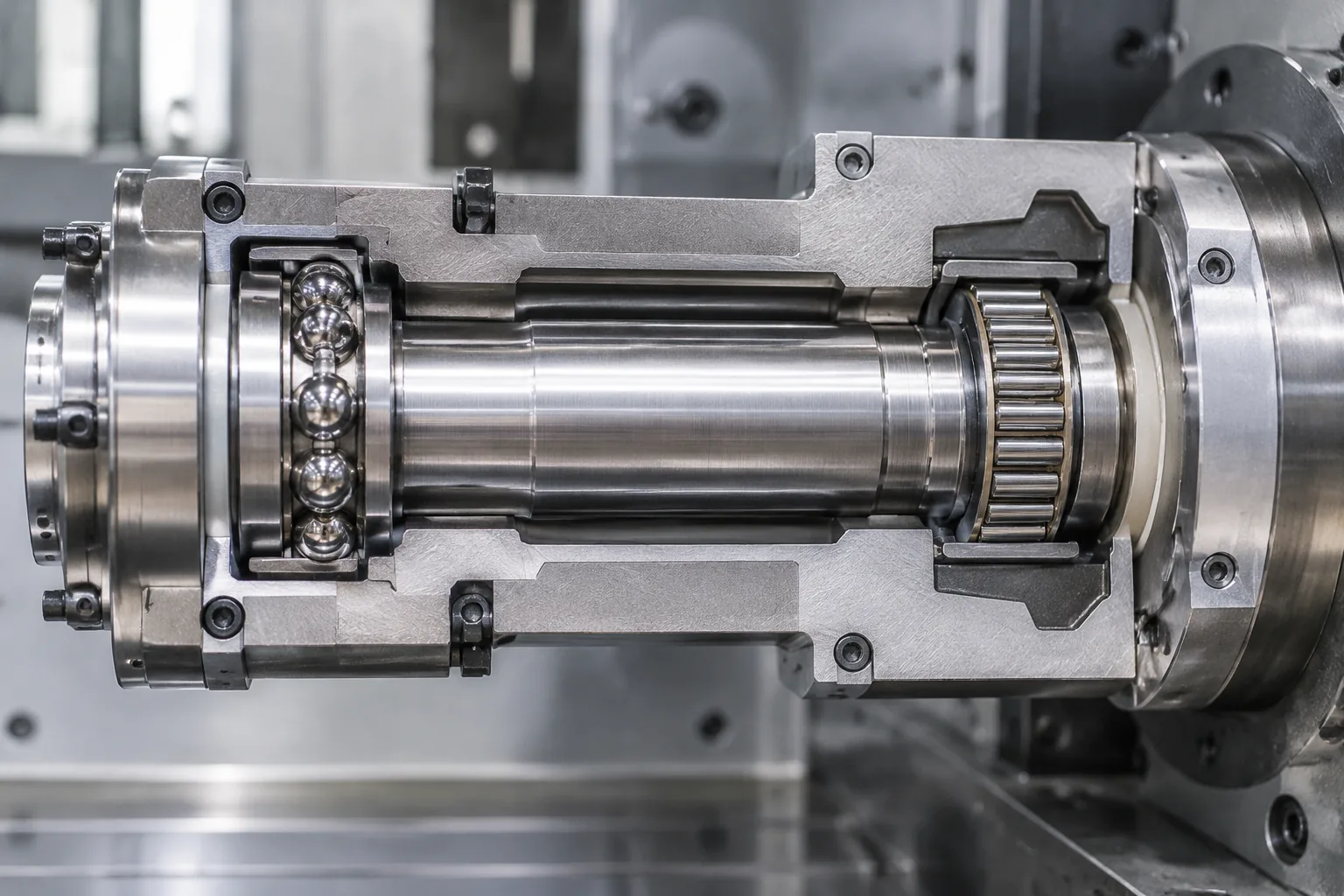
Choose the layout against load direction, speed, the thermal growth path, lubrication method, and maintenance access. A layout copied without those constraints usually underperforms.
Key Takeaways
- Angular-contact and hybrid angular-contact ball bearings are central to high-speed spindles with precise axial location and adjustable preload.
- Cylindrical roller bearings supply radial stiffness and a thermally free support, but they carry little axial load.
- Tapered roller bearings suit heavy combined loads and high rigidity, with a speed penalty from friction and heat.
- Double-direction angular-contact thrust bearings provide axial location in arrangements that separate radial and axial support.
- Air and magnetic bearings serve ultra-high-speed or ultra-precision work, with their own load, air-supply, and control-system constraints.
- Final selection follows the spindle’s load case, speed, stiffness, precision, lubrication, sealing, and thermal requirements.
Conclusion
The types of bearings used in machine tool spindles are significant because each one solves a different part of the same problem. Angular-contact ball bearings buy speed, axial location accuracy, and adjustable preload. Cylindrical roller bearings buy radial stiffness and thermal freedom. Tapered roller bearings buy combined load capacity and rigidity for heavy cutting. Double-direction thrust bearings buy bidirectional axial location. Air and magnetic bearings buy speed and smoothness at the cost of load capacity or control hardware.
The practical next step is to write down the load case first: radial and axial load direction, magnitude, speed range, required axial location accuracy, lubrication method, and expected temperature rise. Then match the bearing type, contact angle, precision grade, pairing arrangement, and preload to that list, and confirm the choice against the spindle builder’s specification before ordering.
FAQs
Q1: What bearings are commonly used in machine tool spindles?
A: Angular-contact ball bearings, cylindrical roller bearings, and tapered roller bearings are the common rolling types, and double-direction angular-contact thrust ball bearings appear in arrangements that separate axial from radial support. Hybrid ceramic angular-contact bearings are used where higher speed and thermal stability are needed. Air and magnetic bearings appear in special ultra-high-speed or ultra-precision spindles.
Q2: Which bearing type is best for a high-speed spindle?
A: There is no single best type, because speed capability depends on the whole arrangement. Angular-contact ball bearings, especially hybrid ceramic versions with small contact angles and controlled preload, are usually the starting point for high-speed spindles, while air and magnetic bearings go further when loads are light. Radial load, axial load, stiffness, and lubrication decide which one fits.
Q3: Why are angular-contact ball bearings often used in pairs?
A: A single angular-contact ball bearing carries axial load in one direction only, and its radial load creates an axial component, so pairs or multi-bearing sets are used to handle that load path. Pairing also allows controlled preload, which raises stiffness and improves axial location accuracy in a spindle.
Q4: What is the difference between DB, DF, and DT bearing arrangements?
A: DB back-to-back carries bidirectional axial load with a wider support span and higher tilting stiffness. DF face-to-face also carries bidirectional axial load and tolerates mounting misalignment better. DT tandem shares a one-direction axial load across the bearings for heavier one-way thrust. Selection follows load direction, stiffness, and mounting conditions.
Q5: Can cylindrical roller bearings carry axial loads?
A: Generally no, or only very little. Cylindrical roller bearings are chosen for very high radial stiffness and radial load capacity, and they often serve as a floating support that lets the spindle grow axially with temperature. Axial location must come from another bearing in the arrangement, such as a double-direction thrust bearing.
Q6: When should tapered roller bearings be used in a spindle?
A: Tapered roller bearings suit spindles that must carry large combined radial and axial loads with high rigidity, such as lathes, turn-mill machines, and heavy-cutting spindles. Their sliding contact between the roller large end and the rib adds friction and heat, so very high speed needs optimized internal geometry, cage design, and air-oil lubrication.
Q7: What is a hybrid angular-contact ball bearing?
A: A hybrid angular-contact ball bearing uses steel rings with ceramic rolling elements, commonly silicon nitride in machine tool spindle products. The lighter rolling elements reduce centrifugal loading, supporting higher speed, lower temperature rise, and a more stable preload. Ceramic rolling elements also expand far less than steel, so preload stays more predictable as the spindle heats up.
Q8: How do precision grades affect spindle bearing performance?
A: Precision grade controls dimensional and running accuracy, which in turn affects preload consistency, vibration, and the speed at which the spindle runs smoothly. Machine tool spindles commonly use P5 or higher precision angular-contact combinations, and ISO 492 sets out the tolerance framework for radial rolling bearings. Grade alone is not enough, because vibration acceptance criteria must also be defined.
Q9: What lubrication methods are used for high-speed spindle bearings?
A: Grease, oil-air, and oil-mist systems are all used, and the choice depends on speed, heat, and maintenance access. High-speed cylindrical roller and tapered roller spindle bearings often need metered air-oil supply and optimized cage design, while sealed angular-contact ball bearings rely on a defined grease fill and predictable grease life. Lubrication and sealing must be selected together with the bearing type.
Q10: Can air bearings carry heavy cutting loads?
A: No. Hydrostatic air bearings provide very low friction and very high speed, but their load capacity and stiffness are low, and they need a continuous supply of clean, stable compressed air. They suit light-load work such as micro-tool machining and precision grinding, not heavy cutting.