Quick Answer: Linear guides vs linear bearings is not a like-for-like comparison: a linear guide is a complete rail-and-carriage guidance system, while a round-shaft linear bearing is a bushing or block that runs on a cylindrical shaft. They are compared at different levels: one may include rail, carriage, seals, and lubrication; the other may need shafts, supports, and housings. Choose by load direction, moment capacity, stiffness, accuracy, installation space, contamination, and maintenance, then confirm ratings and tolerances from the selected datasheet.
Linear guides and linear bearings appear in the same motion projects, but the names do not describe interchangeable parts. One term usually points to a complete rail-and-carriage assembly; the other often describes a shaft-based bearing or, loosely, the rolling element inside a carriage. That ambiguity changes how you compare load capacity, stiffness, installation effort, and cost. A useful comparison therefore starts with definitions, then moves to the application requirements that decide the result.
Definitions and Terminology: Why the Comparison Can Be Confusing
The confusion is not only a language problem. Buyers, designers, and maintenance technicians often use the same words for different levels of assembly. A linear guide is normally a system, while a linear bearing is often a component. When those levels are mixed, a catalog rating from one product can be compared with a completely different scope from another. Some catalogs and formal naming systems use the phrase recirculating linear ball bearing for a guide, while shop language often uses linear bearing for a shaft bushing.
What Is a Linear Guide?
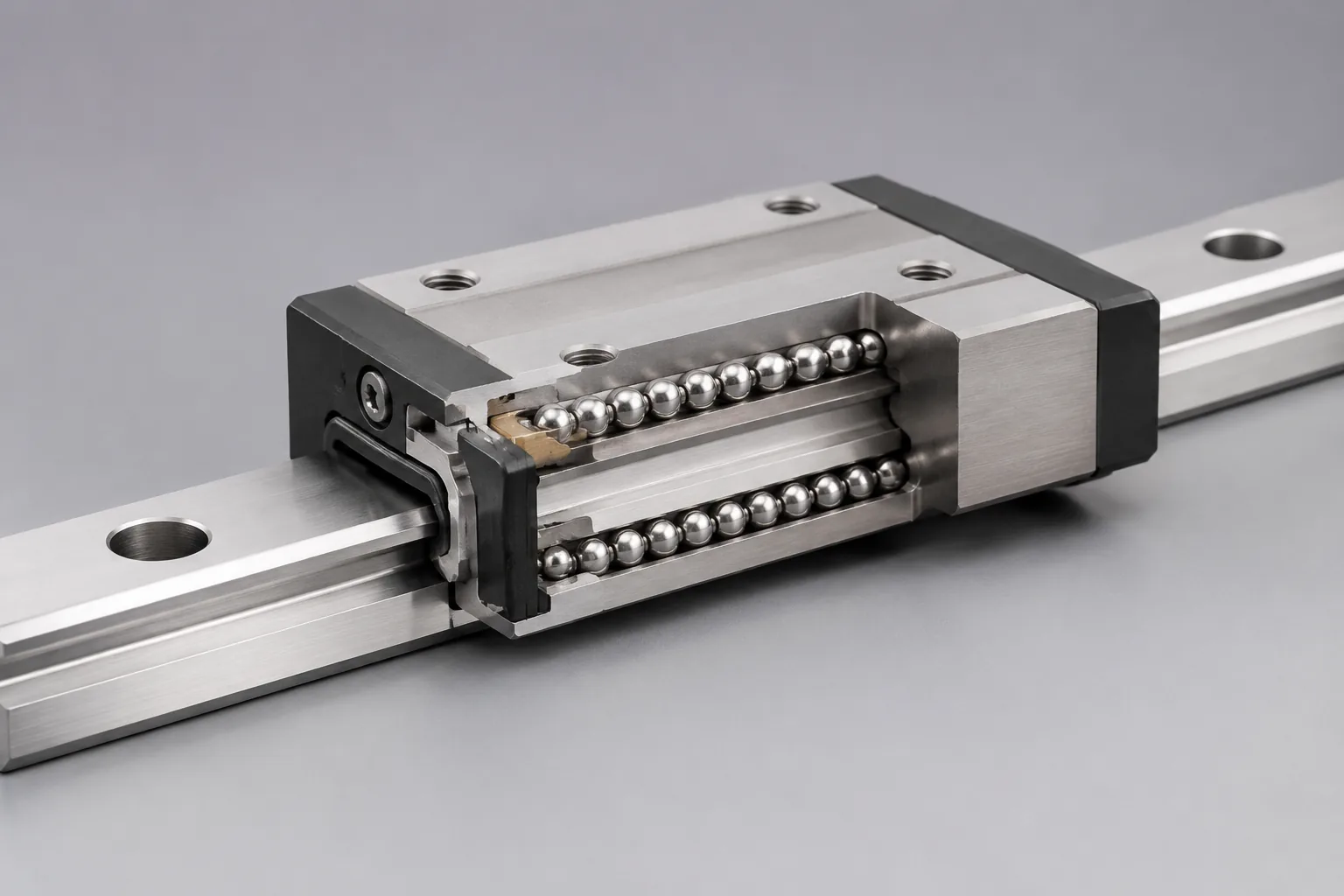
A linear guide is a rail-and-carriage guidance system. The rail provides a continuous raceway, and one or more carriages move along it on recirculating balls or rollers. The carriage constrains motion along the rail and can resist forces and moments, with capability depending on carriage length and rail arrangement. Seals, wipers, and lubrication are part of the assembly, not accessories added after the fact. Guide rails are mounted to a machined surface, so mounting flatness and rail parallelism affect performance. Load ratings, moment capacities, and accuracy grades must come from the specific manufacturer datasheet.
What Is a Linear Bearing?
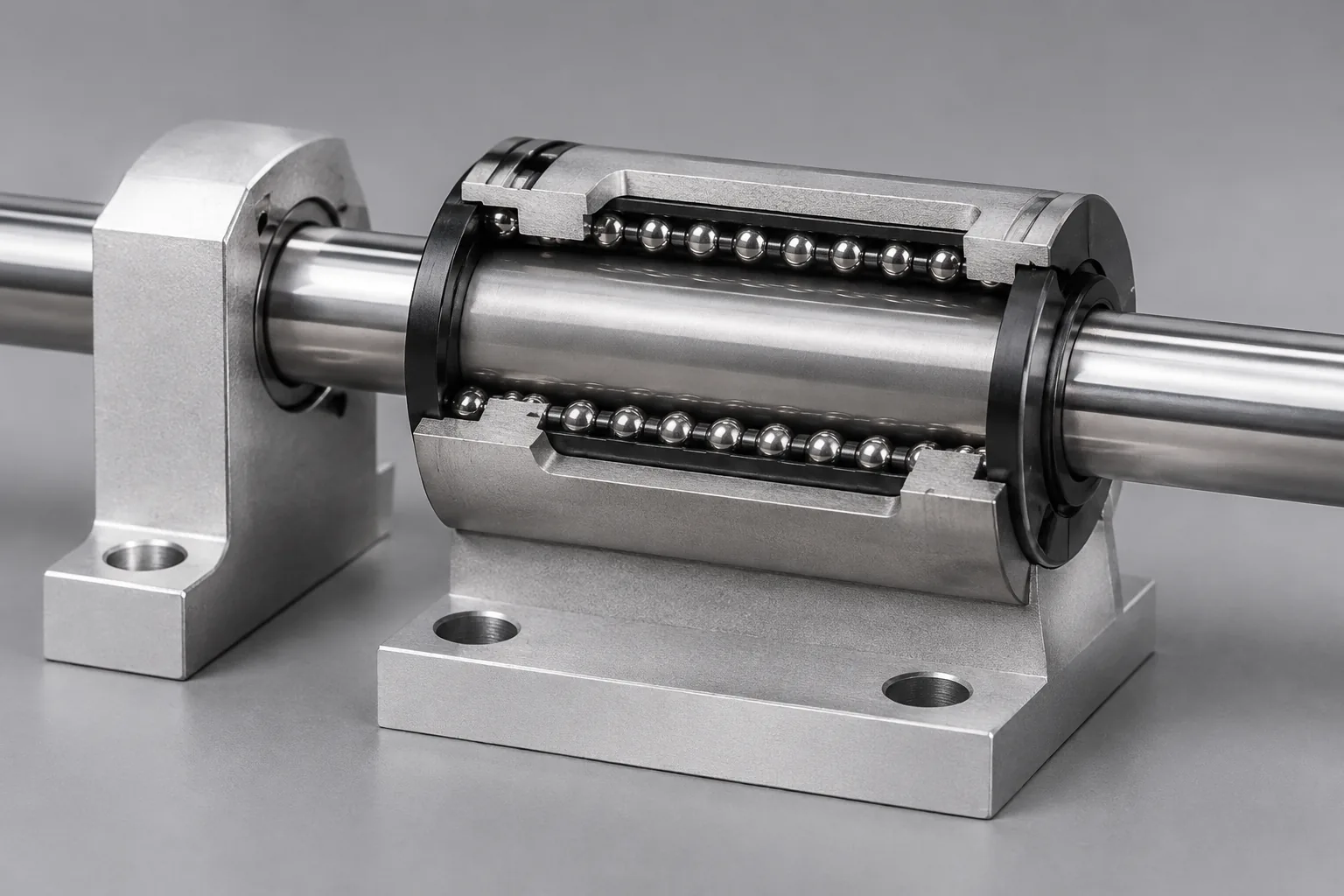
In the round-shaft sense, a linear bearing is a bushing or bearing block that slides or rolls along a cylindrical shaft. Common forms include ball bushings, plain bushings, and roller-type shaft bearings. Design details include shaft support, housing type, clearance or preload, seals, and lubrication. The same term is sometimes used for the rolling element inside a linear guide carriage, so context determines meaning. Load ratings, shaft hardness, and surface finish requirements should be checked in the product datasheet rather than assumed from the name.
Why the Comparison Is Not Always Apples-to-Apples
One option is often a complete guided system; the other may be a component that needs shafts, supports, and housing. A fair comparison is made at the assembly level: rail plus carriage versus shaft plus bearing plus support blocks. Define load direction, moment loads, travel length, speed, environment, and precision before comparing products. There is no universal ranking between the two categories. Suitability depends on the application and on how completely each option is specified.
Construction and Working Principle
Rolling versus sliding contact changes friction, stiffness, contamination sensitivity, and maintenance. Recirculating ball or roller guides are not the same as round-shaft ball bushings, and neither is the same as a plain bushing. Preload, seals, and lubrication belong to the system behavior; they are not optional details that can be ignored during selection.
Linear Guide Construction
A profile rail provides a continuous raceway, and the carriage contains recirculating rolling elements. Preload is set by ball or roller size or by carriage adjustment, and it affects both stiffness and friction. Seals and wipers protect the raceway, while lubrication reduces wear and friction. Rail joints, mounting holes, and carriage length influence travel and load behavior. A longer carriage or a wider rail spacing can improve moment resistance, but the actual values must be verified from the manufacturer’s data.
Round-Shaft Linear Bearing Construction
A shaft provides the raceway, and a bushing or bearing block contains balls, rollers, or a plain bearing liner. Shaft support spacing and shaft diameter strongly influence deflection over the span. Housing style, clearance, and preload affect play and stiffness. Seals and lubrication arrangements vary by bearing type and environment. Because the shaft is part of the guidance system, shaft quality and support design are as important as the bearing itself.
Plain Bearings and Other Sliding Linear Bearings
Plain linear bearings use sliding contact rather than rolling elements. Materials may include polymer, PTFE-filled, composite, or metallic bushings. Sliding contact changes friction, stick-slip behavior, contamination tolerance, and wear compared with ball bushings. Compare this category only when the reader is using linear bearing to mean a plain bushing; otherwise the comparison may be against a different product family.
Performance Comparison: Linear Guides vs Linear Bearings
Performance should be compared qualitatively first, then with datasheet values for the exact products under consideration. Mounting, preload, lubrication, and structure stiffness can dominate the result. No technology should be declared universally better without defining the application, the duty cycle, and the environment.
Load Capacity and Moment Loads
Load capability depends on direction: radial, axial, and moment loads are not interchangeable. Linear guide carriages can resist moments depending on carriage length and rail spacing. Round-shaft systems often need two shafts or two bushings per shaft to resist moment loads. Do not compare catalog load ratings without checking load direction and moment arm. Specific dynamic and static load ratings require manufacturer datasheet evidence.
Stiffness and Deflection
Preload generally increases stiffness but can increase friction and heat. Rail mounting flatness, carriage length, and rail support affect guide system stiffness. Shaft diameter, unsupported span, and support spacing affect round-shaft deflection. System stiffness also includes the machine frame, not only the bearing component. Deflection values and stiffness curves require datasheet or test evidence, so they should not be estimated from a generic rule of thumb.
Accuracy, Repeatability, and Guiding Precision
Absolute accuracy and repeatability are different requirements. Guide accuracy depends on rail straightness, carriage preload, mounting surface, and thermal effects. Round-shaft accuracy depends on shaft straightness, support alignment, and bearing clearance. Accuracy grades and permissible mounting tolerances must come from manufacturer documentation. A precise bearing on a flexible frame will not produce precise motion.
Friction, Speed, and Acceleration
Rolling contact generally has lower friction than sliding contact, but seals and preload add resistance. Plain bearings can exhibit stick-slip, especially at low speed. Recirculating rolling elements have speed and acceleration limits tied to lubrication, retainer design, and load. Friction coefficients and speed limits require specific catalog evidence and should be confirmed for the selected size and preload.
Noise, Vibration, and Smoothness
Ball recirculation, dirt ingress, and preload can affect guide noise and vibration. Plain bearings may be quieter in some setups but can show stick-slip and wear. Lubrication condition and mounting rigidity influence smoothness. Sound and vibration data are application-specific, so they should be evaluated with the machine structure and operating profile in mind.
Installation and Machine Design Impact
Installation effort and machining requirements often decide the practical choice. Space envelope, alignment, sealing, and maintenance access should be evaluated together. The lowest-cost component can become expensive if mounting surfaces or shaft supports are complex.
Mounting and Alignment Sensitivity
Guide rails generally require flat, parallel mounting surfaces and careful rail alignment. Round shafts require aligned support blocks, and shaft sag must be considered over long spans. Misalignment increases bearing loads, friction, and wear. Permissible mounting tolerances require the manufacturer’s installation manual, so the machine design should reserve adjustment where needed.
Space, Height, and Integration
Profile guides integrate rail and carriage into a relatively compact cross-section, but they require mounting holes and rail length. Round-shaft systems need shaft supports, housing clearance, and end supports. Housing height, carriage width, and mounting pattern affect the machine envelope. Compare actual installation dimensions from datasheets, not only bearing cross-sections.
Contamination, Sealing, and Environment
Recirculating rolling elements are sensitive to debris; seals, wipers, and bellows are common protections. Plain bearings may tolerate some contamination better but can wear and generate particles. Washdown, corrosive, vacuum, cleanroom, and high-temperature environments require specific materials and lubrication review. Environmental ratings and test data require manufacturer evidence and should not be inferred from a general product description.
Lubrication and Maintenance
Lubrication interval depends on load, speed, temperature, contamination, and seal effectiveness. Some units are sealed or lubricated for life; others require relubrication. Round-shaft systems may wear the shaft as well as the bearing. Maintenance intervals and replacement criteria require specific product documentation. A maintenance plan should include inspection access, lubricant type, and a replacement path.
Cost and Lifecycle Considerations
Initial cost includes bearings, rails or shafts, supports, machining, installation, and alignment labor. Lifecycle cost includes lubrication, replacement parts, downtime, and lost precision. Round-shaft systems can be economical for simple low-load motion; guides can be cost-effective where stiffness and moment capacity are required. Price comparisons must state region, date, and quantity, and cost conclusions should be based on a defined load, life, precision, and environment. A lower purchase price does not always mean a lower total cost.
High-precision or high-moment applications may justify guide systems despite higher component cost. Simple low-load applications may not benefit from the added capability of a profile rail guide. The decision should include the cost of the mounting structure, not just the bearing line item.
Selection Guide: When to Use Each
Translate application requirements into load, stiffness, accuracy, speed, environment, installation, and cost criteria. Use the comparison to narrow options, then verify with datasheets and application engineering. Do not choose by product name alone; a round-shaft bearing and a profile rail guide solve different system-level problems.
Choose Linear Guides When…
- The application needs controlled moment load capacity from a carriage-and-rail system.
- High stiffness, precise guiding, or compact carriage integration is important.
- The machine can provide suitable machined mounting surfaces and sealing.
- The duty cycle justifies lubrication and maintenance planning.
Conditions matter: moment loads may be significant or multiple load directions may act on the carriage; precision and stiffness may be central to machine performance; and installation must be able to meet rail flatness and parallelism requirements. Heavy contamination may require additional sealing, bellows, or protective covers, while very simple low-load motion may not justify the cost and installation effort.
Choose Round-Shaft Linear Bearings When…
- The motion is primarily radial and the shaft can be supported to limit deflection.
- Simple assembly, adjustable clearance, or low initial cost is a priority.
- The application can use one or more shafts to manage moment loads.
- The environment and duty cycle match the selected bushing or ball bearing type.
Conditions include mainly radial loads and a shaft span that can be controlled, plus a design that can accommodate shaft supports and housing alignment. Large moment loads may require dual shafts, wider bearing spacing, or a different technology. High-precision or high-acceleration applications may need additional preload, support, or a guide system.
Hybrid and Application-Specific Considerations
Some machines combine profile rails for guidance with separate support or drive elements. Shaft systems can use supported rails, twin shafts, or custom housings to improve stiffness. Selection should be based on measured or specified requirements, not stereotypes about either technology. Confirm compatibility of lubrication, seals, materials, and mounting with the machine environment.
Common Misconceptions and Selection Checklist
Several common assumptions lead to poor selection. The checklist below is intended for use with vendor datasheets and the machine requirements, not as a substitute for engineering verification.
Common Misconceptions
- The claim that a linear guide is always more accurate does not hold if mounting, structure, or contamination is poor.
- The claim that a linear bearing is always cheaper ignores shafts, supports, machining, and installation labor.
- The claim that more preload is always better ignores friction, heat, and life effects.
- The claim that a sealed product is maintenance-free is not reliable across all environments and duty cycles.
Selection Checklist
- Define load magnitude, direction, moment arm, and shock loads.
- Define stiffness, accuracy, repeatability, speed, acceleration, and noise requirements.
- Review the environment: dust, chips, coolant, washdown, corrosion, vacuum, and temperature.
- Review installation: mounting surface, rail or shaft alignment, space envelope, and access.
- Review maintenance: lubrication interval, replacement method, and downtime cost.
- Verify all ratings, tolerances, and life calculations with the selected manufacturer’s datasheet.
Summary Comparison
The table keeps the comparison qualitative. Numeric load ratings, stiffness, accuracy grades, friction, speed limits, and prices are product-specific and should be taken from manufacturer datasheets for the exact size, preload, and configuration.
| Dimension | Linear Guide | Round-Shaft Linear Bearing |
|---|---|---|
| Construction | Profile rail plus carriage with recirculating rolling elements, seals, and lubrication | Shaft plus bushing or bearing block; may use balls, rollers, or a plain liner |
| Load and moment behavior | Carriage and rail can resist forces and moments depending on length and rail spacing | Often radial-first; moment resistance usually needs multiple shafts or wider bearing spacing |
| Stiffness | Preload and rail mounting strongly influence stiffness | Shaft diameter, support spacing, and bearing clearance strongly influence deflection |
| Accuracy and repeatability | Depends on rail straightness, preload, mounting surface, and thermal behavior | Depends on shaft straightness, support alignment, and bearing clearance |
| Friction and speed | Rolling contact with seal and preload drag; limits set by product design and lubrication | Rolling or sliding contact; plain versions can show stick-slip at low speed |
| Installation | Requires machined, flat, parallel mounting surfaces and careful rail alignment | Requires aligned shaft supports and attention to shaft sag over the span |
| Contamination | Sensitive to debris; seals, wipers, and covers are common | Plain versions may tolerate more debris but can wear and generate particles |
| Maintenance | Lubrication and seal inspection are part of the plan | Bearing and shaft wear both need inspection; relubrication depends on type |
| Cost | Higher component scope, but may reduce structure and integration cost where stiffness is needed | Can be economical in simple radial motion, but supports and machining count |
Neither technology is universally superior. The fit depends on the application, and the final choice should be checked against the selected product’s ratings and installation requirements.
Conclusion
Linear guides vs linear bearings is a comparison of system scope as much as of bearing type. A linear guide packages a rail, carriage, rolling elements, seals, and lubrication into a guided assembly. A round-shaft linear bearing may be only one part of a system that also needs shafts, supports, and housing. Compare load direction and moment demand, stiffness, accuracy, friction, installation, contamination, maintenance, and lifecycle cost. Then confirm the ratings, tolerances, and lubrication requirements in the manufacturer datasheet before ordering or designing the mounting structure.
FAQs
Q1: Is a linear guide the same as a linear bearing?
A: No. A linear guide is usually a complete rail-and-carriage assembly, while a linear bearing often refers to a round-shaft bushing or bearing block. The term linear bearing is sometimes used for the rolling element inside a guide carriage, so check the context and the product scope before comparing specifications.
Q2: Which option handles moment loads better?
A: A linear guide carriage can resist moment loads depending on carriage length and rail spacing, which is one reason guides are common in cantilevered or multi-direction load applications. A round-shaft system can also resist moments when it uses two shafts or sufficiently spaced bushings, but the arrangement and ratings must be verified for the specific design.
Q3: Are round-shaft linear bearings always cheaper?
A: No. The bearing itself may have a lower purchase price, but the total cost includes shafts, support blocks, housing, machining, alignment, and installation labor. A guide system can be more cost-effective when it reduces structure complexity or provides the stiffness and moment capacity the machine needs.
Q4: Can a linear guide run without lubrication?
A: Some units are sealed or lubricated for life, but that does not make every guide maintenance-free. Lubrication requirements depend on load, speed, temperature, contamination, and seal effectiveness. Confirm the lubricant type and service interval in the product datasheet, and include seal inspection in the maintenance plan.
Q5: Does more preload always improve performance?
A: No. Preload can increase stiffness, but it also raises friction and heat and can affect life. The correct preload depends on accuracy, stiffness, speed, and duty cycle. Use the manufacturer’s preload class and application guidance rather than assuming that a tighter setting is better.
Q6: What should I define before comparing linear guides and linear bearings?
A: Define load magnitude and direction, moment arm, shock loads, stiffness, accuracy, repeatability, speed, acceleration, noise, environment, mounting surface, available space, lubrication access, and downtime cost. With those requirements listed, compare assembly-level dimensions and ratings from the selected manufacturer’s datasheet.