Quick Answer: A gear ratio calculator divides the driven gear tooth count by the driving gear tooth count. A 20-tooth driven gear paired with a 10-tooth driving gear gives a 2:1 ratio, so output speed is halved while ideal output torque doubles. The result is dimensionless. Use it to check a gear pair before you build or buy and to compare reduction, overdrive, and direct drive.
A gear ratio calculator turns two tooth counts into a clear statement about speed and torque. It is useful when you need to check a gear pair, plan a compound train, or compare a reduction against an overdrive. The sections below cover the formula, calculator steps, worked examples, result interpretation, applications, and common errors.
What Is a Gear Ratio?
A gear ratio is the relationship between the number of teeth on the driven gear and the number of teeth on the driving gear. In a simple pair, it tells you how many turns the input gear makes for one turn of the output gear. A 2:1 ratio means the driving gear turns twice while the driven gear turns once.
The ratio sets the relationship between input and output rotational speed and torque. It is dimensionless, so it has no units, and it is often written as X:1 or X:Y. The ratio describes the gear pair, not the absolute size of either gear.
Gear Ratio Formula
The basic formula is Gear Ratio = Driven Gear Teeth / Driving Gear Teeth. The same ratio drives the speed and torque relationships for an ideal simple gear pair.
| Quantity | Formula | Meaning |
|---|---|---|
| Gear ratio | Driven gear teeth / driving gear teeth | Defines the ratio of the pair |
| Output speed | Input speed / gear ratio | Shows how rotation changes |
| Output torque | Input torque x gear ratio | Shows ideal torque multiplication |
These relationships apply to a simple two-gear train with spur or helical gears. The torque result assumes 100% mechanical efficiency. Real systems lose energy to friction, lubrication churning, and deflection, so measured output torque is lower than the ideal value.
How to Use the Gear Ratio Calculator
- Count the driving gear. Record the number of teeth on the input gear, the gear that receives power from the motor, engine, or other source.
- Count the driven gear. Record the number of teeth on the output gear, the gear that drives the next stage or the load.
- Enter both tooth counts. The calculator divides driven teeth by driving teeth and returns the gear ratio.
- Add input speed if needed. Enter input RPM to estimate output RPM with Output RPM = Input RPM / Gear Ratio.
- Add vehicle data only when relevant. For a vehicle estimate, tire diameter and axle ratio can be used with the gear ratio to estimate speed, but the result is only as good as the input data.
For a compound gear train, calculate each stage separately and multiply the stage ratios. For a belt or chain drive, use pulley or sprocket tooth counts instead of gear teeth; the ratio logic is the same, but the physical components differ.
Gear Ratio Examples
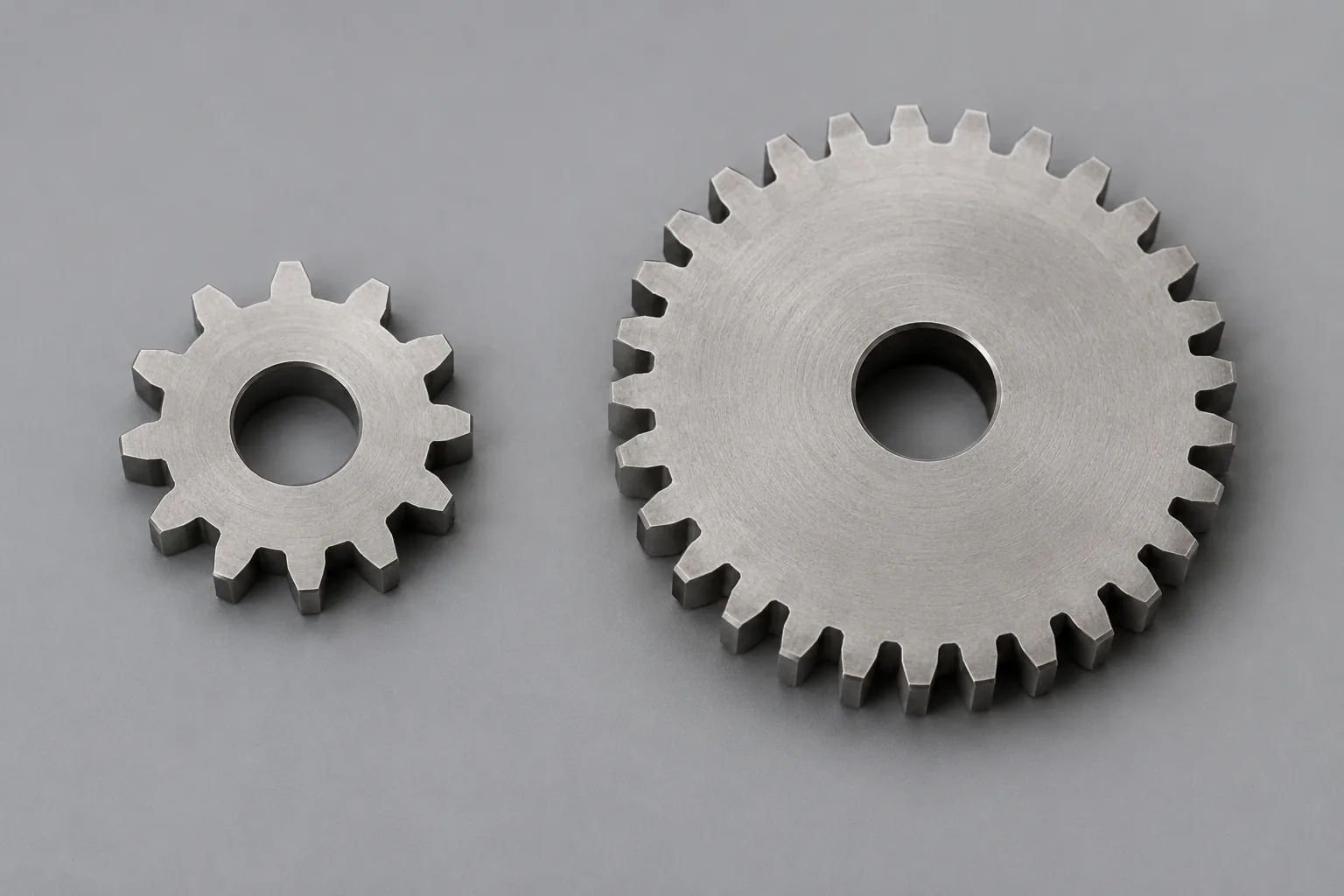
These three examples show how the same formula produces a reduction, an overdrive, and a stronger reduction.
| Driving teeth | Driven teeth | Ratio | Result |
|---|---|---|---|
| 10 | 20 | 2:1 | Reduction: output speed half, ideal torque doubled |
| 20 | 10 | 0.5:1 | Overdrive: output speed doubled, ideal torque halved |
| 15 | 45 | 3:1 | Reduction: output speed one-third, ideal torque tripled |
The 10-tooth to 20-tooth pair is a 2:1 reduction: the output turns half as fast as the input, and ideal torque is twice the input. The 20-tooth to 10-tooth pair is a 0.5:1 overdrive: the output turns twice as fast, and ideal torque is half. The 15-tooth to 45-tooth pair is a 3:1 reduction: output speed is one-third of input speed, and ideal torque is three times the input.
Interpreting Gear Ratio Results
Read the ratio before you use the speed or torque result. The numerical value tells you which way the output will move.
- Greater than 1: a reduction. Output speed is lower, and ideal output torque is higher.
- Less than 1: an overdrive. Output speed is higher, and ideal output torque is lower.
- Exactly 1:1: direct drive. Speed and torque are unchanged in the ideal case.
Actual performance also depends on the power source, efficiency, and load. A ratio alone does not define acceleration, top speed, or energy use.
Gear Ratio Applications
Gear ratios appear wherever a power source needs a different speed or torque at the load. The examples below are illustrative; specific ratios depend on the design requirements.
- Automotive: differentials, transmissions, and final drive ratios affect acceleration, top speed, and fuel economy.
- Bicycles: chainring and cassette sprocket sizes determine pedaling effort and road speed for a given cadence.
- Industrial machinery: gearboxes adjust speed and torque for conveyors, mixers, and robots.
- Robotics: gearmotors use gear ratios to match motor speed and torque to the application.
Automotive axle ratios vary widely by vehicle, so confirm the exact ratio with manufacturer data before ordering parts. Bicycle gear ratios also vary with chainring and sprocket choice, so compare setups on the same basis.
Common Mistakes and Limitations
Most calculation errors come from the input data or from applying a simple formula to a system it does not describe.
- Using outside diameter instead of tooth count. Outside diameter is not the tooth count. Pitch diameter can track the ratio for gears of the same module, but tooth count is the direct basis.
- Swapping driving and driven gears. This inverts the ratio and reverses the speed and torque conclusion.
- Forgetting compound stages. Multiply each stage ratio; do not add them.
- Ignoring efficiency losses. Friction and other losses can make real output torque lower than the ideal calculation.
- Assuming ratio alone sets vehicle performance. Weight, engine power, tire size, and other factors also matter.
Two exceptions are worth keeping in mind. Belt and chain drives use pulley or sprocket tooth counts; the same ratio logic applies, but the components are not gears. Planetary gear sets have more complex ratios, so the simple two-gear formula does not directly apply.
Conclusion
The gear ratio calculator is a first-pass tool: count teeth accurately, identify the driving and driven gears, and divide driven teeth by driving teeth. Use the result to compare reduction, overdrive, and direct drive, then check speed and torque against the real system. Multiply stage ratios for compound trains, keep efficiency losses in view, and confirm final component limits with the applicable manufacturer data before you commit to a design.
FAQs
Q1: What is a gear ratio?
A: A gear ratio is the number of driven gear teeth divided by the number of driving gear teeth. It is dimensionless and describes the relationship between input and output speed and torque in a simple gear pair.
Q2: How do I calculate gear ratio from teeth?
A: Divide the driven gear tooth count by the driving gear tooth count. For example, a 45-tooth driven gear and a 15-tooth driving gear give 45 / 15 = 3, or a 3:1 ratio.
Q3: What does a 4.10 gear ratio mean?
A: A 4.10:1 ratio means the driven gear turns once for every 4.10 turns of the driving gear. In tooth-count terms, that corresponds to a 41-tooth driven gear and a 10-tooth driving gear; output speed is input speed divided by 4.10, and ideal output torque is input torque multiplied by 4.10.
Q4: Can I use this calculator for bicycles?
A: Yes, if you keep the input and output convention consistent. With this calculator’s driven/driving rule, enter the chainring as the driving gear and the rear sprocket as the driven gear; many cycling references present the inverse, so compare results on the same basis.
Q5: What is the difference between gear ratio and final drive ratio?
A: Gear ratio is the general relationship for a gear pair or train. Final drive ratio applies the same tooth-count logic to the last reduction stage, usually the differential, and it is only one factor in vehicle performance.
Q6: Are higher gear ratios better?
A: There is no universal answer. A numerically higher ratio gives more torque multiplication and lower output speed, which can help acceleration or climbing, but it may reduce top speed and change operating speed at cruise. The better choice depends on the load, power source, and duty cycle.