Quick Answer: Stainless steel bearings are rolling bearings made with corrosion-resistant steels for the rings, balls, or rollers. They resist moisture and many cleaning chemicals better than standard bearing steel, but they usually carry less load and still need the right seal, lubricant, and grade. They suit food processing, pharmaceutical equipment, pumps, washdown machinery, and other wet or corrosive applications where hygiene and low maintenance matter.
Stainless steel bearings solve a specific problem: keeping a rolling bearing working when water, cleaning agents, or process chemicals would shorten the life of a standard bearing. The label covers several material combinations, seal types, and lubricant choices, so two bearings with the same dimensions can behave very differently. The useful question is not whether a bearing is stainless, but whether its grade, seal, lubricant, and load rating fit the application.
What Makes a Bearing a Stainless Steel Bearing?
A stainless steel bearing is not made from one stainless grade. The load-bearing parts, the raceways and rolling elements, usually use a hardened martensitic stainless steel. Cages, shields, and other non-load-bearing components may use an austenitic stainless steel, which is softer and more formable. The material split matters because each grade contributes different hardness, corrosion resistance, and cost.
Published catalog examples show the range. SKF stainless steel deep-groove ball bearing series uses X65Cr13 rings, X105CrMo17 balls, and X5CrNi18-10 cages and shields. NTN’s stainless series uses SUS440C or an equivalent martensitic stainless steel for raceways and rolling elements, SUS304 for cages and oil slingers, and SUS410 for set screws. These are specific product choices, not a universal recipe; grades vary by manufacturer and series.
ASTM A756-17(2022) remains the active specification for stainless anti-friction bearing steel, with requirements for chemical composition, decarburization, surface defects, microstructure, and hardness. That standard is useful when comparing suppliers, but it does not by itself prove that a finished bearing will resist a particular chemical or washdown cycle.
Standard Dimensions and Tolerances
Metric SKF stainless steel deep-groove ball bearings generally use ISO 15 for boundary dimensions, ISO 492 Normal for tolerances, and ISO 5753 Normal for radial internal clearance. Inch series generally correspond to ANSI/AFBMA Standard 12.2-1992. Some products with a WBB1 prefix or an X suffix have dimensional exceptions, so the suffix and series should be checked before ordering. Do not assume that a stainless version shares every dimension and tolerance of the standard bearing it replaces.
Key Performance Characteristics
The useful characteristics fall into five groups: corrosion resistance, load capacity and direction, sealing and lubrication, temperature limits, and available sizes and configurations. Manufacturer data should be read within those groups, because a claim that is true for one sealed stainless bearing may not hold for an open bearing of the same size.
Corrosion and Moisture Resistance
The primary benefit of stainless steel bearings is better resistance to moisture and corrosive media. NTN states that its stainless steel bearing units have stronger corrosion resistance than standard cast iron units. That advantage is real, but it is not unlimited. No stainless steel bearing is immune to every corrosive environment. Suitability depends on temperature, loading, the specific corrosive medium, and the condition of the seal or shield.
Material microstructure also matters. ASTM sources note that conventional AISI 440C is widely used for corrosion-resistant bearings, but coarse eutectic carbides can act as crack starters in rolling contact and can reduce the effective chromium content in the martensitic matrix. In practice, a higher alloy grade or a different heat treatment may be needed for aggressive service.
Load Capacity and Load Direction
Stainless steel deep-groove ball bearings can support radial loads and axial loads in both directions. SKF guidance states that pure axial loads should typically not exceed 25% of the static load rating C0; higher axial loads can shorten bearing life. Stainless steel deep-groove ball bearings generally carry less load than same-sized bearings in conventional high-chromium bearing steel. Do not directly reuse the standard bearing’s load rating when selecting a stainless equivalent. Confirm the rating for the stainless version, its internal design, and the actual load direction.
Sealing, Lubrication, and Maintenance
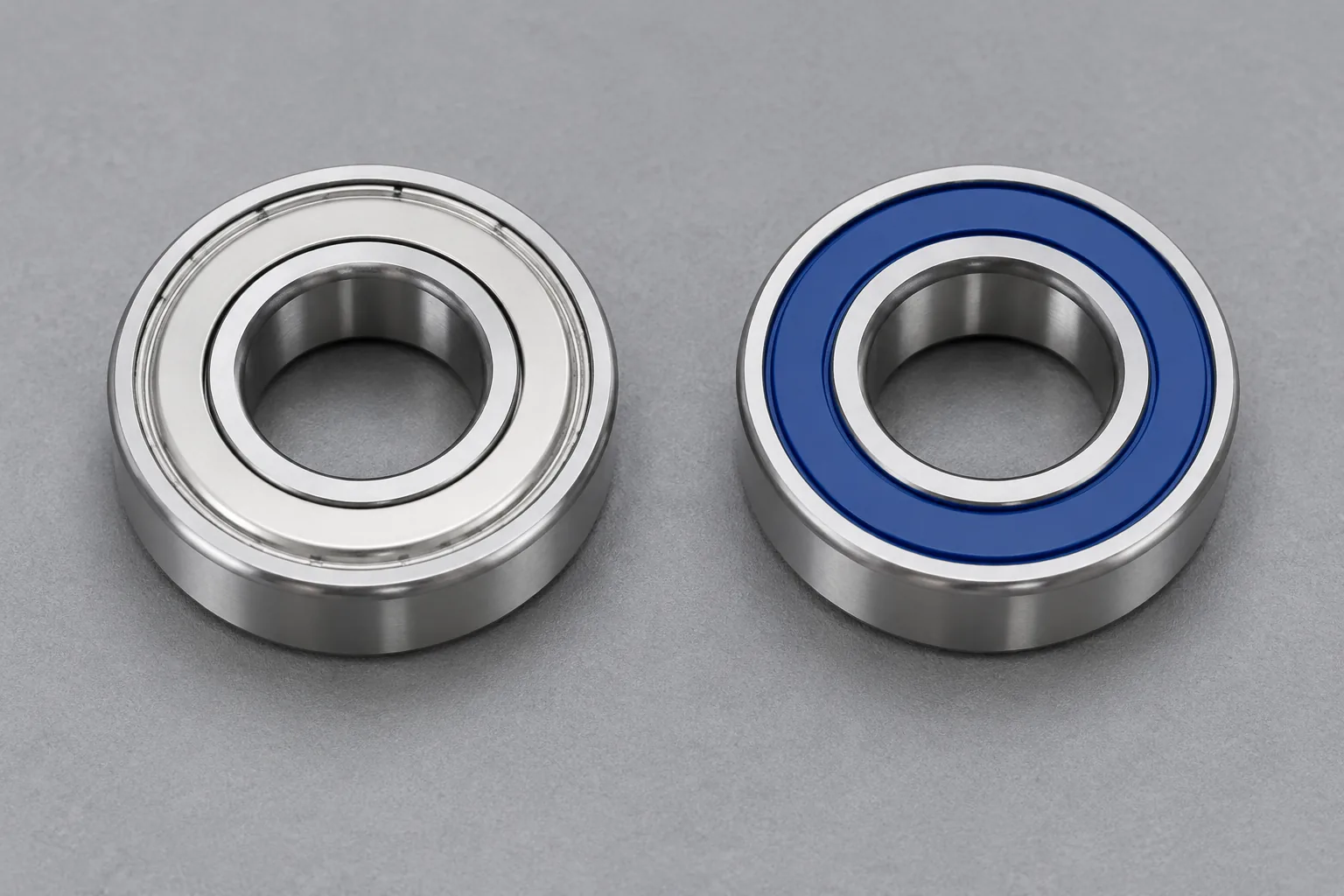
Sealed or shielded stainless steel bearings hold grease in place and limit the ingress of water, dust, and process contaminants. Timken offers open, double shielded, and double contact sealed configurations. Contact seals usually provide higher grease retention and dust protection than shields, but they also add torque and friction. The seal choice is a trade-off between contamination protection and running drag.
Prelubricated capped bearings can reduce maintenance. SKF standard capped stainless steel deep-groove ball bearings are filled with LHT23 grease and defined as maintenance-free for the bearing service life when operating conditions remain within the manufacturer’s limits. NTN solid-grease stainless bearing units reduce grease leakage and may cut rotational torque to approximately one-third to one-quarter that of comparable units using conventional grease. That torque figure is specific to the solid-grease product and should not be generalized to all stainless steel bearings.
Temperature and Extreme-Environment Limits
Timken’s standard corrosion-resistant deep-groove ball bearings have temperature limits of -50°C to +120°C when shielded and -40°C to +120°C when contact-sealed. Those ranges apply to the standard seal, grease, and material combination. Higher temperatures require a different grease, seal, or bearing material.
Extreme cold also has limits. ASTM research reports that 440C at -267°C has a fracture toughness of approximately 11 MPa√m. That value helps explain why cryogenic turbo-pump service may need a special carburizing stainless bearing steel rather than a conventional 440C grade. For any extreme-temperature application, the bearing, lubricant, and seal must be evaluated as a system.
Size and Configuration Range
Timken’s corrosion-resistant deep-groove ball bearing range covers bore diameters of 6 to 50 mm and outside diameters up to 90 mm. The range includes standard, thin-wall, and narrow designs, with open, double shielded, and double sealed options. These figures describe one manufacturer’s range, not a universal size limit for stainless steel bearings. Availability varies by manufacturer, series, and region.
Typical Uses of Stainless Steel Bearings
Stainless steel bearings make sense where moisture, corrosive media, washdown, hygiene, or reduced maintenance justify the cost and the performance trade-offs. The applications below are grouped by that driving condition, not by industry label alone.
Food, Beverage, and Pharmaceutical Equipment
Typical applications include food and beverage processing and pharmaceutical and medical equipment. For equipment that sees frequent washdowns, moisture, food residue, and cleaning agents, stainless steel bearing units are particularly suitable. Examples include automatic slicing and grading equipment on fishing boats and evisceration equipment in poultry processing. Smooth stainless steel housings limit foreign matter adhesion and support hygienic equipment design.
Food-industry variants can pair corrosion-resistant components with NSF H1-registered grease and blue seals that are optically detectable. SKF VP311 uses blue NBR seals that conform to 21 CFR 177.2600, and its lubricant is registered in the NSF H1 category. For its blue food-contact seal, Timken cites compliance with FDA 21 CFR 177.2600 for repeated-use rubber articles and with European Regulation (EC) No 1935/2004. Timken also uses stainless riveted cages that are metal-detectable. Food-contact suitability depends on the complete combination of bearing material, seal, lubricant, and washdown conditions; stainless steel alone is not a food-compliance claim.
Chemical, Hydrocarbon, Pump, Printing, Paper, and Offshore Equipment
SKF lists pumps, printing machinery, paper machinery, offshore equipment, and chemical and hydrocarbon processing among typical stainless steel bearing applications. These uses benefit from improved resistance to moisture and corrosive media, but the bearing still has to be matched to the medium. Confirm chemical compatibility, load, temperature, and lubrication against the specific catalog data. A stainless grade that works in a dilute cleaning solution may not work in a concentrated process chemical.
Machinery Requiring Low Maintenance or Clean Operation
NTN solid-grease stainless bearing units are used in winding machines, film take-up machines, and packaging machinery. These units reduce grease leakage and can lower rotational torque compared with comparable conventional-grease units. Sealed or prelubricated stainless steel bearings can also suit washdown areas or hard-to-service locations when they are specified within manufacturer limits. Solid-grease performance is product-specific and should not be applied to every stainless steel bearing.
Advantages and Trade-Offs of Stainless Steel Bearings
Stainless steel bearings are best understood as a balanced choice, not a universal upgrade. They offer better corrosion resistance and hygiene potential, but they also impose load, temperature, and specification limits that must be designed around.
Advantages in Wet, Corrosive, and Hygienic Environments
Improved corrosion resistance supports use in moisture, washdown, chemical, and hygienic processes. Sealed and shielded designs retain lubricant and reduce the ingress of water, dust, and process contaminants. Detectable components and compliant seals and lubricants can reduce the risk of unplanned downtime and food-line contamination when the full combination is correctly specified. Compared with standard carbon or bearing-steel products, stainless steel bearings can offer cleaner operation and greater suitability for wet or hygienic processes. The benefit depends on the complete seal, lubricant, material, and cleaning regime, not on the word stainless alone.
Trade-Offs to Check Before Selection
Stainless steel deep-groove ball bearings generally have lower load capacity than same-sized conventional high-chromium bearing steel bearings. Stainless steel is not immune to every corrosive environment, and AISI 440C performance depends on temperature, loading, and the specific medium. Contact seals improve lubricant retention and contaminant exclusion but usually increase torque and friction. Standard seal and grease combinations have temperature limits; higher temperatures require alternative grease, seals, or materials. Careful selection of stainless grade, seals, lubricant, and dimensions is required.
Product-specific designs can change the balance. Solid-grease units may reduce maintenance and torque, but that result should not be generalized to other stainless bearings or other operating conditions.
Selection Checklist for Stainless Steel Bearings
Use this checklist as a selection aid, not as a substitute for manufacturer catalog confirmation and application-specific testing.
- Define the environment: list moisture, washdown chemicals, food contact, corrosive medium, temperature, and load direction.
- Choose the grade and confirm ratings: use the stainless version’s load rating, not the rating for a standard bearing steel equivalent.
- Select the closure: choose open, shielded, or sealed based on contamination risk, lubricant retention, and acceptable torque.
- Verify food-contact compliance: check NSF H1 grease, FDA 21 CFR 177.2600 or EC 1935/2004 compliance where applicable, and detectable components if required.
- Check temperature against seal and grease limits: move to alternative lubricants, seals, or materials beyond the standard range.
- Confirm dimensions and tolerances: use ISO 15, ISO 492 Normal, ISO 5753 Normal, or ANSI/AFBMA 12.2-1992 as applicable, and note WBB1 or X-suffix exceptions.
Conclusion
Stainless steel bearings are a corrosion-resistant solution for wet, chemical, hygienic, and low-maintenance applications, but they are not a drop-in upgrade for every standard bearing. The grade, seal, lubricant, load rating, temperature range, and dimensional standard all affect whether the bearing will last. Start with the operating environment, then confirm the stainless version’s ratings and compliance rather than assuming they match the standard bearing. That approach keeps the advantages of stainless steel bearings without hiding their trade-offs.
FAQs
Q1: Are stainless steel bearings rust-proof?
A: No. Stainless steel bearings resist moisture and many corrosive media better than standard bearing steel, but they are not immune to every environment. Chlorides, concentrated chemicals, high temperature, and poor sealing can still cause corrosion or shorten life. The grade, seal, lubricant, and actual medium determine performance.
Q2: Do stainless steel bearings have lower load capacity?
A: Stainless steel deep-groove ball bearings generally have lower load-carrying capacity than same-sized bearings made from conventional high-chromium bearing steel. Use the stainless version’s published load rating rather than reusing the standard bearing’s rating, and check whether the load is radial, axial, or combined.
Q3: What is the difference between shielded and sealed stainless steel bearings?
A: Shields are usually metal and reduce dust entry while allowing some lubricant movement; contact seals are usually elastomer and provide better grease retention and contaminant exclusion but add torque and friction. Choose shields where lower drag matters and seals where washdown or fine contamination is the main risk.
Q4: Can stainless steel bearings be used in food processing equipment?
A: They can be, but food-contact suitability depends on the full combination of bearing material, seal, lubricant, and washdown conditions. Look for NSF H1-registered grease, seals that comply with FDA 21 CFR 177.2600 or EC 1935/2004 where applicable, and detectable components if the line uses metal detection. Stainless steel alone does not establish food compliance.
Q5: Why do stainless steel bearings still fail in corrosive service?
A: Corrosion resistance is limited by the grade, heat treatment, seal integrity, lubricant, temperature, and chemical concentration. AISI 440C, for example, can suffer from coarse carbides and reduced effective chromium in the matrix. If the medium is aggressive or the seal is damaged, the bearing can still corrode, wear, or fracture.
Q6: How do I choose the right stainless steel bearing grade?
A: Match the grade to the medium, load, temperature, and cleaning regime, then confirm the stainless version’s ratings and tolerances. Review the manufacturer’s data for the exact series, including any WBB1 or X-suffix dimensional exceptions, and verify food-contact or detectability requirements when those apply.