Quick Answer: A reliable bearing supplier is the manufacturer or an authorized distributor that can prove, at source, its legal identity, a valid and scope-matched quality certificate, full product-standard conformity, batch or unit traceability, real inspection values and controlled storage. Choose suppliers by evidence and application risk, not by price, stock photos or a self-issued authenticity certificate. Then verify certificates in the issuing body or accreditation database, and confirm authorization and product authenticity through manufacturer channels before approving a first order.
How to choose a reliable bearing supplier is a documentation question before it is a price question. A low quotation, a clean product photo and a scanned certificate image tell you nothing about whether the bearing in the box matches the drawing, the standard or the application. The workflow below turns supplier selection into a repeatable evidence check you can attach to an RFQ, an audit or a repeat order.
Define the bearing requirement and risk level before comparing suppliers
Two quotations for the same bore size can describe two different products. Before comparing anyone, write down the operating conditions: load magnitude and direction, speed, temperature range, contamination exposure, mounting space, maintenance access, and whether the part is safety-related or regulated. Risk level decides the depth of evidence you must demand.
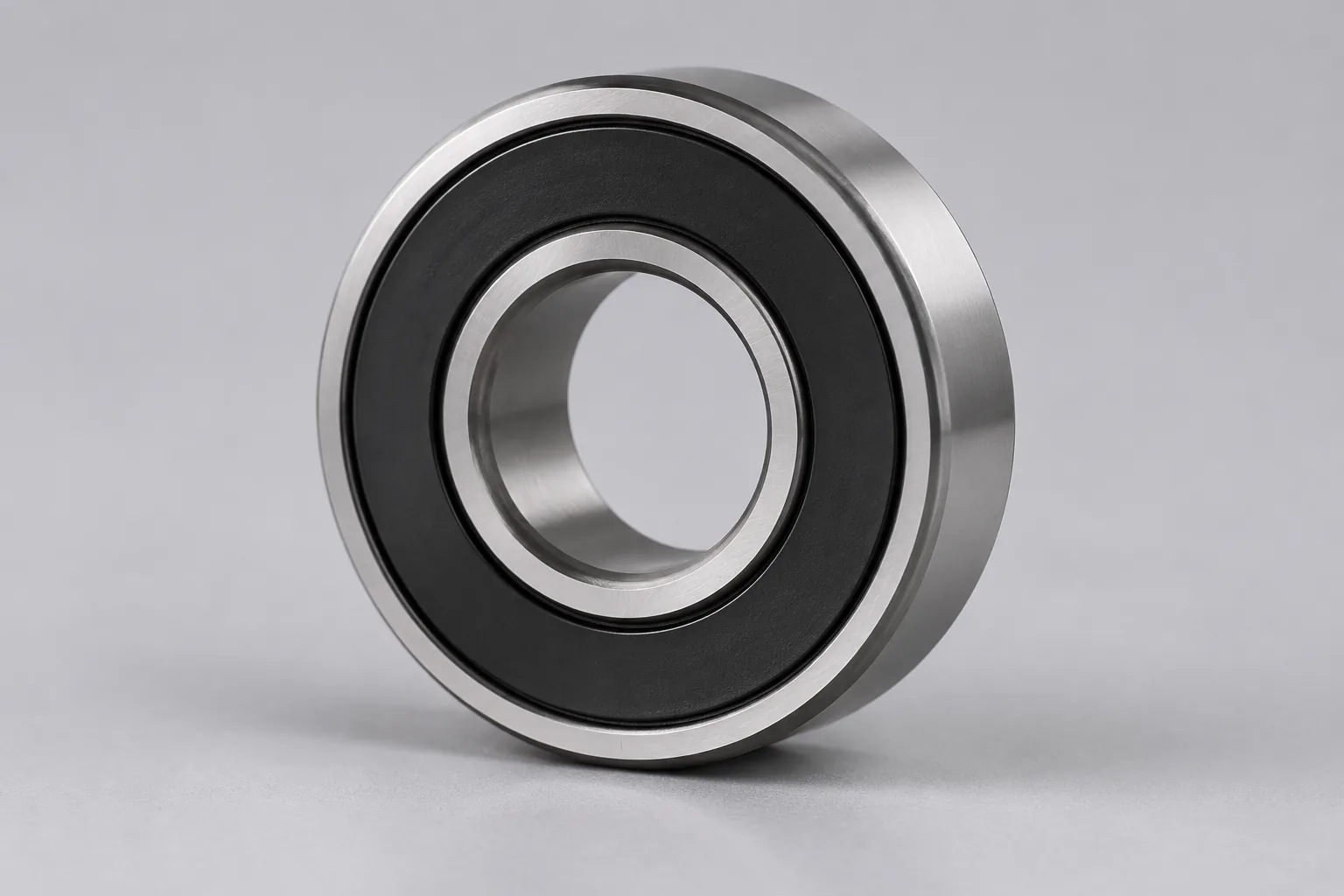
Convert those conditions into mandatory RFQ fields so every supplier answers the same questions:
- Bearing type and complete designation, including the full suffix
- Bore x outside diameter x width
- Tolerance class and internal clearance grade
- Seal or shield configuration
- Cage material
- Lubricant type, quantity and fill
- Dynamic load rating and static load rating
- Limiting speed
Use published standards as the reference framework when you check the answers. ISO 15:2017 covers preferred boundary dimensions for radial bearings, including diameter series 7, 8, 9, 0, 1, 2, 3 and 4. ISO 492:2023 covers radial rolling bearing dimensions, geometric characteristics, nominal deviations and tolerance values. ISO 281:2007 defines basic rating life at 90% reliability and also allows modified life calculations that account for reliability, lubrication condition, lubricant contamination and fatigue load.
A rating life figure is not a total service prediction. ISO 281 does not cover wear, corrosion or electrical erosion, so a calculated life cannot replace an audit of sealing, lubrication, contamination and current damage risk.
Where the application requires it, escalate the system requirement: IATF 16949 with the customer-specific requirements of the relevant vehicle manufacturer for automotive supply, and ISO 22163:2023 for railway supply, which addresses defect prevention and product safety across the rail supply chain.
Conditions and exceptions. Safety-related, precision or high-value applications justify tighter evidence than general maintenance stock. Some needle bearings and aircraft bearings fall outside ISO 492 scope and must be checked against their dedicated standard.
Verify the supplier’s legal identity and quality-system certificate at source
A certificate image proves nothing until it is matched to the seller you are actually paying. Compare the legal entity name, the production site address, the certification scope, the standard and the validity dates against the supplier’s business licence and the products you intend to buy. If the certificate names a different legal entity or a different site, the scope does not cover your order.
Then check the certificate in a database rather than in the supplier’s email attachment. IAF CertSearch, the global accredited-certificate database designated by the International Accreditation Forum, confirms status, standard, scope and site, and it flags certificates that are suspended, withdrawn, expired or suspected as forged. Its own published figures describe coverage of about 3.8 million certificates, 81 accreditation bodies, more than 2,600 certification bodies and more than 300 standards.
Read the certificate for what it is. ISO 9001:2026, published on 16 September 2026, is a quality management system standard covering process control, personnel competence, documented information, performance evaluation and improvement. It is not a product certificate. A valid ISO 9001 certificate cannot prove the dimensional accuracy, material grade, rating life or batch conformity of a specific bearing model.
Automotive projects should request IATF 16949 plus the applicable customer-specific requirements; railway projects should request ISO 22163:2023 evidence. A trading company’s certificate does not automatically cover its manufacturing source, so ask which site actually produces the parts.
Require full product-standard conformity in the quotation and data sheet
Ask for the applicable standard and the complete bearing designation, suffix included, in writing. Then compare every declared value with the referenced standard data: boundary dimensions, tolerance class, clearance, seal or shield type, cage material, grease, dynamic and static load ratings and limiting speed. A quotation that lists only a base model number is an incomplete offer, because the suffix often carries the seal, clearance, cage and grease the application depends on.
Inspection documents deserve the same scrutiny. Reject reports that state only “qualified” or “pass”. A usable report names the model, names the batch or serial number, and lists the measured characteristic, the specification limit, the actual measured value and the instrument used. Actual values, not a conformity stamp, are what you can audit.
Accept ANSI/ABMA, DIN or JIS equivalents only when the exact standard number and product scope are stated, and confirm that special bearings are covered by a dedicated standard rather than a general dimensional claim.
Check manufacturer authorization and use official anti-counterfeit tools
Start with the manufacturer’s own authorized distributor directory. A seller listed there has a documented commercial relationship; a seller absent from it needs a different level of scrutiny. Authorization status and product authenticity are separate checks, and both should be closed before a first order.
Where the brand publishes verification tools, use them on the product and on the packaging:
- Schaeffler OriginCheck scans the Data Matrix Code on a sales partner certificate and on packaging to verify both.
- The World Bearing Association Check App covers JTEKT/Koyo, NACHI, NTN, NSK, Schaeffler/INA/FAG, SKF and Timken, matching a packaging QR or DMC code against the manufacturer database.
- NSK Verify reads two-dimensional codes on selected precision bearing packaging and returns the single-piece inspection report without opening the box; it can export CSV or PDF records, and applicable products are identified by an N mark at the lower right of the code.
- NTN has used anti-counterfeit labels carrying microtext, a hologram and QR verification since 2017.
A scan result counts as evidence only when it resolves cleanly. The scheme distinguishes three outcomes: the code exists in the manufacturer database, the code is valid but has been scanned an unusually high number of times, or the code is unknown and the product is suspected counterfeit. An unknown or heavily over-scanned code is an unresolved risk, not a pass, and the item should stay out of service until the manufacturer confirms it.
Two shortcuts fail repeatedly. A supplier-issued certificate of authenticity is paperwork written by the party under suspicion, and counterfeit sellers can produce exactly that. Price is equally weak: published brand-protection guidance notes that counterfeit bearings may sell only slightly below genuine parts, so a bargain price proves nothing in either direction. Manufacturer-published figures for one large brand show an authorized network of more than 17,000 distributors across 130 countries, and even that brand states that final confirmation of a marked product rests with its own specialists.
Scan-based verification works only for participating brands, product lines and packaging formats, so treat it as one control among several rather than a universal test.
Demand batch- or unit-level traceability and real inspection records
Ask the supplier to describe the chain from the manufacturer to the seller you are buying from, in writing. Then require the identifiers that make the chain checkable: manufacturer part number, batch or serial number, production or packaging date, original packaging label, packing list and invoice. Traceability is a field-level requirement, not a promise.
Link the documents to the product. An inspection report should name the exact model and batch and carry measured values; for precision bearings, public traceability examples include dimensional tolerance, rotational accuracy and grease type. For a first order or a high-risk application, add physical sample verification: a packaging code check plus measurement of bore, outside diameter, width, radial clearance, roundness, runout, hardness, vibration and noise. Confirm that the laboratory performing those measurements holds accreditation that actually covers them.
Standard stock bearings can often be traced at batch level. Precision, safety-related or regulated parts may justify unit-level traceability, where each piece carries its own record.
Assess testing capability, calibration and failure-analysis competence
A test report is only as good as the laboratory behind it. Check whether the supplier’s own laboratory or the third-party laboratory holds ISO/IEC 17025:2017 accreditation, and read the scope: accreditation for an unrelated test does not validate the bearing measurements you are relying on. The standard addresses laboratory competence, impartiality and consistent operation, and accredited laboratories are expected to maintain measurement traceability and evaluate measurement uncertainty.
Ask for calibration certificate numbers and expiry dates for the critical gauges used on your parts. Uncalibrated equipment produces numbers that look precise and mean very little.
Failure analysis separates a supplier that investigates from one that explains everything as an installation error. ISO 15243:2017 classifies in-service damage and failure modes of rolling bearings made from standard bearing steel and describes the appearance and probable causes of each mode. A supplier that can name the damage mode from evidence is more useful than one that offers a blanket explanation.
Audit stock age, packaging and warehouse controls
Bearings are shelf-sensitive products. Require original, unopened and undamaged packaging, and ask where and how the stock was held. Published guidance from one major manufacturer recommends storage free from frost, condensation and vibration, with a maximum storage temperature of 40 °C, and first-in-first-out inventory practice; warehouse vibration can damage raceways before the bearing is ever mounted.
Storage life depends on humidity, temperature, bearing type, grease, seal and packaging. For open bearings, published typical figures are:

| Relative humidity | Storage temperature | Typical storage period |
|---|---|---|
| 65% | 20-25 °C | 10 years |
| 75% | 20-25 °C | 5 years |
| 75% | 35-40 °C | 3 years |
| Uncontrolled tropical conditions | Uncontrolled | 1 year |
Sealed or shielded bearings with pre-filled grease are a different case: published guidance gives a maximum storage period of about 3 years, because grease ages, stiffens or separates oil from thickener over time.
These figures describe storage, not a warranty period, and they assume the original packaging remains intact. Ask a stock-holding supplier for packaging dates, warehouse temperature and humidity records, FIFO rules and a re-inspection procedure for long-stored stock. Unknown-age stock should not be treated as equivalent to a fresh production batch.
Put quality, traceability and remedy obligations into the purchase order
Verbal assurances do not survive staff changes. Write the applicable standard, the complete designation and suffix, tolerance and clearance grade, lubrication requirement, inspection documents and traceability fields into the order itself, and attach the required document package. If a document is not named in the order, you have no contractual lever to obtain it later.
The order should also define acceptance criteria, how nonconforming product is handled, return and replacement windows, and who is responsible for failure analysis when a part fails early. Avoid ordering an incomplete base model when the application needs a specific suffix, grease or precision grade; the missing suffix is a defect you bought yourself.
Remedy wording should be reviewed under your own jurisdiction and contract framework. The technical criteria above are an engineering checklist, not legal advice.
Use a weighted supplier scorecard and risk-based approval when choosing a reliable bearing supplier
How to choose a reliable bearing supplier becomes a scoring exercise once the evidence is on the table. Score each candidate on certificate validity and scope match, authorization evidence, product-standard conformity, traceability depth, inspection data quality, storage records, written quality terms and responsiveness. Weight the criteria by application risk, and approve or reject on evidence gaps and risk, not on price alone.
For high-risk categories, require sample verification or first-article approval before release to production, and re-check approved suppliers periodically rather than once. Keep the approval record, the evidence you checked and the date, so a repeat order can be released quickly and an audit can be answered.
Immediate red flags that should block or pause approval
- The certificate cannot be verified in a database, or it names a different legal entity, site or scope.
- The supplier cannot explain the manufacturer-to-seller chain, or refuses to provide batch identifiers.
- The inspection report has no model, no batch and no measured values.
- The only authenticity evidence offered is a certificate issued by the seller.
- Stock age and storage records are unavailable for shelf-sensitive bearings.
Conclusion
How to choose a reliable bearing supplier comes down to one habit: converting every assurance into a checkable record. The supplier’s legal identity and certificate status must be verified at source, the product must be tied to a standard and a complete designation, the chain from manufacturer to seller must be documented, and the laboratory, gauge calibration and storage records must support the claims being made.
Use the criteria in this article as an RFQ attachment, an audit aid and a repeat-order control. Approve on matched evidence and application risk, keep the record, and re-check periodically; a supplier that cannot close a documented gap today is unlikely to close it after the invoice is paid.
FAQs
Q1: Is an ISO 9001 certificate enough to approve a bearing supplier?
A: No. It confirms that a quality management system exists at the certified entity and within the certified scope, and it says nothing about the dimensions, material, clearance or rating life of a specific bearing model. Match the legal name, site and scope to your order, confirm the certificate status in an accreditation database, and add product-level inspection data and traceability for the models you actually buy.
Q2: How can I check whether a bearing is genuine before installing it?
A: Use the manufacturer’s own channels rather than the seller’s assurances: the authorized distributor directory, a packaging code scan through an official brand app or the World Bearing Association app, or a single-piece inspection record read from the packaging code. Treat an unknown code, or a code scanned far more often than normal, as unresolved and hold the part until the manufacturer confirms it.
Q3: Can a supplier’s own certificate of authenticity be accepted?
A: Treat it as a claim, not as evidence. A document issued by the seller does not verify the origin of the product, and counterfeit supply chains produce such paperwork routinely. Accept authenticity confirmation only from the manufacturer, its published verification tools or its authorized directory, and keep the scan result or confirmation with the receiving record.
Q4: How long can bearings be stored before use?
A: It depends on the bearing type, grease, seal, packaging and storage conditions. Published typical figures for open bearings range from 10 years at 65% relative humidity and 20-25 °C down to about 1 year in uncontrolled tropical conditions, while sealed or shielded bearings with pre-filled grease normally carry a maximum storage period of about 3 years. These are storage indications, not warranty terms.
Q5: Do all bearings need unit-level traceability?
A: No. Standard stock bearings can usually be controlled at batch level, with a batch or serial number, packaging date and inspection record tied to the model. Unit-level records are justified for precision, safety-related or regulated parts, and for first orders or high-risk applications where individual measurement results, including dimensional tolerance and rotational accuracy, must be retained.