Quick Answer: A bad bearing often makes a continuous humming, rumbling, or growling sound that rises with speed; grinding, whining, or squealing can also occur. Clicking or popping may come from bearing endplay but also from CV joints; knocking or clunking more often points to CV joints, U-joints, or differentials. Wheel-end bearing noise usually changes with vehicle speed and cornering load. Sound is a diagnostic clue, not proof: CV joints, tires, U-joints, differentials, or lubrication problems can produce similar noises.
A bad bearing does not always make the same sound. A worn wheel-end bearing often starts as a low, continuous hum that follows road speed; later it may turn into a rumble, growl, or grind. Those words can also describe tire noise, a failing CV joint, or a differential problem, so the useful question is not only what the noise sounds like but when it appears, what changes it, and what a physical inspection finds.
This guide begins with automotive wheel-end bearings, then covers industrial bearing noise patterns because the question is not limited to one vehicle type. The aim is practical triage: match the noise to a likely mechanism, then confirm the source before replacing parts.
Common Sounds of a Bad Bearing
The same bearing fault can be described in different words by different people. The table below groups the most useful sound patterns by what they often suggest and whether a bearing is a realistic source.
| Sound | What it often suggests | Bearing is a likely source? |
|---|---|---|
| Continuous hum, rumble, or growl that follows speed | Wheel-end bearing wear or raceway damage; may change with cornering load | Yes, a common pattern |
| Grinding or scraping | More advanced mechanical contact or damage at the wheel end; confirm before replacing | Possible, but confirm |
| Continuous squeal or whine | Lubrication, alignment, load, or contact conditions; can also be wheel-end bearing noise | Possible, not specific |
| Intermittent high-pitched squeal | Some grease-lubricated bearings at low temperature can do this without reduced life under those conditions | Condition-dependent |
| Clicking, popping, or snapping on sharp turns | Bearing endplay or an outer CV joint | Shared symptom |
| Knocking or clunking on torque changes | CV joints, U-joints, or differential backlash more often than a classic wheel bearing | Less typical |
| Regular or irregular metallic noise in industrial equipment | Raceway defects, clearance, foreign matter, or rolling-element damage | Yes, but pattern needs inspection |
Use this table as triage, not a final diagnosis. A bearing noise that appears only when the vehicle is moving and the bearing is loaded can be missed during a simple stationary check.
Humming, Rumbling, or Growling Noise
Humming, rumbling, or growling is the classic continuous wheel-bearing noise. It usually rises with vehicle speed because the rolling elements pass a damaged area more often as the wheel turns faster. The sound may already be present while driving straight, then become more noticeable after a slight steering input changes bearing load. Wheel-end bearing noise can also increase with acceleration or cornering.
This pattern is most useful when the noise is speed-dependent and load-sensitive. Cabin location alone may mislead because noise travels through the body or frame. A rumble heard on one side does not prove that the bearing on that side is the failed part.
Grinding, Scraping, or Metal-on-Metal Sounds
Grinding is a stronger warning than mild humming because it can indicate existing mechanical damage. Grinding that appears while driving, turning, or changing wheel-end load may point to rolling-element or raceway damage at the wheel end. It deserves prompt inspection, especially if it is continuous or accompanied by roughness or looseness.
Contamination can also raise bearing noise. Solid particles pressed by rolling elements can create indentations and fatigue starting points on raceways, and the operating noise may increase as damage develops. Even so, grinding is not exclusively a bearing sound; brake contact, shields, or other rotating parts can produce a similar noise. Confirm the source with physical bearing checks before replacement.
Whining, Squealing, or High-Pitched Sounds
Whining, squealing, or high-pitched sounds are less specific than a steady rumble. Continuous squealing or grinding can be a wheel-end bearing symptom, but a loud metallic sound may also involve abnormal load, shaft or housing misalignment, inadequate or improper lubrication, rolling-element sliding, or rotating-part contact.
Some grease-lubricated medium or large cylindrical roller or ball bearings can produce intermittent squeal or high-frequency sound at low temperatures. Under those specific conditions, this does not affect fatigue life or grease performance. Do not assume every squeal means the bearing must be replaced; check the operating conditions and lubrication state first.
Clicking, Popping, or Snapping Sounds
Snapping, clicking, or popping during sharp turns can come from excessive bearing endplay, but the same symptoms can come from a worn or damaged outer CV joint. This pattern is most relevant during sharp low-speed turns, when the joint and wheel-end load change quickly.
Because the symptom is shared, replacing a bearing on sound alone is risky. Inspect the CV joint boots, joint play, and wheel-end bearing condition together. Clicking is not a bearing-specific symptom.
Knocking or Clunking Sounds
Knocking or clunking is generally not the most typical wheel-bearing sound. When it appears on acceleration-to-coast or forward-to-reverse transitions, look first at CV joints, U-joints, or differential backlash. Those components are loaded and unloaded during torque reversal, which can produce a distinct knock that a steady-speed wheel-bearing rumble does not.
Use the pattern, not the word alone. A single knock during a direction change is a different clue from a continuous growl that follows road speed. Do not use knocking alone as a reason to replace a wheel bearing.
Industrial Bearing Noises: Regular vs Irregular Sounds
Industrial bearing diagnosis often separates regular and irregular abnormal sounds. Regular sounds may correspond to raceway scratches, corrosion, brinelling, or spalling. Irregular sounds may correspond to excessive clearance, foreign matter ingress, or rolling-element surface spalling. A loud metallic sound should prompt checks for load, alignment, lubrication, and rotating-part contact.
This section applies to industrial bearing noise, not only automotive wheel bearings. Because sound descriptions are subjective, the pattern should be linked to operating conditions and a physical inspection of the bearing and its housing.
How the Sound Changes With Speed, Load, and Turning
Wheel-bearing noise usually changes with vehicle speed because rolling elements pass a damaged area more often as speed rises. Slight steering changes load distribution across the wheel end and can make a bad bearing louder. A useful road test compares steady driving, a slight left turn, and a slight right turn at similar speeds.
One field rule holds that if rumbling increases during a slight turn, the faulty bearing is often on the opposite side of the direction indicated by the noise. That rule is a clue, not a location test: noise can travel through the body or frame, so the location heard in the cabin may be misleading. Tire and road effects can also obscure the true source.
Bad Wheel Bearing vs Other Noises
Wheel-bearing noise overlaps with several other fault patterns. The comparison below keeps the common distinctions visible without treating any single sound as proof.
| Noise pattern | Wheel bearing | Other likely source |
|---|---|---|
| Hum, rumble, or growl that follows speed and changes with cornering | Common pattern | Tire or road noise can mimic it |
| Click, pop, or snap on sharp turns | Possible if endplay is excessive | Outer CV joint wear |
| Knock or clunk on acceleration-to-coast or forward-to-reverse | Not typical | CV joints, U-joints, or differential backlash |
Bearing sound is not exclusive. Overlapping symptoms mean one noise can have multiple possible sources, so component-level checks are needed before any part is condemned.
How to Confirm a Bad Bearing Without Relying on Sound Alone
A safe lift inspection adds information that a road test cannot provide. With the vehicle lifted and properly supported, check each wheel end in a consistent order.
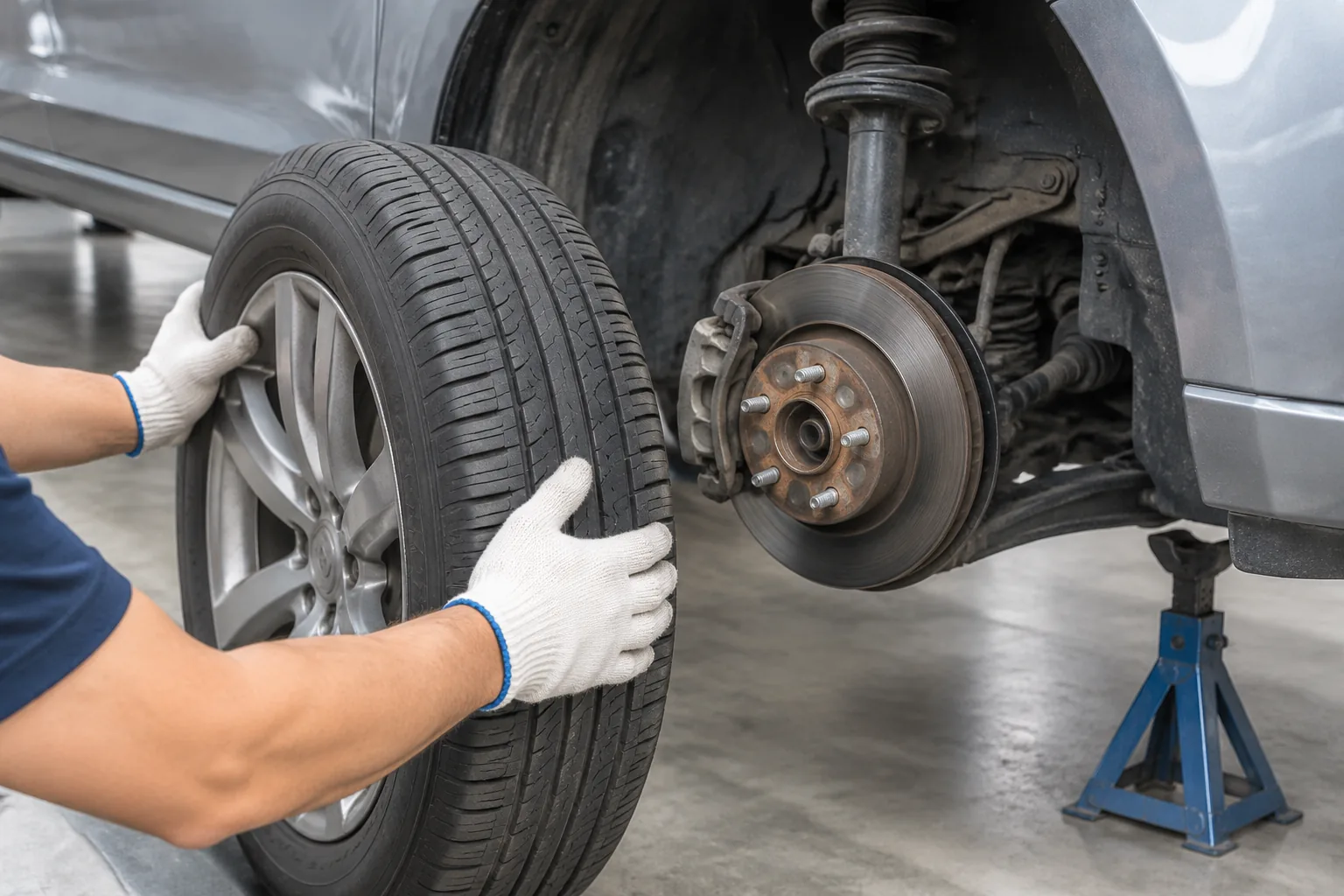
- Rotate the wheel fully and listen and feel for roughness or noise.
- Push and pull the wheel at the 3/9 o’clock and 12/6 o’clock positions to check for looseness.
- While rotating the wheel, touch the suspension spring to feel for vibration that may be present before the noise is obvious to the ear.
- Use vibration monitoring where available; sound monitoring alone has limits.
Some bearing noise appears only when the vehicle is moving and the bearing is loaded, so a quiet wheel when lifted does not always rule out early damage. If rotation shows roughness, looseness, or noise, the bearing is damaged and replacement should be planned.
Why Sound Alone Is Not a Final Diagnosis
Written sound descriptions are subjective, and different observers may describe the same noise differently. A useful diagnosis combines the noise pattern, load and speed behavior, physical play or roughness, and vibration data where available.
ISO 15243:2017, Rolling bearings – Damage and failures – Terms, characteristics and causes, was prepared by ISO/TC 4/SC 4, published in March 2017, and confirmed in 2022. It classifies service damage and failure modes of standard bearing steel rolling bearings by appearance characteristics and likely causes. It does not provide a rule for determining failure from sound alone.
What to Do Next
- If humming, rumbling, growling, or grinding changes with speed or turning, inspect the wheel-end bearing.
- If inspection finds roughness, looseness, or noise during hub rotation, plan bearing replacement.
- If the noise is clicking, popping, knocking, or clunking, also inspect CV joints, U-joints, and differential components.
- Use the sound vocabulary as a triage aid, not a replacement decision by itself.
Seek professional inspection when the noise is persistent, load-dependent, or accompanied by wheel-end play. Keep the low-temperature squeal exception in view as well: for the specific grease-lubricated bearing conditions described above, intermittent squeal may not require replacement.
Conclusion
Sound narrows the search; it does not finish it. A bad bearing commonly produces a speed-related hum, rumble, or growl, and grinding suggests more advanced damage, but clicking and clunking often lead to CV joints, U-joints, or differentials. The practical next step is a road test that records speed and turning effects, followed by a safe lift inspection for roughness, looseness, or noise.
Replace a wheel-end bearing when those checks confirm damage. If the pattern does not fit a wheel bearing, inspect the other loaded components before buying parts. That approach keeps a normal low-temperature squeal, a tire-noise issue, or a driveline clunk from being misread as a failed bearing.
FAQs
Q1: Can a bad wheel bearing make noise only when turning?
A: Yes. A wheel bearing can be quiet while driving straight and become louder when a turn changes the load on that wheel end. The same pattern can also come from a CV joint, tire, or road surface, so confirm the source with a lift inspection before replacing parts.
Q2: Is grinding worse than humming?
A: Grinding is usually a stronger warning because it can indicate existing mechanical damage at the wheel end, such as rolling-element or raceway damage. Humming can appear earlier. Neither sound proves the bearing is the only faulty part, so check for roughness, looseness, and noise during rotation.
Q3: How can I tell which wheel bearing is bad?
A: Use road-test patterns first: compare steady driving with slight left and right turns at similar speeds. If rumbling increases in one direction, the faulty bearing is often on the opposite side, but noise can travel through the body. A lift check of each wheel for roughness, looseness, and rotational noise is more reliable.
Q4: Can a bad bearing click or clunk?
A: Clicking, popping, or snapping on sharp turns can come from excessive bearing endplay, but an outer CV joint can produce the same sound. Knocking or clunking during acceleration-to-coast or forward-to-reverse changes is more often linked to CV joints, U-joints, or differential backlash than to a classic wheel bearing.
Q5: Does bearing noise stop when the car is stationary?
A: Wheel-bearing noise usually follows vehicle speed and load, so it often stops or changes when the car is stationary. Some bearing damage can be quiet when the wheel is unloaded, which is why a moving road test and a loaded inspection both matter.
Q6: When should a wheel bearing be replaced?
A: Plan replacement when a lifted wheel shows roughness, looseness, or noise during hub rotation, because those findings indicate bearing damage. If the noise is persistent, load-dependent, or accompanied by wheel-end play, have the wheel end inspected promptly.