Quick Answer: Heavy duty roller bearings offer their main advantages where line contact between rollers and raceways supports high load capacity and where the bearing type matches the dominant load direction. Cylindrical rollers suit high radial loads, tapered rollers handle combined radial and axial loads, and spherical rollers tolerate misalignment and shock. Calculated life, friction, sealing, temperature capability, and installation still depend on bearing size, internal design, lubrication, and operating conditions.
Heavy duty roller bearings are specified when a machine must carry high load, survive shock or misalignment, or reach a long calculated life target. The useful question is not whether a bearing carries a heavy-duty label, but whether its roller geometry, internal design, and mounting arrangement match the load path. The advantages below are real, but each one has a type limit and an application condition.
What “Heavy Duty” Means for Roller Bearings
Heavy duty is an application description, not a single bearing design. A bearing may be called heavy duty because it carries high radial load, because it absorbs shock, because it tolerates shaft deflection, because it operates in a contaminated environment, or because the duty cycle and reliability target demand a longer calculated life. Those demands do not point to the same bearing.
The basic load-capacity advantage comes from contact geometry. Roller bearings carry load through line contact between the rollers and raceways, while ball bearings carry load through point contact. Published bearing technical guidance describes the difference this way: rollers contact the raceways along a line, while balls contact at a point, so roller bearings can carry higher loads. That difference is the starting point for higher load capacity, but it does not make every roller bearing suitable for every heavy-duty duty.
Selection therefore starts with the dominant load direction and the mounting arrangement. A machine that needs maximum radial capacity has a different answer from one that needs combined radial and axial capacity, and a machine that sees misalignment or shock has another answer again. The heavy-duty label does not replace a type, size, and arrangement check.
Higher Load Capacity from Line Contact
Line contact spreads load over a larger contact area than point contact. That is why roller bearings are generally chosen for higher load capacity than ball bearings of comparable size. In heavy-duty work, the practical benefit is that a given envelope can carry more load, or that a given load can be carried with a more compact bearing section, provided the bearing type and internal design suit the duty.
Cylindrical roller bearings are a clear example. Their rollers maintain linear contact with the raceways, which gives them high radial-load capacity. Published technical data describes cylindrical roller bearings as able to provide very high radial load capacity in a compact installation space. That combination is useful in gearboxes, mill stands, crushers, and other machine sections where radial load is high and space is fixed.
For a sense of scale, the 23180 CC/W33 spherical roller bearing has a 400 mm bore, 650 mm outside diameter, and 200 mm width, with a basic dynamic load rating of 4,864 kN. That figure belongs to that bearing and that rating basis. It is not a generic capacity for heavy-duty roller bearings, and it does not mean the bearing is automatically suitable for every high-load application.
Capacity also has boundaries. A higher load rating does not automatically bring higher axial capacity or better misalignment tolerance. Those properties come from the bearing type and arrangement. A cylindrical roller bearing selected for radial capacity may still need a separate axial locating bearing, while a spherical roller bearing selected for misalignment may have different speed and sealing limits.
Load-Direction Fit: Radial, Combined, and Moment Loads
Load direction decides the family. In a heavy-duty machine, the bearing arrangement usually has to carry radial load, axial load, or both, and sometimes a moment. The common heavy-duty roller bearing types are not interchangeable: each one solves a different part of that load map.
Cylindrical Roller Bearings: High Radial Capacity
Cylindrical roller bearings are primarily high-radial-load bearings. The rollers make linear contact with the raceways, and the design can support very high radial loads with relatively low friction. Low sliding friction between the rollers and flanges also helps cylindrical roller bearings reach higher speeds than some other roller bearing types.
Their axial capability is limited unless the bearing is combined with another bearing or a special arrangement. Use cylindrical roller bearings where radial load dominates and axial load is small or handled elsewhere. They should not be presented as general-purpose combined-load bearings.
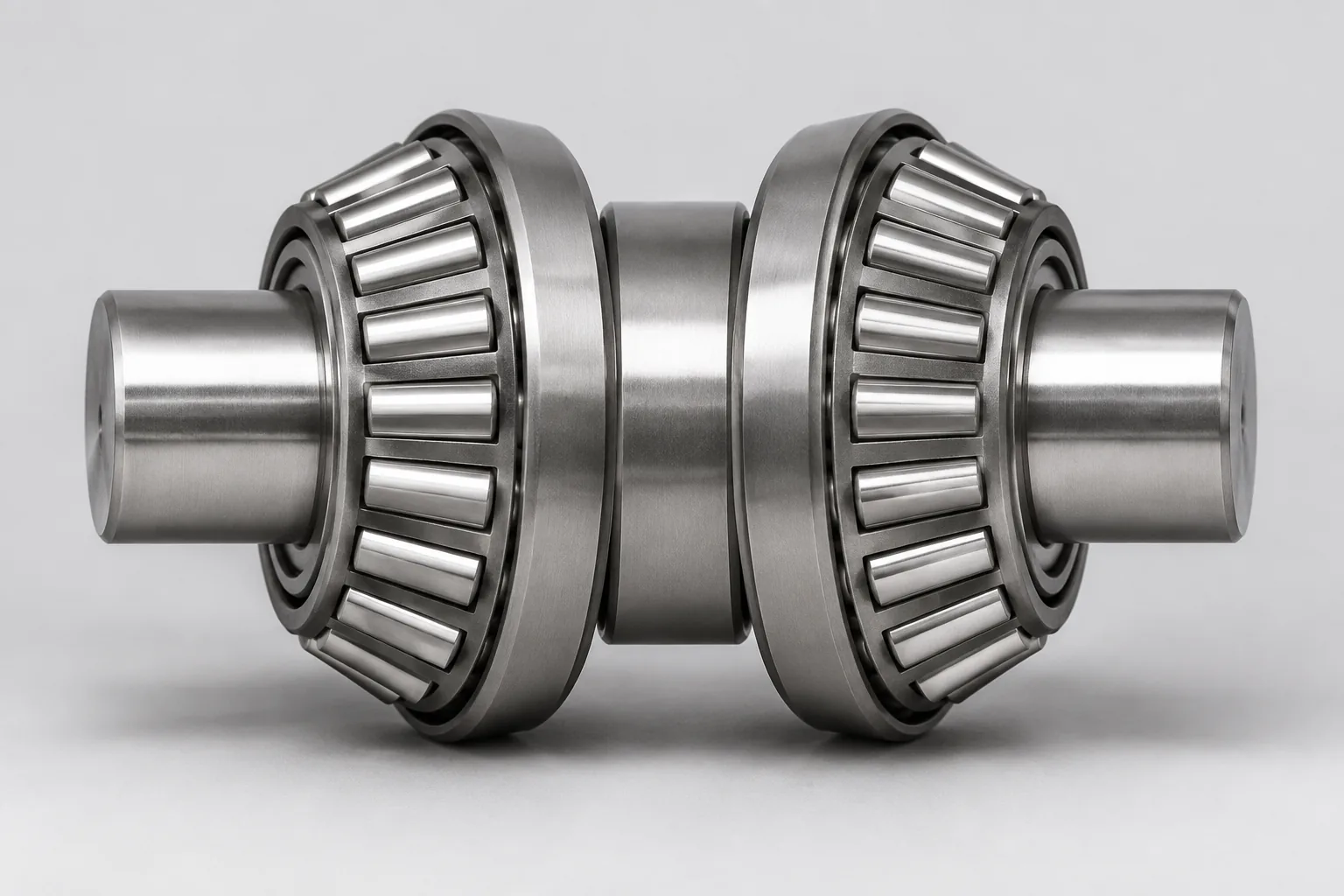
Tapered Roller Bearings: Combined Radial and Axial Loads
Tapered roller bearings are suited to radial loads, thrust loads, and combinations of both. The cone and cup geometry creates a load line that can carry both directions of force when the bearings are mounted and adjusted correctly. A common selection method uses the equivalent dynamic radial load Pr = XFr + YFa for combined radial and axial loads, where the X and Y factors depend on the bearing and the load ratio.
Paired tapered roller bearings can also accommodate moment loads. Technical guidance notes that paired mounting can support radial load, axial load, and overturning moment. The axial spacing between the inner and outer rings can also be adjusted to set internal clearance or preload. Moment capability belongs to the paired or arranged system, not to every single tapered roller bearing.
Spherical Roller Bearings: Misalignment and Shock Loads
Spherical roller bearings can carry radial loads and axial loads in both directions and can compensate for shaft or housing deflection and off-centering. Their high radial capacity makes them suitable for heavy loads and shock loads. That makes them a common choice for conveyors, crushers, fans, and other equipment where the shaft may deflect under load.
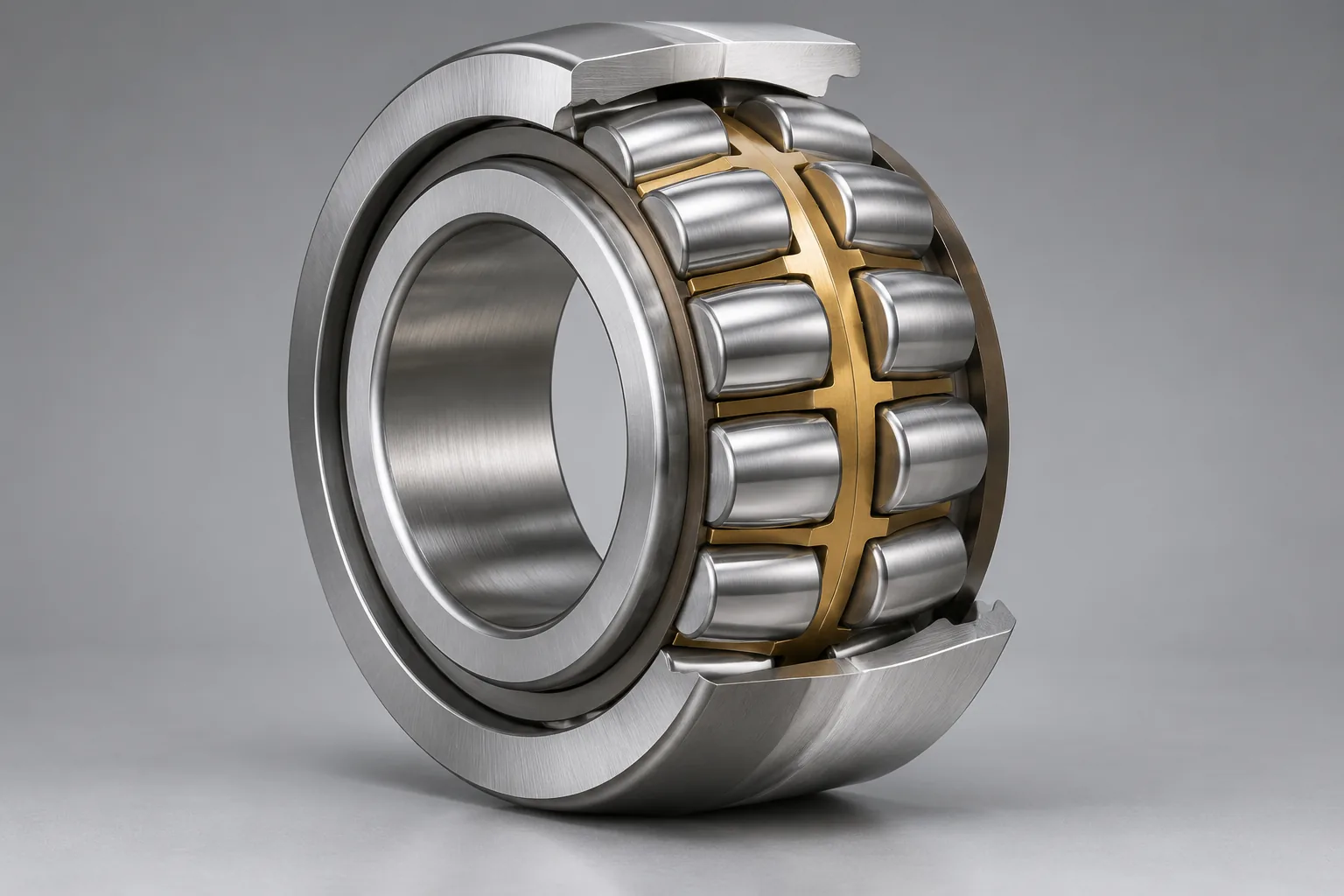
Self-alignment helps reduce the risk of edge loading, but it does not remove the need for correct installation. Misalignment compensation and load capacity depend on the series, size, internal clearance, lubrication, and mounting. A spherical roller bearing can tolerate some misalignment, but it still has limits and still needs a proper fit and alignment check.
Misalignment and Shaft-Deflection Tolerance
Misalignment tolerance is one of the clearest heavy-duty advantages, but it is also one of the easiest to overgeneralize. A self-aligning spherical roller bearing can follow shaft or housing deflection and reduce edge loading. That helps in applications where welded structures, long shafts, or thermal growth make perfect alignment difficult.
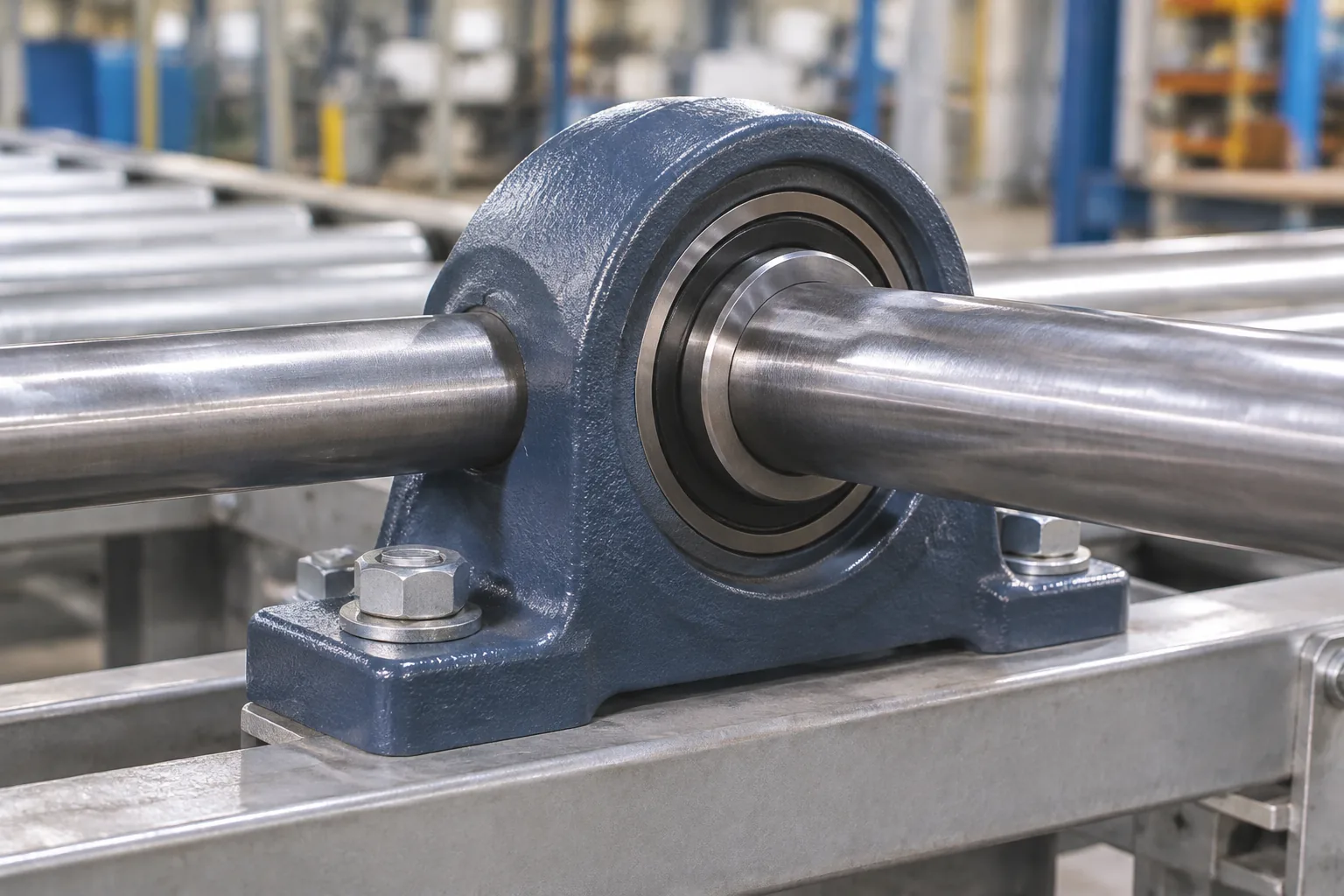
A heavy-duty mounted roller bearing unit with a spherical roller bearing insert provides a quantified example. It compensates for misalignment up to plus or minus 2 degrees. Manufacturer data for that unit states that on a 5 ft shaft, this angle corresponds to more than 4 in of mounting height or horizontal offset.
The plus or minus 2 degree figure is specific to that mounted unit. It should not be applied to every heavy-duty roller bearing. Cylindrical and tapered roller bearings generally require more careful alignment unless a special self-aligning arrangement is used. Even self-aligning bearings need the housing, shaft, and mounting surfaces to be within the manufacturer’s limits.
Longer Calculated Fatigue Life and Reliability
Calculated fatigue life is another major advantage, but it is a rating-life estimate, not a promise of service life. The basic rating life for roller bearings is proportional to (C/P)^(10/3), where C is the basic dynamic load rating and P is the equivalent dynamic load. Because the exponent is 10/3, increasing C or reducing P has a strong effect on calculated life.
ISO 281:2007 sets the basic rating life at 90 percent reliability for specified material, manufacturing quality, and normal operating conditions. The standard also includes modified rating life methods that account for reliability, lubrication, lubricant contamination, and fatigue load. The standard’s rating life does not cover wear, corrosion, or electrical erosion. Actual life also depends on mounting, clearance, temperature, and load distribution.
Optimized designs can raise the rating itself. Optimized tapered roller bearing designs can raise the basic dynamic load rating by up to 25 percent compared with conventional products, and the rating life can reach about twice as long. That is a documented product comparison, not a universal gain for every roller bearing.
Lower Friction and Energy-Saving Potential
Friction matters in heavy-duty machinery because it turns into heat and power loss. Optimized roller bearing internal design can reduce friction torque while keeping the load path stiff. Optimized tapered roller bearing designs can lower friction torque by as much as 75 percent relative to conventional designs.
The energy effect can be measurable in a complete system. In one documented case, a 140 kW wheel loader hydraulic system using low-friction cylindrical and tapered roller bearings recorded power savings of up to 9 kW. That 9 kW result belongs to that specific machine and test case. It is not a general savings figure for all heavy-duty roller bearings.
Real savings depend on load cycle, speed, lubrication, preload, alignment, and system design. A bearing with lower friction torque can still lose its advantage if it is misaligned, over-preloaded, under-lubricated, or contaminated. Friction improvement should be checked as part of the whole drive or hydraulic system, not as a stand-alone claim.
High-Temperature, Sealing, and Contamination Resistance
Temperature and contamination resistance are application-specific advantages. Certain high-capacity spherical roller bearing series cover a 40 to 420 mm shaft diameter range and offer dimensional stability up to 200 degrees C. That capability is useful in high-temperature fans, kilns, and process equipment, but the limit is not just the bearing steel. Seal material, cage material, lubricant, and operating conditions also set the real temperature limit.
Sealing can change the maintenance picture. Some sealed spherical roller bearing designs are factory greased and sealed, which helps keep the correct lubricant in place from installation and helps block external contaminants. Some designs also include an annular lubrication groove and three lubrication holes to support relubrication.
One sealed spherical roller bearing range uses standard ISO dimensions, and its manufacturer reports that the load-rating calculation and test procedure are certified under certificate GL-CER-002-2015. Sealed bearings are not universally maintenance-free. Relubrication and inspection requirements depend on the specific design and environment, and a sealed bearing can still fail if it runs above its temperature or speed limit.
Installation and Design Flexibility
Standard dimensions and pre-packaged lubrication can simplify replacement planning. Sealed spherical roller bearings that use standard ISO dimensions can be swapped into an existing envelope without changing the shaft or housing fit, provided the series and internal clearance are correct. Factory grease can also reduce the initial lubrication step.
Higher-capacity designs can support machine downsizing, but only after validation. High-capacity spherical roller bearing designs can offer higher dynamic load ratings, higher limiting speeds, and longer operating life, and their high-capacity design may allow reduced design space without reducing machine load capacity. That is a design possibility, not an automatic outcome.
Any downsizing move requires a recheck of load rating, life, stiffness, thermal behavior, and mounting conditions. A smaller bearing with a higher rating may still change shaft stiffness, housing fit, seal performance, and heat paths. Installation also remains a controlled process: mounting, alignment, clearance or preload, and lubrication still need correct procedures.
Selection Checklist: When the Advantages Apply
Use the following checklist to decide whether the advantages of a heavy-duty roller bearing apply to a specific machine. The phrase heavy duty is not enough on its own.
- Load magnitude and direction: radial, axial, or combined.
- Shock and vibration: magnitude, frequency, and location.
- Misalignment: expected shaft or housing deflection.
- Speed: continuous and peak speed against the bearing limit.
- Temperature: operating range and heat soak.
- Contamination: dust, water, washdown, and debris.
- Lubrication: grease or oil, relubrication access, and viscosity.
- Life target: required rating life and reliability.
- Available space: envelope, shaft, and housing limits.
- Mounting arrangement: locating, floating, paired, or self-aligning.
- Verification: current manufacturer datasheet for ratings, seals, clearance, and limits.
Map each claimed advantage to a bearing type and a verified condition. A high load rating does not prove misalignment tolerance, a sealed design does not prove maintenance freedom, and a low friction torque does not prove system energy savings. For any DUHUI bearing under consideration, request the current datasheet for dimensions, ratings, seals, lubrication, temperature limits, and certifications before release.
Conclusion
Heavy duty roller bearings deliver their key advantages when the bearing type matches the load path. Line contact supports high load capacity, cylindrical rollers favor high radial loads, tapered rollers handle combined radial and axial loads, and spherical rollers add misalignment and shock tolerance. Calculated life, friction, sealing, temperature capability, and installation flexibility are real advantages, but each one is bounded by size, internal design, lubrication, mounting, and operating conditions. The safe next step is to verify the specific bearing, arrangement, and datasheet against the actual duty cycle rather than relying on a heavy-duty label.
FAQs
Q1: Are heavy duty roller bearings always better than ball bearings for high-load applications?
A: No. Roller bearings usually have a load-capacity advantage because their rollers contact the raceways along a line, while balls contact at a point. The better choice still depends on speed, friction, misalignment, axial load, lubrication, and space. A ball bearing may be the better fit when load is moderate and low friction or high speed dominates.
Q2: Which roller bearing type should I use for combined radial and axial loads?
A: Tapered roller bearings are the usual starting point because they are designed for radial loads, thrust loads, and combinations of both. Spherical roller bearings can also carry radial and axial loads in both directions while tolerating misalignment. Cylindrical roller bearings are mainly radial-load bearings unless combined with another bearing.
Q3: Do spherical roller bearings eliminate alignment problems?
A: No. Spherical roller bearings compensate for shaft or housing deflection and off-centering within their design limits, which reduces edge-loading risk. They still need correct shaft and housing fits, mounting, lubrication, and clearance. A quantified misalignment figure belongs to a specific product and size, not to all spherical roller bearings.
Q4: What does a 4,864 kN basic dynamic load rating mean on the 23180 CC/W33?
A: It is the basic dynamic load rating for that 400 mm bore, 650 mm outside diameter, 200 mm width spherical roller bearing. It is used with the equivalent dynamic load to calculate rating life. It is not a safe working load and it does not transfer to other bearing sizes or types without a new calculation.
Q5: Why is L10 life tied to 90 percent reliability?
A: ISO 281:2007 sets the basic rating life at 90 percent reliability for specified material, manufacturing quality, and normal operating conditions. That means a calculated L10 life is the life at which 90 percent of a population is expected to reach without fatigue failure. It does not cover wear, corrosion, electrical erosion, or poor lubrication and contamination.
Q6: Can sealed spherical roller bearings be relubricated?
A: Some can. Certain sealed spherical roller bearing designs include an annular lubrication groove and three lubrication holes for relubrication. Others are intended to run with their factory grease for a defined service period. Check the specific design, seal type, speed, and temperature before planning a relubrication interval.
Q7: Does a higher load rating mean I can use a smaller bearing?
A: Not automatically. A higher dynamic load rating can support a smaller design space in some machines, but downsizing requires a new check of rating life, stiffness, thermal behavior, housing fit, seal performance, and mounting. The machine load capacity must still be verified for the complete arrangement.
Q8: How do I verify a heavy duty roller bearing for a specific application?
A: Start with the load magnitude and direction, shock, misalignment, speed, temperature, contamination, lubrication, life target, available space, and mounting arrangement. Then check the current manufacturer datasheet for dimensions, ratings, clearance, seals, lubrication, temperature limits, and certifications. The phrase heavy duty is not a substitute for that review.