Quick Answer: A turntable bearing is a large-diameter rotary bearing, also called a slewing bearing or slewing ring, that connects a rotating structure to a stationary one. It carries axial load, radial load and tilting moment, separately or together, and can run continuously or oscillate through a limited angle. Steel designs use balls or rollers in hardened raceways; small polymer versions use sliding elements. Typical uses include cranes, excavators, platforms and wind turbines.
A turntable bearing is the rotary joint under a crane slewing platform, an excavator house, a wind turbine nacelle or a machine-tool table. It looks like a wide, shallow ring rather than a conventional bearing, and it takes the whole load of the structure above it – weight, side force and the tipping effect of an overhung load – in one position.
Buyers and maintenance engineers usually need the same four answers: what the component actually is, which loads it takes, how the design variants differ, and what has to be checked before one is ordered or installed. The sections below work through construction, load directions, common designs, gearing, size ranges, applications, selection, installation and mounting flatness, static rating practice and inspection intervals.
Definition and Common Names
A turntable bearing is a large-diameter bearing that sits between a rotating structure and a stationary one, allowing the upper structure to turn or oscillate while the lower one stays fixed. In industrial use, turntable bearing, slewing bearing, slewing ring and slew ring all name the same general component; the shorter forms are simply shop-floor usage.
The bearing carries axial load, radial load and tilting or overturning moment, separately or at the same time. That combined capability is what distinguishes it from a plain thrust bearing or a radial bearing used on its own.
A slew drive is a different product. It packages a slewing ring together with a geared drive, a housing and usually factory lubrication, so the two terms should not be swapped in a specification or a purchase order.
How a Turntable Bearing Works
Both rings are drilled for mounting, and each ring is bolted to a different structure – typically the chassis or tower below and the rotating platform above. Relative motion happens inside the bearing: the inner and outer rings stay fixed to their structures while balls or cylindrical rollers roll along hardened raceways. Some lightweight designs replace rolling elements with low-friction polymer sliding elements.
Motion is not limited to full revolution. These bearings handle continuous rotation and also limited-angle slewing or oscillating movement, which is common on cranes, positioning tables and indexing machinery.
Because one ring set takes all three load directions, a single slewing ring can replace a conventional arrangement of separate radial and thrust bearings, or of fixed and floating bearings. That collapses several bearing positions into one, simplifies the housing and shortens assembly time.
Basic Construction
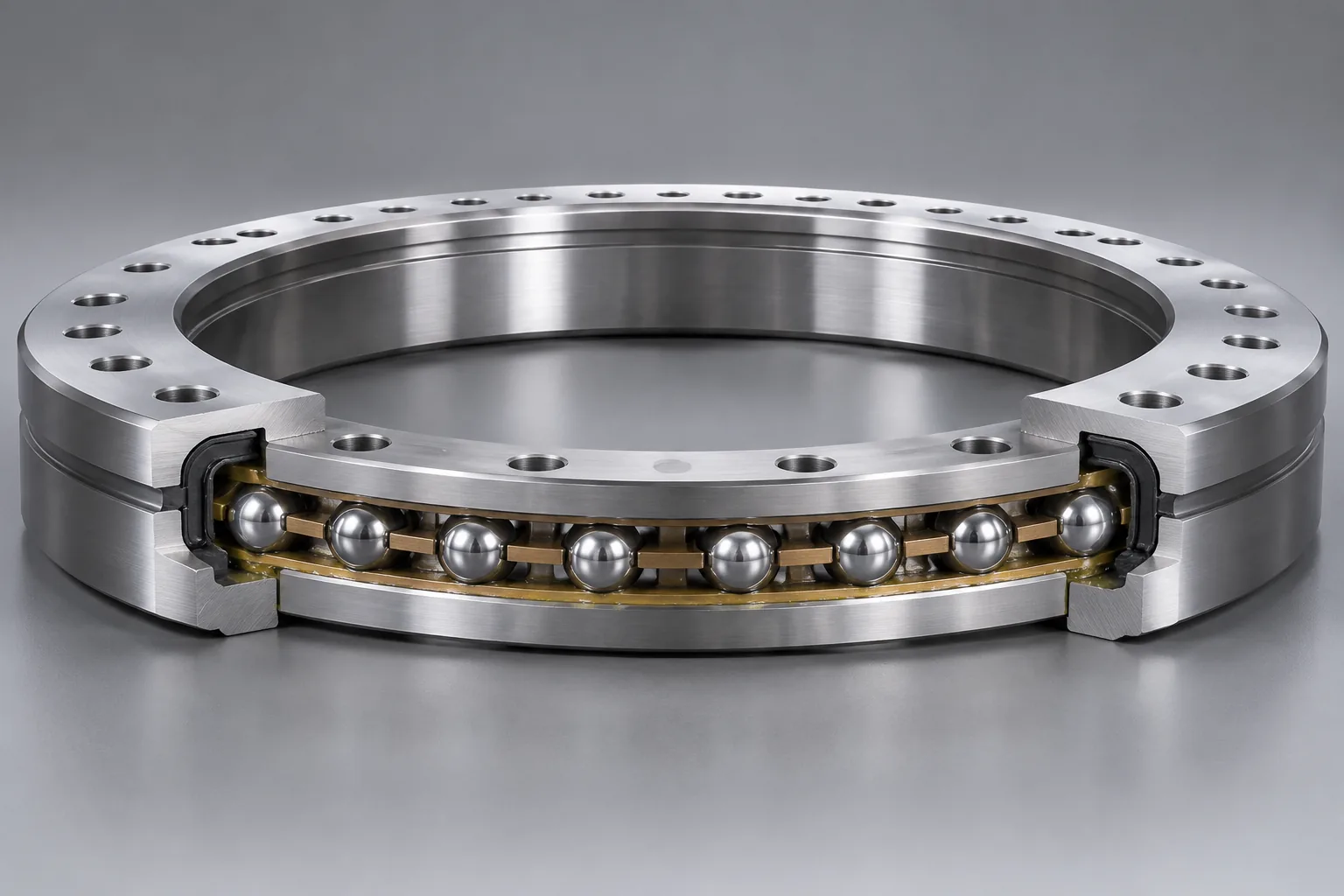
A typical rolling-element turntable bearing contains:
- an inner ring and an outer ring, both with mounting holes;
- balls or cylindrical rollers as rolling elements;
- spacers or a cage that separates the rolling elements;
- hardened and machined raceways;
- seals across the raceway gap;
- one or more grease fittings.
Either ring can carry a gear. Where a gear is used, the teeth are cut directly into the inner or outer ring and driven by a pinion, so rotation is powered through the bearing itself rather than through a separate ring. Mounting holes are normally provided in both rings and may be threaded depending on the product.
Loads and Motion Supported
- Axial load acts parallel to the rotation axis – the weight of the platform plus working loads.
- Radial load acts perpendicular to the axis, for example from a jib, a side-mounted tool or wind pressure.
- Tilting or overturning moment tries to tip one ring relative to the other and often governs the size on an overhung structure.
The three directions can act separately or simultaneously, and the same bearing supports continuous rotation as well as limited-angle slewing.
Common Turntable Bearing Designs
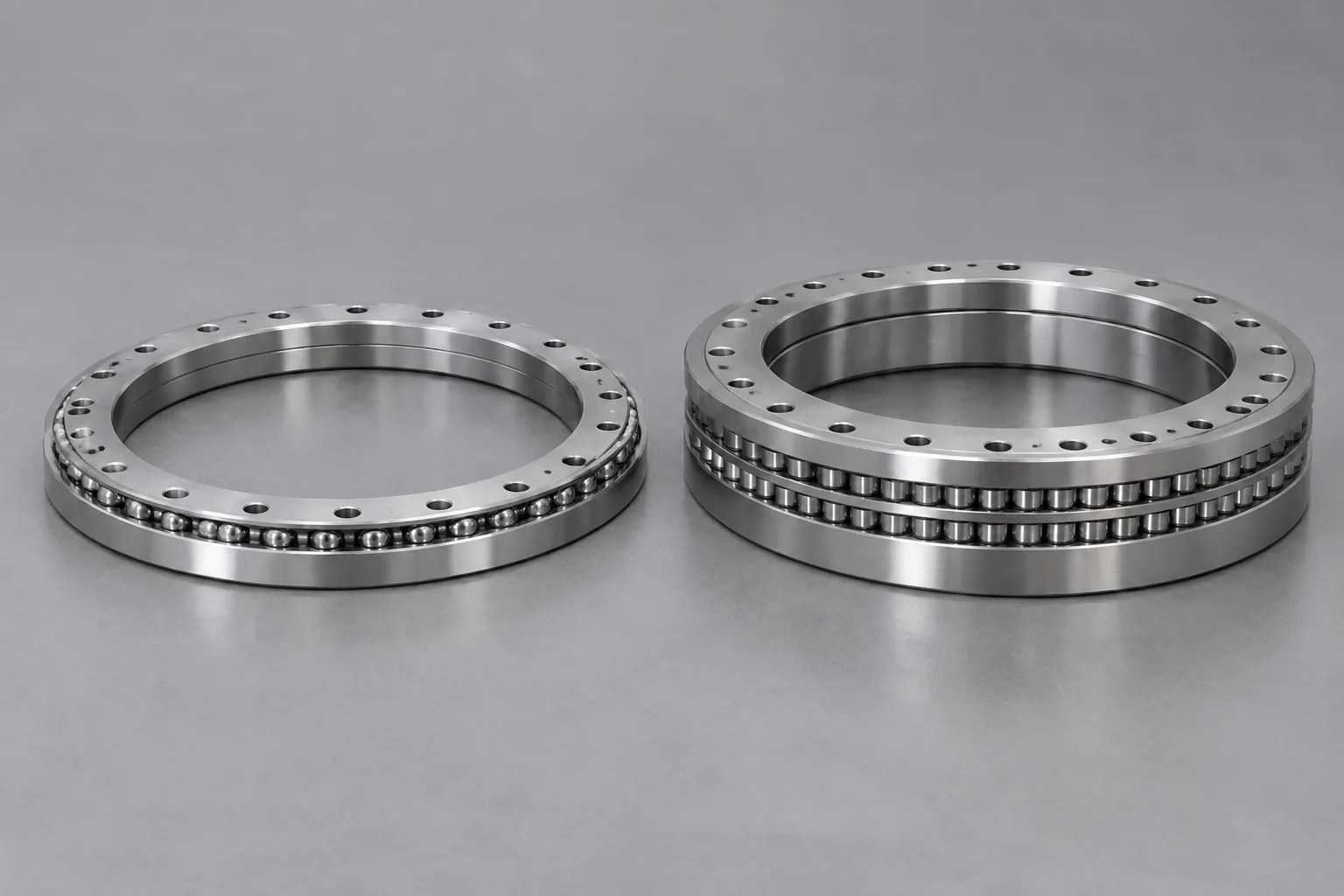
Common configurations cover single-row and double-row ball types, single-row and triple-row roller types, plus crossed-roller, four-point-contact and combined ball-and-roller designs.
The choice depends on load capacity, installation height, motion requirement and the stiffness of the surrounding structure. A heavier-duty design is not automatically the better answer for a lightly loaded indexing table, where section height and rotational resistance may matter more than maximum moment capacity.
Single-Row Four-Point-Contact Ball Bearings
A single-row four-point-contact bearing uses one ball row, and its raceway geometry lets the same ball transmit load in more than one direction. The result is a comparatively low section height with combined load capability. This design suits excavator swivelling systems, tower cranes and large rope winches, according to Liebherr.
Triple-Row Roller Bearings
Triple-row roller slewing bearings target high load capacity within a relatively compact installation height, because separate roller rows handle axial load, radial load and moment. Standard triple-row products from IMO cover raceway diameters of 1,250 to 4,750 mm and maximum tilting moments of 1,735 to 48,351 kNm.
Crossed-Roller and Combined Ball/Roller Designs
Crossed-roller bearings are listed among commercial slewing-ring configurations, with the rollers crossed in the raceway so the same track carries load in several directions. Combined ball-and-roller bearings are also available where an application needs mixed characteristics, such as high axial stiffness together with moderate moment capacity. Treat these names as configuration options to be matched to the duty, not as universal recommendations.
Polymer Sliding-Element Turntable Bearings
Some small turntable bearings use self-lubricating polymer sliding elements instead of balls. The igus iglide PRT-04 is offered in these inner diameters: 20, 30, 50, 60, 100, 150, 200 and 300 mm. The supplier describes it as maintenance-free. These are light-duty components for rotary tables, packaging stations and similar mechanisms; they are not a substitute for a steel rolling bearing in a high-moment application.
Gear Options
Turntable bearings may have an external gear, an internal gear, or no gear at all. When a gear is present it can be cut directly into the inner or outer bearing ring, and a pinion drives that gear to produce rotation. Induction-hardened gear teeth are an option on large-diameter bearings, according to Liebherr.
Gear layout usually follows the drive arrangement: an internal gear keeps the pinion within the ring diameter, while an external gear is easier to reach for inspection of tooth condition and backlash.
Materials, Raceways, Sealing, and Lubrication
Steel slewing bearings commonly use induction-hardened raceways, which give a hard running surface over a tougher core. Liebherr reports induction-hardened, finely machined raceways on its large-diameter bearings, with induction-hardened gear teeth as an option.
Conventional steel bearings normally use a sealed raceway system with grease lubrication, and relubrication is carried out through grease fittings. Integral acrylonitrile-butadiene rubber (NBR) seals, as specified by SKF, retain lubricant and keep contaminants out. Sealing deserves attention because the raceway circumference is long: water or grit that enters the gap stays in the track instead of being thrown clear.
Polymer sliding-element designs may be self-lubricating instead of grease-lubricated, which is why they are described as maintenance-free within their stated duty limits.
Size, Load, and Weight Ranges
Turntable bearings cover a very wide span. Industrial slewing rings from IMO span diameters of 100 to 6,000 mm, with ball sizes of 12 to 80 mm and roller diameters of 10 to 100 mm. Unsplit slewing bearings from Liebherr range from 800 to 8,000 mm, and larger units can be made in segmented form. Liebherr bearings can weigh up to 25 metric tonnes, with gear modules up to 55.
A published example shows how those figures scale in practice. Liebherr model KUD02500-050VO15-900-000 is a single-row four-point slewing bearing with:
- outside diameter 2,676 mm and raceway diameter 2,500 mm;
- rolling elements of 50 mm;
- weight 1,046 kg;
- static load rating 18,212 kN and dynamic load rating 1,324 kN.
Typical Applications
Applications documented in the literature range from cranes, excavators and access platforms to tunnel-boring machines, wind turbines, robots, indexing tables, rotary platforms, railway bogies, solar mirrors, offshore equipment, radar and antenna systems, and bottling machinery.
In wind turbines, slewing rings serve as blade-pitch bearings, yaw bearings and generator bearings. Turbine sizes covered by IMO products range from 5 kW to more than 14 MW, with bearing diameters from 200 to 6,000 mm.
Selection Factors
Sizing is a load-case exercise, not a bore-and-diameter lookup. A complete selection normally requires:
- axial and radial forces and the overturning moment;
- the load spectrum and duty cycle, not only a peak value;
- rotational speed, and whether motion is continuous or oscillating;
- mounting-space limits and the stiffness of the supporting structure;
- required life and the acceptable safety margin;
- gear torque where a geared ring is used;
- lubrication conditions, operating temperature and environmental exposure.
Manufacturers use static load-capacity curves and service-life curves for the final check, because an oscillating duty with small angles loads the raceway differently from continuous rotation. Confirm the final selection with the manufacturer, especially for unusual loads or environments.
Installation and Supporting-Structure Requirements
Bolt holes in both rings allow the bearing to be attached directly to the rotating and stationary structures. The two mounting surfaces must be sufficiently flat and rigid, because deformation of the supporting structure can change load distribution and rotational resistance even when the bearing itself is correct.
thyssenkrupp rothe erde publishes permissible flatness limits under DIN EN ISO 1101, and those limits vary with bearing design and circuit diameter. Exact flatness and mounting requirements therefore depend on the specific bearing and must be verified with the manufacturer before a structure is machined.
Static Load Ratings and Standards
ISO 76:2006 sets out methods to calculate basic static load ratings. It also covers static equivalent loads for conventional rolling bearings. The third edition was published in May 2006, amended in 2017 and confirmed in 2020.
Under DIN ISO 76 principles, the basic static load rating corresponds to a contact stress that produces permanent deformation of approximately 1/10,000 of the rolling-element diameter under normal contact conditions. That figure defines the rating; it is not a failure threshold for the bearing in service.
ISO 76 also warns that standard calculations may not give satisfactory results where contact areas are truncated or normal load distribution is altered by misalignment, preload, unusually large clearance, coatings or special surface treatments. In such cases the manufacturer should be consulted.
Inspection and Maintenance
Per Schaeffler guidance, check fixing-screw condition, tightening torque and tilting clearance every 500 operating hours and at least every six months. On steel bearings, seals and grease condition need the same attention: changed running noise, roughness, vibration or rotational resistance points to a raceway or lubrication problem and calls for diagnosis rather than immediate replacement.
Polymer sliding-element bearings such as the iglide PRT-04 are described as maintenance-free, but load, speed, temperature and contamination should still be checked against the published limits. Heavy loads and high contamination call for shorter inspection intervals.
Turntable Bearing vs Slew Drive
A turntable bearing, slewing bearing or slewing ring is a bearing component on its own. A slew drive combines that bearing with a geared drive, a housing and usually factory lubrication, so it arrives as a complete rotation unit.
The practical difference is scope. With a bearing, the drive, housing and lubrication arrangement are designed around it; with a slew drive, those decisions are already made by the supplier. Spare-part identification also differs, because a slew drive is ordered as an assembly rather than as a single ring.
Conclusion
Turntable bearings are large rotary bearings that take axial load, radial load and tilting moment in one position, which is why a single slewing ring can replace several conventional bearing positions. The design family – four-point-contact ball, triple-row roller, crossed-roller, combined or polymer sliding – follows the duty, the available height and the stiffness of the structure. Confirm load case, mounting flatness, gear torque and lubrication against the manufacturer’s data before ordering, and set inspection intervals from operating hours and environment rather than from habit.
FAQs
Q1: Are turntable bearings the same as slewing bearings?
A: In common industrial usage, yes. Turntable bearing, slewing bearing, slewing ring and slew ring are different names for the same general component, a large-diameter bearing that connects a rotating structure to a stationary one and carries combined loads. A slew drive is a different product because it includes the geared drive and housing.
Q2: What loads can a turntable bearing carry?
A: Axial load parallel to the rotation axis, radial load perpendicular to it, and tilting or overturning moment, separately or at the same time. On an overhung structure the moment often governs the size, while on a mainly vertical load the axial capacity does.
Q3: Can turntable bearings rotate continuously?
A: Yes. They support continuous rotation and also limited-angle slewing or oscillating movement. Match the lubrication and inspection plan to which of the two the machine actually does, because small oscillation angles load the raceway differently from full revolution.
Q4: Do turntable bearings need lubrication?
A: Conventional steel bearings normally use a sealed raceway with grease lubrication and are relubricated through grease fittings. Some polymer sliding-element designs are self-lubricating and described as maintenance-free, but their load, speed and temperature limits still apply.
Q5: How often should a turntable bearing be inspected?
A: Per Schaeffler guidance, inspect fixing screws, tightening torque and tilting clearance every 500 operating hours and at least every six months. Heavy loads, high contamination or frequent oscillation justify shorter intervals.
Q6: What is the difference between a turntable bearing and a slew drive?
A: A slew drive combines a slewing bearing with a geared drive, a housing and usually factory lubrication, so it is a complete rotation unit. A turntable bearing is the bearing component alone, and the drive and housing are designed around it.
Q7: How do I choose a turntable bearing?
A: Start with axial and radial forces, the overturning moment and the load spectrum, then add speed, duty cycle, mounting space, structure stiffness, required life, gear torque, lubrication, temperature and environment. Compare the result against the manufacturer’s static capacity and service-life curves, and confirm the final selection with them.