Quick Answer: McGill bearings include CAMROL cam followers, TRAKROL track rollers, CAGEROL and GUIDEROL heavy-duty roller bearings, SPHERE-ROL spherical roller bearings, and aircraft or specialty bearings. Common CAMROL configurations include stud-type and yoke-type designs, while TRAKROL outer rings may be plain, V-grooved, or flanged. Series codes and suffixes identify the configuration, so final selection should be checked against current official catalog data for dimensions, ratings, and availability.
McGill bearings are usually specified by family, mounting style, and series code, not by a single universal part number. This McGill bearings overview of common types compares cam followers, track rollers, heavy-duty roller bearings, spherical roller bearings, and specialty designs so buyers and maintenance teams can narrow the choice before checking current catalog data.
What Are McGill Bearings?
McGill is a bearing brand under Regal Rexnord Corporation, headquartered in Milwaukee, Wisconsin, USA. The brand covers mounted and unmounted bearings, with a product scope that includes cam followers, track rollers, heavy-duty roller bearings, spherical roller bearings, and specialty or aerospace bearings. McGill was founded in 1905 and obtained the CAMROL cam-follower bearing patent; the CAMROL catalog lists more than 1,400 combinations and configurations. CAMROL remains a central reference point in the brand’s cam-follower technology.
- Founded: 1905.
- CAMROL: patented cam-follower bearing design; more than 1,400 combinations and configurations in the catalog.
- Corporate ownership: Regal acquired Emerson Power Transmission Solutions in 2015, including McGill, Browning, Rollway, and Sealmaster.
- Headquarters: Milwaukee, Wisconsin, USA.
Common McGill Bearing Families at a Glance
The table is a quick-reference anchor; the sections below explain the same families in more detail.
| Family | Main function | Common configurations | Representative codes | Typical selection drivers |
|---|---|---|---|---|
| CAMROL cam followers | Cam-follower and radial load support in cam or guide motion | Stud type and yoke type; inch and metric; full-complement, caged, or cylindrical roller internals | CF, CFH, CYR, MCF, MCYR, CFD, CYRD, SDCF, SDMCF | Mounting style, radial load, shock, speed, lubrication, outer-ring profile |
| TRAKROL track rollers | Track, guide, and wire-straightening support | Plain OD, V-groove OD, flanged OD | PCF, VCF, FCF | Track profile, contamination, seal construction, load |
| CAGEROL heavy-duty roller bearings | Caged roller support for higher speed or shaft misalignment than ordinary full-complement needle bearings | MR outer ring, cage, and roller assembly; typically no inner ring | MR | Speed, misalignment, shaft hardness and finish, lubrication |
| GUIDEROL roller bearings | Center-guided roller support | Outer ring and roller assembly; optional MI-series separable inner rings | GR | Shaft support, inner-ring preference, interchange checks |
| SPHERE-ROL spherical roller bearings | Self-aligning spherical roller support | Clearance C1, C2, Standard, C3, C4; S and SS seals; E internal floating design | SB | Load, clearance, seal type, temperature, misalignment |
| Aircraft and specialty bearings | Compact, high-static-capacity or application-specific bearing support | Historical aircraft roller series and custom designs | NBE, NBK | Application approval, current availability, mounting envelope |
CAMROL Cam Followers
CAMROL cam followers are available in stud-type and yoke-type configurations. Stud type is intended for cantilever or overhung mounting; yoke type is intended for straddle mounting with shaft support at both ends. Common inch series include CF, CFH, and CYR; metric series include MCF and MCYR.
Metric CAMROL bearings offer three internal designs: full-complement needle rollers, retained or caged needle rollers, and cylindrical rollers. The outer ring uses a relatively heavy radial section to handle bending stress and heavy or shock loads. Standard outer-ring options include a cylindrical OD and a 500 mm crown radius; standard products use black oxide surface treatment, and most sizes have relubrication holes.
Standard catalog grease is lithium-based with an operating range of -29°C to +120°C (-20°F to +248°F). That range applies to the standard lithium grease, not necessarily to every optional lubricant. LUBRI-DISC seals can help retain lubricant, exclude contaminants, and reduce metal-to-metal contact between the outer ring and end plate or flange.
Heavy-Duty CAMROL Variants
Heavy-Duty CAMROL bearings use double-row full-complement cylindrical rollers for higher radial load capacity and shock resistance. Roller ends can help accommodate intermittent axial loads. Typical series codes include CFD and CYRD.
Inch Heavy-Duty CAMROL versions default to a cylindrical OD, which increases contact area between the roller and track. These bearings use hardened raceways, a heavy-section outer ring, and sealing to suit higher radial loads and shock conditions.
Special-Duty CAMROL Variants
Special-Duty CAMROL bearings use caged needle rollers to create more grease storage space and allow higher speeds. Typical codes are SDCF and metric SDMCF.
Standard construction includes a metal expansion plug, LUBRI-DISC seal, synthetic NLGI No. 2 grease, and a hex mounting hole in the stud end. Mounting dimensions are interchangeable with standard CAMROL cam followers.
TRAKROL Track Rollers
TRAKROL track rollers are intended for track, guide, and wire-straightening applications. The three main outer-ring profiles are PCF plain OD, VCF V-groove OD, and FCF flanged OD.
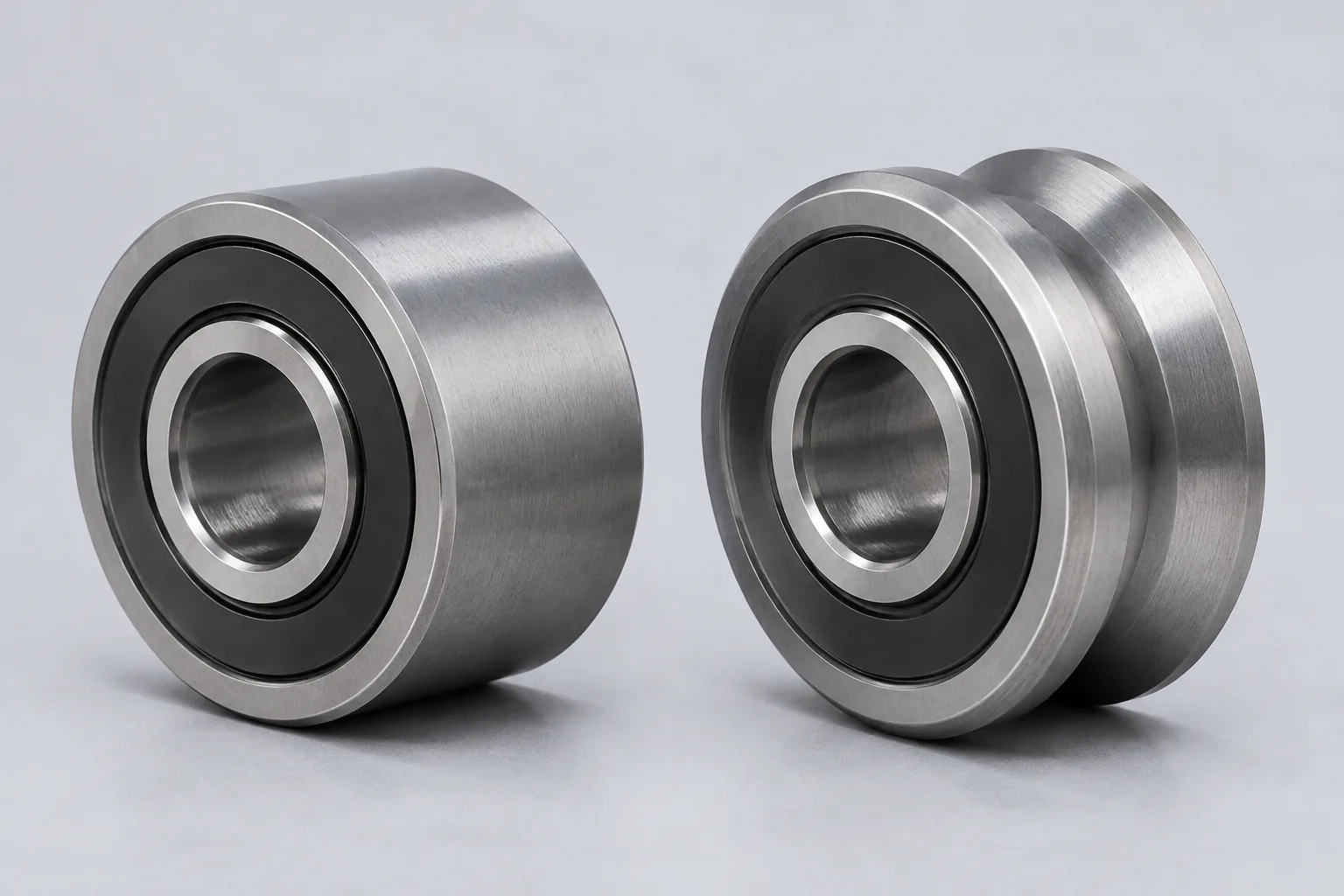
Sealing construction changes with size. Smaller TRAKROL sizes use ball bearings with rubber lip seals plus NYLAPLATE sealing; larger sizes use tapered roller bearings with double-lip rubber seals. This sealing approach makes TRAKROL suitable for contaminated environments where protection is important.
CAGEROL Heavy-Duty Roller Bearings
CAGEROL bearings are caged heavy-duty roller bearings for speeds and shaft misalignment beyond the capability of ordinary full-complement needle bearings. The typical MR construction is an outer ring, stamped steel cage, and rollers without an inner ring, running directly on a hardened and ground shaft.
The stamped steel cage separates and guides the rollers, helps prevent skewing, increases grease storage, and supports higher allowable speeds. The catalog states that life can be up to 10 times that of ordinary end-guided needle bearings under suitable conditions. That figure is a manufacturer catalog claim, not a guarantee for every application.
GUIDEROL Roller Bearings
GUIDEROL bearings use a center-guided roller assembly; the typical series code is GR. They can be used as an outer ring and roller assembly or with MI-series separable inner rings.
McGill groups GUIDEROL with CAGEROL heavy-duty roller bearings and provides interchange tables for Torrington, RBC, and INA equivalents. Interchange information should still be checked against the exact series, size, and suffix.
SPHERE-ROL Spherical Roller Bearings
SPHERE-ROL bearings are McGill spherical roller bearings with self-aligning capability; the typical base series is SB. Radial internal clearance options are C1, C2, Standard, C3, and C4, with C1 and C2 below standard and C3 and C4 above standard.
Single NYLAPLATE seal versions use suffix S; double seal versions use SS. Standard sealed versions have a catalog maximum operating temperature of 300°F, approximately 149°C. NYLAPLATE sealed versions should operate at no more than ±2° misalignment, and installation or handling should not exceed ±3°.
LAMBDA sealing is intended for severe contamination such as heavy moisture, direct water splash, dirt, or immersion. Recommended operating misalignment for LAMBDA sealed versions is no more than ±0.5°, with an absolute limit of ±1°. Suffix E indicates an internal floating SPHERE-ROL design that compensates for thermal expansion or manufacturing variation; it has a basic dynamic load rating 10% lower than the standard version and must not be used in a fixed-end position that carries thrust.
Aircraft and Specialty Bearings
Historical McGill precision catalogs include NBE and NBK aircraft heavy-duty roller bearing series. The catalog also lists MS aviation bearing equivalents using MIL-G-81322 grease. Regal Rexnord references custom McGill aircraft bearings for thin-wing designs that require compact structure and high static capacity.
Aircraft bearing information from historical catalogs should be verified against current official product status before any availability claim is made.
How to Choose the Right McGill Bearing Type
Selection starts with the mounting arrangement and the direction of load. A stud-type CAMROL suits cantilever or overhung mounting; a yoke-type CAMROL suits straddle mounting with support at both shaft ends. Heavy-duty and caged variants then address different radial load, shock, speed, and misalignment conditions.
For SPHERE-ROL bearings, match the internal clearance, seal type, temperature limit, and allowable misalignment to the application. NYLAPLATE and LAMBDA seals serve different contamination levels, and the E suffix changes load rating and fixed-end suitability. For any family, confirm series code, suffix, dimensions, and ratings in the current official Regal Rexnord/McGill catalog.
This section is general guidance. Final bearing selection still requires dimensional checks, load ratings, life calculation, and application engineering.
Quick Selection Checklist
- Identify the mounting type: stud, yoke, or shaft-supported arrangement.
- Determine radial and axial loads, including shock or intermittent axial load.
- Check operating speed and shaft misalignment against the family limit.
- Review contamination, sealing needs, and lubrication method.
- Confirm the series code, suffix, dimensions, and ratings in current official data.
- Verify availability and interchange information with Regal Rexnord/McGill before ordering.
Use the at-a-glance table for the first comparison, then confirm the decision in the detailed family sections above.
Conclusion
The practical value of this McGill bearings overview of common types is a faster path from application conditions to the right bearing family. CAMROL handles cam-follower and track-guide duties, with stud and yoke types matching different mounting arrangements; heavy-duty and special-duty variants adjust load, shock, speed, and grease-storage behavior. TRAKROL addresses track and guide profiles, CAGEROL and GUIDEROL serve caged heavy-duty roller applications, and SPHERE-ROL choices depend on clearance, seal type, temperature, and misalignment limits.
Before ordering, confirm the series code, suffix, dimensions, load rating, and current availability in official Regal Rexnord/McGill data. That final check is the safe next step when two families appear close on paper.
FAQs
Q1: What are the main McGill bearing families?
A: The main families are CAMROL cam followers, TRAKROL track rollers, CAGEROL and GUIDEROL heavy-duty roller bearings, SPHERE-ROL spherical roller bearings, and aircraft or specialty bearings. Series codes and suffixes define mounting style, internal design, sealing, and other configuration details.
Q2: What is the difference between CAMROL stud-type and yoke-type cam followers?
A: Stud-type CAMROL cam followers are intended for cantilever or overhung mounting, while yoke-type cam followers are intended for straddle mounting with shaft support at both ends. The mounting arrangement should be confirmed before selecting a series code.
Q3: Which series codes identify common CAMROL cam followers?
A: Common inch series include CF, CFH, and CYR; metric series include MCF and MCYR. Heavy-duty variants use CFD and CYRD, and special-duty variants use SDCF and SDMCF. The suffix and size still need to be checked in the current catalog.
Q4: What do PCF, VCF, and FCF mean on TRAKROL track rollers?
A: PCF denotes a plain outside diameter, VCF denotes a V-groove outside diameter, and FCF denotes a flanged outside diameter. The profile should match the track or guide surface and the sealing needs of the application.
Q5: When should I choose CAGEROL instead of GUIDEROL?
A: Choose CAGEROL when a caged heavy-duty roller bearing is needed for speeds or shaft misalignment beyond ordinary full-complement needle bearings. GUIDEROL uses a center-guided roller assembly and can be used with MI-series separable inner rings; the mounting and shaft support arrangement determine the better fit.
Q6: What do the S, SS, and E suffixes mean on SPHERE-ROL bearings?
A: S indicates a single NYLAPLATE seal and SS indicates a double NYLAPLATE seal. E indicates an internal floating design that compensates for thermal expansion or manufacturing variation, has a basic dynamic load rating 10% lower than the standard version, and must not be used in a fixed-end position that carries thrust.
Q7: How is McGill related to Regal Rexnord?
A: McGill is a bearing brand under Regal Rexnord Corporation, which is headquartered in Milwaukee, Wisconsin, USA. Regal acquired Emerson Power Transmission Solutions in 2015, and that business included McGill along with Browning, Rollway, and Sealmaster.