Quick Answer: A cam follower bearing is a rolling bearing that runs directly on a cam, track, or guide surface. In its common stud-type form, a threaded stud replaces the inner ring, and a thick-walled outer ring rolls on the track while needle or cylindrical rollers carry the radial load. It converts cam motion into controlled movement or supports linear guidance. Dimensions, load ratings, seals, and mounting style must be matched to the application.
A cam follower bearing is often specified when a machine must convert a cam profile into controlled motion or guide a moving load along a track. The term covers stud-type cam followers and yoke-type track rollers, and the differences matter for mounting, adjustment, load path, and service access. The main selection checks are radial load, outer-ring and stud stress, track condition, speed, sealing, and lubrication.
Definition and Naming
A cam follower bearing is a rolling bearing that rolls directly on a cam, track, or guide surface. It converts cam profile motion into controlled movement and can also support linear guidance. The working surface is the outer ring, so the bearing is selected as a complete rolling unit rather than as a shaft support alone.
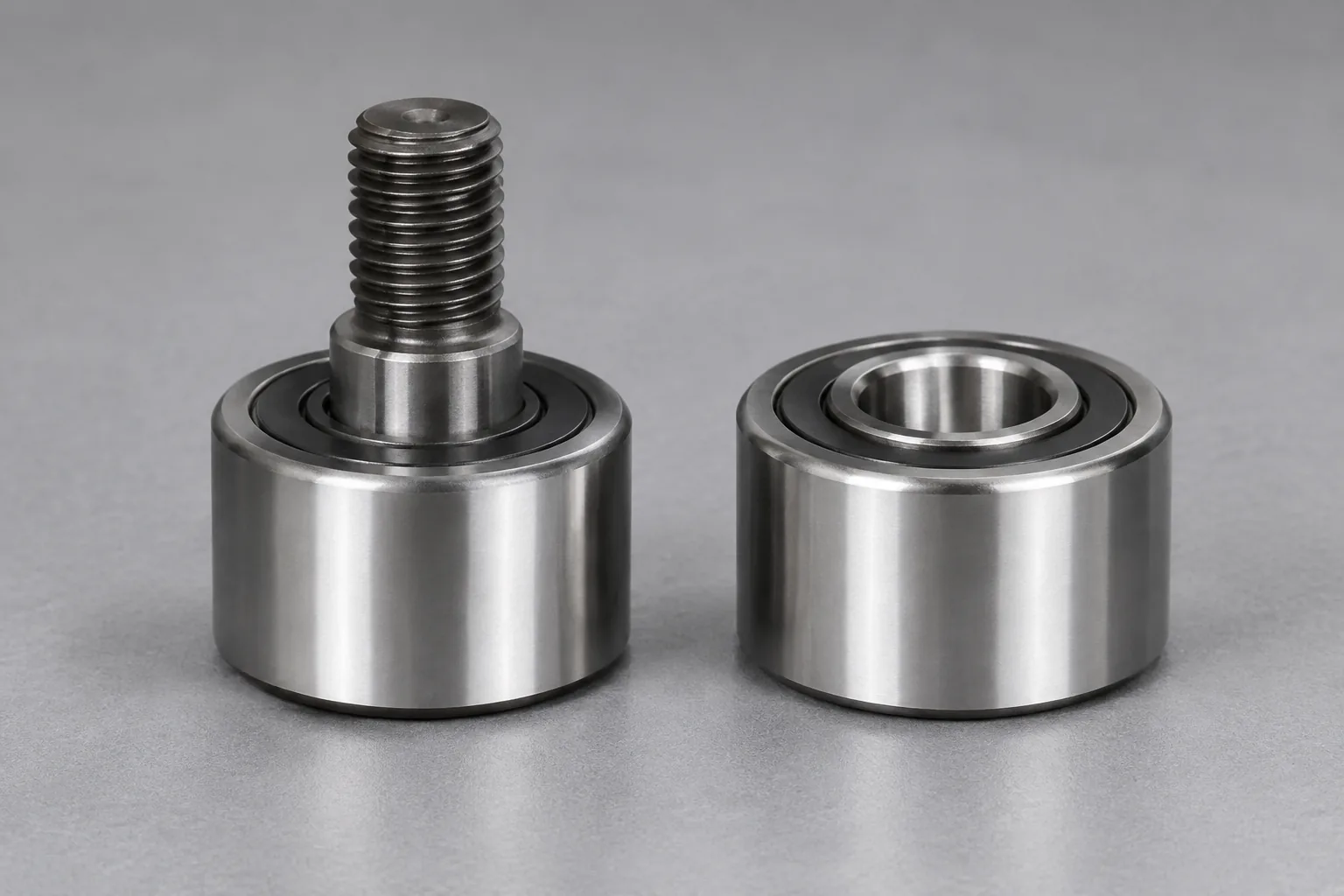
In a common needle roller design, needle rollers run between a threaded stud and a thick-walled outer ring. In stud-type cam followers, the stud replaces the inner ring of a standard bearing. The stud provides the mounting thread, while the outer ring contacts the track.
Common names include cam follower, stud-type track roller, roller follower, and yoke-type track roller. The terms overlap, but stud-type and yoke-type describe different mounting methods. ISO 7063:2018 covers both stud-type and yoke-type needle roller track rollers, although product names often separate the two families.
Cam Follower vs Standard Rolling Bearing
The main differences appear in the mounting interface and the outer-ring function.
- In a stud-type cam follower, a threaded solid stud replaces the inner ring.
- The thick-walled outer ring acts as the rolling tire and directly contacts the track.
- The outer ring must carry track contact loads and may not rely on a rigid bearing housing.
- Cam follower size is often identified by outer diameter D rather than bore diameter d.
- Selection must consider outer-ring and stud behavior, not only rolling-element bearing ratings.
These differences apply primarily to stud-type cam followers. A yoke-type track roller uses a center bore and a separate shaft or pin, so it does not have an integral mounting stud.
Construction and Load Path
A typical cam follower assembly includes a thick-walled outer ring, needle or cylindrical rollers, a cage or full-complement roller set, an integral stud, axial retaining rings or flanges, seals, and lubrication holes. The outer ring directly receives track contact load, shock, and bending stress. Construction details vary by type, sealing option, and series.
Cam followers mainly carry radial loads. A selection check should include dynamic and static rolling-element ratings, but it should also include outer-ring deformation, track load capacity, and stud bending stress. Effective ratings for cam follower designs must account for reverse bending stress in the outer ring.
The load path runs from the track into the outer ring, through the rolling elements, into the stud or inner raceway, and then into the machine frame. Each interface has its own limit.
Common Configurations
Cam follower configurations differ by mounting method, adjustment method, roller complement, outer-ring profile, sealing, and lubrication features. Match the configuration to mounting accuracy, load, speed, contamination, and adjustment needs.
Stud Type vs Yoke Type
Stud-type cam followers have an integral threaded stud for mounting. Yoke-type track rollers or roller followers have no stud and mount on a separate shaft or pin through a center bore. Use stud type when direct threaded mounting is required. Use yoke type when a separate shaft or pin is part of the machine design. ISO 7063 covers both families, but product naming often separates them.
Concentric vs Eccentric Mounting
Concentric stud versions have the stud axis coincident with the bearing rotation axis. They suit mounting holes whose position is already accurately defined. Eccentric stud or eccentric collar versions allow roller position, preload, or clearance adjustment by rotating the eccentric feature. Published eccentricity values for adjustable stud versions can range from 0.25 mm to 1.0 mm, depending on the series.
Roller Complement and Outer-Ring Profile
- Caged needle rollers reduce friction and heat generation and suit higher speeds.
- Full-complement needle rollers provide more rollers and are typically used for higher radial loads at lower speeds.
- Double-row cylindrical roller designs are used for heavy-duty cam follower applications; some series use designations such as KRU, KRVU, and NUKRU.
- Crowned or spherical outer rings reduce edge stress under misalignment.
- Cylindrical or flat outer rings provide greater track contact area when alignment is good.
Many cam followers use a crowned profile by default, and cylindrical variants are available for well-aligned tracks. Choose the outer-ring profile according to expected misalignment and track contact requirements.
Sealing and Lubrication Features
- Common sealing forms include gap seals, labyrinth seals, and contact seals.
- Seals help exclude dust and contaminants and help retain grease.
- Contact seals generally increase friction.
- Many cam followers include lubrication holes at the stud ends, and some allow grease nipples or a centralized lubrication connection.
- Common mounting drive features include screwdriver slot, hex socket, and hex head.
Use sealed versions for contaminated environments, and account for the friction increase of contact seals. Lubrication port locations and drive features vary by series.
Dimensions, Designations, and Common Size Ranges
ISO 7063 specifies boundary dimensions, geometrical product specifications, and tolerance values for needle roller track rollers. Cam follower size designations are commonly organized by outer diameter D, while standard bearings are usually organized by bore diameter d. This difference reflects the way the cam follower is mounted and how its outer ring contacts the track.
Size ranges vary widely by series and should not be treated as universal limits. The values below are examples of range coverage, not a specification for every cam follower.
- Overall ranges may cover stud diameters from 1.4 mm to 41 mm and outer diameters from 4 mm to 90 mm, with maximum dynamic ratings up to 142 kN and marked operating temperatures from -20 °C to +120 °C.
- Micro series (such as CFS) may use studs from 2 mm to 6 mm and outer diameters from 4.5 mm to 12 mm.
- Standard series (such as CF…B) may span studs from 3 mm to 30 mm and outer diameters from 10 mm to 90 mm, with maximum dynamic ratings up to 67.7 kN.
- Inch heavy-duty series (such as CRH…B) may reach studs up to 2 in and outer diameters up to 4 in, with maximum dynamic ratings up to 142 kN.
- Industrial cam follower outer diameters may range from 1/2 in to 10 in.
Industrial ranges may include standard stud, heavy stud, yoke type, caged roller, eccentric, and airframe track roller designs. Confirm dimensions and ratings against the selected product data for the exact series.
Selection and Application Checks
- Cam followers primarily support radial loads. Confirm load direction and track contact geometry.
- Do not rely only on dynamic and static rolling-element ratings. Check outer-ring deformation, track load capacity, and stud bending stress.
- Choose caged rollers for lower friction and higher speed. Choose full-complement rollers for higher radial load at lower speed.
- Match sealing to contamination and grease retention needs. Account for the friction increase of contact seals.
- Confirm operating temperature limits for the selected product and lubricant.
Selection must reflect actual cam geometry, mounting alignment, load direction, speed, and environment. Detailed life calculation, mounting torque, and lubrication intervals require product-specific data.
Typical Applications
Cam followers are used where a rolling element must follow a cam profile or run along a track under radial load.
- Cam-driven mechanisms and conveying systems.
- Construction machinery, packaging machinery, and industrial robots.
- Medical equipment, parking garage conveyors, and automated warehouses.
- Indexing mechanisms, machine tools, electronic component production equipment, and office automation equipment.
These applications typically involve radial track contact and controlled motion rather than general shaft support.
Related Standards
ISO 7063:2018 is the primary standard for needle roller bearing track rollers. Its full title covers boundary dimensions, geometrical product specifications, and tolerance values. It covers yoke-type and stud-type track rollers. The third edition was published in July 2018, with a corrigendum in 2020 and confirmation in 2024. ISO 7063 is maintained by ISO/TC 4/SC 5 and classified under ICS 21.100.20.
ISO 6278 is also used as a dimensional reference for some stud-type cam follower families. ISO 5753-1 defines internal clearance, and some standard no-stud cam followers use C2 radial clearance. These references are product-family specific and should not be generalized to every cam follower.
Conclusion
Cam follower bearings are compact rolling units that combine a track-contacting outer ring with a stud or center bore. The correct choice depends on mounting method, adjustment needs, roller complement, outer-ring profile, sealing, lubrication, and the loads carried by the outer ring and stud. Use size ranges only as a starting point, then confirm dimensions, ratings, clearance, and temperature limits for the exact series and application. Inspect the cam or track for alignment and surface condition before installation, and follow the product-specific mounting and lubrication instructions.
FAQs
Q1: What is a cam follower bearing?
A: A cam follower bearing is a rolling bearing that runs directly on a cam, track, or guide surface. In a stud-type design, a threaded stud replaces the inner ring, and a thick-walled outer ring contacts the track while needle or cylindrical rollers carry radial load. It is used to convert cam motion into controlled movement or to support linear guidance.
Q2: Is a cam follower the same as a track roller?
A: The terms overlap but are not always identical in commercial use. A cam follower is often a stud-type track roller with an integral threaded stud. A yoke-type track roller has no stud and mounts on a separate shaft or pin. ISO 7063 covers both stud-type and yoke-type needle roller track rollers, but product names may separate them.
Q3: What is the difference between stud-type and yoke-type cam followers?
A: A stud-type cam follower has an integral threaded stud for direct mounting. A yoke-type track roller has a center bore and mounts on a shaft or pin that is part of the machine. Use stud type when the mounting thread is part of the design, and yoke type when a separate shaft or pin is already present.
Q4: Why are cam follower dimensions often given by outer diameter?
A: Cam follower sizes are commonly organized by outer diameter D because the outer ring is the track-contacting surface. Standard rolling bearings are usually organized by bore diameter d. The difference reflects mounting practice, so confirm both the outer diameter and the stud or bore dimensions for the application.
Q5: What loads can cam follower bearings carry?
A: Cam followers mainly carry radial loads from the cam or track. Selection should check dynamic and static rolling-element ratings, but also outer-ring deformation, track load capacity, and stud bending stress. Effective ratings for cam follower designs must account for reverse bending stress in the outer ring. Do not rely on rolling-element ratings alone.
Q6: What is the difference between crowned and cylindrical outer rings?
A: A crowned or spherical outer ring has a slight convex profile that reduces edge stress when the track and mounting are misaligned. A cylindrical or flat outer ring provides greater track contact area when alignment is good. Choose the profile according to expected misalignment and track contact requirements.
Q7: What is an eccentric stud used for?
A: An eccentric stud or eccentric collar allows the roller position, preload, or clearance to be adjusted by rotating the eccentric feature after mounting. Concentric studs have the stud axis coincident with the bearing rotation axis and suit mounting holes whose position is already accurately defined. Published eccentricity values for adjustable stud versions can range from 0.25 mm to 1.0 mm, depending on the series.
Q8: What do caged and full-complement cam followers mean?
A: A caged cam follower uses a cage to separate and guide the needle rollers. This reduces friction and heat generation and suits higher speeds. A full-complement cam follower uses more rollers without a cage and is typically used for higher radial loads at lower speeds. Match the roller complement to load, speed, and lubrication conditions.
Q9: What standards apply to cam follower bearings?
A: ISO 7063:2018 is the primary standard for needle roller bearing track rollers and covers boundary dimensions, geometrical product specifications, and tolerance values for stud-type and yoke-type designs. ISO 6278 is used as a dimensional reference for some stud-type families. ISO 5753-1 defines internal clearance, and some standard no-stud cam followers use C2 radial clearance. Confirm the applicable standard for the exact product family.