Quick Answer: Dental bearings are miniature precision ball bearings that support the high-speed turbine shaft inside air-driven dental handpieces. A replacement must match the handpiece, not just the bore and outside diameter. Selection also depends on width, internal design, cage, clearance, lubrication, and mounting features. Because these bearings face repeated cleaning and steam sterilization, corrosion resistance and correct handpiece maintenance strongly affect service life.
A dental handpiece can look like one simple instrument, but its head contains a small, highly stressed rotating assembly. The bearing is only one part of that assembly, yet it governs much of the handpiece’s speed, smoothness, and service life. This guide explains what dental bearings are, how they differ from the spindle and turbine unit, which dimensions and materials matter, and how to select and maintain a replacement without relying on size alone.
What Are Dental Bearings?
Dental bearings are miniature precision ball bearings that support the rotating turbine shaft in dental handpieces. In a typical air turbine arrangement, two bearings support the turbine shaft. The bearing is a component, not the complete handpiece, spindle, collet chuck, or turbine unit.
A bearing manufacturer based in Tokyo publishes an air turbine example with a bore of about 3 mm, an outside diameter of about 6 mm, a width slightly above 2 mm, and an operating speed of up to 400,000 rpm. That example shows how small and how fast these bearings can be, but it does not define every dental handpiece.
The FDA describes air-driven dental handpieces as devices in which compressed air drives a turbine that rotates a dental bur. The bearing is part of that rotating assembly. FDA product code EFB applies to air-driven dental handpieces under 21 CFR 872.4200, Class I. That classification is for the handpiece, not for a standalone replacement bearing.
Bearing arrangement and dimensions vary by handpiece model. Always confirm the arrangement with the handpiece manufacturer’s instructions and parts diagram.
Dental Bearing vs. Handpiece, Spindle, and Turbine Unit
The bearing supports high-speed rotation. The spindle or collet chuck clamps and guides the bur or milling tool. The turbine unit is the rotating assembly, while the complete handpiece also includes the housing, air paths, chuck, and other components.
Using bearing, spindle, and turbine interchangeably in specifications or procurement can lead to the wrong part being ordered. A bearing supplier may list a bearing, a spindle, and a complete turbine unit as separate items because they perform different functions.
This terminology distinction matters when reading OEM catalogs, repair manuals, and regulatory documents. ISO 14457:2017 and FDA product code EFB address handpieces and motors, not standalone bearings as independent dental devices.
Common Dental Bearing Designs
Dental handpieces commonly use deep-groove ball bearings or angular-contact ball bearings. The outer-ring geometry may be straight, grooved, or flanged depending on how the bearing is mounted in the handpiece head.
A single dental bearing line can include deep-groove ball bearings, angular-contact ball bearings, and straight, grooved, and flanged outer-ring configurations. Some series offer both single-row deep-groove and angular-contact designs, with mounting dimensions intended to be interchangeable with conventional dental handpiece bearing designs. One manufacturer’s standard dental series includes 100 series straight, 150 series grooved, 200 series flanged, and 250 series variants, with common widths of 2.380 mm and 2.779 mm.
Visual similarity or matching bore and outside diameter is not enough to confirm interchangeability. The internal design, outer-ring features, cage, clearance, lubrication, and mounting direction must also match.
Dimensions and Interchangeability: What You Must Match
Common dental bearing sizes are very small, and they require precision matching rather than generic dimensional substitution. The table below shows two common size families with the same bore and outside diameter but different widths.
| Model | Bore | Outside Diameter | Width |
|---|---|---|---|
| B3Z-77 and BH3Z-87 | 3.175 mm / 0.125 in | 6.350 mm / 0.250 in | 2.380 mm / 0.094 in |
| B3Z-88 and BH3Z-86 | 3.175 mm / 0.125 in | 6.350 mm / 0.250 in | 2.779 mm / 0.109 in |
One manufacturer also publicly describes other dental air turbine designs around 3 mm bore, 6 mm outside diameter, and slightly over 2 mm width. These examples show why a single size family cannot be treated as a universal dental bearing specification.
When matching a replacement, check all of the following:
- Bore, outside diameter, and width.
- Deep-groove or angular-contact structure.
- Inner-ring or outer-ring counterbore.
- Flange or groove geometry.
- Cage type and material.
- Internal clearance or preload.
- Lubricant type and quantity.
- Installation orientation.
The same dimensional family can include multiple structures with different performance and mounting requirements. Confirm the handpiece model and OEM part number before selecting a replacement bearing. Do not assume that all dental bearings use the 3.175 mm x 6.350 mm size; that is a common dental bearing size, not a universal standard.
Materials and Internal Construction
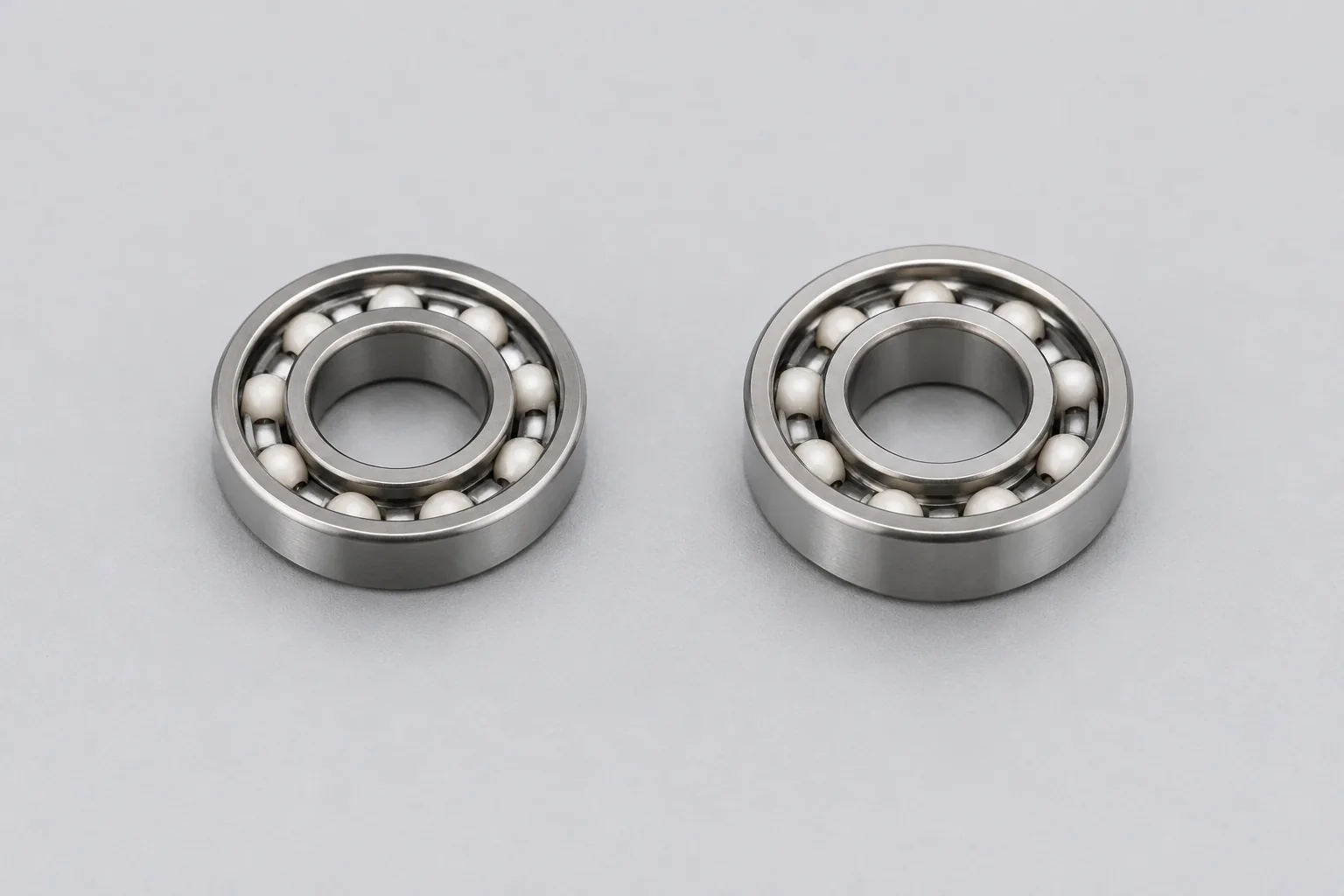
A ceramic dental bearing usually means a bearing with ceramic rolling elements, not a bearing made entirely of ceramic. Common construction options include ceramic or stainless steel balls, stainless steel rings, and metallic or polymer cages.
One dental bearing series uses Si3N4 silicon nitride ceramic balls, ES1 stainless steel inner and outer rings, and a PEEK cage. The manufacturer states a maximum stable operating speed of 400,000 rpm for that series. Standard dental bearings from one manufacturer can use ceramic balls or stainless steel balls.
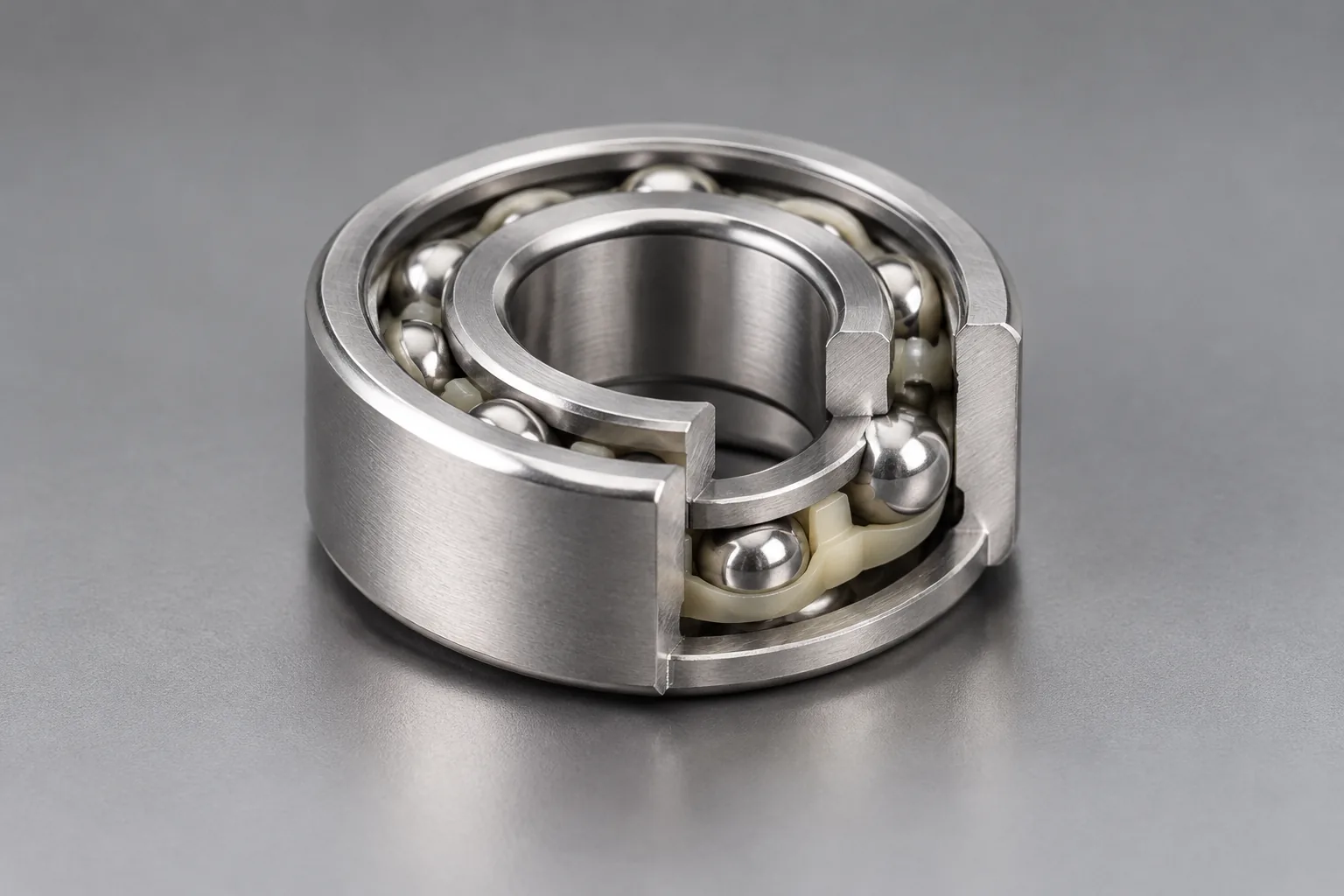
Another micro-bearing supplier lists options including steel or ceramic balls, steel or phenolic resin cages, flanges, single-side shields, different radial clearance, and different lubrication.
A 2015 dental air turbine bearing series from one manufacturer used corrosion-resistant steel. The manufacturer reported internal test results of 1.5 times conventional service life and 10 times corrosion resistance for that series. Those figures apply to that series and its test conditions. They should not be presented as a universal specification for all ceramic dental bearings.
Speed, Precision, and Tolerance Grades
Dental bearings are specified for very high speed and tight precision. One dental bearing series lists a maximum stable operating speed of 400,000 rpm. That is a bearing-series figure, not a statement that every dental handpiece or every dental bearing runs at the same speed.
Standard dental bearings from one manufacturer use inner-ring bore tolerances of ABEC 9 / P2, while other areas are ABEC 7 / P4. That manufacturer lists two inner-ring bore deviation ranges: -0.0025 to -0.00125 mm and -0.00125 to 0 mm.
ISO 492:2023 specifies dimensions, geometric features, and tolerance values for radial rolling bearings. It is a general bearing standard, not a dental handpiece standard, and it does not by itself establish suitability for a particular dental handpiece.
Keep bearing tolerance grades separate from handpiece-level performance claims such as noise, bur stop time, or clamping force. Handpiece-level speed or noise figures should not be written as bearing-only ratings.
Lubrication and Sealing
Dental bearings require carefully specified lubrication for high-speed operation and repeated sterilization cycles. A lubricant that suits one handpiece may not suit another because the bearing design, seal arrangement, and maintenance procedure can differ.
Standard dental bearings from one manufacturer use low-viscosity CG1 oil. BF7 grease is also listed as an option. The choice between oil and grease affects retention, starting behavior, and the handpiece manufacturer’s maintenance procedure.
One micro-bearing supplier states that dental bearings can be supplied with H1-approved lubricants on request. H1 approval refers to lubricants for applications with possible incidental food contact. It is not a dental device certification.
Follow the handpiece manufacturer’s instructions for lubricant type, quantity, location, and frequency. Do not prescribe a universal lubricant or re-lubrication interval across brands. Exact requirements depend on the handpiece model and its instructions for use.
Sterilization, Cleaning, and Corrosion Resistance
Dental handpieces and their bearings must withstand repeated cleaning, chemical exposure, and steam sterilization. Corrosion and lubricant loss are key life-limiting concerns in air turbine bearings.
One bearing manufacturer identifies repeated cleaning, chemical media, and high-temperature steam sterilization as major challenges for dental air turbine bearing corrosion and life. These conditions can attack ring surfaces, affect lubricant condition, and contribute to abnormal noise or vibration.
One handpiece manufacturer requires steam sterilization of handpieces after each patient. It advises removing the handpiece from the sterilizer promptly, then cooling and drying it with the head facing up. Current turbine product information from that manufacturer lists sterilization up to 135°C / 275°F for the complete handpiece.
The same manufacturer also warns against ultrasonic cleaning of handpieces because it may damage ball bearings or cause other technical faults. It warns against immersing handpieces in water or chemical solutions and against chlorine-containing or unapproved disinfectants.
Use the specific handpiece model’s instructions for use for sterilization temperature, cycle, lubrication sequence, and drying. Do not apply one manufacturer’s handpiece sterilization temperatures or cycle advice directly to another brand or to bulk replacement bearings.
Installation and Fit Checks
Critical installation checks for dental bearings include correct orientation, adequate clearance, unobstructed air flow, and correct retaining components. A bearing that fits the bore and outside diameter can still be wrong if the width, flange, groove, or internal design does not match the handpiece.
Installation guidance for one dental bearing series requires a 0.2-0.3 mm gap between the bearing and the slinger to keep exhaust air flow unobstructed. The same guidance states that air flow through a single bearing should be less than 10 L/min. Above that value, the manufacturer recommends contacting its engineering department.
Retaining accessories such as shims, spring washers, circlips, and bushes help control preload and operating clearance. One micro-bearing supplier offers these components for dental bearing assemblies to help avoid bearing overload or excessive operating clearance.
Incorrect installation can cause overload, excessive clearance, blocked exhaust, or premature failure. Verify the procedure against the handpiece service manual before installation. The air-flow and gap values above are specific to one dental bearing series, not universal dental bearing specifications.
Maintenance Practices That Protect Bearings
Bearing life depends heavily on the complete handpiece maintenance routine, not only on bearing quality. Cleaning, disinfection, lubrication, and sterilization all affect the bearing environment.
One handpiece manufacturer advises maintaining and lubricating rotating handpieces after each cleaning and disinfection and before each sterilization. Lubrication points include the chuck system, ball bearings, and gears. The same manufacturer also advises cleaning and lubricating the chuck at least weekly and increasing lubrication frequency under high-load conditions such as crown cutting.
Avoid practices that can shorten bearing life:
- Ultrasonic cleaning of handpieces, which may damage ball bearings or cause other technical faults.
- Immersion in water or chemical solutions.
- Chlorine-containing disinfectants or other unapproved chemicals.
High-load use may require more frequent maintenance according to the handpiece manufacturer’s instructions. These are handpiece maintenance recommendations from one manufacturer; other brands may specify different intervals and procedures.
Standards and Regulatory Context
Handpiece standards, bearing tolerance standards, and supplier management-system certifications are different levels of evidence. They should not be presented as interchangeable forms of product approval.
ISO 14457:2017, Dentistry – Handpieces and motors, was published in October 2017 and reaffirmed in 2023. It covers requirements, test methods, manufacturer information, marking, and packaging for dental handpieces and motors, including high-speed air turbine handpieces. The FDA recognizes ISO 14457:2017, with ANSI/ADA Standard No. 35-2019 as the corresponding U.S. standard.
FDA product code EFB for air-driven dental handpieces is Class I under 21 CFR 872.4200 and is not GMP-exempt according to the FDA database. FDA also lists consensus standards for EFB handpieces including ISO 9168:2009, ISO 3964:2016 with 2018 amendment, ISO 1797:2017, ISO 22052:2020, and ISO 21850-1:2020.
FDA issued a final guidance in September 2024 on performance criteria for air-powered dental handpieces and air motors under the Safety and Performance Based Pathway. That guidance applies to the handpiece and motor regulatory pathway, not to a replacement bearing sold as a component.
One micro-bearing supplier states DIN EN ISO 9001:2015 and ISO 14001:2015 certification for its management systems covering micro ball bearings and precision rotary systems. These certificates cover management systems. They are not individual bearing product approval, FDA clearance, CE marking, or ISO 14457 product certification.
How to Select a Replacement Dental Bearing
A practical selection sequence starts with the handpiece, not with a generic bearing size:
- Identify the handpiece model and serial or version details where available.
- Obtain the OEM parts diagram and the specified bearing part number.
- Confirm bore, outside diameter, width, and internal design.
- Verify cage type, clearance, lubrication, and any seal or shield arrangement.
- Check retaining accessories such as shims, spring washers, circlips, and bushes.
- Confirm the installation orientation and air-flow path.
Bore and outside diameter alone are insufficient for replacement selection. A bearing with the same envelope dimensions can differ in width, raceway geometry, counterbore, flange, cage, clearance, or lubricant.
Confirm whether the bearing is supplied as a loose component or as part of a qualified assembly. Document the selected bearing specification for traceability and future maintenance.
A replacement bearing may not be separately regulated as a dental device, but the complete handpiece must still meet applicable handpiece requirements. Base replacement selection on the handpiece manufacturer’s parts list and service documentation, not only on generic bearing dimensions.
Conclusion
Dental bearings are small components with a large effect on handpiece performance. The safe approach is to identify the handpiece first, match the full bearing specification, and follow the manufacturer’s instructions for lubrication, cleaning, sterilization, and installation. Bore and outside diameter are only the starting point; the full specification decides whether a replacement will run correctly in that particular head.
For replacement work, keep the OEM parts diagram with the handpiece records and document the bearing specification you install. That record makes future maintenance and repeat ordering more reliable.
FAQs
Q1: Are ceramic dental bearings made entirely of ceramic?
A: No. A ceramic dental bearing typically uses ceramic balls with metal rings and a suitable cage. For example, one dental bearing series uses Si3N4 ceramic balls, ES1 stainless steel rings, and a PEEK cage.
Q2: Can I select a dental bearing by bore and outside diameter only?
A: No. Width, deep-groove or angular-contact design, counterbore, flange or groove, cage, clearance, lubricant, and installation orientation must also match. Dimensional tables can list multiple structures with the same or similar envelope dimensions.
Q3: Do dental bearings themselves require FDA approval?
A: FDA product code EFB and 21 CFR 872.4200 address air-driven dental handpieces, not standalone replacement bearings. A bearing supplier’s ISO 9001 or ISO 14001 certificate is not FDA approval or product certification.
Q4: Can a dental handpiece be ultrasonically cleaned to clean the bearings?
A: One handpiece manufacturer explicitly warns that ultrasonic cleaning may damage ball bearings or cause other technical faults. Follow the specific handpiece manufacturer’s cleaning instructions rather than applying a universal method.
Q5: What speed do dental bearings run at?
A: Dental air turbine bearings operate at very high speed. Public data from one bearing manufacturer lists up to 400,000 rpm for a dental bearing series. Do not apply one speed rating to all dental bearings or confuse handpiece speed with a bearing-only rating.
Q6: Are all dental bearings 3.175 mm x 6.350 mm?
A: No. That is a common dental bearing size, but other dental air turbine designs are publicly described around 3 mm bore and 6 mm outside diameter. Always confirm the exact handpiece model and OEM specification.
Q7: What standard covers dental handpieces?
A: ISO 14457:2017 covers dentistry handpieces and motors, including high-speed air turbine handpieces and other handpiece types. ISO 492:2023 covers general radial rolling bearing tolerances but is not a dental-specific standard.