Quick Answer: Bearing clearance is the small internal gap that lets one bearing ring move relative to the other. It matters because the operating clearance left after fits and heat affects fatigue life, friction, heat, vibration, noise, stiffness, and rotational accuracy. Too little clearance can cause overheating or seizure, while too much reduces stiffness and precision, so the correct grade must match the fit, temperature, speed, load, and bearing type.
Bearing clearance is often treated as a suffix on a part number, but it is a working condition. The gap that remains after mounting and warming up decides how the rolling elements share load, how much friction the bearing creates, and how quietly and accurately the shaft turns.
Understanding the importance of bearing clearance starts with separating it from fit and precision class, then following how fits and temperature change the gap. The aim is practical: choose a clearance that still works at operating temperature, not just on the drawing.
What Bearing Clearance Means
Bearing internal clearance is the total distance one bearing ring can move relative to the other. When the movement is radial, it is radial internal clearance; when the movement is axial, it is axial internal clearance. The value is a property of the assembled bearing, not a property of the shaft or housing alone.
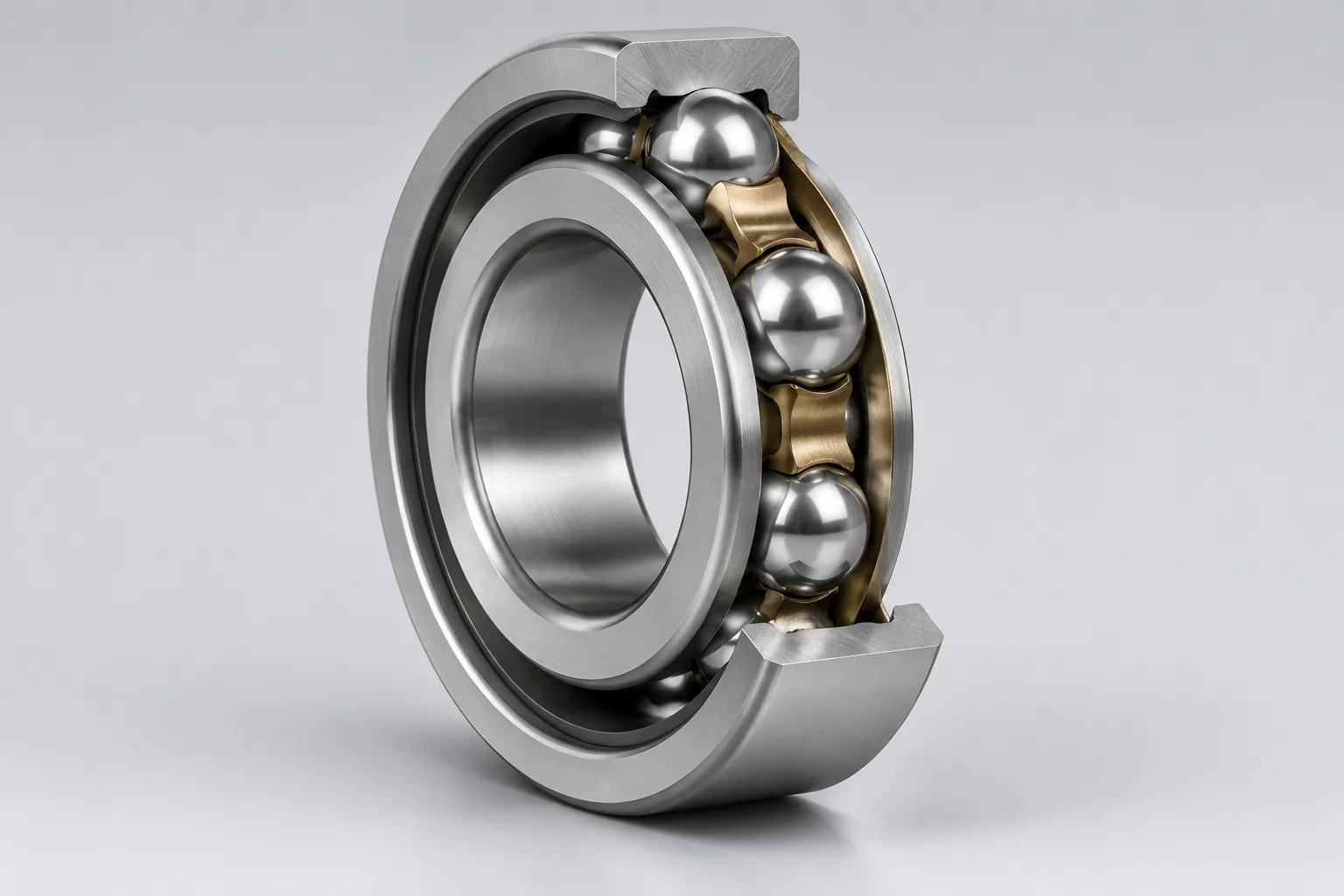
Clearance is often confused with two other specifications. Fit describes how tight or loose the shaft, bearing, and housing assembly is. Tolerance or precision class describes manufacturing accuracy. Clearance describes the internal free space between the rolling elements and raceways. A suffix such as C3 is an internal clearance grade, not a shaft or housing fit grade.
That distinction matters at the specification stage. A drawing can call for a tight interference fit and a C3 clearance at the same time, because the fit will reduce the clearance that exists before mounting. Treating C3 as a fit grade, or treating a precision class as a clearance value, leads to the wrong bearing for the application.
Initial, Mounted, and Operating Clearance
Clearance changes through the life of an installation, so engineers distinguish three conditions:
- Initial clearance is measured before installation, with the bearing in its supplied condition.
- Mounted or residual clearance is what remains after the bearing is pressed onto the shaft or into the housing, but before it reaches a stable working temperature.
- Operating or effective clearance is the clearance at steady operating temperature, when fits and thermal expansion have taken effect.
Interference fits and temperature gradients usually reduce clearance from the initial value to the operating value. A common engineering relationship separates the two effects: Δf = Δ0 – δfi – δfe, where Δ0 is initial clearance, Δf is residual clearance after fit, and δfi and δfe are the clearance reductions caused by the inner-ring and outer-ring fits. The operating value is then Δ = Δf – δt, where δt is the thermal reduction.
Use this relationship whenever interference fits and an inner-ring/outer-ring temperature difference are present. A bearing that looks correct on the bench can still run with too little clearance after the fit closes and the inner ring grows.
Why Clearance Matters in Bearing Performance
Operating clearance significantly affects fatigue life, vibration, noise, and heat generation. Once bearing type and size are fixed, clearance selection is one of the most important remaining tasks because it changes how the bearing carries load and how much friction it produces.
Too little clearance raises friction and heat. If the operating clearance becomes a large negative value, the bearing can seize. Too much clearance lowers rotational accuracy and system stiffness and increases vibration and noise. High-stiffness or high-positioning-accuracy equipment therefore often uses preload, which is negative internal clearance, to remove unwanted play.
There is a theoretical exception: maximum fatigue life can occur at a slightly negative operating clearance. In practice, fit, temperature, and manufacturing errors cannot be controlled perfectly, so most applications target zero or slightly positive operating clearance. That target keeps the bearing away from the steep life loss caused by excessive negative clearance.
Consequences of Incorrect Clearance
Incorrect clearance can sharply reduce bearing life and can also cause overheating or seizure. The symptoms are not unique to clearance, so evaluate them together with load, speed, lubrication, fit, and thermal conditions. Noise, vibration, abnormal heat, loss of stiffness, and premature fatigue can all point to a clearance problem, but each can have another cause as well.
Too Little Clearance or Negative Clearance
When clearance is too small, friction and heat generation rise. The bearing may become hard to turn, and in severe cases it can seize. If negative clearance becomes excessive, fatigue life drops sharply rather than improving.
A thermal feedback loop makes this failure mode dangerous. If lubricant viscosity falls, friction increases, and clearance falls further, the bearing can heat faster than the housing can shed heat. Over-tight interference fits add to the risk: they reduce clearance and can put the inner ring under high tensile stress, which may lead to cracking.
Too Much Clearance
Excessive clearance reduces rotational accuracy and system stiffness. It also increases vibration and noise, because the rolling elements have more room to move before they carry load. High-stiffness or high-positioning-accuracy applications are poor candidates for loose clearance unless preload or a tighter clearance strategy is used.
How Fits and Installation Change Clearance
An interference fit of the inner ring on the shaft, or of the outer ring in the housing, expands or contracts the ring and reduces radial internal clearance. A large share of the interference is converted into clearance reduction; a practical planning value is that about 70% to 90% of the interference fit may become lost clearance.
That is why a clearance suffix alone is not a selection method. The required starting clearance depends on the fit, and the fit depends on load, speed, shaft and housing material, surface finish, and mounting method. Different manufacturers may recommend different fit-related clearance reductions and residual clearance ranges, so use the product table for the exact bearing type and bore size.
Larger clearance may be needed when one or more of these conditions apply:
- Press fits or high interference fits
- Heavy loads or impact loads
- High speed that increases inner-ring fit growth
- High inner-ring temperature
- Both rings mounted with tight fits
- Shaft deflection or mounting misalignment that the bearing must accommodate
C3 should not be treated as a fit grade. Exact clearance ranges depend on bearing type, bore size, and the manufacturer’s data. A C3 suffix on one bearing size does not define a universal micron value for another.
How Temperature Changes Operating Clearance
During normal operation, the inner ring and rolling elements are often hotter than the outer ring because the housing usually sheds heat more easily than the shaft. A typical inner-ring and rolling-element advantage is about 5°C to 10°C. That gradient makes the inner ring grow more than the outer ring and reduces operating clearance.
High speed can raise inner-ring temperature further and reduce clearance again. Thermal expansion should be estimated when selecting initial clearance, especially where temperature gradients, high speed, or heat-sensitive lubrication are present. A useful approximation for the thermal clearance reduction is:
δt = α × Δt × De
Here α is the linear expansion coefficient of bearing steel, approximately 12.5 × 10⁻⁶/°C; Δt is the temperature difference between inner and outer rings; and De is the outer-ring raceway diameter. For an approximate raceway diameter, use De ≈ (4D + d)/5 for ball bearings and De ≈ (3D + d)/4 for roller bearings, where D is the bearing outside diameter and d is the bore diameter.
Thermal feedback can reduce clearance progressively and contribute to seizure. If heat generation rises, viscosity can fall, friction can rise, and the clearance can close further. The calculation is a starting point, not a substitute for checking the real thermal behavior of the assembly.
Standard Clearance Grades and What C-Suffixes Mean
ISO 5753-1:2009 specifies radial internal clearance for radial bearings. ISO 5753-2:2010 covers axial internal clearance for four-point contact ball bearings. These standards define how clearance values are presented and measured; they do not remove the need to use the bearing manufacturer’s table for the exact type and size.
The common DIN/ISO grade mapping is:
| Bearing suffix | ISO clearance group | General position |
|---|---|---|
| CN | Group N | Normal radial clearance |
| C2 | Group 2 | Smaller than normal |
| C3 | Group 3 | Larger than normal |
| C4 | Group 4 | Larger than C3 |
| C5 | Group 5 | Larger than C4 |
The usual order from smaller to larger clearance is C1 → C2 → CN → C3 → C4 → C5. CN denotes normal radial clearance and is often not written in the bearing designation. C2 is smaller than normal, C3 is larger than normal, C4 is larger than C3, and C5 is larger than C4.
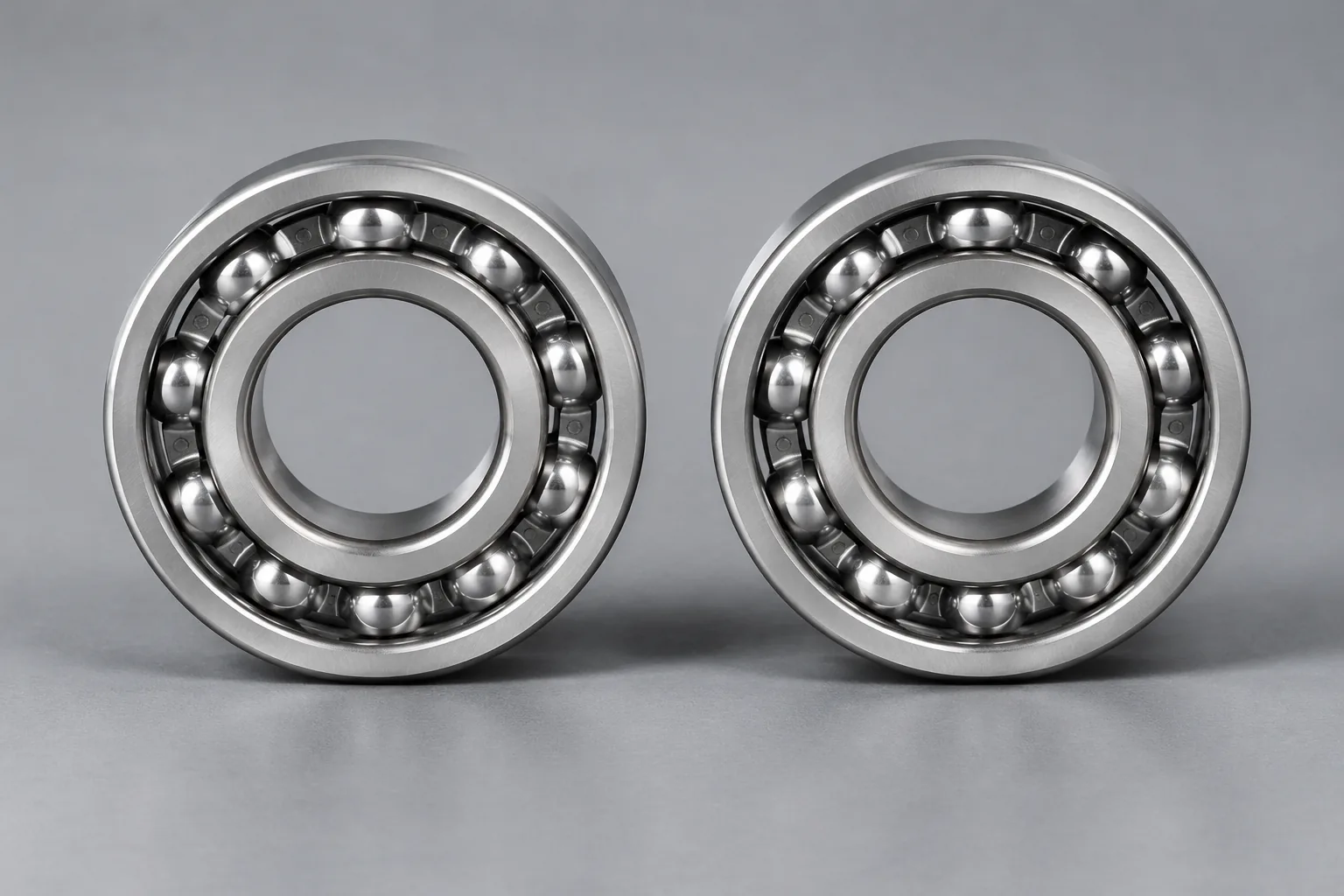
C3 does not represent a fixed micron value. The range depends on bearing type and bore size, so always use the relevant product table. As an example, one deep groove ball bearing table for a 24 mm to 30 mm bore lists CN radial clearance at 5 μm to 20 μm, C3 at 13 μm to 28 μm, and C4 at 23 μm to 41 μm. A 25 mm bore bearing in the 6305 class therefore cannot be assigned an arbitrary C3 value from the suffix alone; it must use its own size-range table.
Choosing the Right Clearance for the Application
Clearance choice must balance fit, temperature, speed, load, required stiffness, noise, and positioning accuracy. There is no single best suffix. The right choice is the one that leaves a safe operating clearance in the real assembly.
Use standard CN clearance for normal operating conditions and conventional shaft and housing tolerances. Consider a larger clearance such as C3 when press fits or large temperature differences will reduce operating clearance. A smaller clearance such as C2 may help reduce rotational noise and vibration, or support a system that will be adjusted after assembly, but it is not a universal high-precision grade.
Larger clearance may be appropriate for high interference fits, heavy or impact loads, high speed, high inner-ring temperature, both rings tight, shaft deflection, or mounting misalignment. Each of these conditions changes the clearance left at operating temperature, so the decision should be made with the fit and thermal calculation together.
General Selection Principles by Bearing Type
Bearing type sets the starting logic:
- Ball bearings generally target an operating clearance near zero.
- Cylindrical roller, needle roller, spherical roller, and toroidal roller bearings generally require at least a small positive operating clearance.
- Tapered roller and angular contact ball bearings generally use small operating clearance or preload where high stiffness or position control is required.
These are starting principles, not fixed rules for every application. Load direction, speed, lubrication, and mounting arrangement can change the final setting.
When Preload or Reduced Clearance Is Considered
Preload is negative internal clearance. It is used to increase stiffness or positioning accuracy by removing internal play. Machine tool spindles and similar high-stiffness applications may use preload to eliminate clearance and control shaft position.
Preload decisions require fit, temperature, speed, and lubrication analysis. Excessive preload can shorten life and cause thermal failure, so it is not a universal solution for precision applications. A preloaded bearing must still have a safe operating condition after the housing and shaft reach steady temperature.
Measuring and Verifying Bearing Clearance
Clearance measurement usually requires a specified measuring load. For ball bearings, elastic deformation under the measuring load can make the measured clearance slightly larger than the theoretical value, so a correction may be needed. Roller bearing deformation under the measuring load is usually smaller and often negligible.
The measuring tool and the bearing should be at the same temperature. A bearing installed by oil bath or induction heating must cool completely before measurement, because thermal expansion will distort the result. Rotate the bearing several times before measurement so the rollers seat correctly.
For a tapered-bore spherical roller bearing, control interference by comparing clearance before and after mounting. A feeler gauge graded to 0.03 mm (0.001 in) can be used between the outer ring and an unloaded roller, with the bearing rotated first to settle the rollers.
For a deep groove ball bearing in the 18 mm to 50 mm bore range, one table specifies a measuring load of 49 N (5 kgf). The corresponding radial clearance correction is 5 μm for CN and 6 μm for C3/C4/C5. These values are table-specific; use the correction that belongs to the bearing type, size, and clearance grade being checked.
Calculation tools can account for fits, temperature difference, and shaft and housing materials, but the final design should still be verified against actual application conditions. A calculation is a guide to the starting clearance, not proof that the mounted bearing will run at the intended value.
Common Mistakes and Practical Checklist
Most clearance errors come from treating a suffix as a complete specification. Watch for these mistakes:
- Confusing bearing clearance with shaft or housing fit or with precision class
- Assuming C3 always means one fixed clearance value
- Ignoring interference-fit reduction and thermal reduction
- Measuring clearance while the bearing is still hot
- Treating C2 as a generic high-precision grade
- Using a published clearance value without checking the table for bearing type and bore size
- Failing to validate the selected clearance in the real application
Use a checklist that covers bearing type, bore size, fits, temperature gradient, speed, load, lubrication, mounting method, and required stiffness. If one of these inputs is missing, the clearance decision is incomplete.
Conclusion
Understanding the importance of bearing clearance means looking past the suffix and checking the clearance that remains after fits and heat. The operating value controls fatigue life, friction, vibration, noise, stiffness, and accuracy, and it can move far from the initial value when interference fits and temperature gradients are present.
Choose the grade with the fit, temperature, speed, load, lubrication, and bearing type in view. Then verify the result by measurement or calculation and confirm it in the real application. That sequence keeps the bearing away from both seizure and excessive play.
FAQs
Q1: What is bearing clearance?
A: Bearing clearance is the internal free movement between the rolling elements and raceways, measured as radial or axial displacement of one ring relative to the other. It is a bearing property, not a shaft or housing fit specification.
Q2: What is the difference between initial, mounted, and operating clearance?
A: Initial clearance is the value before installation. Mounted or residual clearance is what remains after fits are applied but before stable working temperature. Operating or effective clearance is the value at steady temperature, after both fit reduction and thermal expansion have acted.
Q3: Is C3 better than CN?
A: C3 is not better in general; it is a larger internal clearance grade than CN. It helps when press fits, temperature gradients, or other conditions will close the operating clearance, but it can be wrong for an application that needs high stiffness or low play.
Q4: What happens if bearing clearance is too small?
A: Too little clearance raises friction and heat, can make the bearing hard to turn, and can lead to seizure. Excessive negative clearance also causes a sharp drop in fatigue life, and over-tight fits can add inner-ring stress.
Q5: What happens if bearing clearance is too large?
A: Too much clearance reduces rotational accuracy and system stiffness and increases vibration and noise. It is a poor match for high-stiffness or high-positioning-accuracy equipment unless preload or a tighter clearance strategy is used.
Q6: Does an interference fit change bearing clearance?
A: Yes. An interference fit expands or contracts the ring and reduces radial internal clearance. A practical planning value is that about 70% to 90% of the interference may become lost clearance, so the fit must be included when choosing the starting grade.
Q7: How does temperature affect bearing clearance?
A: The inner ring and rolling elements often run about 5°C to 10°C hotter than the outer ring, which reduces operating clearance. High speed can increase that gradient, and thermal feedback can close the clearance further if friction and heat continue to rise.
Q8: How is bearing clearance measured?
A: Clearance is measured with a specified measuring load, with the tool and bearing at the same temperature. Ball bearings may need a correction for elastic deformation, and a heated bearing must cool completely before measurement.
Q9: When should preload be used instead of clearance?
A: Preload, which is negative internal clearance, is used when high stiffness or precise shaft positioning is required. It needs fit, temperature, speed, and lubrication analysis because excessive preload can shorten life and cause thermal failure.
Q10: Is bearing clearance the same as fit or tolerance?
A: No. Fit describes how tight the shaft, bearing, and housing assembly is; tolerance or precision class describes manufacturing accuracy; clearance describes the internal free space between rolling elements and raceways. A suffix such as C3 belongs to clearance, not fit.