Quick Answer: Urethane coated bearings bond a polyurethane contact layer to a rolling bearing, adding damping, workpiece protection and wear resistance to normal rolling function. Industrial advantages include lower contact noise and vibration, protection of fragile parts and machine surfaces, high abrasion resistance, selectable hardness for balancing cushioning against load, elastic recovery, low rolling resistance, and resistance to grease and ozone. Each benefit depends on compound, hardness, coating thickness, bond quality, load, speed, temperature and contact surface, so the coating must be specified for the actual duty.
Industrial conveying, positioning and inspection equipment often needs a rolling element that grips, cushions and protects instead of marking a hard surface against a finished part. A urethane coated bearing fills that role, but its advantages are not automatic. They follow from how the polyurethane layer is formulated, bonded and sized for the duty.
The useful question is not whether polyurethane is generally better than steel, nylon or rubber. It is which combination of hardness, bearing size, coating thickness and compound keeps noise, wear, load and chemical exposure inside safe limits for a specific machine.
What Counts as a Urethane Coated Bearing?
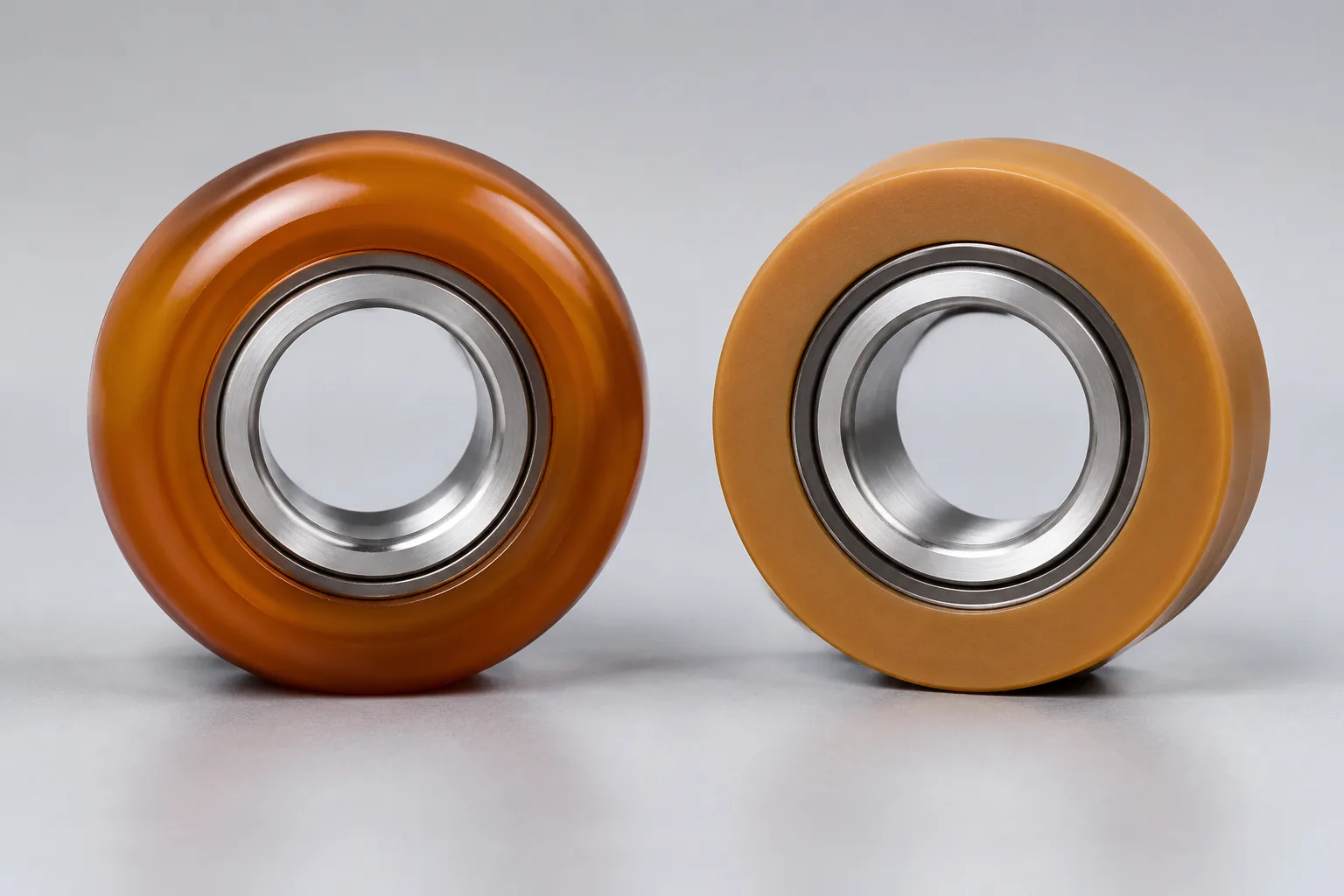
A urethane coated bearing is a rolling bearing with a molded, bonded or heat-sealed polyurethane layer on its outer ring. The polyurethane becomes the contact surface, while the inner bearing carries the rolling load. The layer may be molded or heat-sealed onto the bearing so that the elastomer forms a bonded, abrasion-resistant tire around the steel or stainless outer ring.
This construction differs from a solid polyurethane wheel, which has no internal rolling bearing, and from an uncoated steel, stainless steel or plastic bearing, which presents a hard contact face. A coated bearing still rolls on balls or rollers, but the outer contact is compliant.
Common configurations show how widely the product family can be specified:
- Hardness range: standard molded urethane bearings are available at Shore A50, A70, A90 and A95, with an antistatic version at Shore A90.
- Bearing material: bearing steel and stainless steel options are available, including 440C stainless steel for selected sizes.
- Compliance: some thermoplastic polyurethane coated bearings are listed as RoHS 10 compliant, with the coating and bearing integrally molded at Shore A90.
- Size range: one molded bearing series covers approximately 10 mm to 65 mm outer diameter, so small precision units and larger load rollers can come from the same product concept.
Typical industrial roles include feed rollers, conveyor contact rollers, guide and load rollers, pallet centering, and inspection mechanisms that rotate a product without damaging it. In each role the coating is doing a different job: traction, cushioning, protection, noise control or wear resistance.
Lower Noise and Vibration in Precision and High-Speed Equipment
Polyurethane changes the contact event. Instead of steel meeting steel, or steel meeting a finished workpiece, the outer layer deforms slightly, spreads contact pressure and damps small impacts. That behavior is why precision feed equipment often uses urethane bearings where high positional accuracy, low vibration and low noise must occur together.
The same principle applies at higher surface speeds. A resilient covering can reduce noise and vibration generated by high-speed bearing operation and reduce wear on the bearing and adjacent machinery. In practice, thicker and softer treads generally run quieter than thin, hard treads, while harder compounds may carry more load. Noise control therefore competes with load capacity and wear resistance rather than standing apart from them.
Noise and vibration results depend on speed, load, coating hardness, coating thickness, surface finish and machine structure. When noise is a critical acceptance criterion, validate the coated bearing in the actual mechanism. A polyurethane coating should not be described as universally quieter than every steel, nylon or rubber bearing.
Protection of Bearings, Adjacent Machinery, and Workpieces
The compliant layer acts as a contact interface between the rolling bearing and the outside world. Because the polyurethane can deflect, it reduces the concentration of contact stress that would otherwise pass into the bearing, the fixture or the product. That is the mechanical basis for reduced wear on the bearing and on contacting machine parts.
Practical examples make the benefit easier to see:
- In pallet centering mechanisms, urethane or rubber molded bearings can prevent damage to fixtures or workpieces while still allowing controlled centering.
- In inspection mechanisms, a coated bearing can rotate a product without marking or damaging it, which matters for finished surfaces, painted parts, glass, electronics and soft packaging.
- On floors, tracks and guide surfaces, elastic treads such as polyurethane generally protect the contact surface better than hard wheels and usually run more quietly.
Protection depends on contact pressure, workpiece sharpness, coating hardness and contamination. A urethane coating is most useful with sensitive, finished or fragile workpieces. It does not replace proper guarding or handling design for sharp, hot or chemically aggressive workpieces, and sharp edges can cut or tear a soft coating.
Wear Resistance and Service Life
Thermoplastic polyurethane is selected where repeated rolling and sliding contact would wear a softer elastomer too quickly. Published material data describe TPU as one of the most abrasion-resistant elastomer families, which is why it is used for contact layers that must keep their profile over many operating cycles.
Abrasion is commonly measured by ISO 4649, which reports volume loss in cubic millimetres. Lower volume loss means better abrasion resistance. Representative polyurethane material data include 26 mm³ to 37 mm³ for one industrial elastomer family and 40 mm³ to 50 mm³ for another wheel and roller material family. These figures describe the tested materials, not a universal specification for every urethane coated bearing.
ASTM D5963-22 describes a rotating drum abrasion test that also uses volume loss, and it notes that laboratory abrasion results do not directly equal field wear life. That limitation matters. A coated bearing can fail by coating wear, bond failure, cracking, contamination or bearing fatigue, and abrasion data address only one of those modes.
Wear life depends on compound, hardness, coating thickness, load, speed, surface roughness, contamination and duty cycle. Compare abrasion values only within comparable materials and test conditions, and treat any single supplier value as a material example rather than a bearing rating.
Selectable Hardness Balances Cushioning and Load Capacity
Hardness is the central design lever. A softer polyurethane improves cushioning, conformability and grip, which helps with fragile workpieces and uneven contact. A harder polyurethane generally increases allowable load and reduces deflection, but it gives back some of the noise and cushioning benefit.
Published allowable load data for one molded bearing series show the trade-off clearly. The values below apply to the stated outer diameter and bearing size, not to the whole product family:
| Outer diameter | Bearing | Polyurethane hardness | Allowable load |
|---|---|---|---|
| 28 mm | 626ZZ | Shore A95 | 218 N |
| 28 mm | 626ZZ | Shore A90 | 157 N |
| 28 mm | 626ZZ | Shore A70 | 44 N |
| 28 mm | 626ZZ | Shore A50 | 39 N |
| 65 mm | 6205ZZ | Shore A90 | 750 N, approximately 76.5 kgf |
The 65 mm example shows that a coated bearing can still carry a practical load when the bearing size and coating are matched. The 28 mm example shows why hardness cannot be chosen in isolation: allowable load rises from 39 N at Shore A50 to 218 N at Shore A95 on the same bearing size.
Load ratings are series- and geometry-specific. Verify the supplier rating for the exact bearing, coating and size. Do not estimate load capacity from hardness alone, because the inner bearing, outer diameter, coating thickness and mounting condition all change the result.
Elastic Recovery and Tensile Properties for Shock and Repeated Deformation
Polyurethane combines tensile strength with elasticity, so a coating can stretch, recover and carry compression without behaving like a brittle shell. That combination helps it survive shock loading, repeated deformation and minor misalignment in conveyors, guide rollers and positioning mechanisms.
Representative data for an industrial polyurethane elastomer at approximately 83 to 95 Shore A show tensile strength of 42 MPa to 54 MPa, elongation at break of 660% to 740%, and rebound of 61% to 65%. A broader set of polyurethane wheel materials reports rebound of 42% to 75%.
Rebound also has a dynamic meaning. Higher rebound generally means less heat build-up during dynamic operation, which helps a coating retain its dynamic load capacity in continuous or high-speed conveying. Lower rebound can provide more damping but may generate more heat under the same duty.
These are material-level properties. Confirm them for the specific coated bearing compound, hardness and manufacturing process, and still check the load and speed limits of the finished part.
Low Rolling Resistance and Controlled Dynamic Heat
A polyurethane contact layer can roll with low resistance when the compound is formulated for low hysteresis and the surface is smooth. Published data for industrial polyurethane wheel materials give rolling resistance of approximately 0.7% to 1.0%, with specific grades listed at 0.7% and 0.8%.
Those figures describe wheel and roller materials, not a complete coated-bearing friction specification. Total drag also depends on bearing friction, preload, lubrication, load, speed, alignment and surface condition. A low-resistance tread cannot compensate for a misaligned shaft or a damaged bearing.
Rebound and heat are connected. A compound with higher rebound generally produces less dynamic heat, which helps maintain dynamic load capacity in continuous conveying. Validate energy consumption and temperature rise in the actual assembly when those factors affect motor sizing, product quality or bearing life.
Chemical, Oil, Grease, Ozone, and UV Resistance
Many polyurethane elastomers resist lubricating greases, oils, ozone and UV exposure, which suits industrial environments where bearings run near lubricated chains, hydraulic equipment or outdoor light. Liquid-cast polyurethane materials are also described as resistant to oil, ozone, grease and many solvents.
That does not make every coated bearing chemically universal. Compatibility depends on the polyurethane type, especially polyester versus polyether formulations, and on concentration, temperature and exposure time. Some solvents, acids, bases and process fluids can attack a specific compound even when another polyurethane performs well in the same fluid.
Check the supplier chemical compatibility table for the exact compound before use in contact with cleaners, cutting fluids, process chemicals or aggressive washdown agents. If the exposure is intermittent, state the concentration and temperature rather than relying on a general resistance claim.
Usable Temperature Range and Cold Flexibility
Urethane coated bearings suit many ambient and moderate industrial temperatures, but they are not high-temperature bearing substitutes. One industrial polyurethane family lists a continuous working temperature up to 80°C and short-term exposure up to 120°C. General polyurethane material data list heat resistance at approximately 70°C.
Cold performance is also formulation-dependent. General polyurethane data give low-temperature performance from -20°C to -40°C depending on hardness and compound, and a polyether thermoplastic polyurethane can have a glass transition temperature of -41°C. That means some grades retain useful flexibility below freezing.
Temperature limits vary by formulation, hardness, load and duration. Consider heat generated by continuous operation, not only ambient temperature. Above the compound limit, the coating may soften, creep or lose bond strength, and a high-temperature bearing or a different material should be selected.
Application-Specific Configurations: Antistatic, Stainless Steel, and RoHS
Coated bearings can be specified for more than mechanical advantage. Antistatic polyurethane, stainless steel bearing components and RoHS-compliant materials extend the product into electronics, clean equipment and corrosion-sensitive areas.
- Antistatic: a gray Shore A90 antistatic polyurethane version is available for static-controlled production and handling lines.
- Stainless steel: 440C stainless steel bearing options are available for selected urethane molded bearings, which helps where moisture or corrosion is a concern.
- RoHS: some thermoplastic polyurethane coated bearing series are listed as RoHS 10 compliant, with an integrally molded Shore A90 coating.
Availability depends on series, size and supplier. Confirm the antistatic performance requirement, the stainless steel grade and the compliance scope for the exact product before ordering.
Industrial Use Cases Where These Advantages Matter
The advantages become concrete when they are matched to a handling problem:
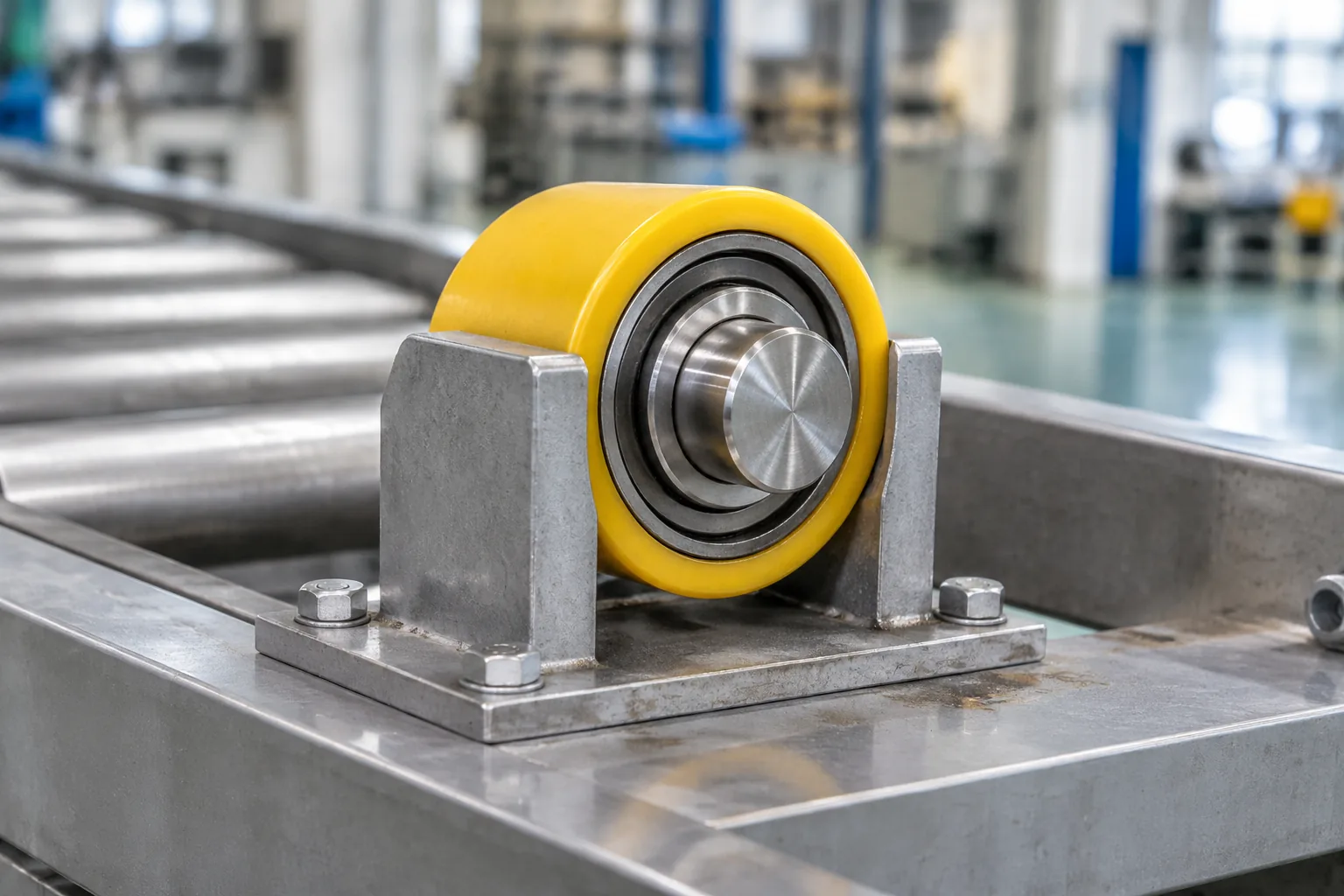
- Conveyors and feed equipment: low noise and vibration, low rolling resistance and workpiece protection in manufacturing and warehousing lines.
- Pallet centering and positioning: compliant contact prevents fixture or workpiece damage while allowing controlled centering.
- Inspection and rotation mechanisms: rotate products without damage while maintaining smooth motion.
- Guide rollers and load rollers: combine cushioning, traction and wear resistance where hard steel contact would mark the product or surface.
- Static-controlled or corrosion-sensitive lines: specify antistatic or stainless steel variants when the environment requires them.
Match each use case to load, speed, temperature, chemical exposure and workpiece sensitivity. For high loads or high temperatures, confirm that a coated bearing is still the appropriate component rather than assuming the coating will solve every contact problem.
Selection Checklist: Turning Advantages into Specifications
Use the following sequence to convert a general advantage into a purchasable specification:
- Define the duty: actual load, contact pressure, speed, duty cycle and allowable deflection.
- Choose hardness: balance cushioning, noise and vibration reduction, traction, wear and allowable load instead of defaulting to the hardest compound.
- Check the environment: temperature, chemical exposure, cleaning agents and UV or ozone conditions against the specific polyurethane compound.
- Select bearing material and options: bearing steel, 440C stainless steel, antistatic polyurethane and RoHS-compliant series as required.
- Specify the coating: coating thickness, bond quality, outer diameter tolerance and runout must come from the supplier, because published sources do not provide universal numeric design rules for these items.
- Validate in the application: test noise, wear, heat and life when the bearing is critical to product quality or safety.
Do not select a coated bearing from hardness and load alone when chemical, thermal or contamination conditions are severe.
Limitations and When a Urethane Coated Bearing Is Not the Best Choice
A clear view of the limits is part of a sound specification:
- Temperature: standard polyurethane compounds are not suitable above their rated temperature limits.
- Chemical exposure: some solvents, acids, bases or process fluids attack specific polyurethane formulations, so compatibility must be checked.
- Load and stiffness: polyurethane is more compliant than steel and may not suit very high-load or high-stiffness applications.
- Abrasion and contamination: sharp debris, abrasive slurry or severe contamination can shorten coating life.
- Data limits: abrasion, load, rolling resistance and temperature values are material- and product-specific and should not be generalized across all urethane coated bearings.
Use an alternative bearing material or an uncoated bearing when the application requires high temperature, high stiffness or broad chemical resistance beyond the polyurethane compound limits. Also reconsider the design when sharp edges, hot workpieces or heavy shock loads would cut, soften or deform the coating.
Key Takeaways for Industrial Specification
- Urethane coated bearings offer a selectable balance among noise and vibration reduction, workpiece protection, wear resistance, cushioning, load capacity and rolling efficiency.
- The best-supported advantages are reduced contact noise and vibration, protection of contact surfaces, high abrasion resistance of polyurethane materials, hardness-dependent load capacity, and availability of antistatic, stainless steel and RoHS-compliant configurations.
- Successful specification requires matching hardness, bearing size, coating, temperature, chemical exposure and load or speed conditions to the application.
- Do not generalize one polyurethane material test value to all coated bearings. Verify the exact compound and finished part with the supplier and, where the duty is critical, with application testing.
Conclusion
The industrial advantages of urethane coated bearings come from a compliant contact layer working with a rolling bearing, not from polyurethane alone. Lower noise and vibration, protection of workpieces and machine surfaces, abrasion resistance, elastic recovery and low rolling resistance all have a place, but each one depends on compound, hardness, coating thickness, bond quality and operating conditions.
Use hardness and load data to set the basic geometry, then check temperature, chemical exposure and contamination before confirming the part. When the bearing is critical to product quality or safety, validate noise, wear and heat in the real mechanism rather than relying on a generic material claim.
FAQs
Q1: What are the main advantages of urethane coated bearings?
A: They combine a rolling bearing with a polyurethane contact layer that can reduce contact noise and vibration, protect workpieces and machine surfaces, resist abrasion, provide cushioning and elastic recovery, lower rolling resistance, and tolerate grease, oil and ozone. The practical benefit depends on compound, hardness, coating thickness, load, speed and environment.
Q2: Do urethane coated bearings reduce noise and vibration?
A: Yes, a polyurethane layer can damp contact noise and vibration in feed equipment, conveyors and precision mechanisms. Thicker and softer treads generally run quieter, while harder compounds may carry more load. Confirm the result in the actual machine when noise is a critical requirement.
Q3: Can urethane coated bearings protect workpieces and machine surfaces?
A: They can. The compliant outer layer spreads contact pressure and reduces the risk of marking fixtures, finished parts, glass, painted surfaces and soft packaging. Protection is best with sensitive workpieces; sharp edges, hot parts and aggressive chemicals require guarding or a different contact material.
Q4: How does polyurethane hardness affect load capacity?
A: Higher hardness generally increases allowable load. In one 28 mm outer diameter series with a 626ZZ bearing, allowable load rises from 39 N at Shore A50 to 44 N at Shore A70, 157 N at Shore A90 and 218 N at Shore A95. Hardness alone is not enough, because bearing size and coating geometry also change the rating.
Q5: Are urethane coated bearings resistant to oil, grease, and chemicals?
A: Many polyurethane elastomers resist lubricating grease, oil, ozone and UV exposure, and some resist many solvents. Compatibility still depends on the polyurethane type, concentration, temperature and exposure time. Check the supplier compatibility table for the exact compound before contact with process fluids, acids, bases or aggressive cleaners.
Q6: What temperature range can urethane coated bearings handle?
A: One industrial polyurethane family allows continuous operation up to 80°C and short-term exposure up to 120°C, while general polyurethane data list heat resistance near 70°C. Some grades remain flexible from -20°C to -40°C. These bearings are not high-temperature substitutes, and continuous operation adds internal heat to ambient temperature.
Q7: Are antistatic or stainless steel urethane coated bearings available?
A: Yes, configurations include a gray Shore A90 antistatic polyurethane version and 440C stainless steel bearing options for selected sizes. Some thermoplastic polyurethane coated series are also listed as RoHS 10 compliant. Confirm availability, antistatic performance and stainless grade for the exact series and size.
Q8: When should you avoid using a urethane coated bearing?
A: Avoid it when the duty exceeds the compound temperature limit, when the coating would contact an incompatible solvent, acid or process fluid, or when very high load or stiffness makes a compliant layer unsuitable. Sharp debris, abrasive slurry and cutting edges can also shorten coating life and call for a different bearing or handling design.