In the world of precision machinery, the ability to handle complex loads at high speeds is not just a requirement—it’s a necessity. This is where the angular contact ball bearing comes into its own. Designed to support combined loads (radial and axial simultaneously), these bearings are the workhorses of machine tool spindles, high-speed pumps, and precision gearboxes.
DUHUI Bearing will walk you through everything you need to know about angular contact bearings. We’ll explore their working principle, the different types available, a detailed selection criterion, and the critical role of preload, helping you make the best choice for your application.
1. What Are Angular Contact Ball Bearings?
1.1 Definition and Key Characteristics
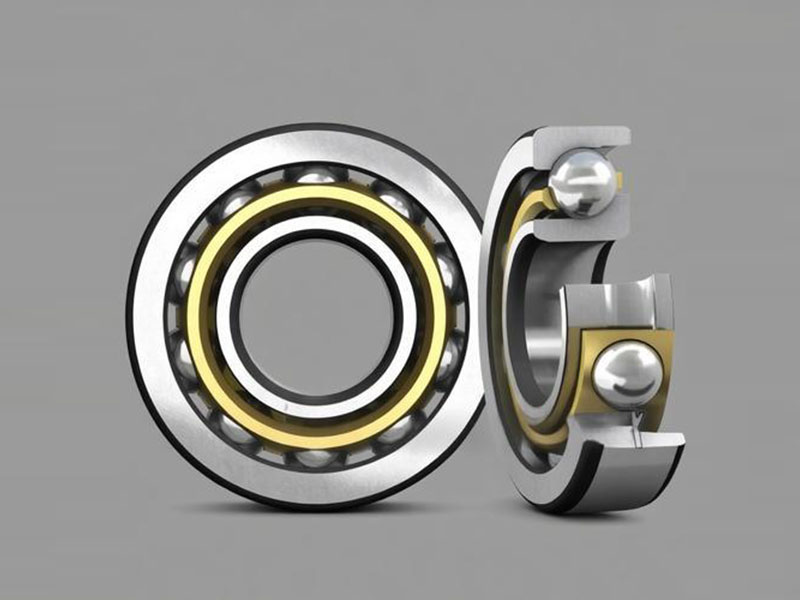
An angular contact ball bearing is a type of precision rolling-element bearing designed to support combined loads. Unlike a deep groove bearing, its races are offset relative to each other in the direction of the bearing axis. This design creates a contact angle between the balls and the races, allowing it to accommodate significant axial loads in one direction while simultaneously handling radial loads.
1.2 Core Components
Like all rolling bearings, it consists of four main parts:
- Inner Ring: The component that typically mounts onto the shaft.
- Outer Ring: The component that mounts into the housing.
- Balls (Rolling Elements): The elements that transfer the load and reduce friction.
- Cage: Separates and guides the balls, ensuring even spacing and preventing metal-to-metal contact.
1.3 The Principle of Operation: The Contact Angle
How the Contact Angle Works
The contact angle (α) is the angle formed between a line perpendicular to the bearing axis and the line of action of the resultant force transmitted from one raceway to the other through a rolling element. This angle is typically 15°, 25°, 30°, or 40°. A larger contact angle provides a greater capacity for axial loads, while a smaller angle is optimized for high-speed operation.
Load Analysis and Transmission
When a radial load is applied, it creates an internal force that pushes the balls against the side of the raceway. This induces an axial force component. Because of the contact angle, the bearing can efficiently transmit this combined load from the inner ring to the outer ring. This is why they are often used in pairs, as a single bearing can only handle axial load in one direction.
2. The Types of Angular Contact Bearings
2.1 Single Row Angular Contact Ball Bearings
- Key Features: Can support radial and axial loads in one direction only. They must be used with a second bearing (or a set) to provide bidirectional axial location.
- Common Applications: Ideal for applications where the axial load is predominantly in one direction, such as in centrifugal pumps, gearboxes, and some industrial fans.
2.2 Matched (Duplex) Angular Contact Ball Bearings
These are sets of two or more bearings ground for specific mounting arrangements to achieve the desired performance.
- Back-to-Back (DB) Arrangement: The load lines converge towards the bearing axis. This offers high rigidity and excellent moment load resistance, making it ideal for machine tool spindles.
- Face-to-Face (DF) Arrangement: The load lines diverge. This arrangement is more forgiving of misalignment and shaft deflections but offers less rigidity than DB.
- Tandem (DT) Arrangement: The load lines are parallel. This is used when the axial load is always in one direction, as it shares the load across multiple bearings, increasing the total thrust capacity.
2.3 Double Row Angular Contact Ball Bearings
- Key Features and Benefits: Essentially two single-row bearings integrated into one unit. They can handle axial loads in both directions and offer high rigidity in a compact, easy-to-mount package.
- Typical Applications: Commonly used in gearboxes, agricultural machinery, and lifting equipment where space is limited and high rigidity is needed.
2.4 Four-Point Contact Ball Bearings
- Key Features and Benefits: A single-row bearing with a raceway designed to support axial loads in both directions. They have a significantly higher axial load capacity than single-row bearings in a very small axial space.
- Typical Applications: Ideal for applications requiring a compact, weight-saving design, such as hydraulic pumps, swivel drives, and industrial gears.
3. How to Select the Right Angular Contact Bearing
Selecting the correct bearing is critical for machinery performance and longevity.
3.1 Define Your Application Parameters
Start by gathering your application’s basic data:
- Target Operating Speed: Maximum and typical RPM.
- Load Type and Magnitude: Radial, axial (thrust), or combined loads.
- Rigidity Requirements: How much deflection can the system tolerate?
- Mounting Space: Shaft diameter and available housing space.
- Operating Environment: Temperature, contamination, and humidity levels.
3.2 Understanding Speed Performance: Limits and Ratings
- Thermal Reference Speed: A thermal-based speed rating that accounts for the bearing’s operating temperature.
- Limiting Speed: The mechanical speed limit determined by the cage and bearing design.
- Speed Selection Reference Table:
| Application Scenario | Target Speed (rpm) | Recommended Bearing Reference Speed |
| High-speed CNC spindle | 12,000 | ≥ 15,000–18,000 rpm |
| High-speed electric motor | 18,000 | ≥ 22,000 rpm |
| General industrial drive | 3,000–5,000 | ≥ 6,000 rpm |
3.3 Factors Influencing Speed Capability
The actual achievable speed is influenced by:
- Bearing Arrangement and Preload: Higher preload increases friction and reduces speed capability.
- Lubrication Method: Oil mist or air-oil lubrication allows for higher speeds than grease.
- Cage Material and Design: Lightweight, high-strength cages like PEEK or Phenolic are essential for extreme speeds.
3.4 Selecting Based on Load Requirements
- For combined loads (radial + axial), an angular contact bearing is the optimal choice.
- For pure, single-direction axial loads, a tandem (DT) arrangement is highly effective.
- For alternating or bidirectional axial loads, a DB, DF, or double-row configuration is necessary.
3.5 Choosing the Optimal Contact Angle
The contact angle is your primary tool for tuning load capacity versus speed.
| Contact Angle (°) | Characteristics | Typical Applications | Common Suffixes (e.g., SKF / FAG) |
| 15° (C) | High Speed, Low Load | Spindle Motors, Precision Instruments | C / C |
| 25° (A5/E) | Medium Speed, Moderate Axial Load | Machine Tool Spindles, Servo Motors | A5 / E |
| 30° (A) | Balanced, Medium-High Load | Industrial Drives, General Machinery | A / – |
| 40° (B) | High Thrust, Lower Speed | Heavy-Duty Pumps, Compressors, Gearboxes | B / B |
3.6 Selecting Materials and Cages for Your Environment
| Application Requirement | Recommended Material/Cage | Key Benefits |
| Ultra-High Speed | Hybrid Ceramic (Ceramic Balls) + PEEK Cage | Reduced heat generation, higher speed capability, and electrical insulation. |
| High Corrosion/Humidity | Stainless Steel or Full Ceramic Bearings | Excellent corrosion resistance for food processing or marine applications. |
| Quiet Operation, Light Load | Resin Cages (Nylon, Phenolic) | Low friction, noise reduction, ideal for electric motors and light machinery. |
3.7 Choosing the Right Preload Level
Preload eliminates internal clearance, increasing rigidity and reducing noise. Levels are typically classified as light, medium, or heavy.
3.8 Determining the Best Bearing Arrangement
| Arrangement | Characteristics | Recommended Applications |
| DB (Back-to-Back) | High rigidity, excellent moment load resistance. | Machine tool spindles, precision shafts, and applications requiring high tilting stiffness. |
| DF (Face-to-Face) | Accommodates misalignment and shaft deflections. | Long shafts, applications where the housing may not be perfectly aligned. |
| DT (Tandem) | Shares single-direction axial loads. | High thrust load applications like pump rotors or axial compressors. |
4. Materials in Angular Contact Bearings
The materials used define the bearing’s limits.
4.1 Ring and Rolling Element Materials
- High-Carbon Chromium Bearing Steel (GCr15 / 52100): The industry standard for most applications, offering an excellent balance of hardness, wear resistance, and cost.
- Stainless Steel (AISI 440C): Provides good corrosion resistance in moist or chemically aggressive environments.
- Hybrid Ceramics (Si3N4 Balls): Silicon nitride balls are lighter, harder, and generate less heat than steel. They are ideal for ultra-high-speed spindles and provide electrical insulation.
- Full Ceramic Bearings (ZrO2, Si3N4): Used in extreme environments with very high temperatures, aggressive chemicals, or a need for total non-magnetism.
4.2 Cage Materials: Performance and Selection
| Cage Type | Common Materials | Optimal Contact Angles | Key Advantages |
| Stamped Steel | Steel Sheet | 30°, 40° | Cost-effective, durable, and good for high-temperature applications. |
| Machined Brass | Brass | 30°, 40° | High strength, excellent vibration damping, and long service life in heavy-duty applications. |
| Molded Resin | Nylon 66, Nylon 46 | 15°, 25°, 30° | Low noise, low friction, lightweight, and capable of high speeds. |
| Machined Synthetic Resin | PEEK, Phenolic | 15°, 25°, 30° | Superior high-speed performance, high precision, and low vibration for critical spindles. |
5. Installation and Preload of Angular Contact Bearing Performance
5.1 Pre-Installation Best Practices
Always inspect the shaft and housing for burrs or damage. Ensure components are absolutely clean and lubricate the bearing immediately before installation.
5.2 Understanding Preload: Definition and Functions
Preload is the process of applying a permanent axial load to a bearing to remove internal clearance. This:
- Increases rigidity.
- Reduces noise and vibration.
- Ensures accurate shaft positioning.
- Prevents ball skidding at high speeds.
5.3 Methods of Applying Preload
- Constant Pressure Preload: A spring applies a constant, consistent preload regardless of thermal expansion. Good for high-speed applications.
- Fixed Position Preload: Achieved by tightening a nut or using ground spacers. This provides very high rigidity but is sensitive to temperature changes.
5.4 Preload Recommendations by Application
| Application | Recommended Preload | Primary Reason |
| High-Speed Spindles (CNC) | Light to Moderate | Minimizes friction and heat buildup, ensuring stable performance at high RPMs. |
| Heavy-Duty Gearboxes | Moderate to High | Improves load distribution across the rolling elements, reducing wear and extending bearing life. |
| Precision Instruments | Light | Reduces internal stress, ensuring high running accuracy and minimizing thermal expansion. |
| Electric Motors | Variable/Adjusted | Adapts to varying axial forces from thermal growth or magnetic fields, maintaining consistent performance. |
6. Angular Contact Bearings vs. Deep Groove Ball Bearings
Choosing between these two common types depends entirely on the application demands.
| Feature | Angular Contact Bearings | Deep Groove Ball Bearings |
| Contact Angle | Has a defined contact angle (15° to 40°). | No contact angle; designed for radial loads. |
| Axial Load Handling | Can handle high axial loads in one direction (or both when paired). | Limited axial load capacity. |
| Rigidity | High rigidity, especially with preload applied. | Lower rigidity, more flexible. |
| Speed Capability | Excellent for very high-speed applications. | Good for medium to high-speed applications. |
| Mounting | Requires precise mounting and often pairing. | Easier to install and align, can be used individually. |
Conclusion
Selecting the right angular contact ball bearing is a critical engineering decision that impacts the performance, reliability, and lifespan of your machinery. From understanding contact angles and load requirements to mastering preload and material selection, every detail matters.
Whether you need a standard single-row bearing for a gearbox or a custom-matched set for a high-speed spindle, our team is ready to support you.