Quick Answer: The causes of wheel hub failure usually begin with damage to a raceway, seal or lubricant, not with the noise heard later. Incorrect bearing adjustment or axle-nut torque, impact-wrench and pressing damage, water and dirt ingress, wrong or mixed grease, road impacts, overloading and worn mating surfaces all shorten hub life. Normal rolling-contact fatigue is the long-term background mechanism; practical causes are usually installation, contamination, lubrication and operating loads.
Wheel hubs rarely fail at random. A hub that growls, develops play or triggers an ABS warning has usually been running with a changed bearing setting, a damaged seal, contaminated grease or a distorted seat for some time. This article explains the physical damage modes behind the causes of wheel hub failure, links common symptoms to likely causes and sets out the installation and maintenance checks that reduce repeat failures. It uses ISO 15243:2017 damage terminology as the classification backbone.
How Wheel Hubs Actually Fail
Wheel hub failure is not one event. Damage starts as a surface or subsurface change on the raceway, seal or lubricant and only later becomes noise, play or vibration. That sequence matters because a hub replaced for noise may already have a long history of wrong preload, water entry or grease breakdown.
ISO 15243:2017, Rolling bearings – Damage and failures – Terms, characteristics and causes, is the second edition, published in March 2017 and confirmed on review in 2022. It remains the current published version, with a third edition in preparation. It groups bearing damage into six categories:
- Rolling contact fatigue
- Wear
- Corrosion
- Electrical erosion
- Plastic deformation
- Fracture and cracking
For wheel hubs, these categories trace back to overload, contamination, water ingress, poor lubrication, installation impact, incorrect fit, misalignment and wrong preload.
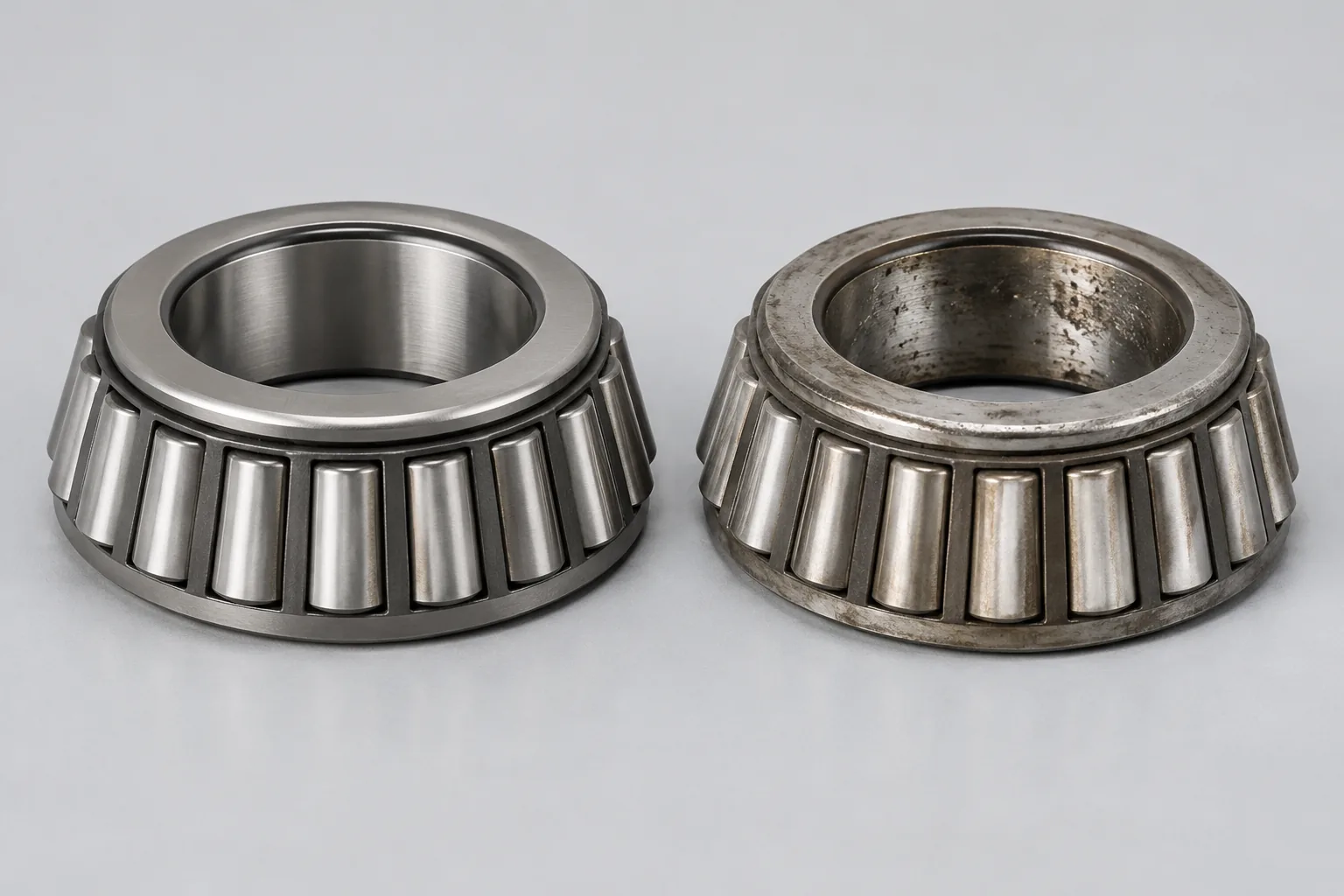
Normal rolling contact fatigue is a long-term mechanism: cyclic loading creates microcracks below the rolling contact surface that eventually develop into spalling. Overload, an inadequate lubricant film and solid contamination accelerate that fatigue, so a hub can fail far earlier than its design life without any single dramatic event.
A sealed hub assembly and a conventional adjustable wheel bearing do not share the same dominant failure route. Cause statistics must therefore be applied to the correct design, not transferred from one bearing type to another.
These statements describe mechanisms, not a predicted service life; no mileage or service interval is implied.
Installation and Adjustment Errors
Installation and adjustment problems are the largest controllable group of wheel bearing failure causes and a common reason a replacement hub fails again quickly. The main examples are incorrect adjustment or torque, impact-tool damage, wrong pressing method, incomplete roller seating and contaminated mating surfaces.
Incorrect Bearing Adjustment and Axle-Nut Torque
SKF technical data for conventional wheel bearings attributes about 80 percent of failures to incorrect adjustment, 8 percent to seal damage during installation, 7 percent to seal failure and 5 percent to other causes. Incorrect adjustment includes excessive clearance or excessive preload as well as damage caused during handling, assembly and adjustment. That split is specific to conventional wheel bearings and should not be pasted onto every sealed hub assembly.
Timken identifies loss of bearing retention as a main cause of wheel hub and wheel bearing damage. An axle nut with incorrect torque or a failed self-locking feature can back off, change the bearing setting inside the hub, cause misalignment and accelerate wear.
Both too much end play and too much preload change the internal load distribution, so the bearing runs with the wrong contact pattern rather than simply wearing faster. The setting must follow the vehicle or component manufacturer’s specified torque and adjustment procedure, not a generic value.
Exception: Sealed hub assemblies with a pre-set bearing are not adjustable, so misadjustment does not apply in the same way. Incorrect axle-nut torque can still change the setting where the nut clamps the bearing.
Impact Wrench and Pressing Damage
Timken requires a certified, calibrated torque wrench when installing a hub assembly. An impact wrench can damage the axle nut, the threads and related parts, and it can produce torque that is either too high or too low.
Applying the installation force through the wrong bearing ring deforms the raceway. Pressing on the wrong part leaves indentations that become noise and premature failure. Striking a bearing directly, damaging the seal or using the wrong tools can produce a bearing that is noisy and fails after only a short distance of driving.
SKF’s HBU1 guidance warns that a press tool which touches the seal or the inner ring instead of pressing the outer ring squarely into the knuckle can damage the seal and misalign the rolling elements. Water then enters, spalling starts and bearing noise follows.
Press force must therefore go through the ring the mounting design intends, with correct adapters and the hub supported squarely. This torque and pressing guidance applies to hub assemblies and bearings installed with an interference fit; always follow the OEM service procedure for the specific vehicle.
Incomplete Roller Seating on Tapered Roller Bearings
On paired tapered roller bearings, the hub must be rotated while the axle nut is tightened to the specified torque so the rollers seat against their raceways. Where the OEM procedure does not state otherwise, SKF’s technical procedure is to rotate the hub 5 to 20 turns during the setting operation.
If the rollers stay in the wrong position, the result can be excess clearance, cage damage, overload on a single roller and early bearing failure. In severe cases the wheel can detach. This is a procedure failure that leaves no visible damage at the moment of assembly, which is why it is easily repeated on the next repair.
Exception: Where the vehicle manufacturer publishes its own run-down or setting procedure, that procedure governs.
Rust, Dirt, and Uneven Mating Surfaces
Small amounts of rust, dirt, old grease or an uneven surface on the hub flange can prevent a part from seating correctly and create lateral runout. Runout at the flange or brake disc applies additional load and can damage the wheel bearing even when the bearing itself was installed correctly.
Mating surfaces must be cleaned and checked before fitting, not just wiped, because a raised burr or corrosion patch changes the clamped geometry.
Seal Damage, Contamination, and Lubrication Problems
Seals and lubricant protect the raceways. Once either is compromised, corrosion, abrasive wear and surface-origin fatigue follow. The sections below cover what seal failure does, how water and particles enter, and how incorrect, insufficient, degraded or mixed lubricant shortens hub life.
Seal Failure and Water Ingress
A failed wheel-end seal can leak grease or oil, leaving the bearing under-lubricated, running hotter and failing early. The same seal failure lets water, mud and particles into the bearing, contaminating the lubricant and causing corrosion, abrasive wear and raceway surface damage.
Even small scratches or rust on the seal contact surface can damage the seal lip, allowing water to enter and cause corrosion and early bearing failure. Water ingress can end in spalling; a hub that failed after wet-season driving may show rust and pitting rather than a clean fatigue band.
Seal condition must be treated as a cause in its own right, not only as a symptom of an old hub.
Wrong, Insufficient, or Mixed Lubricant
SKF lists insufficient lubrication, incorrect lubricant selection, lubricant degradation and ingress of water or other fluids as bearing damage causes. Solid contaminants are repeatedly rolled over on the raceway, breaking the lubricant film and producing metal-to-metal contact, microcracks, micro-spalling and surface-origin fatigue.
SKF wheel-end material also lists lubricant contamination, mixing of different lubricants and incompatibility between seal material and lubricant as factors in premature seal failure. Seal failure then leads to lubricant loss or further contaminant entry.
Lubricant quantity matters as much as type: an under-filled hub and an over-filled hub both run at the wrong operating condition. For sealed hub assemblies the lubricant is factory-set, so the practical controls are correct part selection, undamaged seals and avoiding heat or impact that degrades the grease.
Exception: Sealed-for-life hub assemblies cannot be re-greased. Lubricant advice applies to the assembly as supplied and to bearings that are packed and adjusted during service.
Road Impacts, Overloading, and Worn Surrounding Parts
External loads and worn mating parts can start hub damage without any installation error. The main groups are impact loads, overloading and worn hubs, spindles, knuckles and housings.
Potholes, Curb Impacts, and Other Road Shocks
FAG, part of Schaeffler, lists harsh road conditions such as potholes, impacts against curbs and storm or flood environments among the factors that damage wheel bearings. Impact loads act briefly but can leave indentations on the raceway that then generate noise and spalling under normal driving.
The same FAG list names incorrect installation, wrong tools and failure of surrounding parts such as the bearing housing or knuckle, which shows that impact and installation causes often combine. Driving style and route therefore affect hub life even when the hub is correctly specified and fitted.
Vehicle Overloading
FAG explicitly lists excessive loading as an external factor that shortens wheel bearing life. SKF’s ISO 15243 guidance links overload to plastic deformation, higher rolling contact stress and reduced fatigue life.
Overloading acts cumulatively: the hub may survive individual trips but accumulates damage faster than a correctly loaded vehicle. Load rating is a vehicle and axle specification, so the check is against the permitted axle load, not against the bearing’s nominal rating alone.
Worn Hubs, Spindles, and Bearing Housings
SKF notes that even small wear in a bearing housing or on an axle can cause misalignment and lead to early bearing failure. Timken notes that a worn hub spindle lets the inner ring rotate on the hub, which accelerates wear on both the bearing bore and the spindle.
A new bearing fitted onto a worn or damaged seat reproduces the original failure, so the seat must be measured and assessed before replacement. Distortion or damage in the knuckle, housing or flange is a hub-level cause rather than a bearing-level cause and cannot be corrected by a better bearing.
Matching Symptoms to Likely Causes
Symptoms indicate that diagnosis is needed; they do not prove that one specific part has failed. Typical wheel-end symptoms include:
- A hum or growl that changes with road speed or cornering load
- Play at the wheel
- Vibration
- Uneven or rapid tire wear
- Grease leakage around the hub
- ABS or traction warnings on vehicles with wheel-speed sensors
Cause clues matter as much as the symptom:
- Grease visible around the seal points toward seal failure and contamination.
- A hub that failed shortly after a repair points toward adjustment, torque or pressing errors.
- A failure after a heavy impact points toward raceway indentations.
- A heavily loaded vehicle points toward overload and plastic deformation.
Inspection should check wheel play, roughness felt while rotating the hub, seal condition, lubricant condition and color, and the condition of the flange and knuckle mating surfaces. Comparing the failed side with the opposite side helps separate a local cause from a vehicle-wide one such as overloading or a worn housing.
Noise alone cannot separate bearing wear from tire, brake or driveline noise, so the hub should be confirmed before parts are ordered.
Diagnosis note: These steps describe inspection practice; they do not replace the vehicle manufacturer’s diagnostic procedure or a road test by a qualified technician.
Prevention: What Actually Reduces Wheel Hub Failure
Prevention is mostly about controlling the installation and operating inputs that drive the causes above.
- Use a calibrated torque wrench set to the specified axle-nut torque and never an impact wrench to set the nut.
- Follow the specified adjustment or run-down procedure, including rotating the hub 5 to 20 turns on paired tapered roller bearings when the OEM procedure does not state otherwise.
- Press only through the ring the mounting design intends, with correct adapters, and keep tools away from the seal and rolling elements.
- Clean and inspect the hub flange, knuckle and spindle seats; remove rust, dirt and burrs, and replace housings or spindles that are worn or distorted.
- Keep the specified lubricant clean and correct, do not mix incompatible greases, and never fit a new bearing with damaged seals.
- Respect the permitted axle load and reduce exposure to curb strikes and potholes where possible.
- Record the installation torque and procedure used, so a repeat failure can be traced to cause rather than guessed.
Condition: All torque values and adjustment procedures must come from the vehicle or component manufacturer’s specification; no universal torque figure is given here.
Conclusion
The causes of wheel hub failure usually trace to a small number of controllable causes: incorrect adjustment or torque, damaged or incorrectly pressed parts, seal and lubricant failure, impact and overload, and worn mating surfaces. Normal rolling contact fatigue is the long-term background mechanism, but it is accelerated when lubrication, sealing or setting is wrong.
The cause statistics carry scope: SKF’s 80 percent adjustment figure applies to conventional wheel bearings, not to every sealed hub assembly. A hub that fails twice in the same position points to an installation, seating or mating-surface cause that has not been corrected.
Safe next action: identify the damage pattern and the installation history first, then specify the replacement part against the vehicle and axle load, and follow the OEM torque and run-down procedure.
FAQs
Q1: What is the most common cause of wheel hub failure?
A: For conventional wheel bearings, incorrect adjustment accounts for about 80 percent of failures in SKF data. On sealed hub assemblies, seal failure, contamination, road impact and overload are the practical recurring causes, so the conventional-bearing figure should not be applied to every hub design.
Q2: Can one pothole damage a wheel hub?
A: Yes. A pothole or curb strike can leave raceway indentations that later produce noise and spalling under normal driving; FAG lists potholes and curb impacts among wheel bearing damage factors. A single impact does not always cause immediate failure, but it can start damage that appears later.
Q3: Can using an impact wrench destroy a new hub?
A: It can damage the axle nut, threads and related parts and can leave torque too high or too low, which changes the bearing setting. Timken requires a certified, calibrated torque wrench for hub assembly installation. Follow the vehicle manufacturer’s torque and procedure.
Q4: How many turns should the hub be rotated when setting a tapered roller bearing?
A: SKF’s procedure is 5 to 20 turns while the axle nut is tightened to the specified torque, unless the OEM procedure states otherwise. Rotation seats the rollers; skipping it can leave excess clearance, cage damage or single-roller overload.
Q5: Does overloading really shorten wheel hub life?
A: Yes. FAG lists excessive loading as an external factor that shortens wheel bearing life, and SKF’s ISO 15243 guidance links overload to plastic deformation, higher rolling contact stress and reduced fatigue life. The check is against the permitted axle load, not the bearing’s nominal rating alone.
Q6: Can mixing greases cause a wheel end to fail?
A: Yes. SKF lists lubricant contamination, mixing different lubricants and seal-lubricant incompatibility as factors in premature seal failure. Seal failure then leads to lubricant loss or further contaminant entry, which accelerates corrosion, wear and surface-origin fatigue.