Quick Answer
A failing U-joint might seem like a minor annoyance, but ignoring it can cost you anywhere from $2,500 to $7,500 or more in transmission or differential repairs. Replacing a U-joint early typically costs between $270 and $500 including parts and labor, depending on your vehicle and local shop rates. The math is simple: address the problem when you first hear the squeak or feel the vibration, or pay 10 to 20 times more when the part fails completely and takes expensive components with it.
That faint squeak when you pull out of your driveway. The clunk when you shift from reverse to drive. The vibration that seems to get worse the faster you go.
These aren’t just annoying noises or sensations. They’re warnings. And if you ignore them, you’re not just living with a minor inconvenience–you’re setting yourself up for a repair bill that could run into thousands of dollars.
A U-joint (universal joint) is one of the cheapest components in your drivetrain. A quality replacement part costs anywhere from $20 to $75, with heavy-duty versions running $75 to $100. But when a U-joint fails and you keep driving, it doesn’t just break quietly. It takes other parts with it–expensive parts like your transmission, differential, and driveshaft.
This article breaks down exactly what happens when you ignore a failing U-joint and what each stage of that failure will cost you. By the end, you’ll understand why replacing a U-joint early isn’t an expense–it’s an investment that saves you money.
Why a Small U-Joint Failure Can Destroy Your Drivetrain
Before we get into costs, it helps to understand what this small part actually does and why its failure has such outsized consequences.
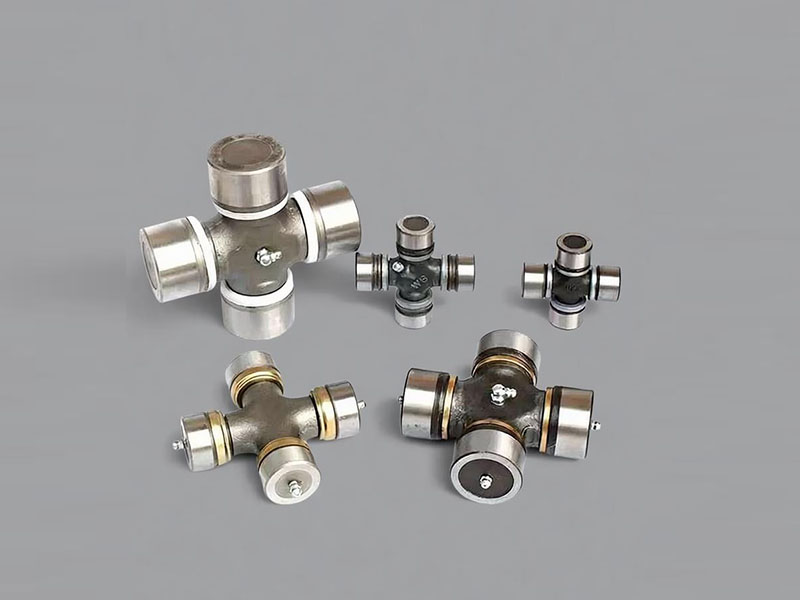
A universal joint is a flexible coupling in your vehicle’s driveline. Its job is to transmit power from the transmission to the differential while allowing the driveshaft to bend and move as your suspension travels over uneven roads.
Most rear-wheel-drive vehicles have at least two U-joints on the main driveshaft: one connecting the driveshaft to the transmission and one connecting it to the differential. In trucks and four-wheel-drive vehicles, there may be three or more, especially if the vehicle uses a two-piece driveshaft or a double-cardan joint at the front.
Here’s the key point: U-joints are constantly under stress. They handle the full torque of your engine every time you accelerate. They’re exposed to road salt, moisture, grit, and extreme temperature changes. They’re designed to last–100,000 miles is a reasonable expectation under normal conditions–but they don’t last forever. And when they start to fail, the clock is ticking on your wallet.
Bad U-Joint Symptoms: Catch the Warning Signs Early to Save Money
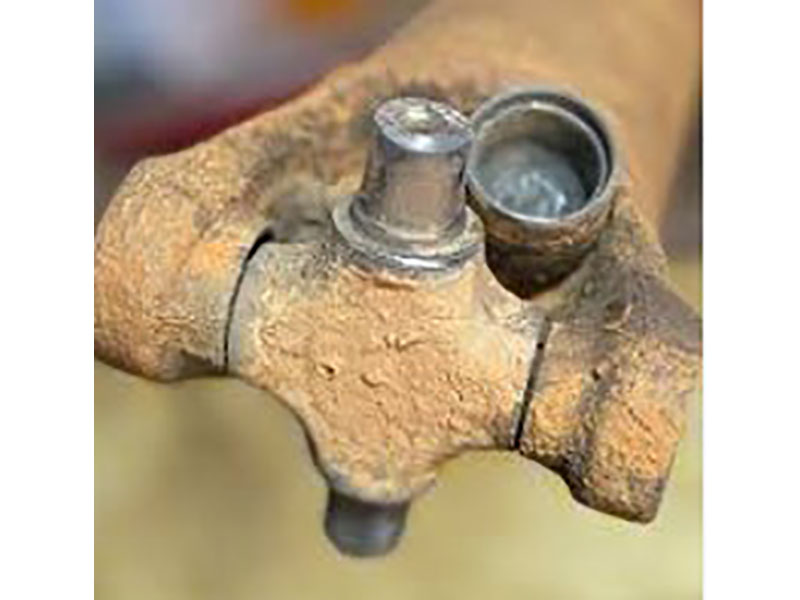
A failing U-joint doesn’t fail silently. It gives you warnings. The earlier you catch these signs, the less damage–and the lower the repair bill.
Symptom 1: Squeaking Noise When Starting to Move
This is often the first warning. You’ll hear a high-pitched squeak or chirp when you pull away from a stop, usually at speeds below 5 to 10 mph. The noise happens because the needle bearings inside the U-joint have lost their grease and are now grinding metal against metal.
Cost implication: At this stage, you can replace the U-joint and nothing else. Total cost: roughly $270 to $500. If you ignore this squeak, the damage escalates quickly.
Symptom 2: Clunking Noise When Shifting
When the squeak turns into a clunk–especially when shifting between Drive and Reverse–the U-joint has developed significant play. The bearings are worn enough that the joint allows the driveshaft to rotate slightly before catching, creating that metallic thud.
Cost implication: You’re now past the point of no return. The U-joint must be replaced, and the abnormal movement has started stressing other components. Still, if you act now, you’re looking at U-joint replacement costs only. But you’re on borrowed time.
Symptom 3: Vibration While Driving
This is the danger zone. When a U-joint wears to the point that it causes the driveshaft to spin out of balance, you’ll feel a vibration that intensifies with vehicle speed. The vibration isn’t just uncomfortable–it’s actively damaging everything connected to the driveshaft.
Cost implication: Every mile you drive with this vibration is wearing down your transmission output bearings, transfer case bearings (on 4WD vehicles), and differential pinion bearings. Replacing these bearings typically costs $800 to $1,500 depending on the component and labor involved. The vibration is also stressing your transmission and differential seals, which will add another $200 to $400 for seal replacement if they fail.
Symptom 4: Fluid Leaks at the Transmission or Differential
When you see fluid leaking from the rear of your transmission, the front of your differential, or around your transfer case, the U-joint vibration has already done its work. The vibration caused the driveshaft stub shaft to rotate out of round, which damaged the seal.
Cost implication: You now have at least two problems: a failing U-joint and a leaking seal. Replacing the seal alone costs $200 to $400. But the bigger risk is what happens next. The leak means your transmission or differential is losing fluid. Low fluid leads to overheating and premature wear on internal gears and bearings. If the fluid runs too low and the transmission or differential fails completely, you’re looking at $2,500 to $7,500 for a transmission or $1,500 to $4,000 for a differential.
Symptom 5: Loud Metal-on-Metal Banging
This is the final warning. When you hear loud banging from under the vehicle, the U-joint is seconds–or miles–away from complete failure.
Cost implication: Stop driving immediately. If the U-joint fails while you’re moving, the driveshaft can detach from the vehicle. You’ll need a tow truck ($100 to $300), a replacement driveshaft ($300 to $2,000+), and potentially repairs to whatever the flailing driveshaft damaged underneath. Total bill: easily $1,000 to $3,000 or more. And that’s assuming no collision occurred.
The True Cost of Ignoring a Bad U-Joint
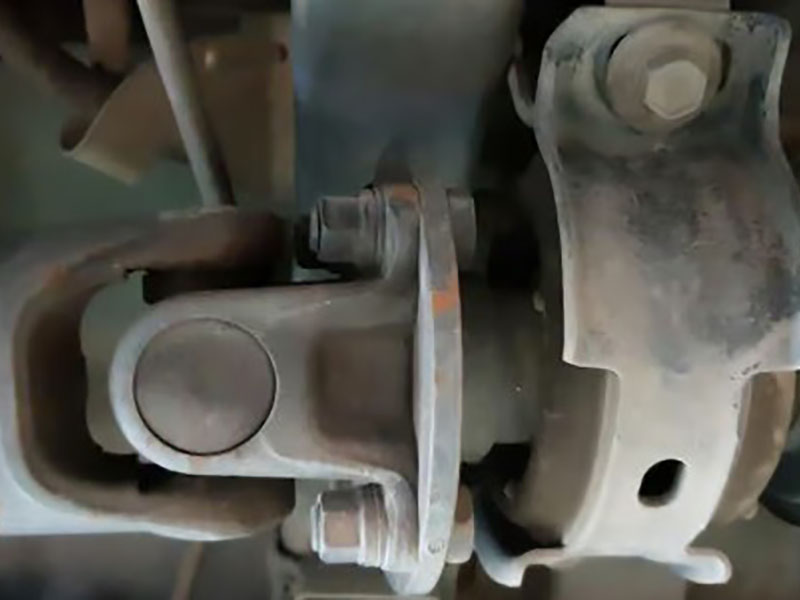
Let’s get specific about what each stage of neglect will cost you. Understanding the true cost of a failing u-joint starts with knowing exactly what’s at stake.
Cost 1: Transmission Failure — $2,500 to $7,500+
When a bad U-joint vibrates, it doesn’t just shake the driveshaft. It transmits that vibration directly into the transmission output shaft. Over time, this causes the shaft to rotate out of round. The out-of-round shaft damages the rear output seal, and transmission fluid starts leaking out.
As fluid levels drop, the transmission runs hotter. Internal components–gears, clutches, valve bodies–start to wear prematurely. Eventually, the transmission fails completely.
A replacement automatic transmission for a mainstream vehicle costs between $2,500 and $7,500 including parts and labor. Manual transmissions are cheaper but still run $1,500 to $3,000. CVT and luxury vehicle transmissions can cost $4,000 to $10,000 or more.
Compare that to the $20 to $75 cost of a U-joint. The math is not complicated.
Cost 2: Transfer Case Damage — $1,500 to $3,500+
If you drive a four-wheel-drive or all-wheel-drive vehicle, the front driveshaft also has U-joints. When those fail, the same vibration damages the transfer case output seal and bearings.
A transfer case rebuild or replacement typically runs $1,500 to $3,500 or more, depending on the vehicle.
Cost 3: Differential Failure — $1,500 to $4,000+
The U-joint at the rear of the driveshaft connects directly to the differential pinion. When this U-joint fails, it vibrates and damages the pinion seal. Differential fluid leaks out. With low fluid, the ring and pinion gears–and the bearings that support them–overheat and wear out.
A differential rebuild typically costs $1,000 to $2,500. A full differential replacement runs $1,500 to $4,000 or more.
Cost 4: Driveshaft and Undercarriage Damage — $500 to $2,000+
When a U-joint fails catastrophically, the driveshaft doesn’t just stop spinning. It becomes a loose, heavy metal pipe rotating at thousands of RPM.
The driveshaft can detach from the vehicle entirely. Or it can flail around under the vehicle, smashing into the exhaust system, fuel lines, brake lines, and the transmission tail housing.
Replacing a driveshaft costs anywhere from $300 to $2,000+ for the part alone, plus $150 to $500 in labor. Add in the cost of damaged exhaust components, fuel lines, or brake lines, and you’re looking at a much larger bill.
Cost 5: Towing and Emergency Labor — $300 to $800
When your U-joint fails and leaves you stranded, you’re not driving to a shop. You’re calling a tow truck. After-hours towing, weekend service, and emergency repair shop rates all add premiums to the bill.
A tow alone can run $100 to $300 or more, depending on distance and time of day. Emergency repair labor often carries higher hourly rates. This is pure waste–money you spend simply because you didn’t address the problem when it was cheap and easy.
Cost 6: Accident Risk — Priceless / Liability Claim
This is the worst-case scenario. U-joints often during hard acceleration–exactly when you’re merging onto faila highway or pulling into traffic. When the driveshaft detaches, you lose propulsion instantly. You’re coasting, not accelerating, and the vehicle behind you may not have time to stop.
The result can be a serious collision. The cost isn’t just the repair bill–it’s potential injury, legal liability, and insurance claims that follow you for years. No amount of money saved by skipping a U-joint replacement is worth this risk.
U-Joint Replacement Cost vs. Transmission Repair: Which Is Cheaper?
Here’s the bottom line in plain numbers:
Replace a failing U-joint early:
- U-joint part (quality OE-style): $20 to $75
- Labor: typically 1 to 2 hours
- Total: roughly $270 to $500
Ignore it and pay later:
- Transmission replacement: $2,500 to $7,500+
- Differential replacement: $1,500 to $4,000+
- Transfer case replacement: $1,500 to $3,500+
- Driveshaft replacement: $500 to $2,000+
- Towing and emergency fees: $300 to $800
The difference is 10 to 20 times the cost of early replacement. Replacing a U-joint isn’t an expense. It’s the cheapest insurance policy you’ll ever buy for your drivetrain.
Replace U-Joints in Pairs to Save on Labor
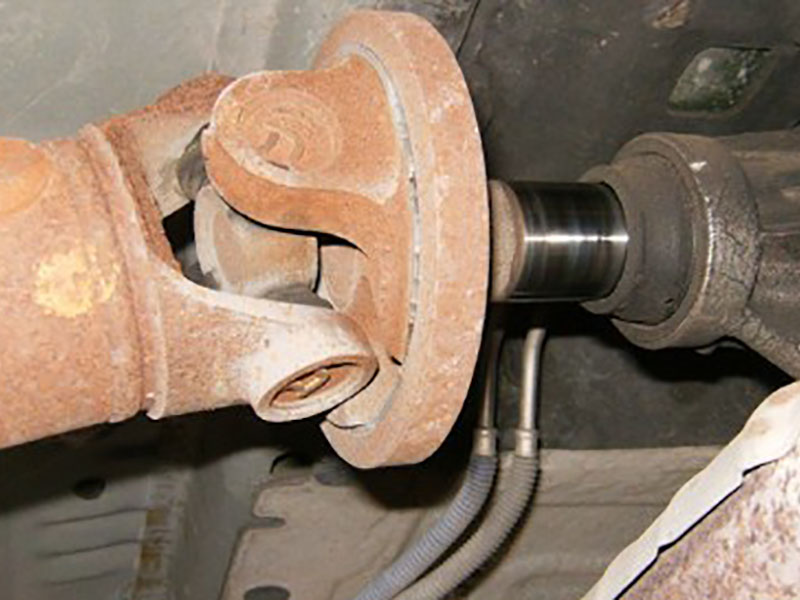
The front and rear U-joints on a driveshaft experience the exact same torque loads, the same number of revolutions, and the same exposure to road salt, moisture, and grit. If the rear joint has failed–whether from dried-out needle bearings, fatigue, or corrosion–the front joint is statistically right behind it. It might feel tight by hand, but the internal grease is already compromised.
The bigger reason to replace in pairs is labor cost. To replace either U-joint, the driveshaft has to come out of the vehicle. Once the driveshaft is on the bench, pressing out the second U-joint adds a negligible amount of time compared to the labor of dropping the driveshaft in the first place.
Here’s the choice:
Option A — Do it once: Pay for driveshaft removal and reinstallation one time. Buy two U-joints. Pay labor for replacing both while the shaft is already out.
Option B — Do it twice: Pay for driveshaft removal and reinstallation today for the bad joint. Come back in a few months when the other one fails. Pay the full labor cost all over again for removing the driveshaft a second time.
Only replacing the bad U-joint might save you $20 to $75 today. But it sets you up for another full labor charge in a few months–typically $110 to $170 or more. Replacing both at once costs you one extra part and almost no extra labor. It’s the smarter financial move, period.
Why Cheap U-Joints Are a False Economy
Not all U-joints are created equal. When you see a U-joint priced at $10 and another at $50, there’s a reason.
Cheap U-joints use lower-grade steel, inferior heat treatment, and cheaper needle bearings. They wear out faster–sometimes in a fraction of the time a quality part would last. They’re more likely to fail suddenly rather than gradually, giving you less warning and more damage.
A quality U-joint from a reputable manufacturer costs $20 to $75 for standard applications and $75 to $100 for heavy-duty versions. Yes, that’s more than the bargain-bin part. But consider the total cost of ownership:
- Cheap part: $10 + labor to install it now + labor to replace it again when it fails prematurely
- Quality part: $50 + one labor charge + years of reliable service
The quality part is cheaper in the long run. And when you factor in the cost of the damage a failed U-joint can cause, skimping on part quality is false economy.
Choose U-joints manufactured to OE standards, with proper materials, corrosion protection, and quality control. Your drivetrain–and your wallet–will thank you.
Conclusion: Pay a Little Now, Save a Lot Later
A U-joint is a small part with an outsized impact on your vehicle. It costs $20 to $75. It takes a mechanic an hour or two to replace. The total bill is somewhere around $270 to $500 depending on your vehicle and local shop rates.
Ignore it, and that $500 repair turns into a $2,500 to $7,500 transmission replacement. Or a $1,500 to $4,000 differential replacement. Or a tow truck, a stranded vehicle, and a driveshaft that’s wrecked the underside of your car. That’s why you should never ignore a bad u-joint–the cost of ignoring u-joint problems is simply too high.
The warning signs are clear: squeaks, clunks, vibrations, leaks. When you notice any of them, don’t wait. Have a professional inspect your U-joints. If there’s any play or wear, replace them–and replace them in pairs.
It’s not an expense. It’s the cheapest insurance you’ll ever buy for your drivetrain. Pay a little now, or pay a lot later. The choice is yours.
FAQs
Q1: How much does it cost to replace a u-joint vs. replacing a transmission?
A: A U-joint replacement typically costs $270 to $500 including parts and labor, depending on your vehicle and local labor rates. That’s the cost of replacing a u-joint before it fails. A transmission replacement for a mainstream vehicle runs $2,500 to $7,500. In other words, replacing a U-joint costs about one-tenth to one-twentieth of what a transmission replacement will set you back. The U-joint part itself is only $20 to $75. The cost of ignoring u-joint problems is simply too high to justify delaying the repair.
Q2: Can I save money by replacing only the bad u-joint?
A: In the short term, yes–you save the cost of one part, roughly $20 to $75. But in the long term, no. The other U-joint on the same driveshaft has endured the same stress, the same miles, and the same environmental exposure. It’s likely close to failure too. Since the driveshaft has to be removed to replace either joint, replacing both at once adds almost no extra labor. Replacing only one means you’ll likely pay for driveshaft removal all over again when the second one fails a few months later.
Q3: Is it safe to drive with a bad u-joint if I’m on a tight budget?
A: No. Driving with a bad U-joint doesn’t save you money–it costs you more. Every mile you drive accelerates damage to your transmission, differential, and driveshaft. The eventual repair bill will be far higher than the cost of replacing the U-joint now. If you’re on a tight budget, the most cost-effective thing you can do is address the problem immediately, before it becomes a much more expensive problem.
Q4: How long do u-joints typically last, and when should I worry about replacement cost?
A: Under normal driving conditions, U-joints should last 100,000 miles or more. However, heavy towing, off-roading, frequent high-speed driving, and exposure to road salt and moisture can shorten their lifespan. The key isn’t mileage–it’s symptoms. When you hear squeaking, clunking, or feel vibration, it’s time to act. The cost of replacement is minimal compared to the cost of the damage that follows if you ignore those symptoms.
Q5: Why do some u-joints cost $20 while others cost $100? Is the expensive one worth it?
A: The price difference reflects materials, manufacturing quality, and durability. A $20 to $50 U-joint from a reputable OE or OEM manufacturer is a solid choice for standard applications. $75 to $100 heavy-duty versions use stronger materials and are designed for trucks, towing, and performance vehicles. The ultra-cheap $10 U-joints use inferior steel and bearings–they wear out faster and fail more abruptly. Spending a bit more on a quality part is almost always worth it, because the labor cost to replace a failed U-joint far exceeds the price difference between cheap and quality parts.
Q6: Should I replace just the bad u-joint or all of them?
A: Replace them in pairs (or all of them, if your vehicle has more than two). The driveshaft has to come out to replace any single U-joint. Once it’s out, replacing the additional joints adds very little labor time. If you replace only the bad one, the other(s) will likely fail soon–they’ve endured the same stress and environment. You’ll then pay for driveshaft removal all over again. Replacing all U-joints at once is the most cost-effective approach.