Quick Answer: U-joint types refer to locking style (inside-lock vs. outside-lock, based on snap ring position) and lubrication method (greaseable vs. sealed). Sizes follow series numbers – 1310, 1330, 1350, etc. – each with a fixed bearing cap diameter and overall width. To identify a u-joint: check if the snap rings are external or internal; measure the cap diameter and width using calipers; match your measurements to a standard series table. Never rely on vehicle year alone – measurement is the only reliable method.
A universal joint (U‑joint) is a mechanical coupling that connects two shafts at an angle while transmitting torque. It is a critical component in rear‑wheel drive, four‑wheel drive, and heavy‑duty vehicle drivelines. Choosing the wrong u‑joint leads to premature wear, vibration, and even driveline failure. Two factors determine a correct replacement: type and size. But how do you know which series – 1310, 1330, or 1350 – fits your vehicle? And why can’t you simply rely on the model year? This article explains the common u‑joint types, the standard size series, and how to measure a u‑joint accurately. You will also learn when a combination u‑joint is necessary and how to avoid mismatching lock styles.
Types of U‑joints
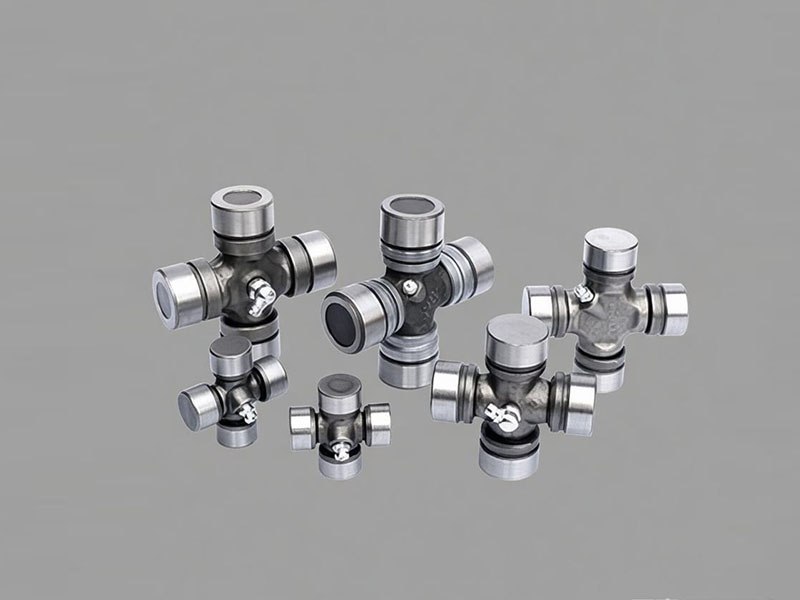
U‑joints are classified by their locking mechanism, lubrication method, and construction. Understanding these types is the first step to selecting the correct part.
By Locking Style: Inside‑Lock vs. Outside‑Lock
The locking style refers to how the bearing caps are secured inside the yoke ears.
- Outside‑lock (external snap ring) – The snap ring sits in a groove on the outer face of the bearing cap. This is the most common design on passenger cars and light trucks. The overall width is measured across the two outer cap faces.
- Inside‑lock (internal snap ring) – The snap ring is located in a groove inside the yoke ear, against the bearing cap’s inner shoulder. Measuring an inside‑lock joint requires the distance between the two snap ring grooves.
Important: Inside‑lock and outside‑lock u‑joints are not interchangeable. Always identify the locking style before ordering a replacement.
By Maintenance: Greaseable vs. Sealed (Non‑Greaseable)
- Greaseable (serviceable) – These joints have a grease zerk (fitting) on the cross. Lubricant can be pushed into the bearing cups periodically. The cross is drilled for the grease passage, which in theory creates a minor stress concentration. In real‑world use, however, no significant strength difference has been proven between greaseable and sealed designs when properly maintained.
- Sealed (non‑greaseable) – These are permanently lubricated at the factory and require no routine greasing. They offer better protection against water and dirt ingress because there is no grease fitting opening. Once the original seals fail, the joint must be replaced.
The choice between greaseable and sealed largely depends on your maintenance habits. If you cannot grease the joint every 5,000 miles (or at every oil change), a sealed unit is more reliable.
By Construction: Single vs. Double U‑joint
- Single u‑joint – One cross and four bearing caps. It operates up to approximately 45° of angularity.
- Double u‑joint – Two single joints connected by a short shaft. It can achieve up to 90° of angular misalignment and also accommodates parallel offset. Double joints are often used in steering shafts and some off‑road drivelines.
Ball and trunnion joints exist but are rare; they are not covered here because they fall outside conventional u‑joint series sizing.
U‑joint Sizes and Series
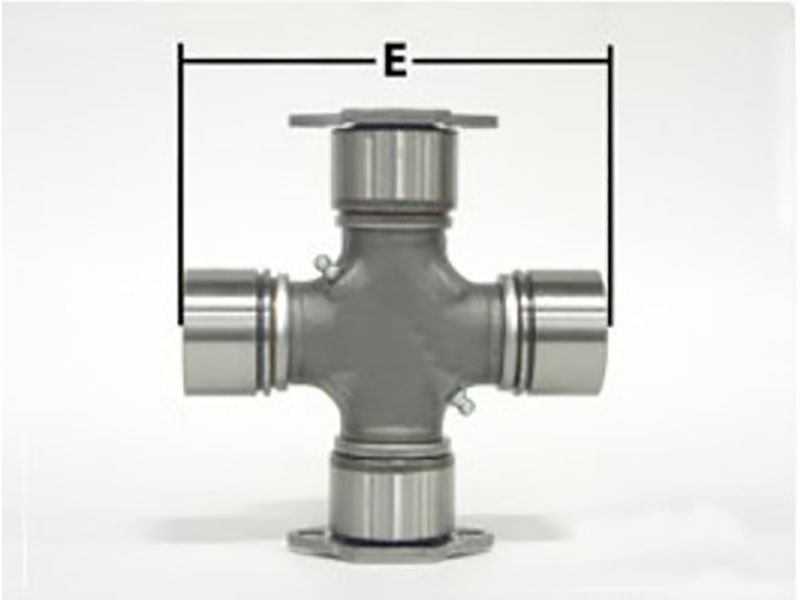
U‑joint sizes are defined by a series number (e.g., 1310, 1330, 1350). Each series specifies the bearing cap diameter and the overall width (outside‑lock measurement). In general, a higher series number indicates a larger, stronger joint – but the actual torque capacity also depends on the material, cross section, and bearing design.
Common U‑joint Series Dimensions
| Series | Overall Width (inches) | Bearing Cap Diameter (inches) | Typical Application |
|---|---|---|---|
| 1210 | 2.438″ | 1.062″ | Obsolete – no longer in production vehicles |
| 1310 | 3.219″ | 1.062″ | Most common OE size; passenger cars, 1/2‑ton trucks, Jeeps |
| 1330 | 3.622″ | 1.062″ | 3/4‑ton trucks; wider body than 1310 |
| 1350 | 3.622″ | 1.188″ | 1‑ton trucks, high‑performance upgrades |
| 1410 | 4.188″ | 1.188″ | 3/4‑ton, 1‑ton, and larger trucks; high angle capability |
| 1555 | 4.965″ | 1.375″ | Heavy‑duty / high‑load industrial applications |
Special Size Variant: The “Big Cap” U‑joint
Ford introduced a “Big Cap” u‑joint used on some truck rear axles. It uses two different cap diameters on the same cross:
– Two caps of 1.062″ (fits the driveshaft side)
– Two caps of 1.125″ (fits the yoke side retained by U‑bolts)
This design resists yoke deformation under high clamping force. When measuring a Big Cap joint, note that the cap diameters differ by axle position – a standard series table will not directly match.
Regional Differences
North American series (1310, 1350, 1480, etc.) are dominant in the aftermarket. Europe typically uses DIN standards and OEM codes. Asia follows JIS, GB, or manufacturer‑specific numbers. If you are sourcing a u‑joint for an imported vehicle, measuring the actual dimensions (cap diameter and width) is safer than relying on the local series name.
How to Measure a U‑joint
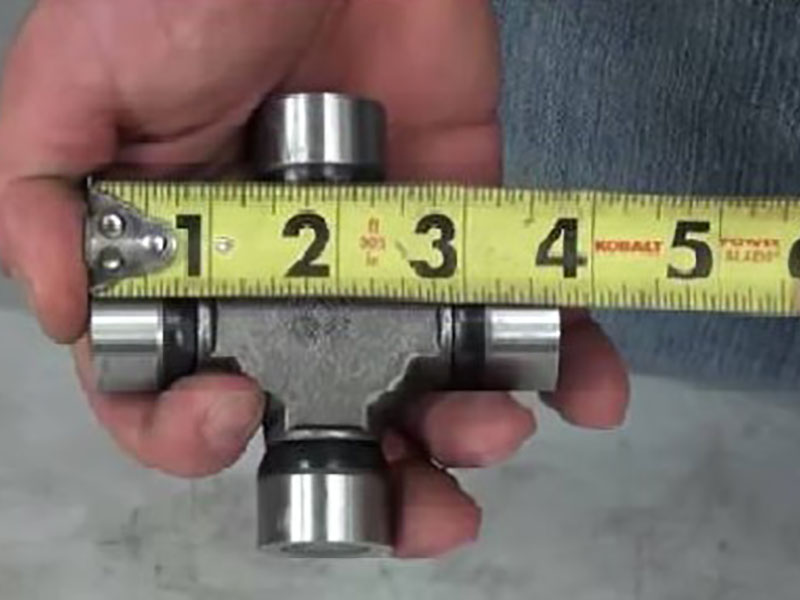
Accurate measurement is the only reliable way to identify a u‑joint – especially for modified vehicles or when the original part number is unreadable.
Tools required: Digital calipers (a tape measure is not precise enough).
- Determine the locking style – Outside‑lock: snap ring visible on the outer face of the bearing cap. Inside‑lock: no outer snap ring; the retaining ring sits inside the yoke ear.
- Measure the bearing cap diameter – Place the caliper jaws across the center of the cap. Measure all four caps because some applications (like the Big Cap) have mixed diameters.
- Measure the overall width (for outside‑lock) – Measure from the outer face of one bearing cap to the outer face of the opposite cap.
- Measure the snap ring span (for inside‑lock) – Measure the distance from the inner snap ring groove on one cap to the inner groove on the opposite cap, then add the thickness of two snap rings (typically 0.050″ – 0.060″ each).
- If you only have the yoke (no old joint) – For outside‑lock: measure the distance between the two snap ring grooves inside the yoke ears. For inside‑lock: measure the inside width of the yoke (between the ears) and the bearing bore diameter.
Always compare your measurements with the series table. If the cap diameters match 1.062″ but the width is 3.622″, you likely have a 1330 series. If the caps are 1.188″ and the width is 3.622″, it is a 1350.
Combination U‑joints
A combination (or conversion) u‑joint is used when the two mating components belong to different series. For example, a 1310 yoke on the transmission side and a 1330 yoke on the axle side.
Common Combination Joints
| Combination | Width (inches) | Cap Diameter (inches) |
|---|---|---|
| 1310 / 1330 | 3.219″ – 3.622″ | 1.062″ (both sides) |
| 1310 / 1350 | 3.219″ – 3.622″ | 1.062″ / 1.188″ |
| 1330 / 1350 | 3.622″ | 1.062″ / 1.188″ |
Strength limitation: A combination u‑joint is only as strong as the smaller series in the pair. For high‑torque applications (racing, heavy towing), using the same large series on both ends is safer. When a conversion joint is unavoidable, design the driveline with an increased safety factor.
Conclusion
Selecting the right u‑joint requires knowing both the type (locking style and lubrication method) and the size (series dimensions). Do not rely on vague vehicle year lookups – measurements with a caliper are the gold standard. The 1310, 1330, 1350, and 1410 series cover most passenger vehicles and light trucks, while combination joints solve mismatched yokes. Whether you choose a greaseable or sealed design depends on your maintenance routine; neither has a decisive strength advantage. When in doubt, consult the actual bearing cap diameters and overall width, then match them to the series table. Correctly identifying u‑joint types and sizes reduces driveline vibration, extends component life, and ensures safe torque transmission. Professional bearing manufacturers such as DUHUI Bearing supply precision u‑joints that meet or exceed OE specifications – always source from a supplier that provides detailed dimensional data.
Frequently Asked Questions (FAQs)
Q: Can I buy a u‑joint using only my vehicle’s year, make, and model?
A: Not reliably – especially for modified vehicles or trucks that have had axle or driveshaft swaps. The same vehicle model may have been built with different u‑joint series depending on the engine, transmission, or assembly plant. Measuring the old joint or the yoke is the only accurate method.
Q: Which is stronger – a greaseable or a sealed u‑joint?
A: Independent tests have not shown a meaningful difference in ultimate strength between the two designs. Greaseable joints have a drilled cross (potential stress riser), but sealed joints can fail early if the original grease escapes or contamination enters. Choose based on your willingness to perform regular maintenance.
Q: How do I choose a u‑joint for a lifted truck?
A: First, measure the existing u‑joint (cap diameter and width). Then verify that the joint’s operating angle range is adequate. If the angle is too steep, you may need a double Cardan (CV) driveshaft – but that is a separate assembly. For the u‑joint itself, the series (e.g., 1350 vs. 1330) must still match the yoke dimensions.
Q: What happens if I use an inside‑lock joint in an outside‑lock yoke?
A: It will not fit. The snap ring grooves are located differently, and the overall dimensions are incompatible. Forcing assembly will damage the yoke or the bearing caps. Always confirm the locking style before ordering.
Q: Is a combination u‑joint reliable for off‑road or racing use?
A: Combination joints are reliable for moderate loads. However, because the torque capacity is limited by the smaller series, they are not recommended for extreme conditions. For competition or heavy off‑roading, convert both yokes to the same larger series (e.g., 1350) and use a standard (non‑combination) joint.