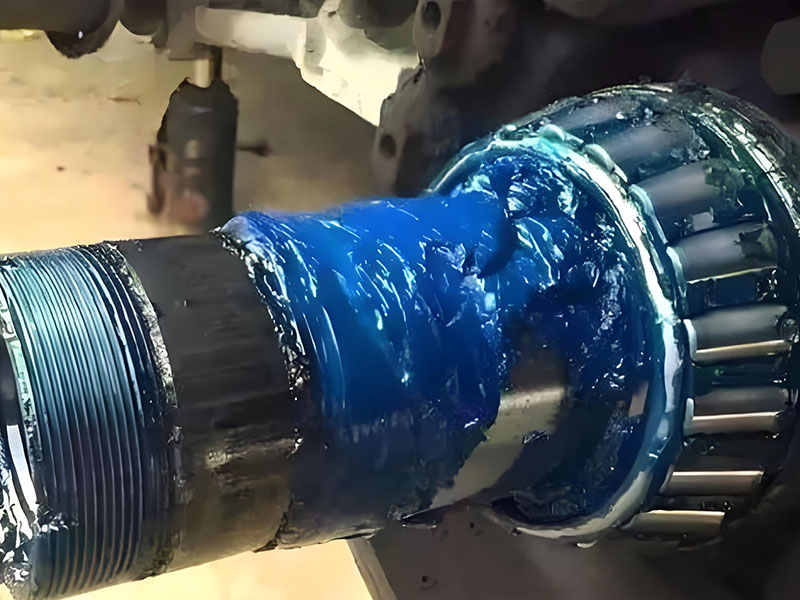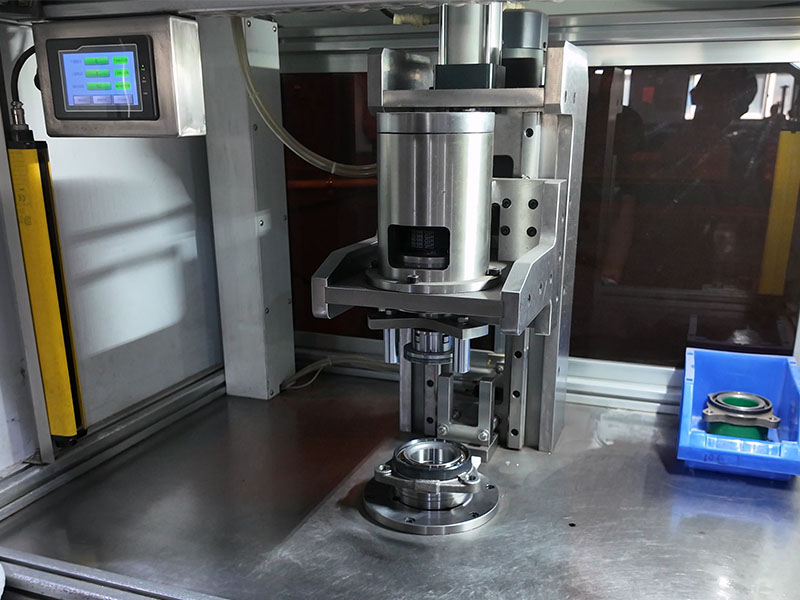
Quick Answer: Stainless steel bearings resist corrosion through the ring and rolling-element alloy, so protection remains if the surface is scratched. Coated bearings add a specified surface layer over a standard or stainless core, which can preserve dimensions or add electrical insulation, but performance depends on coating integrity. Choose by the actual medium, load, fit, damage risk, and test criteria, not by the label alone.
A buyer comparing stainless steel bearings with coated bearings is usually trying to solve one of two different problems: corrosion that starts in the base metal, or corrosion that starts at a surface. The useful question is not which label sounds stronger, but which corrosion source, load path, fit, and maintenance risk matches the machine.
The comparison below treats stainless steel as a material family and coated bearings as a surface configuration. That distinction keeps the decision technically honest and makes the purchasing requirements easier to write.
What Is the Difference Between Stainless Steel Bearings and Coated Bearings?
The labels sound like competing materials, but they describe different things. Stainless steel is a material family in which the rings and rolling elements are made from a corrosion-resistant alloy. A coated bearing is a surface configuration: a standard bearing steel or martensitic stainless core receives a specified layer for corrosion protection, electrical insulation, or friction reduction. That difference controls how each option fails, how it is specified, and what a buyer must verify.
Compare at grade and coating-specification level. Three practical families matter:
- Stainless steel bearings, where the ring and rolling-element alloy provides the corrosion resistance.
- Anti-corrosion coated bearings, where a surface layer is added mainly to resist rust, water, or cleaning chemicals.
- Functional coated bearings, where the coating is selected for electrical insulation, friction reduction, or wear control rather than general corrosion resistance.
Stainless Steel Bearings: Corrosion Resistance From the Base Material
In a stainless steel bearing, the rings and rolling elements are made from corrosion-resistant steel. The corrosion resistance comes from the base alloy, so it remains present if the surface is scratched. That is the central practical difference from a coated bearing, where a damaged layer may expose a less resistant core.
Common bearing grades include AISI 440C and SUS440C martensitic stainless steel. ISO 683-17:2023, published in September 2023 by ISO in Geneva as its fourth edition, includes a stainless bearing steel category. The grade is only the starting point, however. The seal material, lubricant, housing material, medium, concentration, and temperature must be evaluated together.
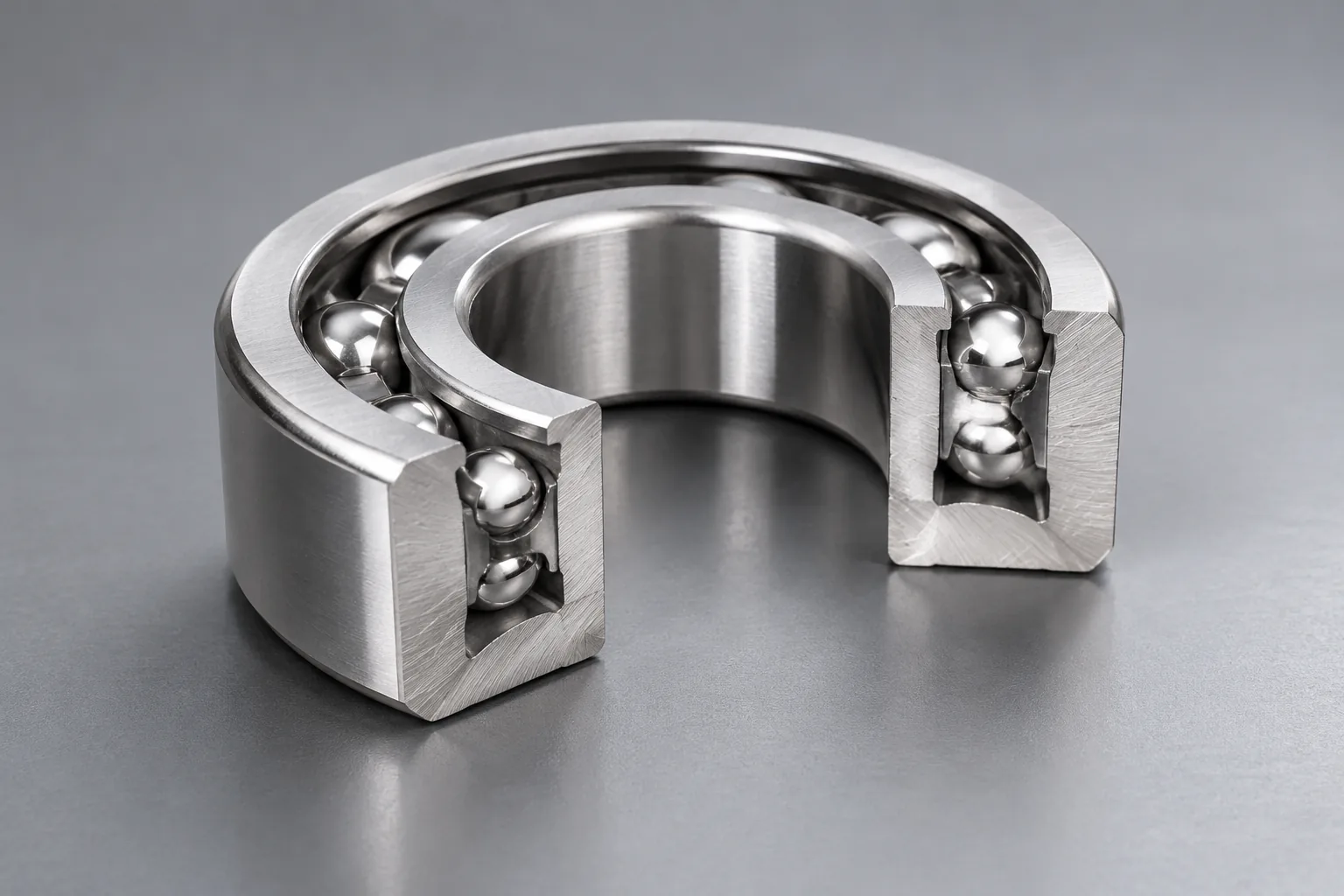
Production examples show how the material family is applied:
- NSK corrosion-resistant mounted units use SUS440C-equivalent rings and balls with SUS304 cages and slingers.
- NTN Sentinel stainless bearings use 440C stainless rings and balls, 302 stainless cages and slingers, and 304 stainless housings and end caps.
These examples matter because a stainless bearing is often part of a mixed material system. A stainless ring does not compensate for a carbon steel housing, an incompatible seal, or a grease that washes out. Stainless steel bearings are not immune to pitting, crevice corrosion, chloride attack, or lubricant washout.
Coated Bearings: Corrosion Resistance From a Surface Layer
Coated bearings usually keep a standard bearing steel or martensitic stainless body and add a layer for corrosion protection, electrical insulation, or friction reduction. Coated bearing is not a single material category. The purchase specification must state coating composition, thickness, coated locations, and purpose.
NSK SPACEA corrosion-resistant coated bearings use a nickel coating on the inner and outer ring surfaces. Schaeffler Corrotect is an electroplated zinc-alloy coating with a typical thickness of 0.5-3 μm, a listed hardness of 300 HV, and 96 hours of salt-spray protection in DIN 50021 testing. Schaeffler lists anti-wear protection for Corrotect as not provided, so the coating should not be treated as a raceway wear layer.
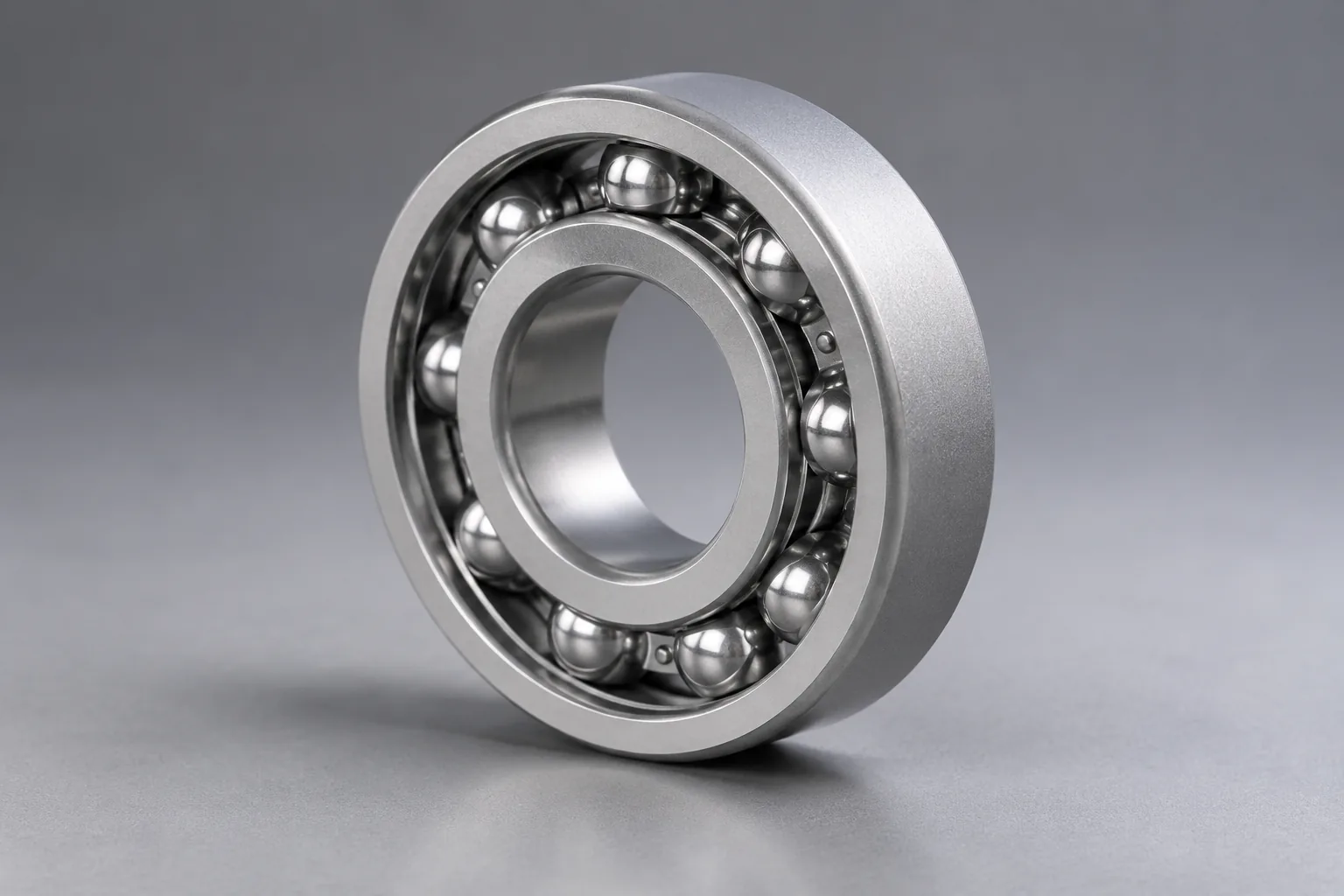
Before installation, verify chemical compatibility between the coating and the actual medium. A coating may be damaged, porous, or locally exposed, so the base metal can still corrode. Handling, pressing, and cleaning damage all matter.
At-a-Glance Comparison Criteria for Bearing Selection
Use the following screening table before a detailed technical review. It separates the corrosion source from the other selection consequences.
| Selection criterion | Stainless steel bearing | Coated bearing | What to verify |
|---|---|---|---|
| Corrosion source | Base alloy throughout ring and rolling element | Surface layer over a core material | Grade or coating composition and thickness |
| Dimensional effect | Normally no added surface layer | Coating thickness may affect fit | Tolerances and coated locations |
| Load capacity | Some stainless grades may involve a strength trade-off | A thin coating may preserve standard steel capacity | Exact series rating, not a generic label |
| Damage tolerance | Protection remains after a scratch | Protection depends on coating integrity | Handling, abrasion, and installation risk |
| Electrical function | Normally none unless a hybrid or ceramic option is specified | Insulating coatings are available | Voltage, resistance, and temperature limits |
| Food documentation | Material and lubricant are separate approvals | Coating and lubricant are separate approvals | Lubricant registration, seal material, hygiene design |
The supplier answer should identify the grade or coating, not only the word stainless or coated. If the quotation gives only a generic label, the technical review has not started yet.
Corrosion Performance: How Do Stainless and Coated Bearings Compare?
Both options can work in wet or corrosive service, but their limits differ by medium, concentration, temperature, and mechanical damage risk. Stainless steel keeps base-metal protection after surface damage; coated bearings depend on coating integrity. The comparison should therefore be made with the same exposure and failure mode in view.
Stainless Steel Bearings in Wet, Washdown, and Chloride Environments
Standard stainless bearings suit high-humidity and splash-water conditions. NSK states that its standard stainless bearings suit high-humidity and splash conditions, while its nickel-coated corrosion-resistant bearings can contact hypochlorous acid and Oxonia disinfectants. Both types may be used in saltwater service, but suitability must be confirmed by medium and concentration.
NSK released SUSBarrier on 22 June 2011. In a 120 ppm sodium hypochlorite immersion test, its rust initiation time was at least 10 times that of traditional martensitic stainless bearings. That result is specific to the test and product; it is not a general guarantee for every stainless grade or bleach concentration.
Stainless bearings can still fail by:
- Pitting and crevice corrosion in stagnant wet zones.
- Chloride attack from bleach, saltwater, or cleaning residues.
- Grease washout that leaves the raceway dry and unprotected.
- Galvanic or housing-related corrosion when the system materials are poorly matched.
Evaluate seals, lubricant, and housing material together with the bearing steel. A general stainless grade is not automatically suitable for chlorides, bleach, or mixed cleaning chemicals.
Coated Bearings in Corrosive Service
Schaeffler Corrotect protects against moisture, contaminated water, salt spray, and weak alkaline or weak acidic cleaning agents. The coating covers chamfers and fillets and can provide cathodic protection at small exposed points.
Coating thickness can affect fit. NSK nickel-coated bearing bore and outside diameter may deviate from JIS Class 0 by up to 5 μm in the diameter direction. Schaeffler requires verification of chemical compatibility with the actual medium and fit tolerances that include coating thickness.
NSK notes that corrosion-resistant coated bearings are not suitable for every medium, concentration, or temperature; published performance values are selection references only. Coating damage exposes base metal and can start local corrosion. A coated bearing should not be selected where the layer will be scraped, abraded, or attacked by the process chemical.
How to Interpret Salt Spray Hours
ASTM B117-26 is the current salt-spray apparatus operating standard. It is maintained by ASTM International, headquartered in West Conshohocken, Pennsylvania, USA, and was updated on 19 January 2026. The standard is used to obtain relative corrosion data for metals and coated metals.
ASTM warns that standalone B117 salt-spray results often lack reliable correlation with natural-environment service life. Compare results only from the same specimen, pretreatment, and test conditions. Use project-specific acceptance criteria rather than ranking bearings by salt-spray hours alone. Do not convert salt-spray hours into guaranteed years of service.
Load Capacity, Hardness, and Fatigue Life
Stainless material selection may involve a strength or load-capacity trade-off. Schaeffler states that its thin Corrotect layer can maintain standard bearing dimensions and load capacity while replacing an uncoated bearing, while switching to corrosion-resistant steel may reduce load capacity.
Not all stainless grades are low-capacity. NSK ES1 uses nitrogen-alloyed stainless steel with hardness comparable to AISI 440C. NSK attributes improved fatigue life to reduced eutectic carbides and offers stainless steel or silicon nitride ceramic balls.
NSK reports improved stainless bearings for dental handpieces up to 400,000 rpm. That figure is product- and application-specific; do not generalize it to all stainless bearings. Coating selection is not a load-rating feature by itself. Check dimensional changes and wear protection separately from corrosion protection.
Coating Functions Beyond Corrosion Resistance
Coatings may be used for corrosion protection, electrical insulation, or friction reduction. Identify the dominant function before comparing options. An insulating coating is not a general anti-corrosion coating and should not be selected only because it is called coated.
SKF INSOCOAT is an alumina-based electrical-insulation coating for bearing-current mitigation. Its coating material is Al2O3 plus sealant, with a thickness of 100-300 μm. It is used on bearings from about 65-1,200 mm diameter and operates below 150°C. Specified breakdown voltage is at least 3,000 V DC or 1,000 V AC; specified resistance is at least 200 MΩ DC or 50 MΩ AC. Typical applications include rail traction motors, generators, and industrial motors.
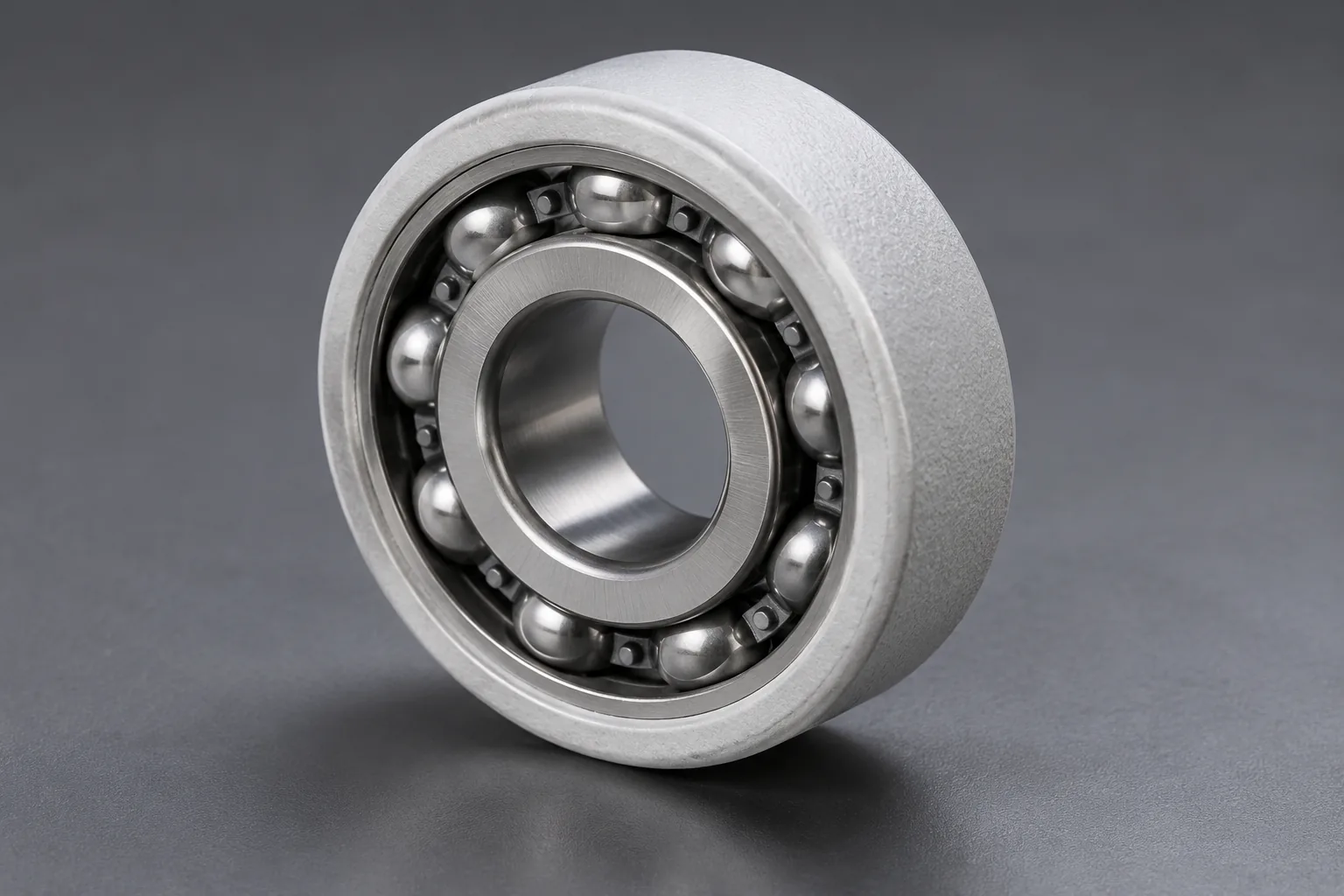
INSOCOAT provides some corrosion protection only on directly covered surfaces. Its primary purpose is electrical insulation. Do not use an electrical-insulation coating as a substitute for a chemical-corrosion bearing without confirming chemical exposure.
Failure Modes and Selection Limits
Stainless bearings can still suffer pitting, crevice corrosion, chloride corrosion, and lubricant washout. Seals, lubricant, and housing must be evaluated as a system, not as separate line items.
Coated bearings add risks of coating scratches, flaking, porosity, exposed edges, and fit changes. Once a coating is damaged, exposed base metal can become a local corrosion site.
Schaeffler requires chemical-compatibility checks before installing Corrotect bearings and fit tolerances that include coating thickness. NSK states that corrosion-resistant coated bearing performance values are references only and do not cover every medium, concentration, or temperature. Review handling, installation, cleaning, and maintenance damage risks before selecting a coated bearing. A coating is not a universal barrier against all cleaning chemicals or abrasion.
Food and Beverage Equipment: Bearing and Lubricant Requirements
Food and beverage bearing selection must cover bearing material, seal material, lubricant registration, and machine hygiene design. A lubricant claim alone is not enough.
NTN Sentinel stainless bearings can be configured with NSF H1 food-grade grease or H1 solid polymer lubricant. NSK corrosion-resistant mounted units use FDA/USDA H1 food-grade grease and C3 radial internal clearance as standard.
NSF H1 means the lubricant is suitable for incidental food contact, not direct or continuous food contact. ISO 21469:2006 specifies hygiene requirements for lubricants with possible incidental food contact. An H1 lubricant alone does not certify the complete bearing for food contact. Confirm the lubricant registration number, seal material, and hygiene requirement for the specific machine.
How to Choose: Stainless Steel vs Coated Bearings
Match the choice to the dominant failure mechanism: base-metal corrosion, surface corrosion, coating wear, electrical erosion, or lubrication loss. Use the rules below as a decision guide, not as a substitute for application testing.
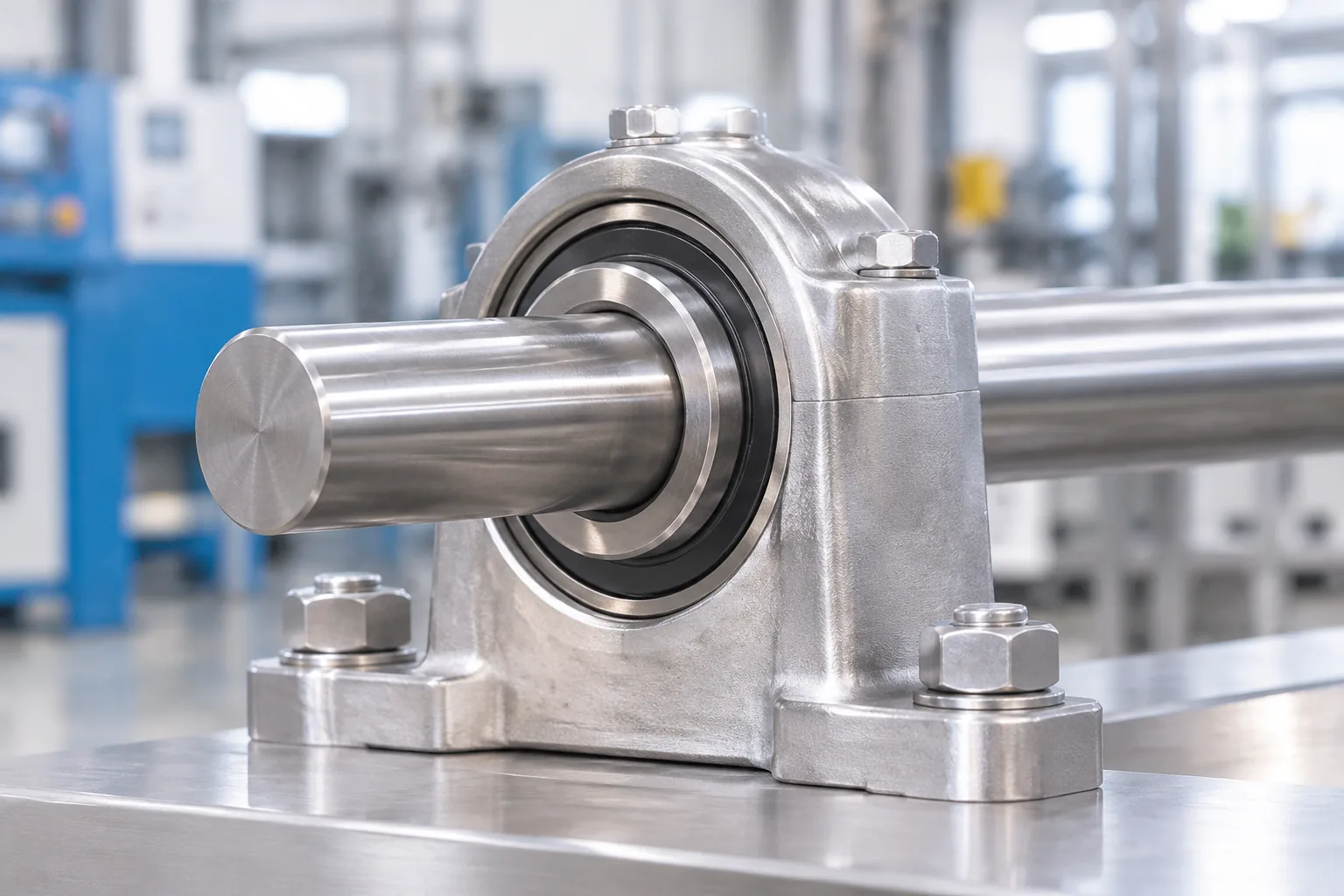
Choose Stainless Steel Bearings When
- The coating may be worn away or damaged by frequent disassembly, abrasion, or handling.
- The bearing is exposed to water for long periods.
- Corrosion resistance must remain even after surface scratches.
- An all-stainless system is required for the bearing, balls, fasteners, and housing.
Confirm the stainless grade and system materials for the actual medium.
Choose Corrosion-Resistant Coated Bearings When
- Standard bearing steel load capacity and the standard dimension series must be retained.
- Corrosion mainly affects exposed static surfaces.
- A direct replacement for standard bearing dimensions is preferred.
- The coated option may be lower cost than an all-stainless system; verify with the current project quote.
Confirm that the coating will not be abraded and that fits can accommodate coating thickness. Do not choose a coated bearing if coating damage is likely or if the medium attacks the coating.
Choose Functional Coated Bearings When
- The problem is electrical erosion, adhesive wear, or insufficient lubrication rather than general rust.
- Motor bearing currents should be evaluated with an insulating coating such as SKF INSOCOAT-type bearings.
- Functional coatings should be compared by their stated function, not only by corrosion resistance.
Confirm the electrical, thermal, and mechanical requirements of the application. Electrical-insulation coatings are not a general replacement for chemical-corrosion bearings.
Bearing RFQ and Testing Checklist
Do not specify only stainless steel bearing or coated bearing. At minimum, state:
- Ring and rolling-element grade.
- Coating composition and thickness.
- Coated locations.
- Seal material.
- Lubricant grade.
- Target medium and concentration.
- Operating temperature.
- Speed.
- Load.
- Corrosion test standard.
- Acceptance criteria.
- Food-contact documentation when applicable.
Use ASTM B117-26 salt-spray testing only with matched specimens and stated pass/fail criteria; do not treat hours as service life. When food equipment is involved, require lubricant registration and material or seal documentation separately. Do not accept a generic stainless or coated label as a complete purchase specification.
Conclusion
Stainless steel bearings and coated bearings solve different corrosion problems. Stainless steel puts the corrosion resistance in the ring and rolling-element alloy, so the protection survives scratches and wear better in many washdown and chemical-exposure cases. Coated bearings put the protection in a specified surface layer, which can preserve standard dimensions and load capacity, support a direct replacement, or add electrical insulation. The right choice follows the dominant failure mechanism, the actual medium, the fit, and the inspection plan.
Before approval, confirm the grade or coating specification, the seal and lubricant system, the target concentration and temperature, and the test acceptance criteria. Treat a generic label as a starting point, not a purchase specification.
FAQs
Q1: Are stainless steel bearings rust-proof?
A: No. Stainless bearings resist corrosion through the base alloy, but they can still suffer pitting, crevice corrosion, chloride attack, and lubricant washout. The grade, medium, concentration, temperature, seals, and housing all affect service. A stainless label alone does not prove suitability for bleach, saltwater, or mixed cleaning chemicals.
Q2: Can a coated bearing replace a stainless steel bearing?
A: Sometimes, but only after checking the coating function and integrity. A thin corrosion coating can preserve standard dimensions and load capacity, while a stainless bearing may offer better tolerance to scratches and long water exposure. Confirm chemical compatibility, coating thickness, fit changes, and damage risk before substitution.
Q3: Does a coating improve wear resistance?
A: Not automatically. Some coatings are designed for wear or friction reduction, but an anti-corrosion coating may provide no anti-wear protection. Schaeffler lists Corrotect as not providing anti-wear protection. Check the stated coating function rather than assuming that any coating improves raceway durability.
Q4: How should I compare salt-spray hours?
A: Compare only results from the same specimen, pretreatment, and test conditions, and require a stated pass/fail criterion. ASTM B117-26 produces relative corrosion data; standalone salt-spray hours often do not correlate reliably with natural-environment service life. Do not convert salt-spray hours into a guaranteed service life.
Q5: Are coated bearings suitable for food equipment?
A: They can be, but the bearing material, seal material, lubricant registration, and machine hygiene design must be checked separately. An NSF H1 lubricant is intended for incidental food contact, not direct or continuous contact. An H1 lubricant alone does not certify the complete bearing.
Q6: Which option is better for washdown?
A: Stainless steel is often the stronger starting point when the bearing sees long water exposure, frequent cleaning, or surface damage risk, because the corrosion resistance comes from the base alloy. A coated bearing may still fit if the coating is chemically compatible and not abraded. Confirm the cleaning chemical, concentration, temperature, and rinse practice.
Q7: What does an insulating bearing coating do?
A: An insulating coating blocks bearing current and helps prevent electrical erosion. SKF INSOCOAT uses an Al2O3 plus sealant layer with specified breakdown voltage and resistance. It provides some corrosion protection only on directly covered surfaces, so it is not a general replacement for a chemical-corrosion bearing.
Q8: What should an RFQ include?
A: State the ring and rolling-element grade, coating composition and thickness, coated locations, seal material, lubricant grade, target medium and concentration, operating temperature, speed, load, corrosion test standard, and acceptance criteria. For food equipment, add lubricant registration and material or seal documentation. Do not accept a generic stainless or coated label.