Quick Answer: A slewing bearing is a rolling-element bearing that lets two structures rotate relative to each other while carrying axial load, radial load, and tilting moment. A jib crane bearing is an application term for the bearing or pivot arrangement at a jib crane’s base, wall pivot, or slew point. Selection depends on the crane’s load diagram, mounting stiffness, duty cycle, environment, and lubrication access. Slewing rings and pivot bearings are not interchangeable without checking loads, stiffness, envelope, and drive requirements.
The terms slewing bearing and jib crane bearing often appear together, but they do not always mean the same thing. One describes a bearing construction; the other describes where a bearing is used. That difference matters when you compare catalogs, check a mounting drawing, or prepare a request for quotation.
This guide explains the common bearing types, the loads they carry, and the selection, installation, lubrication, inspection, and replacement checks that keep a jib crane rotating safely. It stays at the level of general engineering guidance; final ratings and dimensions must come from the specific bearing and crane documentation.
What Is a Slewing Bearing?
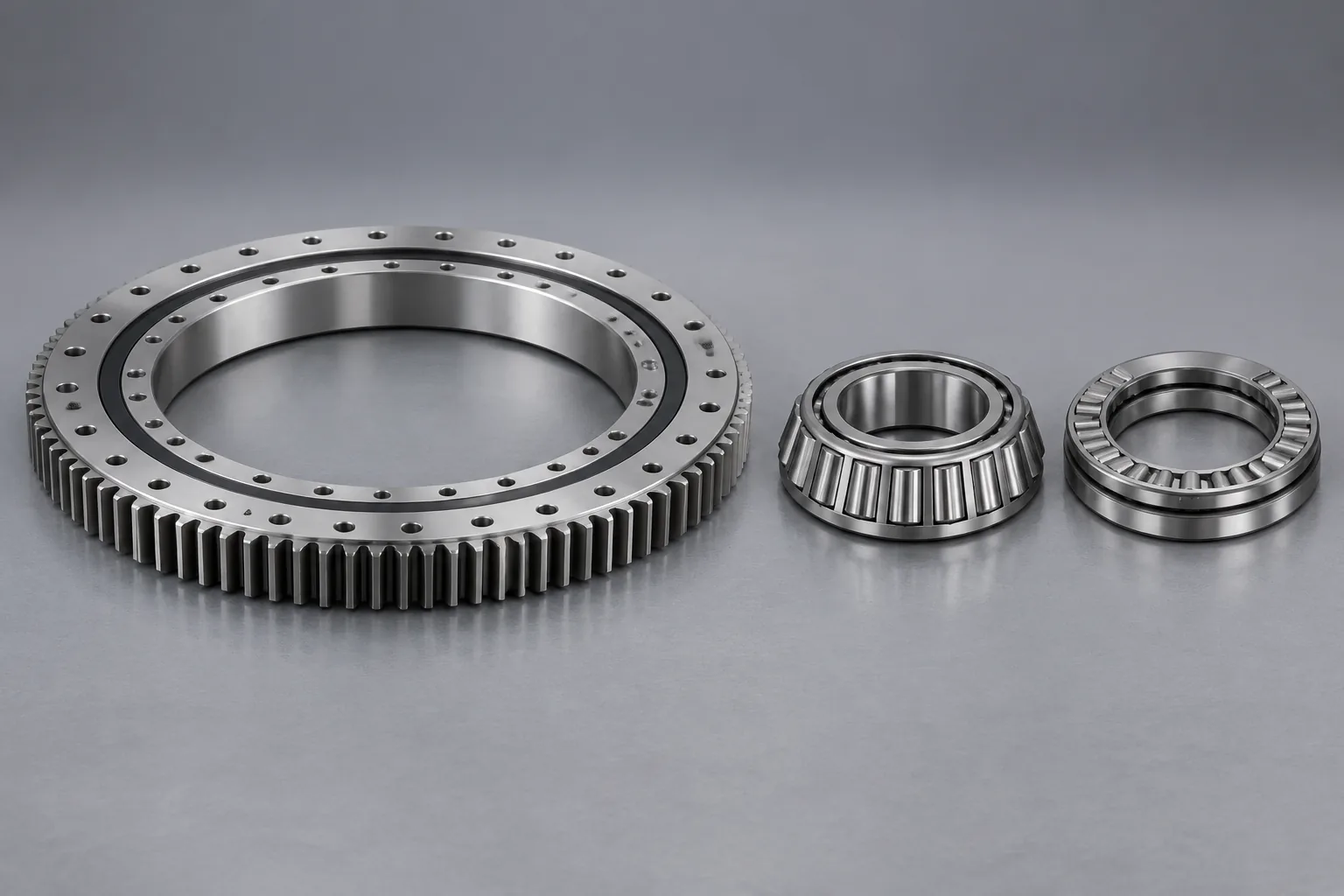
A slewing bearing, also called a slewing ring bearing, is a large rolling-element bearing that permits controlled rotation between two structures while carrying load. Typical construction includes an inner ring, an outer ring, a raceway, rolling elements, and seals. Some designs include an integral gear for a drive pinion.
Slewing bearings are selected for combined axial load, radial load, and tilting moment. Geared and ungeared configurations serve different drive arrangements. Load ratings, materials, and classification details must come from the specific manufacturer’s data; they should not be assumed from the bore or outside diameter.
What Is a Jib Crane Bearing?
Jib crane bearing is an application term rather than a single bearing type. It refers to the bearing or pivot arrangement that allows the jib arm to rotate while carrying the crane load into the support structure.
Typical locations include the pillar-base pivot, a wall-mounted pivot, and the slew point under the jib arm. Some jib cranes use a slewing ring bearing at the slew point. Others use a pivot bearing arrangement with separate radial and thrust components, or a bushing in a low-speed design.
The bearing’s role is to allow rotation with controlled friction and to transfer axial load, radial load, and tilting moment. The correct configuration depends on the crane design and load path, not on the label alone.
How a Jib Crane Uses a Slewing Bearing
A pillar jib crane carries the jib arm on a vertical column, and the bearing at the base or slew point allows the arm to turn. A wall jib crane transfers load into a wall or frame, so the bearing arrangement must suit that support condition.
The bearing transfers axial load, radial load, and tilting moment from the jib arm to the support structure. Manual rotation and powered rotation impose different requirements on friction, drive alignment, and control of starting and stopping loads.
The interface between bearing, mounting structure, and drive or gear arrangement is part of the design. A bearing that suits one jib crane layout may not suit another with a different support stiffness or drive method.
Slewing Bearing vs. Jib Crane Bearing: Key Differences
| Aspect | Slewing bearing | Jib crane bearing |
|---|---|---|
| Term | Specific bearing construction, also called a slewing ring | Application term for a bearing or pivot arrangement at a jib crane |
| Form factor | Large ring with raceway, seals, mounting holes, and optional gear | Can be a slewing ring or a combination of pivot bearings |
| Mounting | Bolted to a machined mounting surface, often above and below the ring | Depends on the crane design; may use a shaft, housing, or flange |
| Load path | Carries axial load, radial load, and tilting moment through the ring | Load path depends on the pivot arrangement and support structure |
| Sealing | Integral or external seals protect the raceway | Sealing depends on the bearing type and exposure |
| Rotation | Usually a slow slewing motion, manual or powered | May be a slow pivot, a limited angle, or a full slew |
A bearing that fits the available space may still be unsuitable. Check the load case, stiffness, mounting, sealing, and drive before substituting one arrangement for another. Bearings are not interchangeable without those checks.
Common Bearing Types for Jib Cranes
Jib crane pivot and slew points are served by several bearing families. The list below covers the main options considered in general engineering practice. Final suitability depends on the load case, duty cycle, environment, and mounting design.
Four-Point Contact Ball Slewing Bearings
A four-point contact ball slewing bearing uses a single row of balls in a raceway that can contact each ball at up to four points. This design can support combined axial load, radial load, and tilting moment in a relatively compact ring.
Geared and ungeared versions may be available. A geared ring adds a drive interface, so gear ratio, tooth load, and alignment become part of the selection.
Selection checks include moment load, axial load, radial load, mounting stiffness, and the condition of the supporting structure. Load ratings and allowable combinations must come from the manufacturer’s data for the specific bearing.
Crossed Roller Slewing Bearings
A crossed roller slewing bearing uses cylindrical rollers arranged at right angles in a crossed orientation. The arrangement is chosen where stiffness and moment capacity are important, and it requires accurate mounting surfaces and correct preload or clearance according to the design.
Suitability depends on the application requirements, cost, and availability. Do not assume that a crossed roller bearing can replace a four-point contact bearing without a full load and stiffness check.
Tapered, Spherical, and Thrust Roller Pivot Bearings
Pillar jib cranes may use a pivot bearing arrangement rather than a slewing ring. A common approach combines a radial bearing to center the pivot with a thrust bearing to carry vertical load, while other designs use a single bearing that handles combined load.
Tapered roller bearings can carry combined radial and axial load; spherical roller bearings are used for radial load and alignment; thrust roller bearings carry axial load. Mounting, preload, alignment, and lubrication must follow the bearing and crane design.
Specific arrangements and load capacities depend on the crane structure and must be confirmed with the crane and bearing documentation.
Bushing and Plain Bearing Options
Plain bearings and bushings can serve low-speed pivot points in some jib crane designs. They are simple and can fit a compact envelope, but they rely on a sliding surface rather than rolling elements.
Trade-offs include friction, wear, lubrication, and maintenance. Suitability depends on speed, load, duty cycle, and environment; a bushing that works for a lightly used manual jib may not suit a high-cycle powered unit.
Key Selection Factors for Slewing and Jib Crane Bearings
Use the crane load diagram and the actual support structure as the starting point. The following factors should be checked together:
- Load spectrum: axial load, radial load, tilting moment, shock, and dynamic effects.
- Motion requirements: rotation angle, speed, frequency, and manual or powered operation.
- Duty cycle and expected service life.
- Environment: dust, moisture, washdown, temperature, corrosion, and outdoor exposure.
- Mounting structure stiffness, flatness, bolt arrangement, and available envelope.
- Gear or drive requirements, sealing requirements, lubrication access, and documentation needs.
- Installation and maintenance access, including the ability to inspect and relubricate the bearing.
Selection must be based on the actual crane load diagram and support structure, not only on the bearing catalog size. A bearing that fits physically may still be unsuitable if moment load, stiffness, or mounting conditions are not checked.
Load Analysis and Bearing Capacity Checks
Define the load cases before comparing bearings: static loads, working loads, dynamic effects, and environmental loads where relevant. For a jib crane, the tilting moment is often a critical check because the jib arm creates an overturning load on the pivot or slew point.
Static and dynamic rating concepts should be applied as defined by the bearing manufacturer. The bearing is only one part of the system; the bolts, mounting structure, and raceway must be checked together.
Calculation methods, safety factors, and any standard references must be agreed for the project. Do not rely on a single catalog number without the corresponding load case.
Installation and Mounting Requirements
Mounting surfaces should be flat, stiff, clean, and free of debris. A soft or uneven support can distort the ring and change the load distribution.
Use the specified bolt grade and clamping force, and control torque during installation. Check bolt tension again after initial operation as recommended for the application.
For pivot bearings, check alignment and concentricity. For geared slewing bearings, check gear mesh alignment and backlash. Welding distortion and machining debris can damage seals and raceways, so finishing work should be controlled.
Flatness values, bolt torques, and alignment tolerances must come from the bearing and crane documentation; they are not universal.
Lubrication and Sealing
Lubrication reduces wear and protects the raceways from corrosion. Grease selection, relubrication points, and contamination control should be planned before the bearing is installed.
Seals retain lubricant and exclude dust and water. Damaged seals allow contamination to enter and can lead to raceway damage.
Relubrication intervals depend on duty cycle, environment, and the bearing design. Use the bearing manufacturer’s instructions and adjust the interval for heavy use, outdoor exposure, or washdown.
Inspection and Preventive Maintenance
Build an inspection route that covers the bearing, its mounting, and the surrounding structure. A practical checklist includes:
- Visual condition of the ring, seals, and mounting bolts.
- Lubricant leakage, seal damage, and contamination.
- Abnormal noise, vibration, or temperature during rotation.
- Clearance or movement at the pivot or slew point.
- Bolt condition and evidence of loosening.
- Gear condition and lubricant condition where a geared bearing is used.
Keep maintenance records and trend the observations. A change over time is more useful than a single reading. Inspection intervals and acceptance limits must be set from the bearing and crane documentation.
Common Failure Modes and Troubleshooting
Common failure categories include raceway fatigue, brinelling, corrosion, seal failure, lubrication failure, bolt loosening, and gear wear. Symptoms such as heat, noise, vibration, excess clearance, or poor rotation can point to more than one cause.
Link each symptom to possible root causes, but do not assume a single cause without inspection. Stop operation and inspect if the bearing shows sudden noise, seizure, loose bolts, or visible displacement of the structure.
Specific failure thresholds, causes, and repair criteria require inspection and the applicable technical documentation.
Replacement and Reconditioning Decisions
Replacement or reconditioning depends on damage severity, safety, downtime, cost, and availability. A bearing with seal damage or light contamination may need cleaning and relubrication, while raceway damage or structural movement usually points to replacement.
A replacement should include checking the mounting interface, bolts, seals, and lubrication path. Reconditioning may be considered only where it is technically and commercially justified and where the repaired bearing can be verified for the application.
Reconditioning feasibility and acceptance criteria must be confirmed with the bearing supplier and the crane inspection requirements.
RFQ and Buying Checklist
For a useful quotation, provide the following information:
- Crane type and general arrangement.
- Load diagram with axial load, radial load, and tilting moment.
- Rotation requirements, including angle, speed, frequency, and manual or powered operation.
- Duty cycle and expected service life.
- Environment, including dust, moisture, washdown, temperature, and corrosion exposure.
- Mounting drawing and available envelope.
- Gear requirement and sealing requirement.
Ask for dimensional drawings, load ratings, material and heat-treatment information, inspection records, and installation instructions. Clarify documentation, traceability, and after-sales support requirements before ordering.
Required standards and certification documents depend on the project and must be stated in the enquiry. Do not assume a certificate or standard applies unless it is confirmed for the specific bearing.
Conclusion
The practical answer is to treat slewing bearing as a bearing construction and jib crane bearing as an application term. A jib crane may use a slewing ring, a pivot bearing arrangement, or a bushing, and the correct choice depends on the load diagram, mounting stiffness, rotation duty, environment, and maintenance access.
Before ordering, confirm the load case, the mounting interface, the sealing and lubrication plan, and the documents you need. If the existing bearing is damaged, inspect the cause before replacing it so the new bearing does not repeat the same failure.
FAQs
Q1: Is a jib crane bearing the same as a slewing bearing?
A: Not always. A slewing bearing is a specific rolling-element bearing construction. A jib crane bearing is an application term for the bearing or pivot arrangement at the jib crane. Some jib cranes use a slewing ring, while others use a combination of pivot bearings or a bushing.
Q2: Can I replace a jib crane bearing with any bearing that fits the space?
A: No. A physical fit does not confirm suitability. Check axial load, radial load, tilting moment, stiffness, mounting flatness, bolt arrangement, sealing, and drive requirements before substituting one bearing type for another.
Q3: Which load is most important for a jib crane slew bearing?
A: Tilting moment is often the critical check because the jib arm creates an overturning load, but axial and radial loads must also be checked. Use the actual load diagram and check the bolts and support structure as part of the same system.
Q4: How often should a slewing bearing be relubricated?
A: The interval depends on duty cycle, environment, bearing design, and the manufacturer’s instructions. Heavy use, outdoor exposure, washdown, and high temperature usually call for a shorter interval. Record each service and adjust the plan based on inspection.
Q5: What are the warning signs of a failing jib crane bearing?
A: Watch for abnormal noise, vibration, heat, excess clearance, poor rotation, lubricant leakage, damaged seals, and loose bolts. These symptoms can have more than one cause, so stop operation and inspect before deciding whether to repair or replace.
Q6: What information should I include in an RFQ for a slewing bearing?
A: Include the crane type, load diagram, axial and radial loads, tilting moment, rotation requirements, duty cycle, environment, mounting drawing, and gear or sealing requirements. Ask for dimensional drawings, load ratings, material and heat-treatment details, inspection records, and installation instructions.