Quick Answer: A polyurethane coated roller bearing is a rolling bearing whose outer ring or core carries a bonded or molded polyurethane layer, so the PU surface becomes the rolling contact face. The bearing carries the load and locates the shaft; the PU layer adds traction, wear resistance, noise damping, and surface protection. Selection depends on bearing size, PU hardness and type, coating thickness, load, speed, temperature, and bonding method, not on hardness alone.
A polyurethane coated roller bearing sits between two worlds: the precision of a rolling bearing and the grip of an elastomer. That combination is why these parts appear on conveyor lines, guide tracks, feed systems, and material-handling equipment where bare steel would slip, mark the product, or transmit too much noise into the frame.
Buyers get into trouble when they treat the part as a single hardness number. Two rollers can both read Shore A90 and behave completely differently once bearing size, coating thickness, load direction, speed, and temperature change. The sections below cover construction, specification reading, selection, service, standards, and the data to demand in an RFQ.
What Is a Polyurethane Coated Roller Bearing?
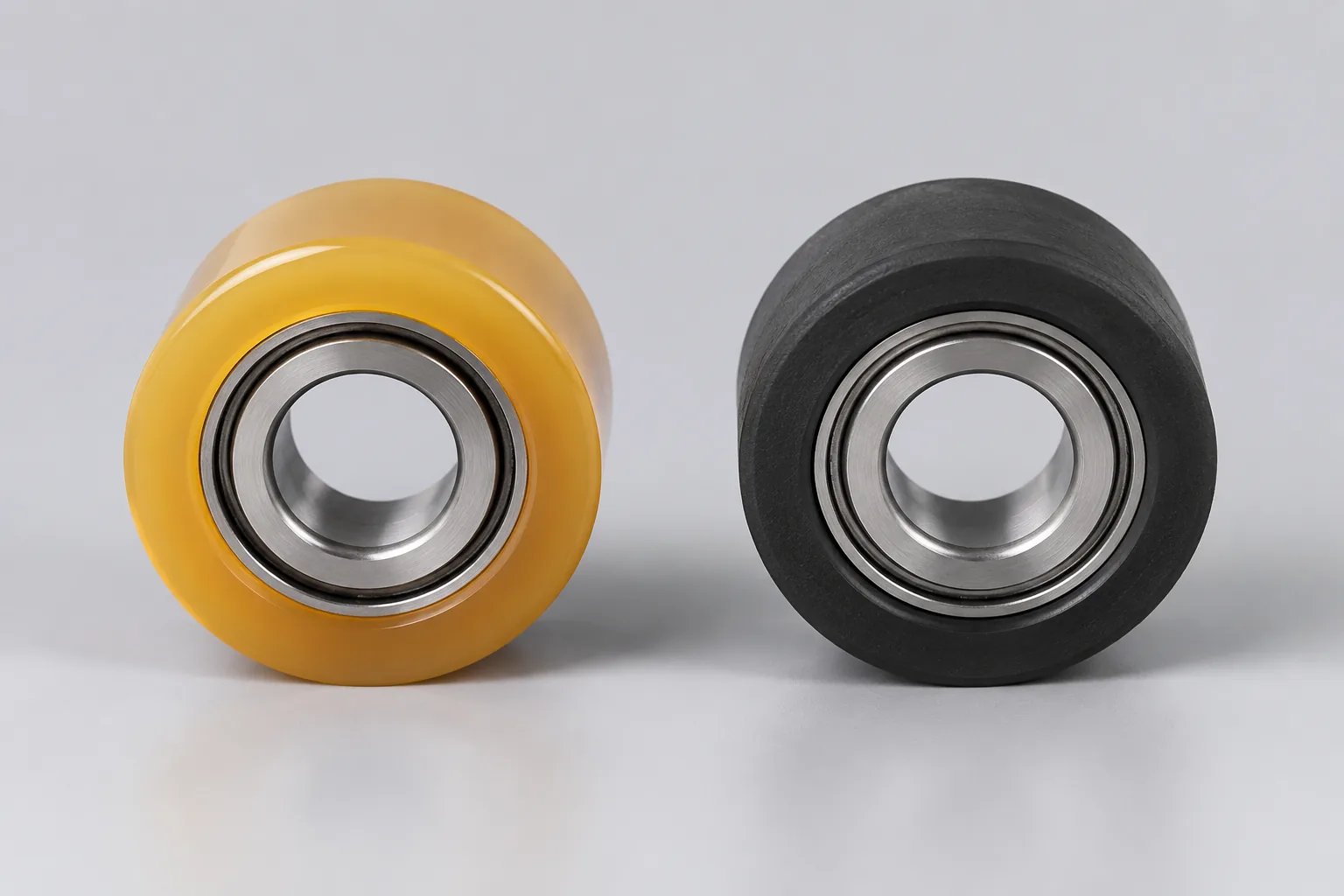
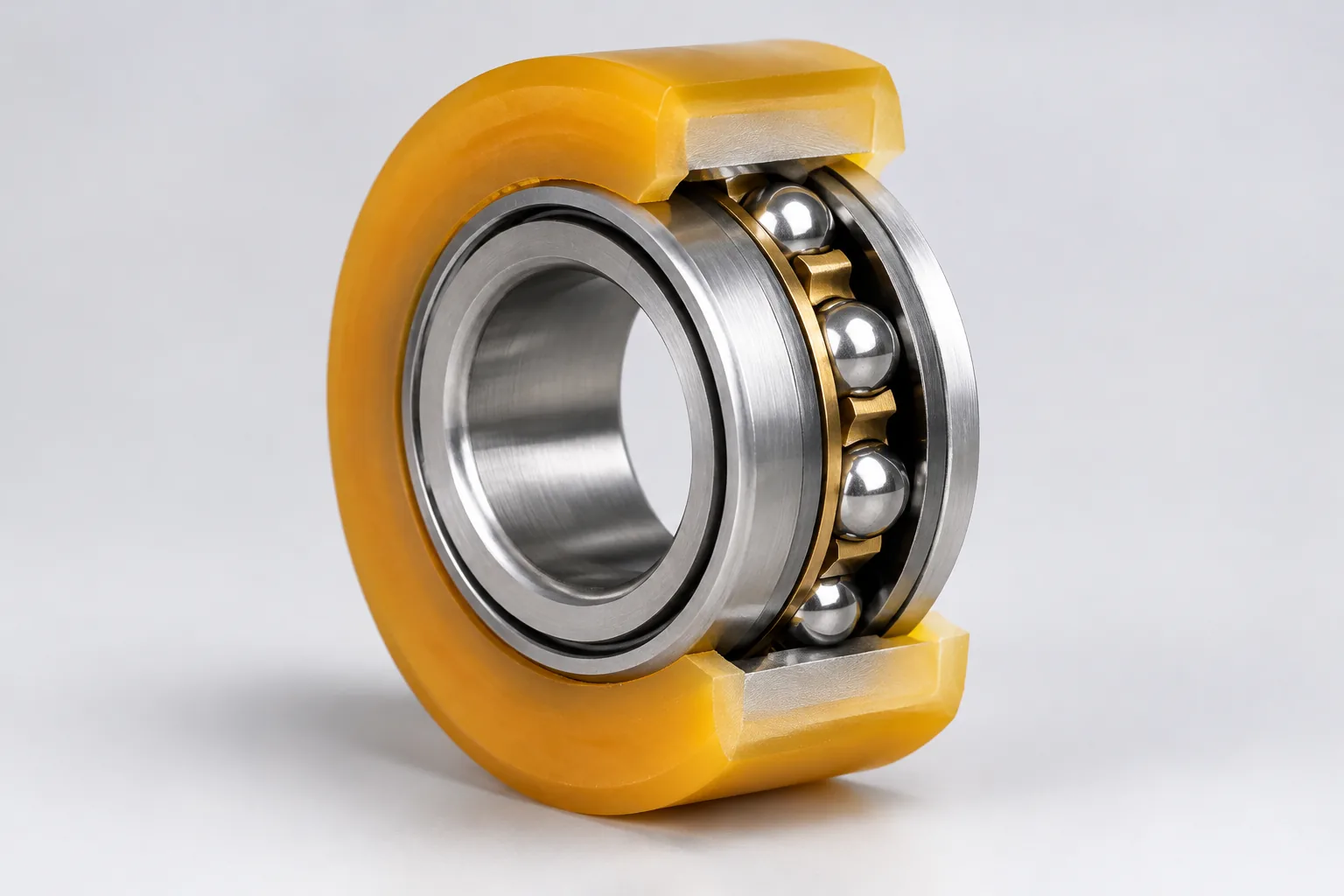
A polyurethane coated roller bearing is a roller bearing with a polyurethane outer layer bonded, cast, baked, or molded onto the bearing outer ring or onto a metal core. The bearing provides the rolling function and locates the shaft; the PU layer provides a compliant, wear-resistant contact surface.
Key elements to identify on a drawing or datasheet:
- The bearing: inner ring, outer ring, rolling elements, cage, and seals or shields where fitted.
- The PU layer: either a coating applied to the outer ring or a molded body formed around a core.
- The bond interface: the surface where PU meets metal; it carries shear and must not peel or spin.
- Bore, outside diameter, and width: measured on the finished part, with the PU included in the outside diameter.
This construction differs from a separate PU roller slipped over a shaft bearing, where the two parts are independent and can be replaced on their own. It also differs from a plain PU wheel without an integrated bearing, which is bored or bushed to run on a shaft and offers no rolling element path of its own.
Representative bearing designations found in PU-coated roller products include 696ZZ, 698ZZ, 6900ZZ, 6001ZZ, 6002ZZ, 626 2RS, 628RS, and the 6205 to 6308 range on larger conveyor rollers.
| Example | Bearing | PU data | Other stated data |
|---|---|---|---|
| Coated roller, 20 mm outside diameter, 30 mm length | 696ZZ x 2 | Shore A90, natural color | PU cured directly on the bearing |
| Coated roller built on a 626 2RS | 626 2RS | 65A to 98A range | Stated dynamic radial load 60 lbf |
| Molded PU roller, 8 mm bore, 45 mm outside diameter, 8 mm width | 628RS | 85 Shore A | Molded PU body around the bearing |
| Conveyor PU disc, 127 to 178 mm diameter | 6205 to 6308 | 95±3 Shore A, polyether PU | Tensile strength 38 MPa, elongation 460% |
Why Use Polyurethane Instead of Steel or Rubber?
Polyurethane earns its place where a steel or cast iron roller would slip, polish, mark, or vibrate. Its main jobs:
- Wear resistance in abrasive dust and repeated contact.
- Compliance that spreads contact stress over a wider footprint than a hard metal wheel.
- Traction for drive and guide rollers that must grip without slipping.
- Surface protection for product, belting, and finished panels.
- Noise and vibration reduction at the rolling contact.
- Guidance in tracks and rails, where a small amount of conformity helps keep the roller centered.
Rubber is the other common tread material for grip and surface protection. Where both options are offered, compare them on the same hardness standard, the same abrasion test, and the same load basis: a rubber compound and a PU compound labeled at the same Shore A value are not interchangeable.
Hardness moves the balance point. Softer grades conform more, cushion impacts, and grip more easily; harder grades usually support higher load, deform less under rolling, and track more precisely. Catalog hardness on PU-coated bearings commonly falls between Shore A50 and A95, and specific products in the cited sources use 65A to 98A, 85A, 87A, 90A, and 95±3A. One roller coating service covers 40 to 90 Shore A for drive rollers, guide wheels, and conveyor rollers.
Hardness alone does not set load capacity. Bearing size, PU thickness, wheel diameter, speed, and temperature all change the answer, and the allowable load must be confirmed for the exact combination.
Wear comparisons deserve the same caution. One manufacturer’s published test reports its PU disc rollers wearing 4.5 times slower than standard steel shell rollers; that is a supplier-specific result under that supplier’s test conditions, not an industry-wide guarantee.
PU is also not automatically the right answer. High temperature, continuous wet service, and aggressive chemicals each need a specific grade and supporting data before the part is released for use.
Construction and Bonding Methods
The bond between PU and metal strongly affects how long the part survives in service. Common constructions:
- Direct adhesive bonding: PU bonded to a prepared outer ring or core with primer and adhesive.
- Cast bonded coating: PU poured around the bearing or core and cured in place.
- Baked or fusion bonding: PU applied to the outside diameter and baked to develop the bond.
- Sulfur-cured PU: a natural-color PU layer cured directly onto the bearing exterior.
- One-piece molded body: PU molded around the bearing as a single component, such as a green thermoplastic PU body at Shore A90.
Thickness belongs to the construction, not to a footnote. PU-coated bearing rollers are offered with 5 mm or 10 mm coating thickness, and that choice changes both the finished outside diameter and the cushioning behavior.
When a bonded coating is worn through or the bond line has failed, replacement guidance usually points to swapping the complete assembly rather than repairing the coating in place. A directly bonded series is described exactly that way: replace the roller bearing as an assembly once the PU layer is severely worn.
Two constraints apply. Whether a PU-coated roller bearing can be stripped and recoated depends on its construction and on supplier approval, so do not assume recoating is possible. And bond strength must be written into the purchase specification, including test method and acceptance criteria, instead of being inferred from a hardness figure.
Key Specifications and How to Read Them
A complete specification for a polyurethane coated roller bearing covers:
- Bearing designation and seal or shield type.
- PU system: polyether or polyester; cast thermoset or thermoplastic.
- Hardness in Shore A, with the test standard named.
- Finished dimensions: outside diameter, width, bore, and PU thickness.
- Bonding method and, where relevant, bond strength criteria.
- Allowable radial load, maximum speed, operating temperature, and duty cycle.
- Mechanical data: abrasion loss, tensile strength, elongation, tear strength.
- Compliance requirements tied to the exact model.
Read the list as a set. Shore hardness is only one parameter and cannot be used alone to estimate load capacity or service life.
Dimensions, Tolerances, and Bearing Designation
Finished outside diameter, width, bore, and coating thickness define the envelope. Tolerances, radial runout, and concentricity define whether the roller runs true in a track or against a belt.
One coated roller series spans outside diameters of 20, 25, 30, 35, 40, and 50 mm with lengths of 20 to 100 mm or 30 to 100 mm, using bearing pairs such as 696ZZ x 2, 698ZZ x 2, 6900ZZ x 2, 6001ZZ x 2, and 6002ZZ x 2 depending on size. Larger conveyor versions run from 127 to 178 mm in diameter with 6205 to 6308 bearings.
State clearly whether a dimension is measured before or after coating, and whether the outside diameter is nominal or finished. Do not infer bore, width, or load rating from outside diameter alone.
Polyurethane Hardness, System, and Coating Thickness
Write hardness as a Shore A value plus the test standard, then add the PU type and coating thickness. Two choices matter most:
- Polyether versus polyester: polyether grades are selected where hydrolysis resistance matters; polyester grades have their own property profile.
- Cast thermoset versus thermoplastic PU: cast systems are poured and cured, while thermoplastic grades are molded and can behave differently in rebound and at temperature extremes.
Published examples show the spread. A natural-color directly bonded series runs at Shore A90; one bearing roller line offers Shore A50, A70, A90, and A95 with 5 mm or 10 mm PU thickness; an injection PU return roller coating is listed at 87 Shore A with density 1.25 g/cm³, tensile strength above 50 N/mm², elongation above 450%, and abrasion loss below 30 mm³; a conveyor PU disc uses a polyether system at 95±3 Shore A.
For wet, cleaning, or high-humidity service, specify polyether PU or require hydrolysis aging data for the exact grade. Hardness values may come from sample testing, from testing the finished roller, or from supplier-specific conditions, so confirm the method before comparing two quotations.
Load, Speed, and Temperature Limits
Allowable radial load, maximum speed, and operating temperature must be confirmed for the exact bearing and PU combination. PU hardness, coating thickness, wheel diameter, bearing size, speed, temperature, and duty cycle all interact.
Available reference points show how wide the range is. A heat-resistant PU version is rated at Shore A90 with a nominal operating temperature around 110°C. One small coated roller states a dynamic radial load of 60 lbf. A PU-tread wheel on an iron core, at 90 to 95 Shore A, lists a maximum capacity of 9,000 lb.
Ask for the load rating at the intended speed and temperature, not only a static catalog value. Do not convert a wheel load rating into a bearing radial load rating without confirming load direction and mounting. Long-term temperature limits, speed limits, and duty-cycle factors belong in the supplier’s model-specific data.
Mechanical and Wear Test Data
Mechanical properties only compare fairly when the standard, specimen type, and test temperature travel with the number. The standards relevant to this product category include:
| Standard | What it measures | Practical note |
|---|---|---|
| ISO 48-4:2018 | Shore hardness of vulcanized or thermoplastic rubber | A scale for normal hardness, D scale for high hardness; published August 2018 and confirmed in 2024 |
| ISO 48-7:2018 | Apparent hardness of rubber-covered rollers | Closest to testing a finished coated roller; reconfirmed in January 2024 |
| ASTM D2240-15(2021) | Durometer hardness of elastomers and some plastics | Includes durometer types A, B, C, D, DO, E, M, O, OO, OOO, OOO-S, and R |
| ISO 4649:2024 | Abrasion resistance using a rotating cylindrical drum | Reported as relative volume loss or abrasion resistance index; not a service-life prediction |
| ISO 37:2024 | Tensile strength, elongation at break, stress at a given elongation | Seventh edition, published May 2024 |
| ISO 34-1:2022 | Tear strength of vulcanized or thermoplastic rubber | Trouser, angle, and crescent test pieces |
For a coated roller, apparent hardness of the finished roller is more informative than a hardness plaque from the same batch. Abrasion results compare materials or production lots; they do not predict how many hours a roller will last on a specific line. Finished-roller hardness and sample hardness should not be mixed in one table without labeling which is which.
How to Select the Right Polyurethane Coated Roller Bearing
- Define the duty. Record radial load, speed, duty cycle, shock, mounting dimensions, and the environment, including moisture, dust, cleaning agents, and temperature.
- Choose the bearing. Match bore, outside diameter, radial capacity, speed, and sealing to the shaft and mounting. Seal choice follows the dust and water exposure.
- Choose the PU grade. Set hardness and PU system from the compliance, wear, temperature, and moisture requirements, not from a habit of ordering A90.
- Fix the geometry. Specify coating thickness, bonding method, tolerances, runout, and surface finish, and confirm whether the outside diameter is finished or nominal.
- Confirm the limits. Obtain the supplier’s load rating, speed limit, temperature limit, test standards, and compliance statement for the exact model, in writing.
Typical selection patterns:
- High load: consider harder PU and a larger bearing capacity, then verify the rating of the complete assembly rather than the bearing alone.
- Wet or high humidity: specify polyether PU or request hydrolysis data for the grade.
- Product contact or delicate conveying: consider softer grades after confirming that wear life and load capacity still meet the duty.
Two rules keep the process honest. Do not select by hardness alone. Do not transfer a compliance statement from one model to an entire family of PU-coated roller bearings.
Common Applications and Service Conditions
PU-coated bearings are used wherever a durable rolling contact surface is needed:
- Conveyor drive rollers.
- Guide rollers and guide wheels.
- Return rollers and idler positions.
- Feed rollers in converting, printing, and packaging equipment.
- General material-handling rollers in tracks and rails.
Application requirements drive the specification. A coating service covering 40 to 90 Shore A lists drive rollers, guide wheels, and conveyor rollers as its target duties, and a roller covering range of 70 to 95 Shore A is positioned for wear and load-demanding conditions. Injection PU return roller coatings appear in conveyor component ranges, and conveyor PU discs are presented for heavy conveyor roller duty.
Environment narrows the choice further. Wet or washdown-like conditions call for polyether PU or hydrolysis aging data. Elevated temperature calls for a heat-resistant grade rated for the actual temperature at the roller, not the ambient reading at the far end of the line.
Some requirements cannot be assumed. Food contact, medical, or potable-water compliance is not established by general PU-coated roller bearing data and needs a specific certificate for the exact compound and construction. Chemical compatibility with oils, solvents, and cleaning agents must be confirmed separately for each grade.
Installation, Operation, and Maintenance
Handling and alignment deserve attention first, because damage to the bore, mounting faces, or coating can cause premature failure:
- Inspect the shaft, bore, mounting faces, and alignment before fitting, and correct burrs or corrosion first.
- Press or drive on the bearing ring, never on the PU surface, and avoid impact that dents or tears the coating.
- Check free rotation and end play after mounting, before the line is loaded.
- During service, monitor coating wear, cracking, flat spots, debonding, and any new noise or vibration.
- Replace the assembly when the PU layer is severely worn or the bond interface is damaged.
Set inspection intervals from load, speed, environment, and supplier guidance rather than a fixed number that ignores duty. Do not attempt field repair of a severely worn bonded coating unless the supplier explicitly approves the method. Keep sharp tools and excessive heat away from the PU during removal, because both can damage the bond line and the metal beneath it.
Quality Control and Applicable Standards
Incoming inspection for a PU-coated roller bearing should cover hardness, finished dimensions, radial runout, bond appearance, and the mechanical property report. Ask the supplier to identify whether hardness was measured on a sample or on the finished roller, and to name the standard used.
Standard references to write into the RFQ and purchase specification:
- ISO 48-4:2018 for Shore hardness, published August 2018 and confirmed in 2024, with the A scale for normal hardness and the D scale for high hardness.
- ISO 48-7:2018 for apparent hardness of rubber-covered rollers, reconfirmed on 4 January 2024.
- ASTM D2240-15(2021) for durometer hardness, covering A, D, and other scales.
- ISO 4649:2024 for abrasion resistance by rotating cylindrical drum.
- ISO 37:2024, seventh edition published May 2024, for tensile strength and elongation.
- ISO 34-1:2022 for tear strength.
Name the standard number, edition or year, specimen preparation, and test temperature together with each value. A RoHS 10 declaration attached to one molded PU bearing line applies to that line only and should be confirmed per model and per certificate. Bond strength acceptance criteria and the test method used to verify them must be agreed in the specification, not left to the drawing notes.
Procurement Checklist and RFQ Data
A clear RFQ reduces avoidable back-and-forth on a PU-coated roller order. Ask for these fields:
- Bearing designation and seal or shield type.
- PU system: polyether or polyester.
- Cast thermoset or thermoplastic PU.
- Hardness in Shore A and the test standard used.
- Finished outside diameter x width x bore.
- Dimensional tolerances, radial runout, and concentricity.
- PU coating thickness.
- Bonding method.
- Allowable radial load, maximum speed, operating temperature, and duty cycle.
- Abrasion loss, tensile strength, elongation, and tear strength, each with its standard.
- Compliance requirement tied to the exact model.
Bearing designations to quote as reference: 696ZZ, 698ZZ, 6900ZZ, 6001ZZ, 6002ZZ, 626 2RS, 628RS, 6205 to 6308. Hardness values to quote as reference: 85 Shore A, 87 Shore A, 90 Shore A, 95±3 Shore A, and the 65A to 98A range.
Also ask for a drawing that shows finished dimensions, tolerances, runout, PU thickness, and bonding method, plus written confirmation of load, speed, temperature, and compliance for the exact model. A catalog example is not a substitute for the model-specific datasheet.
Conclusion
A polyurethane coated roller bearing is a system, not a hardness rating. The bearing sets the load and speed envelope, the PU layer sets traction, compliance, and wear behavior, and the bond between them strongly affects how long the part lasts. Change one element and the others move with it.
Three decisions carry most of the risk: choosing the right bearing designation for the shaft and load, choosing a PU grade and thickness that match the environment, and writing measurable acceptance criteria for hardness, dimensions, runout, and bond quality. For wet service, add polyether PU or hydrolysis data; for heat, add a rated heat-resistant grade; for load at speed, ask for the rating of the complete assembly.
Before the next order, replace any single-number specification with the checklist above and request written confirmation for the exact model.
DUHUI Bearing manufactures automotive bearings in Zhejiang, China, and has operated since 2003.
FAQs
Q1: What does polyurethane coated roller bearing mean?
A: It means a roller bearing whose outer ring or core carries a bonded or molded polyurethane layer that becomes the rolling contact surface. The bearing still does the rolling and locates the shaft. It is not the same as a standard steel bearing, and it is not the same as a plain PU wheel with no integrated bearing.
Q2: What Shore A hardness should I choose?
A: Start from the duty, not from a habit. Softer grades such as Shore A50 to A70 increase conformity and cushioning, while harder grades around A90 to A95 generally support higher load, deform less, and track more precisely. Published PU-coated products bracket the range from 65A to 98A. Confirm load, speed, temperature, and surface conditions before fixing the value, and remember that hardness alone does not define capacity.
Q3: Can the polyurethane coating be replaced separately?
A: It depends on the construction. A directly bonded coating is commonly replaced as a complete assembly once the PU layer is severely worn. Recoating should be considered only with the original supplier’s approval and confirmation of the construction; confirm whether the original part is adhesive bonded, cast bonded, baked or fusion bonded, or one-piece molded before any repair is discussed.
Q4: Is polyurethane suitable for wet or washdown environments?
A: Only with the right formulation. Polyether PU is used specifically to improve hydrolysis resistance in high-humidity and high-temperature service, so wet or cleaning-exposed applications should specify polyether or require hydrolysis aging data for the exact grade. Not every PU-coated roller bearing suits continuous wet duty, and washdown chemicals, steam, and food-contact compliance each need separate evidence.
Q5: How is allowable load capacity determined?
A: By the complete assembly, not by hardness. The rating depends on bearing capacity, PU hardness and thickness, wheel diameter, speed, temperature, and whether the load is radial, axial, intermittent, continuous, or shock. Published examples run from 60 lbf dynamic radial load on a small coated roller to a 9,000 lb maximum for a PU-tread iron-core wheel, which shows why the supplier’s model-specific rating must be requested.
Q6: Which bearing types are commonly used?
A: Small and medium PU-coated rollers use designations such as 696ZZ, 698ZZ, 6900ZZ, 6001ZZ, 6002ZZ, 626 2RS, and 628RS, while larger conveyor versions use the 6205 to 6308 range. Selection follows bore, outside diameter, load, speed, and sealing requirement, and the bearing designation alone does not define the finished roller dimensions or its load rating.